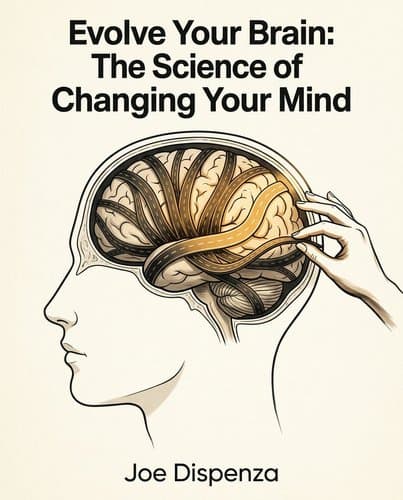
640892_evolve-your-brain
by Joe Dispenza
Your personality isn't who you are — it's a physical structure of hardwired neural circuits your brain built through repetition. Neuroscience now reveals…
In Brief
Evolve Your Brain: The Science of Changing Your Mind (2007) explains that personality is not a fixed identity but a physical structure of neural circuits and chemical patterns — one that neuroscience shows can be deliberately rebuilt.
Key Ideas
Personality Restructures Through Repeated Neural Activation
Personality is a physical arrangement of neural circuits and cellular receptor sites — not a fixed identity. It restructures when you repeatedly fire different patterns, exactly as blind people's visual cortex repurposes for touch.
Thought Repetition Creates Automatic Neural Programs
Every repeated thought thickens its own neural pathway via neural growth factor until it fires automatically without conscious input. Most of your daily thinking is a program running, not a choice being made.
Emotions Build Physical Cellular Infrastructure
Cells build more receptor sites for emotions you habitually experience. This is why attempting to 'just stop' a chronic emotional pattern fails — the body has built physical infrastructure for it and will demand its dose.
Internal Resistance Is Cellular Withdrawal
The internal voice that says 'you can start tomorrow' or 'this just doesn't feel right' when you try to change is cellular withdrawal, not intuition. Recognizing it as a chemical signal rather than wisdom is the first lever.
Stress Degrades Novelty-Seeking Neural Capacity
Chronic stress degrades hippocampus neurons — the region responsible for novelty-seeking. This is why stressed and depressed people crave routine: the biological machinery for wanting something different is breaking down.
Mental Rehearsal Constructs New Neural Circuits
The brain encodes vivid mental rehearsal as real experience. You can build new neural circuits before your circumstances change — morning mental rehearsal of a specific target behavior is not visualization, it is literal circuit construction.
Discomfort Signals Normal Skill Acquisition Progress
Change is a four-stage skill ending in automaticity (unconsciously skilled). The discomfort of consciously trying to be different is not a sign the change is not working — it is the sensation of a skill being mid-acquired. Knowing which stage you are in prevents you from quitting during normal acquisition.
Who Should Read This
People working on personal growth in Neuroscience and Habit Formation, especially those tired of generic motivational advice.
Evolve Your Brain: The Science of Changing Your Mind
By Joe Dispenza
11 min read
Why does it matter? Because the reason you keep failing to change has nothing to do with motivation.
Most people treat personal change as a willpower problem. They just need to want it badly enough, resist long enough, stay disciplined through the discomfort. Then the discomfort wins — again — and they conclude something is wrong with them.
Nothing is wrong with them. Something is wrong with the diagnosis.
Neuroscience has spent the last few decades mapping exactly what happens when a person tries and fails to change. The answer is not a character flaw. It is a physical structure: hardwired neural circuits firing the same sequences they've fired ten thousand times before, while cells throughout the body demand the emotional states they've grown dependent on — the way any cell depends on a drug. You are not fighting weakness. You are fighting architecture.
This book is about how to rebuild it.
Your Personality Isn't Who You Are — It's a Physical Structure You've Been Building Since Birth
A patient lies in recovery after a surgeon has separated fingers that, since birth, had been fused together (syndactyly, a condition that left them capable of little more than gross gripping, all fingers moving together whenever any one moved). The operation itself is straightforward. What happens next is not. Over the following weeks, brain scans show the neural territory once assigned to a single merged hand zone reorganizing into distinct areas, one per finger, tracking each new independent movement. The brain didn't require years of slow adaptation. It mapped the change within weeks.
The five-week timeline is what cracks open the book's central claim. We tend to think of personality as something close to essence: that you're anxious in crowds, or quick to anger, or prone to rumination. These feel constitutional, fixed the way height is fixed. But height is encoded in bone and growth plates that finished their work in your teens. Personality, the neuroscience shows, is encoded in the arrangement of roughly 100 billion nerve cells. And those cells are not done. They are physically reorganizing right now, altered by whatever you repeat: in thought, in action, in attention.
The medical term is neuroplasticity. The syndactyly patients weren't damaged and then repaired. They were reorganized by a change in how the hand was being used. Function rewrote structure. The fingers moved differently, so the brain mapped them differently.
Personality works the same way, literally. What you call your habits, your emotional reactions, your characteristic ways of seeing the world all exist as specific firing patterns in physical tissue. The anxious thought is a pathway. The quick-temper response is a circuit. They feel like "you" because they fire so readily, so automatically, so many thousands of times that the neurons running those patterns have wired into fast, efficient highways. A road used enough stops being a road — it becomes the assumption of how you travel. But roads are infrastructure. They can be rerouted.
When the syndactyly patients started using their fingers independently, the neurons stopped firing together, and within weeks, stopped wiring together. Old architecture dissolved. New architecture formed. The brain stopped recording the past and began mapping a new present.
That's what this book is building toward: the practical question of how you become that patient — how you change what you're doing so the brain starts recording something different. Your personality isn't your destiny. It's your most recent construction project, and it's still open.
Every Repeated Thought Paves a Highway in the Brain — Until That Highway Runs Without You
A road traveled by a thousand cars a day doesn't stay the same width as one used by ten. Traffic demands infrastructure. The more a route gets driven, the wider the lanes become, until the road stops feeling like a choice and becomes simply how you get there.
The same process runs inside your skull. When two neurons fire together repeatedly, a chemical messenger travels from the receiving cell back to the sender, triggering the growth of new connection points between them. More docks. Larger terminals. Thicker wiring. Surgeons and harpists develop measurably denser circuitry in the motor cortex than most people, not because they were born with superior hands, but because they made the same precise movements thousands of times and their neurons grew toward each other.
Now scale that up to a thought you've been thinking since you were nineteen.
A woman sits on a park bench eating her lunch. A stranger passes — blocky jaw, icy blue eyes, one curly lock of hair falling across his face. She makes no conscious decision. Within seconds she is not in the park. She is in a bar from 1986, smelling stale beer and cigarette smoke, watching her roommate's face flash orange in the glow of a cigarette, mascara running, crying over a boyfriend. Then her own breakup arrives — the stomach-drop of seeing him arm-in-arm with someone else two days later. Then she is back on the bench, heavier somehow. "You're always going to be the one sitting alone."
She didn't choose that. One man's jawline ran an entire deprecating program.
A weak signal, a faint resemblance, triggered a strong one: a neural network built from years of pairing rejection with her sense of self. Established pathways pull new activation into their grooves. Once a circuit has been traveled enough times, it fires at nearly zero input. The whole cascade ran without her; the pattern had grown stronger than her attention.
At the neural level, identity is the inventory of which pathways have been widened. Your personality is the set of roads your brain made fast. The body adapts to match: it builds receptor sites calibrated for the emotional chemistry those patterns produce, and then registers as discomfort any day those familiar doses don't arrive. A brain that has spent years wiring loneliness next to love will fire that association on a stranger's face, in a park, on an ordinary Tuesday, without asking permission — and the body will recognize the feeling as home.
Your Body Has Built a Chemical Addiction to Your Emotional States — and Uses Your Own Inner Voice to Demand the Fix
Why do you keep failing to change even when you genuinely want to? The usual answer is discipline: you have it or you don't. But that framing misses what's actually happening inside the body, and once you see the real mechanism, failure stops feeling like a character flaw.
Every strong emotion you habitually feel (shame, anger, anxiety, whatever has been most familiar to you for years) triggers the hypothalamus to produce a matching peptide, a small chemical messenger. That peptide docks at receptor sites on your cells, like cargo arriving at a loading dock built for exactly that freight. Day after day for years, the same deliveries arrive, and when cells divide, they build more docks. More receptor sites, calibrated for those same molecules. Your body has physically restructured itself around the emotions you repeat most.
This is mechanistically identical to cocaine addiction. Repeated stimulation wears out receptor sites; they stop responding properly, requiring more chemical to reach the same threshold. Feelings that once came from a real confrontation now need increasingly vivid internal replays to produce the same hit. The cells grow tolerant. The body demands escalating input. And the substance it's craving isn't a drug — it's you.
Then you decide to stop. Maybe it lasts a morning. By afternoon, subtle urges appear. By evening, a full argument is running inside your head: You can start tomorrow. This isn't the right time. This just doesn't feel right. Dispenza's argument is stark: that voice isn't intuition. It isn't self-knowledge. It's your cells signaling the brain, demanding replenishment. The body wants its dose. The monologue is withdrawal.
What makes the trap complete is the hippocampus, the brain region that encodes new memories and, more critically here, drives the craving for novelty. Laboratory animals whose hippocampi were irradiated stopped exploring. Placed back in familiar spaces, they stayed in the corners they knew, as if curiosity had been switched off. Chronic stress produces the same effect through a slower route: the cortisol released during sustained stress degrades hippocampal neurons over time. Once that region is compromised, novel experiences stop feeling attractive. Routine stops feeling merely safe and starts feeling preferable. Chronic stress, the very state that most demands change, degrades the one brain region that would want one.
There is a pivot. The hippocampus can regenerate. Getting there means deliberately interrupting the stress response — not by waiting for circumstances to improve, but by learning to shift the body's internal chemistry first. Neurogenesis happens actively in that region, which is why antidepressants that support it take roughly a month to shift mood: that's how long new cells need to establish. Break out of survival chemistry long enough, and the machinery that craves the unfamiliar can rebuild. But first you have to survive withdrawal and recognize that the voice urging you to quit is not guidance, not feeling, not truth. Just the body demanding its fix.
The Brain Cannot Distinguish a Vivid Mental Rehearsal from a Real Experience — That Is the Entire Escape Route
The brain does not check whether an experience happened or was imagined. It routes both through the same circuitry, produces the same neurochemical responses, and files them in the same physical tissue. This is not a motivational metaphor — it is a measurable fact about how neural circuits fire and wire. And it changes everything about what you can do before your circumstances change at all.
A minor-league pitcher had a problem: one team owned him. Every time he took the mound against them, the results were carnage — home runs, doubles, line drives, the whole humiliating inventory. Against everyone else, he was fine. Same pitches, same mechanics, same arm. Different disaster. After three or four starts like this, he sat in a hotel room the night before facing them again and decided to try something different.
He opened his notebook and wrote out his game plan pitch by pitch. He knew every hitter's tendencies, their weak spots, where they chased. Then he closed his eyes and mentally pitched all 27 outs. Specifically: slider, inside corner, low. Fastball up and away. Changeup down and away. Fastball on the hands, weak grounder to first. He worked through every hitter until time and space dissolved and he was no longer in a hotel room. He was on the mound. Then he ran through it again.
The next day, he threw a four-hit shutout. Best result he'd ever had against that team.
His brain had no way to distinguish what happened in the hotel room from what happens on the mound. Both fire the same neural circuits. Each pass through the imagined game warmed those circuits, primed the motor sequences, so when the real situation arrived, the brain wasn't encountering it fresh. It had already been there. The game was, in a neurological sense, a repeat performance.
But the most direct evidence comes from a laboratory. In a 1992 study, subjects who physically contracted and relaxed one finger over four weeks gained 30% muscle strength, the expected result of mechanical loading. A second group performed no physical movement at all. They only imagined the same contractions, same schedule, same duration. Their finger strength increased by 22%. The mind produced a quantifiable change in tissue without once touching it.
This is the escape route the book has been building toward. You cannot will yourself out of a chemical addiction your cells have built. You cannot overpower an emotional highway that fires faster than conscious thought. But you can build a new road (in imagination, in a quiet room, before the provocations arrive) and the brain will encode it as real. Old circuits, starved of activation, unwire. New ones, fired repeatedly in the mind, strengthen just as they would from lived experience.
The situation doesn't have to change first. You change first. Then you walk into it with different wiring already in place.
Change Is Not an Insight or a Motivation — It's a Four-Stage Skill That Ends in the Body Knowing Without Thinking
Larry kept a mental catalogue. After a psychiatrist diagnosed him with clinical depression in his late twenties, he declined the antidepressants and started building a list instead: every memory he could tag as "happy." Then he assembled a target personality from scratch. From one colleague, a sense of humor. From a stranger in a coffee shop, social ease. From someone he'd admired in passing, a confidence that never curdled into arrogance. He called the composite "Work Larry": the version of himself that functioned fluently at the design firm where he worked but vanished the moment he walked through his own front door.
He knew what he wanted to become. He didn't yet know what that would feel like to attempt.
Larry moved through it by forcing demonstration. He grocery shopped on Saturday afternoons instead of before dawn to avoid people. He took improv theater classes, not to perform but to train himself to respond aloud instead of retreating inward. For months he navigated social situations with a running internal question: what would the version of himself he was building actually do here? He could pull it off. But it cost something every time.
The final shift happens when the cerebellum takes over. Researchers have measured that at the moment a trained archer aligns a shot, neocortex activity actually ceases. The cerebellum (which holds procedural memory but no conscious centers) assumes command. Larry reached that threshold somewhere between the improv stage show he hadn't expected to survive and the evening he realized he hadn't asked himself that question in weeks. The two versions had merged. The old self felt, in his own words, like a character in a movie he'd seen once and barely remembered.
The protocol is specific enough to start tomorrow. Identify who you want to become. Build the model deliberately. Steal traits from real people, imagined people, anyone who embodies what you're after — Larry took ease from a colleague, confidence from a stranger he'd watched across a coffee shop, and assembled them into someone he could practice being. Rehearse it in imagination. Then go demonstrate it, badly at first, with conscious effort and visible awkwardness. Accept the discomfort as evidence of progress — it means something is actually changing.
The Voice That Says "You Can Start Tomorrow" Is the First Sign It's Working
The same cells that built receptor sites for an old pattern will build different ones given new signals long enough. That's what the body does. The discomfort is structural and finite. That's not a metaphor.
The protocol is specific enough to start before breakfast tomorrow — not because motivation is the mechanism, but because morning is when the environment hasn't yet reasserted its pull. The phone is still off, no one has asked anything of you yet, and the frontal lobe has its best chance to fire first. Change is a four-stage skill. So is the withdrawal. Neither is the end of the story.
Notable Quotes
“What do you mean, you aren't getting your shame chemicals? Whose smart idea was this?”
“Go ahead, this is a great reason to break your promise with yourself.”
“Any other time but this one!”
Frequently Asked Questions
- What does Evolve Your Brain say about personality and identity?
- According to Joe Dispenza's Evolve Your Brain, personality is not a fixed identity but a physical structure that can be deliberately rebuilt. The book explains that "personality is a physical arrangement of neural circuits and cellular receptor sites," similar to how blind people's visual cortex repurposes for touch. Since personality is a physical arrangement rather than an immutable trait, it can be restructured through repeated practice of different neural firing patterns. This foundational insight means personal change isn't about willpower alone but about understanding the neurobiology of how habits and traits develop and can be systematically rewired through targeted mental practice.
- Why is breaking a bad habit so difficult according to this book?
- Dispenza explains that breaking habits is difficult because of cellular-level changes. The book states that "cells build more receptor sites for emotions you habitually experience," creating physical infrastructure that demands continued satisfaction. When attempting to change, the body experiences withdrawal—the internal voice saying "you can start tomorrow" is actually "cellular withdrawal, not intuition." Most daily thinking operates as an automatic program rather than conscious choice because repeated thoughts thicken neural pathways. The body has literally become addicted to its emotional patterns, making simple willpower insufficient without addressing the cellular dimension of habit formation.
- How can mental rehearsal rewire your brain before circumstances change?
- Mental rehearsal is not mere visualization—it's literal neural circuit construction. According to Dispenza, "The brain encodes vivid mental rehearsal as real experience," meaning your nervous system doesn't distinguish between actual behavior and vividly imagined behavior. This allows you to build new neural circuits before your circumstances change. Morning mental rehearsal of specific target behaviors creates the same neural pathways as physically performing those behaviors repeatedly. This is why consistent mental practice can precede behavioral change. The practical implication is that you don't have to wait for external circumstances to align; morning mental rehearsal creates the neurobiology needed for new automatic behaviors.
- What are the stages of lasting change according to Evolve Your Brain?
- Change is a four-stage skill ending in automaticity, where you become unconsciously skilled at new behaviors. Dispenza emphasizes that discomfort while changing is not a sign of failure—it's "the sensation of a skill being mid-acquired." Understanding which stage you're in is critical because many people quit during normal discomfort, mistaking the learning process for evidence the change isn't working. The progression moves from conscious incompetence through conscious competence to unconscious competence. By recognizing that discomfort is a sign of active rewiring rather than resistance, you can push through the phases that typically derail self-improvement efforts.
Related Book Summaries


Read the full summary of 640892_evolve-your-brain on InShort