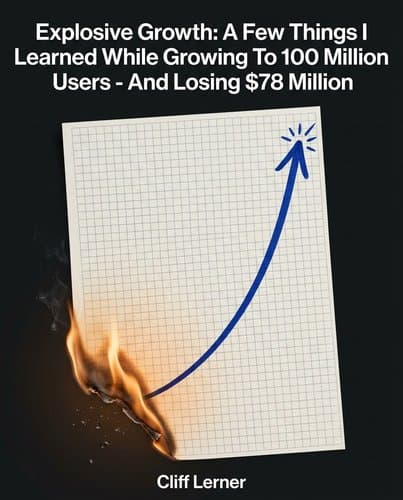
36607149_explosive-growth
by Cliff Lerner
Building to 100 million users is a science of emotional triggers, viral loops, and relentless testing—but Cliff Lerner's $78 million loss proves that execution…
In Brief
Building to 100 million users is a science of emotional triggers, viral loops, and relentless testing—but Cliff Lerner's $78 million loss proves that execution genius and exit wisdom are entirely different skills, and confusing the two is the most expensive mistake a founder can make.
Key Ideas
Emotional benefits outperform feature descriptions
Test your invite and onboarding copy for emotional benefits, not feature descriptions — 'find out which of your friends likes you' massively outperforms 'higher placement in search results' because one triggers a feeling, the other describes a mechanic
Product clarity before marketing investment
Survey your users with one question: 'Describe this product in one sentence.' If answers diverge widely, you don't have a USP — no marketing spend will fix a product without a clear identity; fix the product first
Test revenue models minimum six months
Run revenue model tests for six to nine months minimum, not three — short tests confirm the initial revenue spike but hide the retention decay and network-effect reversal that will eventually collapse the model
Single metric unleashes hidden talent
Collapse your organization onto one shared north-star metric for a 90-day sprint — with a real prize and real deadline, creativity emerges from the people you least expected to have it, including your lowest-paid staff
First to market claims user identity
First impressions are permanent at scale: any competitor who launches your own innovation as their first product will own it in users' minds regardless of who built it first — you cannot reclaim an identity users have already assigned you
Protect wealth despite strong conviction
When life-changing money is available, take some off the table even if you believe deeply in the upside — you can let most of it ride, just not all of it; 'I always believed very strongly in what we were doing' is not a financial strategy
Always explore powerful partnerships first
Never decline an offer to work with someone significantly more powerful or connected without at least exploring it with your team — the regret from not exploring is almost always larger than the disruption of the conversation
Who Should Read This
Business operators, founders, and managers interested in Startups and Scaling who want frameworks they can apply this week.
Explosive Growth: A Few Things I Learned While Growing To 100 Million Users - And Losing $78 Million
By Cliff Lerner
9 min read
Why does it matter? Because the skills that build 100 million users are exactly the ones that make you blind to losing everything afterward.
You're probably expecting a growth playbook. K-factors (how many users each user recruits), invite loops, the exact copy tweak that quintupled replies overnight. Cliff Lerner has all of that — he actually built 100 million users from a failing dating app with zero paid acquisition, so the mechanics are real and they're in here.
But there's a second book hiding inside this one, and it's less comfortable. The same analytical precision that made Lerner unstoppable at growth — the obsession with testing, the conviction to bet the company on a hunch, the ability to hold a line under pressure — proved useless for protecting what he'd built. He never sold a single share. His paper fortune hit $110 million. Then it didn't.
This is a book about what happens when your greatest strength becomes the story you tell yourself to justify every decision that should have scared you.
The Copy Change That Got 100,000 Users in a Single Day
Cliff Lerner's team had a working invite prompt. It said "Invite your friends!" — and it did what generic invite prompts do, which is produce a modest, unsatisfying trickle of signups. So they started testing. Invite five friends and you'll rank higher in search results. Better. Invite twenty friends for the same reward. Better still. On the seventh iteration, after weeks of watching signup numbers shift with each small adjustment, someone changed five words.
Instead of promising higher search placement, the new line read: "Invite five friends to find out which of your friends likes you!"
That version didn't sell a feature. It dangled a secret. On a dating app, the possibility that someone you already know has quietly marked you as attractive is about as emotionally loaded as a sentence can be. Near-universal compliance followed. Daily new signups crossed 100,000 — with no paid advertising anywhere in the mix.
Lerner's explanation for what happened is clean: you're not selling a feature, you're selling a benefit. A feature is what something is. A benefit is what it does to your life. He points to how Apple launched the iPod. Not as a 5-gigabyte hard drive, technically accurate but completely inert, but as "a thousand songs in your pocket," which is something a human being can actually want. The spec describes the object. The benefit describes the feeling.
None of this was lucky. Lerner ran seven documented iterations on the same prompt, one variable at a time. The first four versions sold the feature. The fifth sold an outcome. The sixth and seventh sold an emotion. Each rung produced measurably better results than the last. The emotional hook wasn't instinct; it was what remained after everything rational had been tested and found wanting.
The implication is hard to misread: if your referral flow isn't working, the problem is probably not the mechanism. It's the copy. Find the feeling your product already creates, then write that sentence.
Your Product Doesn't Need to Be First — It Needs to Be Unmistakably, Uncomfortably Better
Andrew Weinreich built the world's first social network in 1997, a decade before Facebook, and already understood what it needed: photos. Social networking without them has no pull — you can't see a face, can't tag a moment, can't make a stranger feel familiar. He even explored having users mail in printed photos so his team could scan them manually. Concluded it wasn't practical. Sold sixdegrees in 1999 for $125 million, and watched.
Digital cameras hit mass adoption around 2003. Friendster came, then MySpace, then Facebook, which built itself around photo sharing and tagging, engineered ways to surface connections users had lost touch with, and eventually reached a valuation analysts predicted could hit $1 trillion. Weinreich's concept was right. His timing was dictated by technology he couldn't control.
Being first to market matters far less than being there when the market is ready. And being marginally better is worthless: on platforms where users have built profiles, uploaded photos, and curated friend lists, a somewhat better product asks them to throw away that investment. They won't. The new product needs to be ten times better just to justify the effort of starting over.
Lerner's math made that concrete. 100,000 users on a dating site, spread evenly across the US and filtered by age, location, and a few other variables, produces fewer than a handful of real matches per person. A large user base that isn't large enough is indistinguishable from none. That's why Match, eHarmony, and PlentyOfFish had held their positions for over a decade despite better-featured challengers launching constantly. Better-featured isn't 10X. It asks users to rebuild their profiles and restart their match history for an improvement they might not even feel. Nobody does that. The network effect is a wall for challengers; the bigger the incumbent's lead, the higher it gets.
You Can Run a Perfect Test and Draw a Catastrophically Wrong Conclusion
What does a successful test look like? Revenue more than doubling inside three months sounds like the answer. That's exactly what Lerner saw when he piloted a subscription model in the UK, AYI's second-largest market, before deciding whether to charge users globally for a product they'd been using free.
The logic was sound. Ad revenue had proven fragile: one client ghosting them had wiped out nearly half a month's income. Subscriptions meant predictability, recurring cash, and investor confidence that could fund faster growth. They tested carefully, running multiple messaging variants in the UK for roughly three months. Usage dropped, as expected. You don't start charging for something free without losing some users. But initial subscription revenue immediately more than doubled. The math said proceed. They proceeded.
Global rollout sent revenue on a twelve-quarter tear: three straight years, $3 million to $19 million annually. Then usage didn't just drop — it cratered. Some markets fell 90% below baseline. And that's when the network effect, which had been their rocket, became their anchor. Users paying $10 to $30 a month for a dating app expect a steady flow of new faces to browse. A shrinking user base produces fewer new profiles, which drives cancellations, which shrinks the base further. Scathing reviews piled up on Facebook and the newly launched iOS app. Revenue eventually followed usage down.
The test had been real. The data had been real. The conclusion had been wrong, because three months is long enough to capture the excitement of early subscribers but not long enough to see what happens when those subscribers don't renew. The cancellation wave wasn't visible in the test window — it needed six to nine months to surface. What looked like a green light was actually a flicker before the bulb burned out.
The more unsettling version of this lesson: the more rigorous your testing infrastructure, the more confident you'll feel in a result that happens to be measuring the wrong thing. Rigor and the right question are different. You can have one without the other.
When the Whole Company Chases One Number, the Best Ideas Come From the Last People You Expected
By the time SNAP Interactive had ballooned from twelve to nearly fifty employees, it had something like twenty goals and KPIs running simultaneously. Lerner surveyed his team on company priorities and got answers all over the map.
His fix was deliberately drastic. He collapsed everything to one metric: daily replies on AYI, because data showed replies correlated directly to revenue. The target: double the current 80,000 per day in ninety days. Teams competed for 10% of the user base to test their ideas. The prize: Broadway tickets, a steak dinner, an Apple gift card, a $5,000 team party budget, and a week of car service.
The best ideas didn't come from the highest-paid employees. They came from administrative and support staff, the lowest-paid people in the building. One of them hadn't contributed a single idea in years. He finally had one. When Lerner asked where the creativity had come from, the answer was perfectly honest: "I really just wanted to see The Book of Mormon."
That motivation produced one of the sprint's best features: a pop-up showing users their unread messages the moment they logged in. It nearly doubled replies on its own. When data revealed it annoyed women who already had more messages than they could process, the team iterated within days.
The ninety days ended with 400,000 daily replies, a quintupling. Revenue grew to $19 million annually. The sprint worked. What it couldn't do was change what users already believed about the product — a problem no prize package, however carefully chosen, was going to solve.
The Brand Your Users Assigned You Is the One You're Stuck With — Forever
A bar in Manhattan. Five or six women in their mid-twenties were huddled over their phones, laughing. Cliff Lerner approached and asked what they were doing. Playing Tinder, one told him — a new game, not a dating site.
He pushed back. They pushed back harder. Finally, someone got exasperated enough to say what they actually meant: they weren't online dating. They were shopping. For men.
That reframe was the product. Tinder built something women would use openly at a bar, show to friends, describe as a game. The mutual-match requirement meant if you hadn't approved someone, they couldn't message you. Women on every other dating site fielded constant messages from men they'd never approved, regardless of how specific their filters were. Tinder made that structurally impossible. Users went out in public and started recruiting for them.
Meanwhile, AYI had just gotten its own diagnostic back. Lerner surveyed users with a single question: describe this product in one sentence. He was hoping for at least 50% convergence: evidence that users agreed on what made AYI worth using. What he got was answers scattered in every direction. The most common single answer: "the Facebook dating app that costs money." Not a description of what the app did for you. A complaint about the price.
AYI had built a mutual-friends matching system before Hinge, a rival app that built its entire identity around that concept, ever launched. Hinge walked away with full brand credit anyway, because for Hinge it was the very first thing users experienced. When you arrive with an idea, you own it. When you add the same idea to something users already believe is something else, you've added a feature nobody associates with you.
Whatever a product is when a large audience forms its first impression is what that product is — permanently. No sprint reverses it. No feature update resets it. You can build the thing that would have changed everything, and if a competitor arrives with it as their opening act while you're still trying to shake loose your original identity, they get the credit.
The Same Conviction That Built Everything Prevented Him From Protecting Any of It
New Year's Eve, 2010. A banker calls Cliff Lerner at 1 a.m. and tells him he's a fucking moron. The man has been screaming for several minutes, threatening to drive to Lerner's apartment, demanding he sign documents he has been reviewing all night without fully understanding. SNAP Interactive's stock has risen 1,500% in one week. The same investors who ignored the company at an $8 million valuation are now fighting for allocations at ten times that. Every rational signal says sign the papers. Lerner puts down the pen.
He was right. The documents contained reset provisions that would have let early investors effectively wipe out his equity in any future raise. By holding firm, the deal closed on January 14 with the same investors, at the same valuation, minus the toxic terms. The banker's argument was a sales tactic. No time. Closing window. Signing fast shows confidence. Lerner's conviction that he understood the situation better than the people screaming at him had just saved the company.
That conviction would later cost him $110 million.
SNAP's stock peaked at $4.50 a share on February 15, 2011. Lerner's stake was worth roughly $110 million on paper. He didn't sell. Not at the peak, not in the months after when the stock held, not a full year later when his stake was still worth around $80 million. He believed deeply in what they were building and thought SNAP would reach a billion-dollar valuation. Then his bankers confirmed it: selling shares would signal a lack of confidence to investors. He had seen his own judgment pay off repeatedly. Why would this time be different?
By 2016, the stock had declined 97% from that high. The paper loss exceeded $100 million.
The discomfort here isn't that Lerner was reckless. He was rigorous. He read the Facebook platform correctly before almost anyone. He found the emotional hook that unlocked 100,000 users a day. He spotted toxic legal terms at 1 a.m. under enormous pressure and refused to sign. Every one of those wins came from the same place: trusting his own analysis when everyone around him said otherwise. That track record earned its confidence.
Which is exactly why it didn't feel like a pattern when it was destroying him. Being analytically exceptional doesn't protect you from the blind spot it creates — it makes the blind spot proportional to the track record. The more times your judgment has been right, the harder it is to notice when you're applying it to a situation where the honest answer is that you simply don't know.
The Question No Dashboard Can Answer
Here's what the book actually teaches, underneath the A/B tests and growth loops: optimization has an outer edge. Lerner built a testing culture that squeezed 400,000 replies out of 80,000. He found the exact sentence that unlocked 100,000 users a day. He spotted predatory legal terms at 1 a.m. and held firm. Every one of those wins came from trusting his own read when everyone around him disagreed.
That track record was real. And it was exactly what made the blind spot invisible. He left $10 million on the table. He turned down a New Year's Eve term sheet. When the stock hit $4.50 — his stake worth $110 million — no framework was going to save him. What might have was someone he trusted enough to say: the story you're telling yourself isn't true. The question the book leaves you with isn't about your metrics. It's whether anyone in your life is actually allowed to say that to you.
Notable Quotes
“If they can do it, we can do it. It's just a matter of who's the hungriest and smartest.”
“to Facebook and came back over and over. This is called the”
“I've learned that you've got to be the smartest in the world at something to win. Cliff, I think you're the smartest in the world at viral marketing on Facebook.”
Frequently Asked Questions
- What is Explosive Growth about?
- Explosive Growth documents how Cliff Lerner built SNAP Interactive into a viral dating app with 100 million users through aggressive growth hacking experimentation, while ultimately losing $78 million due to critical financial missteps. The 2017 work chronicles his methodology for achieving product-market fit and viral adoption, then pivots to hard-won lessons about revenue model testing, exit timing, and capital preservation. It's essential reading for founders optimizing for growth metrics without understanding retention decay and network effects, or who dismiss financial discipline as secondary to product vision.
- What growth hacking lessons does Explosive Growth teach?
- Explosive Growth reveals that emotional copy outperforms feature-focused messaging: 'find out which of your friends likes you' massively outperforms 'higher placement in search results' because one triggers a feeling while the other describes a mechanic. Beyond copy testing, Lerner emphasizes validating your unique selling proposition by surveying users with a single question: 'Describe this product in one sentence.' If answers diverge widely, you lack a clear USP and no marketing spend will fix it; founders must fix product identity before scaling acquisition budgets. Product clarity precedes all growth experimentation.
- What financial lessons does Explosive Growth emphasize?
- Explosive Growth documents critical financial mistakes: underestimating how long revenue model testing takes. Lerner stresses that six to nine months minimum are required to reveal retention decay and network-effect reversal that short-term tests hide. Most importantly, he warns that 'when life-changing money is available, take some off the table even if you believe deeply in the upside'—belief in your product is not a financial strategy. This doesn't mean selling out entirely; rather, it means preserving personal wealth while allowing most of the company's potential upside to compound.
- What does Explosive Growth teach about product positioning?
- Explosive Growth argues that 'any competitor who launches your own innovation as their first product will own it in users' minds regardless of who built it first.' This permanent first impression at scale means founders cannot reclaim identity once users have assigned it to a competitor. Lerner emphasizes that positioning must be decided early and communicated clearly—validated by his core metric: surveying users with 'Describe this product in one sentence.' Divergent answers signal a weak USP that no marketing spend will fix. Product identity clarity precedes and enables all growth.
Related Book Summaries
Read the full summary of 36607149_explosive-growth on InShort