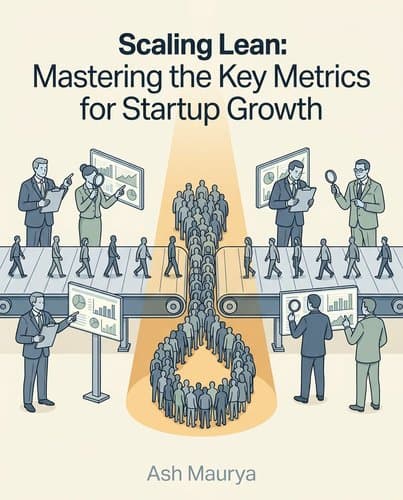
26895164_scaling-lean
by Ash Maurya
The metrics founders default to—build velocity, booked revenue, siloed KPIs—don't just mislead, they actively destroy the businesses they're meant to guide.
In Brief
Scaling Lean: Mastering the Key Metrics for Startup Growth (2016) exposes how default startup metrics — build velocity, siloed KPIs, booked revenue — actively mislead founders and destroy the systems they're meant to improve.
Key Ideas
Customer throughput replaces revenue metrics
Replace build velocity and booked revenue with customer throughput as your north-star metric: the rate at which nonpaying users are converted into paying customers. Unlike revenue, throughput must be attributable to specific user actions — it can't be manufactured by closing deals early.
Validate business model before coding
Before writing a line of code, run a back-of-envelope business model test: convert your three-year revenue goal into annual new customers needed, factor in churn (customers needed = yearly goal ÷ LTV, adjusted for replacement rate), then ask whether your target market and channel can realistically supply that volume.
Test price increases on new customers
Test price increases with new customers only, for two weeks, before any other growth experiment. If doubling price doesn't cut sign-ups by more than half, you come out ahead — same revenue, fewer customers, lower support load. Most founders leave 2–4x revenue on the table.
Price against customer alternatives, not competitors
Anchor pricing explicitly against the customer's existing alternatives, not competitor software. Reframe your monthly fee as hours of developer time saved, pain avoided, or outcomes gained. One reframe drove an 800% conversion increase.
Identify and optimize true bottleneck
Identify your business's single current bottleneck before running any optimization experiment. Improving a non-bottlenecked step doesn't increase throughput — it just piles inventory in front of the real constraint.
Switch to weekly cohort analysis
Switch from cumulative and aggregate metrics to weekly cohort analysis. Cumulative charts can only go up; cohorts reveal whether activation, retention, and conversion are actually improving or decaying beneath a growing user base.
Align all KPIs to macro goal
Never assign individual teams their own KPIs without explicitly tying those KPIs to the system's macro goal. Siloed metrics reliably produce local optimization: each team 'wins' while overall throughput falls.
Root cause analysis beats hiring
Before adding resources to break a constraint, run a Five Whys analysis to find the real root cause, then ask how to get the same output without more headcount or budget. Southwest Airlines invented open seating by refusing to buy a fourth plane.
Who Should Read This
Business operators, founders, and managers interested in Startups and Scaling who want frameworks they can apply this week.
Scaling Lean: Mastering the Key Metrics for Startup Growth
By Ash Maurya
9 min read
Why does it matter? Because the lean methodology you've been following has a structural flaw that opens up exactly when you need it most.
You did everything right. Canvas instead of a business plan, real customer conversations before writing a line of code, an MVP that people actually used. The methodology worked until it didn't. Post-launch, the data multiplied, the team split into departments, and growth flatlined while everyone hit their numbers.
The problem wasn't execution. It was measurement. The metrics founders instinctively reach for — build velocity, departmental KPIs, booked revenue — don't just fail to show what's broken. They actively hide it. Ash Maurya's argument is precise and uncomfortable: your business is a machine with exactly one real constraint at a time, and almost everything you're currently measuring is pointing at the wrong one. That's diagnosable. And it has a fix.
The Lean Playbook Has a Hidden Expiration Date
Conversion to paying customers sits well below target. Mary does what any rational manager does: reorganizes into departments and ties each team's compensation to its own metric. Sales tracks accounts closed, marketing tracks leads, development tracks velocity.
The results are specific and damning. Sales starts closing deals, mostly in the final days of each month as quotas loom. Churn climbs. Marketing blows through its budget and generates hundreds of new leads, but the percentage who become paying customers doesn't move. Developers ship faster than ever and retention falls. Every team can point to its numbers and claim it's winning. The company is losing.
This is the part of the lean story that doesn't get told at conferences. Mary followed the playbook — the canvas, the customer conversations, the MVP — and she's in exactly the same hole as founders who ignored all of it. The lean methodology gave her permission to experiment and a vocabulary for learning, but not a way to see her business as a system — to identify which single link was actually constraining everything else. So each team optimized its corner while the bottleneck sat somewhere upstream, invisible, untouched.
Her departmental KPIs weren't bad metrics. They were the right metrics for the wrong question.
There Is Only One Metric That Actually Measures Progress
Almost every metric a founder reaches for when the business stalls is answering a question the business doesn't actually need answered.
Revenue totals capture what you collected, full stop. Whether you earned it through genuine value delivery or manufactured it by front-loading December with discounts, the number looks identical. Cumulative user counts can only rise, which is why experienced investors recognize them as decoration on a pitch deck. Engagement dashboards confirm that clicking happened. All of them describe effects. The governing question — whether the machine that produces customers is working — sits somewhere upstream, unmeasured.
The only output worth measuring is a customer who can do things they couldn't do before. The person who ran their first marathon because of your training app, who came out the other side changed rather than just satisfied. Kathy Sierra, whose work on building expert users shaped how Maurya thinks about customer value, spent years trying to name exactly this state. Her early candidates, "passionate" and "awesome," both pointed at feeling rather than capability. She landed on "badass" because it names something different: a customer permanently elevated in what they can actually do.
A business that produces customers like that, at scale, is working. Customer throughput is the rate at which it does: the rate at which nonpaying users convert into paying ones. Throughput has to trace back to specific user actions: the value a customer received, the moment they decided it was worth paying for. You can't manufacture it by stuffing deals into the final week of a quarter. Revenue can be assembled from pieces; throughput has to be grown.
That's the machine-level truth each of the other metrics obscures. When throughput is rising, real value is being exchanged repeatedly. When it stalls, something in the conversion process is broken, and you find out now rather than when the churn numbers finally surface six months later.
Most Founders Are Charging Less Than Half of What Customers Will Actually Pay
Six months after launch, Joe was stuck. He was pulling in a few thousand dollars a month — the product worked, customers were happy — but after expenses there was nothing left to invest in growth. When Maurya asked what he was charging, the answer was $30 a month, a price set the way most founders set prices: estimate what it costs to deliver the thing, add a margin, call it done. The logic felt conservative and responsible. It was also the reason he was stuck.
Maurya offered a reframe. If you could double your price without losing more than half your customers, you'd come out ahead: same revenue, fewer customers, lower support load. Joe agreed to a two-week test: new customers only, old price protected. Two weeks later, the same number of people had signed up. At twice the price. He doubled again. A slight dip, still above the threshold. One more doubling finally hit the ceiling. He stepped back and settled at $120 a month: four times his starting price, the same revenue, a fraction of the support load.
The experiment makes a structural point. Price is the fastest lever in any business model. Extending customer lifetime means rebuilding the value proposition. Finding new channels takes months. A price change costs an afternoon to implement and two weeks to read — and if it works, it immediately cuts the number of new customers you need to hit your revenue target. The test mechanics make it real, not theoretical: new customers only, short window, threshold defined before you start. You get a signal without betting the business.
Anchoring the higher price is the other half. Maurya's own product hit resistance at $200 a month until he stopped comparing it to other software tools and started comparing it to developer time. His customers were already spending twenty hours a week building internal dashboards. At fifty dollars an hour, that's a thousand dollars a month in developer wages. His line to prospects: "If you can build something similar in half a workday a month, don't buy this." Conversion moved from 10% to 80%.
Price isn't where the market draws the line. It's where you help customers draw the comparison.
Giving Each Team Its Own KPI Is One of the Most Reliable Ways to Destroy a Company
Imagine measuring a relay race by each runner's individual split time. Everyone trains to hit their personal best. The sprinter on the first leg explodes off the block — but hands off so fast the second runner isn't ready and the baton hits the ground. Individual splits: excellent. Race outcome: disqualified.
IMVU ran exactly this experiment on itself. The company had thrived under an open culture where anyone could test ideas. As the team grew, leadership reorganized into product groups — acquisition, conversion, retention — each accountable to a single metric. The logic seemed airtight: clear ownership, focused incentives, measurable results.
Revenue dropped immediately. Then flatlined.
The damage was invisible until you watched the handoffs. The acquisition team, rewarded on sign-up volume, bought the cheapest traffic available. Users flooded in with no interest in the product. The conversion team's rates collapsed. Their numbers looked terrible while the acquisition team's numbers gleamed. Every team was winning. The company was drowning.
The fix was a single metric for all of them: throughput, the rate at which users became paying customers. Once everyone pulled toward the same number, the incentive to game one stage at another's expense evaporated. Revenue resumed its climb.
What IMVU shows is that local optimization is a structural trap, wired into the incentives themselves. Give smart people separate metrics and they will maximize those metrics, even when doing so drains the system. You don't need bad actors. You just need each team to do exactly what you asked.
Your Most Punishing Constraint Is Probably Your Best Competitive Advantage
In its early years, Southwest Airlines was told to sell one of its four planes or face bankruptcy. The obvious move was to cut routes: fewer planes, fewer destinations. Southwest asked a different question: what would it take to fly all the same routes with three planes?
The answer was buried in a number. Every time a Southwest plane landed, it sat idle at the gate for sixty minutes while cleaners worked the cabin, fuel trucks pulled up, and passengers shuffled on. Sixty minutes where the company's most expensive asset produced nothing. Cut that to ten, and the math worked: three planes, same schedule.
When they asked why the turnaround took sixty minutes, the real bottleneck surfaced: boarding. The whole process backed up at the jetway because passengers hunted for assigned seats. Southwest abolished assigned seating. Passengers boarded in groups, filled any open seat, and the plane was rolling in ten minutes.
That one change saved the company. But then Southwest did something stranger. Instead of restoring what the crisis had stripped away, they kept narrowing. Single aircraft type — Boeing 737s — so every mechanic knew every plane. No in-flight meals. Short point-to-point routes only. Constraint by constraint, they simplified until the whole operation was almost comically focused.
Which is when it became unbeatable. American and United couldn't match Southwest's fares without dismantling the hub-and-spoke infrastructure they'd spent decades building. Those voluntary restrictions had become a moat: the only short-haul, low-fare, high-frequency, point-to-point carrier in the country, operating in a structure the big carriers couldn't replicate without burning down what they'd already built. Southwest went from near-bankruptcy to one of the most profitable airlines in the industry, not despite the constraints, but because of what they revealed.
The pattern holds every time. A business looks like chaos until you find the single bottleneck slowing everything down. Find it. Not the surface symptom, but the root cause, chased by asking why at each layer until the real culprit surfaces. Then the whole mess resolves into one clear question: what would it take to unblock this, without just throwing resources at it?
The Chart That Makes Your Business Look Healthy Might Be Hiding a Crisis
Finding the bottleneck is only half the problem. You have to be able to see it clearly, and most measurement systems are designed to obscure it.
How confident are you in the charts your team reviews each week? Not in the honesty of whoever made them — in the structure of the data underneath.
Cumulative metrics — total sign-ups, total revenue, total users ever — have one flaw baked into their design: they can flatline, but they cannot fall. A chart that can never go down cannot tell you the business is in trouble. It can only tell you that time is passing. That's not a measurement; it's a calendar.
The subtler trap is aggregate measurement. When you count events within a monthly window (conversions, upgrades, revenue) without grouping users by when they joined, you mix customers at entirely different stages of their relationship with your product. A spike in new sign-ups makes your conversion rate look like it dropped this month and recovered next month, even when the underlying product hasn't changed. The noise is a statistical artifact, but you'll spend a quarter acting on it as if it were signal.
The fix is cohort analysis: grouping users by join date so each batch experiences the same version of your product. HubSpot discovered this the hard way. Its salespeople, chasing end-of-month quotas, closed most deals in the final week. When HubSpot sliced its customers into weekly batches by close date, the picture was clear: those last-week customers churned significantly faster than everyone else. The aggregate numbers had hidden this completely. The churn was there, accumulating in the background, invisible until someone asked which customers were churning, not just how many.
HubSpot's fix was to tie sales commissions to a Customer Happiness Index, a score built from product usage and customer outcomes, rather than to the moment a deal closed. One measurement change realigned every salesperson's incentive with the company's actual goal: customers who stayed.
If Your Experiment Can't Fail, It Was Never an Experiment
Most startup experiments aren't experiments at all. They're confirmation rituals — activities designed to produce encouraging data that justifies what you were already planning to do.
The tell is vagueness. "I believe my reputation will drive early adopters to my product." To test this, you give a talk, tweet a link, write a blog post. Sign-ups trickle in. Was the experiment validated? You cannot say — the outcome was never specified, so any result fits. This isn't hypothesis testing. It's a story with extra steps.
The minimum structure that turns a hunch into something falsifiable is one sentence: a specific action will produce a measurable outcome within a defined window. That third element, the time box, is where most teams stop short. "Writing a blog post will drive more than 100 sign-ups" sounds testable until you realize you can run it forever. At 20 sign-ups after a week, you wait. At 50 after two weeks, you wait longer. The experiment never fails because you never let it end.
The two-week window is the forcing mechanism. Whether your goal is 100 sign-ups or 50 doesn't matter; what matters is that the window closes on a fixed date and you have a conversation regardless of the numbers. Teams that commit to this discover something useful: experiments that can't fit two weeks usually contain hidden assumptions that haven't been isolated yet. Breaking a large initiative into two-week batches forces you to identify what you're actually testing at each stage.
Committing to the window is harder in team settings. When results come back ambiguous, experiment discipline collapses if whoever has the most authority gets to call the outcome. That's the HiPPO problem: the highest-paid person's opinion overrides the data. The hypothesis survives not because it was validated, but because it wasn't killed.
The question that exposes bad experiment design: if the results come back negative, will we stop? If the honest answer is no (you'll extend the window, shift the metric, or run it again), it was never an experiment. That discipline is what makes it possible to run experiments at volume rather than one careful bet at a time.
You're Not Building a Product — You're Building a Factory
Every time you found the bottleneck — in Mary's departmental KPIs, in IMVU's acquisition funnel, in Southwest's gate turnaround — you were doing the same thing: running the customer factory. The metaphor earns its keep not because manufacturing is romantic, but because it replaces a paralyzing question with a tractable one. Founders spend years agonizing over what to build next. A factory doesn't agonize. It finds the constraint, tests whether it's the real one, clears it, and moves forward. Every decision (feature, hire, experiment, price change) either serves throughput or it doesn't, and you can actually check.
That's the identity shift. You're building a machine that turns strangers into people whose lives are measurably better — and who pay you for the privilege. Throughput is the only number that tells you whether the machine is running. Everything else is either feeding it or flattering you.
Notable Quotes
“A business model is a story about how an organization creates, delivers, and captures value.”
“creating a third space between work and home.”
“? The reason I describe the output of this customer factory as”
Frequently Asked Questions
- What's the main problem with default startup metrics?
- Default startup metrics — build velocity, siloed KPIs, booked revenue — actively mislead founders and destroy the systems they're meant to improve. Maurya replaces them with customer throughput, the rate at which nonpaying users convert into paying customers. Unlike revenue, throughput cannot be manufactured by closing deals early and must be attributable to specific user actions. This shift forces founders to focus on sustainable growth rather than accounting tricks that create false signals.
- What pricing strategy does Ash Maurya recommend for maximizing revenue?
- Test price increases with new customers only, for two weeks, before any other growth experiment. If doubling price doesn't cut sign-ups by more than half, you come out ahead — same revenue, fewer customers, lower support load. Additionally, anchor pricing explicitly against the customer's existing alternatives, not competitor software. Reframe your monthly fee as hours of developer time saved, pain avoided, or outcomes gained. One reframe drove an 800% conversion increase.
- How should founders identify what to optimize first?
- Identify your business's single current bottleneck before running any optimization experiment. Improving a non-bottlenecked step doesn't increase throughput — it just piles inventory in front of the real constraint. Before adding resources to break a constraint, run a Five Whys analysis to find the real root cause, then ask how to get the same output without more headcount or budget. Southwest Airlines invented open seating by refusing to buy a fourth plane, solving a constraint creatively.
- Why should founders use cohort analysis instead of cumulative metrics?
- Switch from cumulative and aggregate metrics to weekly cohort analysis. Cumulative charts can only go up; cohorts reveal whether activation, retention, and conversion are actually improving or decaying beneath a growing user base. Never assign individual teams their own KPIs without explicitly tying those KPIs to the system's macro goal. Siloed metrics reliably produce local optimization: each team 'wins' while overall throughput falls.
Related Book Summaries



Read the full summary of 26895164_scaling-lean on InShort