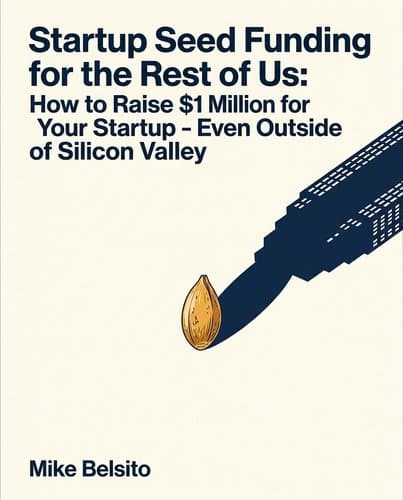
25112743_startup-seed-funding-for-the-rest-of-us
by Mike Belsito
Raising $1 million for your startup isn't about location or connections—it's about proving desperate demand exists before you ever enter a room with investors.
In Brief
Raising $1 million for your startup isn't about location or connections—it's about proving desperate demand exists before you ever enter a room with investors. Learn the exact frameworks, pitch mechanics, and fundraising tactics that work even when you're building outside Silicon Valley.
Key Ideas
Test retention curves before growth investment
Run the retention curve test before any growth investment: plot monthly active users against days since acquisition — if it doesn't flatten into an asymptote, fix product-market fit first. No viral mechanic or press campaign recovers a curve that never flattens.
Interview non-users for critical insights
Talk to non-users before your own users. Your existing users have already decided to tolerate your product's worst problems, which makes them systematically bad sources for identifying the most important fixes.
Batch investor meetings for momentum
Compress all investor meetings into a single week by scripting a two-week delay. Batching creates momentum and prevents the drip-drip of scattered meetings that signals desperation.
Perfect the three-sentence investor pitch
Master the three-sentence pitch: what your company does (grandparent-level clarity), how big the market is (dollar figure), and your traction (growth rate or revenue). Everything else is risk — the more you talk, the more you say something investors don't like.
Protect founder equity in early funding
Guard your equity in early rounds. Early investors care about ownership percentage, not monetary return — and a founder with little remaining stake is a deterrent to Series B/C investors who want to see conviction, not dilution.
Identify and promote your key people
Find your barrels before you scale. Expand each hire's scope until it breaks — that breaking point is their optimal role. Watch whose desk people gravitate toward; that person is likely your next barrel worth promoting and protecting.
Build product-market fit before fundraising
Build something users love before seeking funding — not as a moral principle but as a strategic one. The less you need outside money to prove your idea works, the stronger your negotiating position with every investor you meet.
Ask users about problems, not solutions
Interview users about their lives and problems, never about features or competing products. Users know their problems, not the solutions — asking about features produces the horseless carriage problem: you get a faster horse instead of what they actually need.
Who Should Read This
Business operators, founders, and managers interested in Startups and Business Strategy who want frameworks they can apply this week.
Startup Seed Funding for the Rest of Us: How to Raise $1 Million for Your Startup - Even Outside of Silicon Valley
By Mike Belsito & Lindsay Preston & Lynn-Ann Gries & Jay Donovan
11 min read
Why does it matter? Because the startup wisdom you've been sold is designed to make you feel behind — and that's exactly backwards.
Here's what nobody tells you about the founders behind the companies you admire: most of them didn't know what they were doing. Zuckerberg incorporated Facebook as an LLC in Florida. The DoorDash founders tracked orders on a Google Doc. Wufoo raised less than $120,000 and returned nearly 30,000% to investors. The pattern isn't genius — it's a specific kind of honesty about what you don't yet know, combined with an almost stubborn insistence on finding out whether real people actually want the thing you're building. What keeps most founders outside the Bay Area from accessing it isn't geography — it's the assumption that somewhere, someone else has already figured all this out and you're just missing the invitation. You're not. The invitation is the work.
The Most Successful Founders Didn't Know the Rules — And That Was the Point
Here's the uncomfortable truth about startup success: the founders who built the biggest companies often didn't know what they were supposed to do — and that gap was an advantage, not a liability.
Paul Graham, who co-founded Y Combinator and has watched thousands of startups succeed and fail, makes this case through a single pointed example. When Mark Zuckerberg built Facebook, he structured it as an LLC in Florida. Every startup lawyer in Silicon Valley would have told him to form a C corporation in Delaware — it's the standard, the obvious move, the thing you do before anything else. Zuckerberg didn't know that. He also built one of the most valuable companies in history. Graham's conclusion isn't that legal structure doesn't matter. It's that Zuckerberg succeeded because he understood his users with unusual depth, and that user-specific insight was worth far more than procedural startup knowledge.
The risk cuts the other way too: knowing too much about "how to start a startup" might actually be dangerous. When founders absorb the playbook before they understand their own business, they start making generic decisions rather than specific ones. They follow the formula — generate a great idea, secure investors, hire friends, lease trendy office space — and somewhere in that sequence, skip the part where they check whether anyone actually wants what they're building. Graham calls this "playing house." It looks like starting a startup. It produces the artifacts of a startup. It just doesn't produce anything users love.
This cuts against almost everything the startup media celebrates. The story we're usually told is that founders succeed by learning the rules faster than everyone else — by studying the playbook, attending the right accelerators, absorbing the canonical advice. Graham's version is different. The best founders tend to be driven by genuine curiosity about a specific problem, not by the ambition to run a startup. The company is what comes out of the obsession, not the other way around.
The Case Against Founding a Startup Is Stronger Than Anyone Admits
What if founding a startup is the worst career decision you could make? That's the question Sam Altman and Dustin Moskovitz — co-founder of both Facebook and Asana — posed at a Stanford lecture, and they didn't ask it rhetorically.
The most disarming piece of evidence Moskovitz brought was numerical. The 100th engineer hired at Facebook made more money than 99% of Silicon Valley founders. Google's 1,500th employee created Google Maps. Facebook's 250th hire led the Like button project. These aren't consolation stories — they're outcomes most founders would envy. The people who built some of the most recognized products in the world weren't the ones who started the company. They joined late, inherited infrastructure and users and teams, and then made something that mattered. Moskovitz's point wasn't that ambition is overrated. It was that founding is a specific, brutal vehicle for ambition — and for many talented people, the wrong one.
Phil Libin, who built Evernote, described the founder experience in terms that should give anyone pause: every employee, customer, partner, and journalist becomes your boss. He'd never felt more accountable to more people in his life. Picture a product outage at midnight — you're not the one with authority to go home. You're the one every engineer, every angry customer, and every reporter is waiting on. Anyone who wants to found a company because it sounds like a position of power has the relationship exactly backwards.
And then there's time. Altman framed it plainly: if your startup succeeds, you're working on it for roughly a decade. If it fails, you're still in it for five years. Five years is a graduate degree, a marriage, a child's entire early childhood. That's the floor — which means the startup mythology about pivoting your way to a good idea isn't just wishful thinking. It's arithmetic that doesn't work. You don't have unlimited runway to find the right idea after you start. You need it before.
If you read all of this and still feel compelled to build something, that compulsion is probably the point.
Real Traction Comes Before Real Funding — Not After
After pitching venture capital firms up and down Silicon Valley, Parker Conrad got a piece of advice he hadn't expected: be like the Twitter guys. Not 'refine your deck' or 'work on your narrative.' Be like the Twitter guys — meaning build something so obviously useful that investors come to you, not because you've mastered the art of asking. Marc Andreessen put the logic plainly: you're always better off improving your business than improving your pitch.
Here's the part most founders get backwards. Fundraising feels like the validation — the moment when serious people with money confirm that your idea is real. But the investors worth having are looking for proof that the idea already works. The pitch is just packaging. What they're actually evaluating is whether you've built something with its own momentum.
DoorDash understood this instinctively, even if not by design. Stanley Tang and his co-founders didn't spend months architecting a platform before testing whether anyone wanted food delivery. They threw together a basic website in about an hour, listed a handful of Palo Alto restaurant menus, and drove the orders themselves. Their operations software was Square, a Google Doc, and Apple's Find My Friends. It also proved demand, which is the only thing that matters before you've raised a dollar.
The temptation is to treat that scrappiness as a phase to survive — something to replace with proper infrastructure the moment funding arrives. Walker Williams, who built Teespring, pushed back hard on that instinct. Staying unscaled isn't just a necessary compromise for early startups; it's a genuine edge over competitors who've grown past the point of doing things manually. The moment you optimize for scale, you hand that intimacy to someone smaller and faster.
What DoorDash's Google Doc and Teespring's founder-as-customer-support actually produced was something no dashboard can give you: a detailed, visceral understanding of what your customers need and where your system breaks. That knowledge is what makes you fundable. Not the polish of your slide deck — the proof that the thing works, and that you understand why.
Your Most Loyal Users Are Hiding Information From You
Your most loyal users are actively misleading you — not intentionally, but structurally. The people who stuck around despite your product's flaws have already made peace with those flaws. Which means the complaints they bring you are the small stuff.
Emmett Shear figured this out while building Twitch. When his team analyzed feedback from their existing users, they got detailed notes about interface quirks and functional annoyances — the kind of granular complaints that feel urgent because they come from real people with real frustration. But Shear recognized the trap: anyone still using the product had already decided those problems weren't deal-breakers. The feedback was real. The problems just weren't the important ones.
The users who revealed Twitch's actual weaknesses were the ones who had already left for a competitor. Their complaints were different in kind — not nitpicks about interface, but fundamental issues severe enough to drive someone away entirely. And beyond even those users sat the largest group of all: people who had never tried Twitch or anything like it. In gaming broadcasting, that was nearly everyone. Those non-users couldn't tell Shear what features to build. But they could tell him about their lives, their habits, and the problems they hadn't yet found any product to solve. That's where market expansion actually lives. If you only study people already playing your game, you learn how to win that game — you never learn there's a bigger one.
The instinct runs the opposite direction for most founders. You built the thing, people are using it, so you talk to those people. It feels like rigor. What it actually produces is an improvement loop calibrated to the tolerances of your most forgiving customers.
The same logic applies to how you run those interviews. Ask users what features they want and you get the horseless carriage problem — people describe a faster version of the thing they already know, not the thing that would actually solve their problem. Users understand their own frustration; they don't have access to the solution space. So the first conversation should never mention features or competing products. Just ask about their lives. The insight you're after is the problem, not the fix — and your users will hand you the fix prematurely if you let them.
Capital Efficiency Beats Capital Volume — The Math Most Founders Never Run
Two restaurants open the same week on the same block. The first raises serious money, builds out the kitchen, hires a full front-of-house team, and optimizes for scale. The second scrapes by on almost nothing and treats every customer complaint the way a marriage counselor treats a couple on the brink. Wufoo is the second restaurant — except the numbers are almost impossible to believe.
The company raised roughly $118,000 total at a time when the average startup was pulling in $25 million. Their return to investors: 29,561%, against an industry average of 676%. That's not a lucky exit.
Kevin Hale, Wufoo's founder, borrowed his framework from John Gottman — the marriage psychologist famous for watching couples argue for fifteen minutes and predicting, with unnerving accuracy, whether they'd eventually divorce. Hale mapped Gottman's findings onto customer behavior: the same patterns that destroy relationships destroy retention. The deadliest one Gottman identified is stonewalling — the silent withdrawal that signals contempt. In a startup, it looks like a support queue nobody answers. Hale's conclusion was blunt: stonewalling is the leading cause of churn in early-stage companies.
So Wufoo did something most founders would call wildly inefficient. They had their software engineers handle customer support four to eight hours every week. They spent 30% of engineering capacity building internal tools to make that support work better. One revision to their documentation page cut inbound support volume by 30% overnight — which meant their engineering team's workload dropped by 30% as a direct result of listening more carefully.
This is the math most founders never run. More capital buys more runway, but it doesn't buy the feedback loop that makes your product worth renewing. Wufoo's return wasn't downstream of their fundraising. It was downstream of their support culture, which was downstream of treating customer relationships the way you'd treat something you actually wanted to keep. The raise was almost incidental. The obsession came first.
The Instinct to Eliminate Anomalies Will Kill Your Best Opportunities
Someone on PayPal's team noticed something strange: 54 eBay sellers had handwritten 'Please pay me with PayPal' directly into their auction listings. The executive team's first reaction was to treat it as a problem — rogue behavior, users going off-script. They wanted to remove those sellers from the system. David Sacks pushed back. He came in the next day and told the room they'd just found their market. PayPal leaned in instead of cleaning up, and what looked like an anomaly turned out to be the core growth engine.
That instinct — to see unexpected behavior as something to eliminate rather than interrogate — is how founders miss their biggest opportunities. The data you think you understand is often the least useful signal. The weird edge case, the user doing something you didn't design for, the metric that doesn't fit the story you're telling investors: that's where the information is. The PayPal team almost deleted it.
Knowing which metrics tell you whether you have something worth growing is the other half. Alex Schultz, who ran growth at Facebook, is direct about this: the only graph that matters early on is your retention curve. Plot the percentage of monthly active users against days since they signed up. If that curve bends toward a flat line — if it goes asymptotic — you have a viable product. If it keeps declining toward zero, you don't have a retention problem. You have a product-market fit problem, and no viral mechanic or growth hire will fix it. Schultz watched startup after startup pour resources into distribution before solving this. His diagnosis was consistent: founders convince themselves they have product-market fit before they actually do.
Anomalies reveal markets. Retention curves reveal whether those markets are worth pursuing. Both require the same discipline: caring more about what your data actually shows than about confirming what you hoped it would say.
Hire for Barrels, Not Ammunition — And Guard Your Equity Like It's Oxygen
Hiring fast feels like momentum. It's actually how you accumulate liabilities that compound until they're impossible to unwind.
Keith Rabois draws a distinction that reframes the entire hiring question. Most people you can hire are ammunition — capable, useful, needing direction. Barrels are different: they take an idea from the first whiteboard sketch all the way to a shipped product, and they pull other people with them through the process. The ratio in any company is maybe one barrel to every ten or fifteen ammunition hires, which means when you find one, the right response is aggressive retention. More equity, a promotion, dinner every week. But here's the part that makes the distinction genuinely hard to apply: a barrel at one company isn't automatically a barrel at yours. The capability is culturally specific, inseparable from a particular environment and set of relationships. You can't import it from a resume.
So how do you identify one? Rabois's method is almost counterintuitive. Expand the person's scope of responsibility until something breaks. Everyone has a ceiling — CEOs, interns, everyone. The point where someone starts to struggle defines their optimal role. You're not looking for the failure as a gotcha; you're using it as a calibration instrument. A secondary tell: notice whose desk colleagues gravitate toward when they're stuck. That person — the one everyone finds trustworthy and informed without being formally designated as such — is probably a barrel worth promoting before someone else figures it out.
And here's where equity enters and most early founders make a costly mistake. The instinct is to hand out equity early and generously to fill seats fast. But if you haven't identified your barrels yet, you're diluting your own stake to retain ammunition. That matters more than it sounds. Marc Andreessen has noted that investors scrutinize founder equity closely at Series B and C — a founder who has given away too much too early signals eroding drive, and that's a reason to walk away from a deal. The fix isn't stinginess; it's sequencing. Understand cliff vesting before you grant anything. Give meaningful equity to the people who can ship, and smaller grants to everyone else.
Airbnb operationalized this thinking from the start. They spent five months interviewing their first employee and hired only two people in their entire first year. Before any interview, the founders wrote down the values every Airbnb employee had to have, then built the screening process around a single question: would you take this job if you had one year left to live? The question sounds dramatic. It was designed to be. The cost of a bad early hire isn't just lost productivity — one person who's merely tolerating the mission instead of embodying it reshapes the culture for everyone hired after them.
The Pitch That Wins Is Shorter Than You Think — And Sent From a Position of Strength
What if the most persuasive thing you can say to an investor takes less than thirty seconds to say?
Michael Seibel, a Y Combinator partner who co-founded Justin.tv before selling Socialcam to Autodesk, watched founders destroy their chances by over-explaining — and built a pitch architecture around that diagnosis. His 30-second version has exactly three sentences: what your company does in words a grandparent would follow, how large the market is in dollar terms, and how fast you're growing. The Airbnb example he uses for the first sentence is clarifying: 'We're a marketplace for space' sounds sophisticated and means nothing. 'We let you rent out the extra room in your house' takes four seconds and creates an image. Sophistication disguised as vagueness is the most common pitch failure, and it costs founders the meeting before the market size sentence ever lands.
The more you talk, the more chances you create to say something an investor dislikes. Brevity is risk management.
But here's the part that reframes everything else. Seibel says you should only fundraise from a position of strength, which he defines specifically as the moment investors are already asking to give you money. If they're not, keep building. Marc Andreessen names the same paradox from the investor side: you're always better off making your business stronger than making your pitch more polished. The founders who attract the best capital are the ones who've built something with enough momentum that they can credibly walk away.
So the pitch isn't a performance designed to generate excitement where none exists. It's evidence you assembled before you walked into the room, delivered as quickly as possible. The negotiating position you want — the one that makes investors move fast and on your terms — comes from the work that happened before the meeting, not from what you say once you're in it.
The Paradox Worth Sitting With
Here's what nobody tells you before you start chasing investors: the desperation is visible. Not as a personality flaw — as a signal. It tells every experienced investor exactly what they need to know, which is that the thing you're building hasn't yet answered its own most important question.
The founders who walk into rooms with leverage aren't better at pitching. They've already run the retention curve. They've talked to the non-users. They've built something small enough to understand completely and proved it works without anyone else's money.
Picture one of them the morning of the meeting: no deck anxiety, no rehearsed answer for the traction slide. They know what the numbers say. They've already decided what they'll do if this particular check doesn't come. When the investor asks why they're raising, the honest answer is almost boring — because growing faster is better than growing slower, and this would help with that. They're not asking for belief. They're offering evidence. The investor can feel the difference the moment they walk in.
Notable Quotes
“If you thought that [we set out to] address these problems, you would be wrong. People who are using your service already are willing to put up with all these issues, which kind of means that these are probably not the biggest problems.”
“We focused on this stuff because this was the stuff that was so bad that people weren't even willing to use our service.”
“In the case of gaming broadcasting, almost everyone is a non-user. The majority of people you are competing with are non-users,”
Frequently Asked Questions
- What is the retention curve test described in this book?
- The retention curve test plots monthly active users against days since acquisition to validate product-market fit before seeking growth investment. The book emphasizes: "if it doesn't flatten into an asymptote, fix product-market fit first. No viral mechanic or press campaign recovers a curve that never flattens." This foundational test prevents founders from wasting resources marketing products lacking user retention. Running this validation before approaching investors provides founders with credibility and conviction, establishing the proper foundation needed for successful fundraising. The test demonstrates that growth tactics cannot overcome weak product-market fit.
- What is the three-sentence pitch formula recommended in the book?
- The book teaches streamlining pitches to three essential components: what your company does at "grandparent-level clarity," how big the market is in dollars, and current traction as growth rate or revenue. "Everything else is risk — the more you talk, the more you say something investors don't like," the book warns. This compressed approach keeps pitches focused on what early investors care about most: clarity, market potential, and proof of progress. The formula helps founders avoid overselling or introducing unnecessary complexity that could trigger investor concerns.
- How should founders schedule investor meetings according to this book?
- The book recommends concentrating investor meetings into a single week using a two-week delay strategy between outreach rounds. "Batching creates momentum and prevents the drip-drip of scattered meetings that signals desperation," the authors explain. Rather than spreading pitches across months, this concentrated approach demonstrates investor demand and strengthens negotiating leverage. The batching strategy addresses a critical psychological dynamic: investors respond to momentum, and compressed meetings signal strength rather than weakness, protecting founders from appearing desperate while maximizing impact.
- What does the book recommend about conducting user interviews?
- The book advocates interviewing users about their lives and problems rather than features or competing products. "Users know their problems, not the solutions — asking about features produces the horseless carriage problem: you get a faster horse instead of what they actually need." The book also recommends talking to non-users before existing customers, as "your existing users have already decided to tolerate your product's worst problems, which makes them systematically bad sources for identifying the most important fixes." This approach uncovers true user needs rather than feature requests.
Related Book Summaries
Read the full summary of 25112743_startup-seed-funding-for-the-rest-of-us on InShort