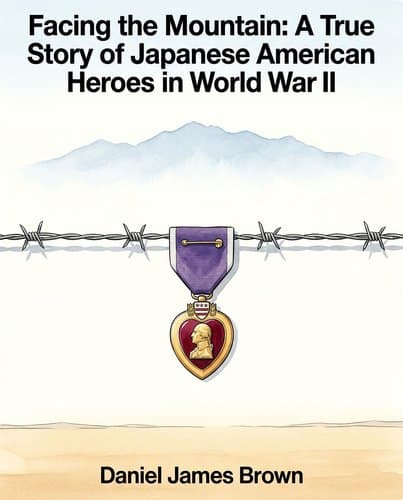
55920278_facing-the-mountain
by Daniel James Brown
When the U.S. stripped Japanese Americans of their rights and imprisoned their families, some of their sons chose to fight for that same nation anyway—not from…
In Brief
When the U.S. stripped Japanese Americans of their rights and imprisoned their families, some of their sons chose to fight for that same nation anyway—not from blind patriotism, but as a calculated wager that battlefield sacrifice could force America to become what it claimed to be.
Key Ideas
Language determines how long injustice persists
Political language is a policy tool: the U.S. government called mass imprisonment 'evacuation' and concentration camps 'relocation centers.' The words chosen to describe an injustice determine how long it goes unacknowledged — and who gets to feel like a victim.
Strategic self-interest differs from patriotism
The most durable argument for working within an unjust system is often strategic, not emotional. Rudy's case wasn't 'I love America' — it was 'if we don't show up, our enemies get to define who we are.' That calculation is different from patriotism, and it's worth distinguishing between them.
Systemic injustice builds through historical policy
Systemic injustice rarely arrives all at once. The mass incarceration of Japanese Americans was enabled by 60 years of Alien Land Acts, immigration exclusions, and FBI watch lists built before Pearl Harbor. The attack was the trigger, not the cause — which means looking for the machinery, not just the moment.
Sacrifice does not guarantee social honor
Military sacrifice does not automatically translate to social recognition. The 442nd returned to neighborhoods with 'Japs Keep Out' spray-painted on their property. Redress took 43 more years. Proving something on a battlefield does not bind a civilian society to honor it.
Both resistance and participation merit respect
Both resistance and participation can be principled responses to the same injustice. Gordon Hirabayashi refused military service, went to prison, and had his Supreme Court case vindicated by history. Rudy Tokiwa volunteered, fought in three campaigns, and spent decades earning the 1988 apology. The book honors both without adjudicating which was right — and that refusal is itself the point.
Who Should Read This
History readers interested in Military History and World History who want a deeper understanding of how we got here.
Facing the Mountain: A True Story of Japanese American Heroes in World War II
By Daniel James Brown
9 min read
Why does it matter? Because the most decorated unit in American history was fighting two wars — and the second one took 43 more years to win.
Most people know the number: the 442nd Regimental Combat Team, most decorated unit in American military history. What they don't know is what was happening the same night those soldiers first picked up rifles to guard their country — their fathers being marched out of darkened houses at bayonet point, wives throwing shoes into moving FBI cars because their husbands had been dragged out barefoot.
This is a book about men who were legally classified as enemy aliens and then chose, in a furious and calculated act, to volunteer anyway. Not out of innocence. They had read the Constitution. They knew what it promised. And they decided that if America wouldn't honor the contract first, they would force the issue from the other direction — with their lives as the argument.
The Incarceration Wasn't a Wartime Overreaction — America Had Been Building the Machinery for 60 Years
The word "evacuation" did not appear in official communications by accident. Orwell noted that political language makes lies sound truthful. Every word chosen for the incarceration — evacuation, assembly center, relocation center — was doing exactly that. The language mattered because the policy underneath had been constructed deliberately, for decades before anyone heard of Pearl Harbor.
The machinery started with land. In 1913, California passed the Alien Land Act, barring anyone "ineligible for citizenship" from owning property. That phrase meant Japanese immigrants, by design. Nine years later, the Supreme Court made the exclusion explicit. Takao Ozawa had spent 28 years in the United States — graduated from Berkeley High School, attended UC Berkeley, worked for Sears, Roebuck, raised two American children, converted to Christianity. In 1922 he asked the Court to recognize what his whole life demonstrated: that he was American. The answer was no. Under the Naturalization Act of 1906, citizenship required being either white or of African descent. Ozawa was neither. His 28 years counted for nothing. Two years after that ruling, the Johnson-Reed Act closed the door on further Japanese immigration entirely.
This is the architecture Pearl Harbor did not create. It only gave the structure a reason to run. When Roosevelt signed Executive Order 9066 in February 1942, no new law was required. The exclusion zones, the curfews, the forced removal of between 108,000 and 120,000 people — all of it slid through a framework fitted together statute by statute across six decades. A poll taken in March 1942 found 93 percent of Americans in favor of removing Japanese immigrants from the West Coast. That number was not spontaneous outrage. You do not get to 93 percent by accident. You get there by telling a country, systematically and legally, for two generations, that these people were never truly here.
The Government Called It 'Evacuation.' The Families Called It Watching 30 Years of Work Disappear in a Week.
On the Monday after Pearl Harbor, Kisaburo Shiosaki drove across Spokane to pick up laundry from Will Simpson's print shop, as he had every Monday morning for more than twenty years. Simpson had been more than a customer — he was a prominent Democrat, FDR's appointee as Spokane's postmaster, widely respected across the state, and for two decades Kisaburo's most important advocate in Hillyard. When Kisaburo appeared at the back door that morning, Simpson held up the front page of the Spokesman-Review. The headline was a four-inch black banner: WAR LIST BIG. "What do you think of that?" Simpson demanded. Kisaburo didn't know what to say. Finally he murmured that it was dumb, that he was sure it would be over soon. Simpson stared at him as if seeing him for the first time. "Well, Kay, I'm afraid I can't do business with you anymore. I have a political position I have to be careful of." He stepped back inside and shut the door.
What stood behind that door was thirty years of American life. Kisaburo had come to Vancouver in 1904 at twenty-one, laid railroad track through British Columbia winters with frozen hands, slipped across the U.S. border, and cleared tables at Spokane's Davenport Hotel, well enough that his employers wrote to say so. He sailed home in his best suit, found a wife, came back, and bought the Hillyard laundry in 1917. By 1941 the family had a car, the kids were in school, his wife Tori had become the most knowledgeable Japanese woman in Spokane on the subject of baseball. Three decades of careful, continuous building.
Simpson's door closed, and it took about a sentence.
The formal orders came later — curfews, exclusion zones, barbed-wire fairgrounds on thirty-three cents per person per day. The damage was already done: thirty years of Monday mornings, cancelled.
Seventeen-Year-Old Rudy Tokiwa Made the Decisive Argument for Enlisting in a Desert Wash, and It Wasn't About Patriotism
Down in a dry wash at Poston, forty young men gathered in whatever shade the mesquite trees offered and tried to decide whether to volunteer for an army that had locked them up. They sat on boulders, leaned against twisted black trunks, kicked at rocks, scratched shapes in the sand. Nobody wanted to speak first.
Someone did. "Why in the hell should we go out, fight for a damn country that locks us up?" The circle shifted. Another man stood up: it seemed foolish, volunteering from inside a concentration camp. The nods kept coming.
Harry Madokoro, the camp's police chief, said he was going regardless: duty, yes, but also calculation. Either you came home still tagged as "Jap," he said, or you came home as a veteran. Most of the younger men weren't persuaded.
Then Rudy Tokiwa stood up. He was seventeen, the youngest there, and he'd grown up moving between California and Japan, more fluent in Japanese than most of the others in the circle. Nothing in that background pointed toward volunteering. But he had one angle the others hadn't worked.
"Say nobody volunteers out of the camps. What can Roosevelt say?" A pause. "Well, he can say that we're more loyal to Japan than the United States. Do you guys want to live in Japan?"
One of the men said he couldn't make it in Japan — he barely spoke the language.
That was the argument: purely positional. If you stay silent, someone else writes the conclusion. Roosevelt fills the blank with your disloyalty, and you've handed him the pen. Rudy was seventeen, furious at being locked up, and he understood that absence doesn't read as neutrality — it reads as confession.
By the end of the meeting, nearly every man had committed to registering. That night, those who hadn't attended showed up at Block 213 to beat up the volunteers. Rudy's group met them with pick handles and baseball bats.
General Dahlquist's Incompetence Encircled the Texans; K Company's 163 Dead Men Fixed It
The version most people know leaves out who surrounded the Texans in the first place.
General John Dahlquist ordered the 141st Infantry's First Battalion to push rapidly along a ridge north of Biffontaine in late October 1944. The Germans let them pass, then felled trees across the trail behind them. More than two hundred Texans were trapped six kilometers behind enemy lines with one day's rations. Dahlquist had created the emergency. Now the 442nd was sent to fix it.
When the 442nd fought uphill through Vosges pine forests where German shells detonated on the canopy and rained steel and splinters down on men with nowhere to hide, Dahlquist arrived at the front and found soldiers dug in. He began kicking at them and demanding a bayonet charge. Lieutenant Colonel James Pursall explained twice why a charge would be suicidal. Dahlquist took Pursall and Rudy Tokiwa uphill to see for himself. His aide Wells Lewis spread a map to show the German positions, and a bullet took Lewis through the head. Dahlquist held the body, uniform soaked in blood, murmuring "Lewis is dead" — and then stood, jogged downhill, and ordered the charge anyway.
Pursall grabbed him by the lapels and told him exactly what he was doing to his men. Dahlquist ordered it anyway and walked away.
Pursall drew a pearl-handled pistol, stood up alone, and started up the hill. Shiosaki stared at him and thought he was going to get himself killed — then stood up anyway. So did every man on the line. A shell punched shrapnel into Fred's side mid-charge. A medic yanked it out and told him to keep going. He did.
Two weeks after the rescue, Dahlquist arrived at a snowy field near Bruyères for the formal ceremony. He looked at the formation and scolded Colonel Miller for not assembling the full regiment. Miller replied quietly: "General, this is the regiment. This is all I have left." K Company had entered the Vosges with 180 men. Seventeen walked out. I Company: four riflemen. October's total casualties: 790.
Dahlquist went quiet. He moved down the lines and pinned a citation on each chest. The men looked past him at the mountains.
The Jury That Acquitted Four Men for Firebombing a Japanese American Farm Took a Lunch Break First
When the Doi family returned to their 85-acre farm outside Auburn, California in early 1945, the exclusion orders were lifting. The official emergency was over. An AWOL soldier named Claude Watson decided to declare his own. He recruited a bartender and several others, drove to the property, and firebombed the packing shed. The following night they shot up the front of the house and planted dynamite — the fuses went out. All four men were caught and promptly confessed.
At trial, the defense chose not to contest a single fact. One attorney argued that the men couldn't be held responsible: the army had spent years training soldiers to destroy Japanese people, and these men had been drinking — what jury could hold that against them? A second attorney blamed the War Relocation Authority for permitting the return in the first place, invoked Pearl Harbor, and asked the jury to keep California a white man's country.
The jury received the case at 11:30 a.m. They took a lunch break. They came back less than two hours later: not guilty.
The camps were closing. The exclusion orders were lifted. The verdict showed the social permission to harm Japanese Americans without consequence had not ended with any of it. Men of the 442nd were earning Presidential Unit Citations in the same weeks their families were discovering they could not safely go home. Military sacrifice proved they were American. It did not make them safe.
The Men Who Found Solly Ganor in the Snow Had Been Stripped of Their Own Citizenship Three Years Earlier
On the morning of May 2, 1945, near the Bavarian town of Waakirchen, Kats Miho and two fellow artillerymen began brushing snow from lumps alongside a road. Underneath: bodies in striped prison uniforms. They found more in the surrounding woods — shot, beaten, or dead of exposure. Then, deeper in the trees, they found someone still alive.
Solly Ganor was seventeen. He had been marched out of Dachau six days earlier with six thousand prisoners, the SS shooting whoever fell behind. He had lost his father somewhere in the column. That morning he had woken surrounded by the dead, found a knife on a dead German civilian, cut flesh from a dead cart horse, and started soup in a pail with potato peelings and snow. He expected to be shot before he finished it. When he heard voices and saw men in uniforms approaching on tanks, he assumed this was the moment. He kept eating.
Then the voices were English. He looked up and saw Asian faces smiling down at him. He wondered if he was dead, if these were angels. "You are free, boy," one said. Solly struggled to form a word. "Who?" — "Japanese Americans." He accepted a chocolate bar, then set it aside and went back to the soup. "You would not eat the Mona Lisa," he said later.
The men who freed Solly from a Nazi death march were soldiers whose own government had locked them in desert camps three years earlier, stripped of their property, their freedom, their claim to a citizenship they had spent their lives earning. Both groups had been declared subhuman by a state. One was liberated by the other. George Oiye, one of the men at Waakirchen, wrote afterward: "Most of all, I felt guilt for the transgression of mankind to do evil in the sight of God."
The Second War Took 43 Years and a Handshake in the House Gallery to Win
The men came home, rebuilt what they could, and waited forty-two years for the government to reckon with what it had done.
Forty-two years after the war, Rudy Tokiwa pushed past the heavy wooden door of Congressman Charles Edward Bennett's office on his crutches. Bennett — a decorated Pacific veteran who had contracted polio in the New Guinea jungles, now dependent on leg braces to walk — looked up and demanded to know what they thought they were doing there. He planned to oppose the redress bill that would formally apologize for the wartime incarcerations and pay each surviving detainee $20,000. The other Nisei vets began filing out.
Rudy stayed. He had done his research and knew what was under Bennett's slacks. So instead of arguing, he thanked him. For coming to work every day in pain. For serving the country that had crippled him. "You're a damn good man," Rudy said, and extended his hand.
When the vote came, Rudy stood in the handicapped gallery on his crutches. Bennett entered the chamber, looked up, saw him, and hesitated. He was scheduled to deliver a three-minute speech against the bill. Instead he walked to the well, stood for a moment, and left through a side door — then voted yes. After the vote, his explanation was simple: he had looked up into the gallery, seen Rudy on his crutches, and couldn't do what he had planned to do.
Reagan signed the Civil Liberties Act in August 1988, acknowledging the incarcerations had been "motivated largely by racial prejudice, wartime hysteria, and a failure of political leadership." Most Issei, the generation who had built the laundries, farms, and hotels that were stripped and looted while they were imprisoned, were already dead.
The 442nd's tools on Monte Folgorito and in the Vosges had been showing up and refusing to leave. Forty years later, the same men used the same tools in the hallways of Congress, and got, at last, an answer.
Whether Sacrifice Can Redeem a Nation, or Only Indict It
What you are left with is not a redemption story, even if it has the shape of one. The arson at the Doi farm happened. The covenant-barred neighborhoods happened. The men who paid for the Vosges with their dead came home to "No Japs" signs on the properties they'd left behind. Then forty-three years passed, and Rudy stood in the House gallery on his crutches, and Reagan signed a paper saying it was wrong. That paper is real. So are the graves of everyone who didn't live to read it.
Tom Ikeda — his family imprisoned at Minidoka, he would later help lead the redress movement — heard his father's warning early: life can change quickly. He meant it as advice: listen, don't assume. He was also naming the book's unresolved question. The camps were built across sixty years of ordinary legislation — none of it announcing catastrophe. The 1988 apology proves it happened. It is not evidence that it couldn't happen again.
Notable Quotes
“I want you guys to charge,”
“Look, if my men said that's the only way they can do it, that's the only way it can be done.”
“Okay, Punch Drunk, let's go.”
Frequently Asked Questions
- What is Facing the Mountain about?
- The book chronicles Japanese American soldiers who fought for the U.S. while their families were imprisoned in wartime internment camps. It examines how strategic calculation—not patriotism—drove many to enlist. The narrative explores systemic injustice built over decades through immigration exclusions and discriminatory laws that preceded Pearl Harbor. Brown follows figures like Rudy Tokiwa and Gordon Hirabayashi, showing how mass incarceration was enabled by deliberate policy language and how military sacrifice did not automatically translate to social recognition, with the 442nd returning to neighborhoods marked with graffiti despite their service.
- How does language shape the narrative of injustice in Facing the Mountain?
- Daniel James Brown demonstrates that political language functioned as a deliberate policy tool to obscure mass imprisonment. The U.S. government called forced relocation "evacuation" and concentration camps "relocation centers," enabling denial and delayed accountability. Brown argues that "the words chosen to describe an injustice determine how long it goes unacknowledged — and who gets to feel like a victim." This linguistic strategy allowed systemic injustice to persist unchallenged for decades, showing how terminology actively shapes public understanding and responsibility for atrocities.
- What's the difference between Gordon Hirabayashi and Rudy Tokiwa's responses to internment?
- Facing the Mountain honors two distinct principled responses to the same injustice. Gordon Hirabayashi refused military service, went to prison, and eventually had his Supreme Court case vindicated through legal reversal. Rudy Tokiwa volunteered for the 442nd, fought in three campaigns, and spent decades advocating for official apology, achieved in 1988. Brown presents both resistance and participation as legitimate without adjudicating which approach was correct. The book's refusal to rank these responses demonstrates that multiple forms of principled resistance can coexist within historical injustice.
- Why didn't Japanese American soldiers receive immediate recognition for their military sacrifice?
- Military sacrifice does not automatically translate to social recognition, as Facing the Mountain makes clear. The 442nd Regiment returned home to neighborhoods marked with hateful graffiti, facing continued discrimination despite battlefield heroism. Official U.S. government redress took 43 years after the war ended. Brown demonstrates that proving sacrifice on a battlefield creates no binding obligation for civilian society to honor or acknowledge it. This gap between military contribution and social recognition exposes how institutions selectively acknowledge service based on racial hierarchies rather than merit.
Related Book Summaries

Read the full summary of 55920278_facing-the-mountain on InShort