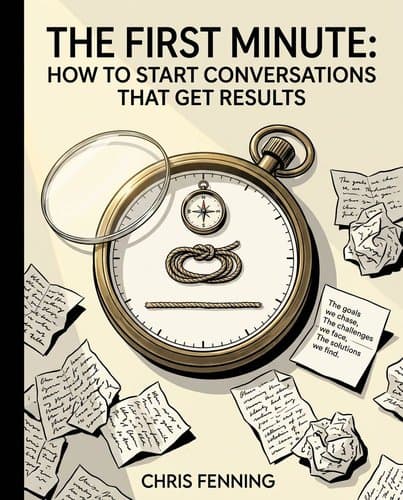
55977442_the-first-minute
by Chris Fenning
Every ignored email and derailed meeting shares one root cause: an unstructured opening. Master a three-part, thirty-second framework—context, intent, key…
In Brief
The First Minute: How to Start Conversations That Get Results (2020) shows that most workplace miscommunication stems from poor openings, not poor content. It gives a repeatable structure — context, intent, and key message — for starting any conversation, email, meeting, or update clearly and concisely.
Key Ideas
Frame conversations with context, intent, key message
Open every work conversation with three slots in under thirty seconds: context (why this is happening now), intent (what you want from the listener), and key message (the one thing they must not miss). This is framing — the skeleton every clear opener shares.
Structure updates with goal, problem, solution
Structure any update as Goal (what you were trying to achieve), Problem (what is blocking it), Solution (what you did or need). In writing, bold-label each heading so a scanner cannot miss the structure.
Add framing summary before forwarding emails
Never forward an email chain without writing a full framing-plus-GPS summary at the top. Treat every forwarded chain as a new conversation — do not make the recipient dig.
Define meeting purpose and expected output
Replace blank meeting invites with two lines: meeting purpose (what the meeting is for) and meeting output (the expected deliverable). For single-topic meetings, these two lines replace a separate agenda document.
Grant permission to leave irrelevant meetings
At the start of any meeting, give attendees explicit permission to leave if the topic is not relevant to them. People who choose to stay are more engaged than people who feel compelled to stay.
Frame first, deliver GPS, then stop
In a job interview, frame first (context, intent, key message), then deliver GPS in past tense, then stop. Let the interviewer ask for more — the structure earns follow-up questions rather than trying to pre-answer them.
Who Should Read This
Business operators, founders, and managers interested in Public Speaking and Persuasion who want frameworks they can apply this week.
The First Minute: How to Start Conversations That Get Results
By Chris Fenning
10 min read
Why does it matter? Because the first sixty seconds of almost every work conversation are already broken — and nobody ever showed you how to fix them.
You've been in that meeting. Nobody said why they were there. Forty minutes passed before someone asked what the goal was. You've received that email — twenty messages deep, topped with "FYI" — and felt the quiet irritation of being handed someone else's homework to decode. You've sat through the status update that should have taken five minutes and somehow consumed the hour, no one knowing when it was safe to stop.
Those failures share one cause. Not unclear thinking. Not low confidence. Not a personality type. Structure — specifically, the sixty seconds missing at the start. Two tools — a framing sequence and a three-part summary — cover all of it. One sets up the conversation so your listener knows what they're walking into before anything important is said. The other compresses your point into three labeled pieces that land fast and stick. You already have the content. This book gives you the structure that makes it work.
Your Communication Problems Are Not a Personality Flaw — Nobody Ever Taught You the Structure
Steve stopped his project manager just outside the cafeteria. He needed to talk about a testing issue. A few minutes in, the project manager had to interrupt: "What project is this for?" Steve explained: the LT-10, a flagship phone launching in a few weeks, millions in TV advertising already locked in. More minutes passed. The project manager waited, listening, trying to figure out what he was supposed to do with all this. Finally he asked: "Is there something specific I can help with?" Steve looked surprised. Oh, he said. We're going to miss the deadline. He needed approval to push the go-live date out by a month.
Ten minutes to surface a piece of news that could unwind the entire launch.
Here's the uncomfortable part: you already know which character you are in this story. You've been the one waiting, trying to decode what the other person actually needs. And — if you're honest — you've probably also been Steve. Most of us have. The reason is simpler than we want to admit: no one ever told us how to begin.
Chris Fenning points out something almost embarrassing in its simplicity: professionals spend fourteen to eighteen years in formal education and never receive a single lesson on how to start a work conversation. Not one. Everything you learned about communication came from watching other people who were figuring it out the same way you were. The habits that formed — leading with backstory, building to the point, saving the key message for when it feels earned — are the natural result of learning nothing formal at all.
The failure is structural. Nobody taught the structure.
That gap shows up everywhere, at scale. A survey by Lucid Meetings found that only one in ten people always understand the purpose of their meetings. That's one in ten. Walk into any ten-person meeting and there is likely only one person who knows what it's for. A third only sometimes know. Nearly one in six rarely or never do. These are people who walked in blind.
The fix Fenning offers is a learnable sequence for the first sixty seconds of any work communication: a structure that tells your audience what you're discussing, why it matters to them, and what you need before you go anywhere near the details. Steve communicated the way most of us do. By feel, by instinct, by imitation of people who were also guessing. Lead with the topic. State why it matters. Say what you need. That's the sequence no one ever taught, and it fits in sixty seconds.
Every Clear Opener Shares the Same Three-Part Skeleton — and You Are Probably Skipping Two of Them
Any opener can be built from three fixed slots, in this order: context, intent, key message. That's the skeleton. Fifteen seconds to deliver. It works for every work conversation, every email, every meeting invitation — and if you've wondered why some colleagues always seem to get to the point while you're still finding your footing, the answer is almost certainly that they're running through these three slots, consciously or not, before they open their mouths.
Here's what it looks like without them. Subject line: "Quick question." Two paragraphs of backstory. A sentence about the timeline being tight. Somewhere in the third paragraph, the actual ask — if you make it that far. The reader doesn't read; they hunt.
Run the same check on the last important message you sent. Did it name the topic in the first sentence? Did it say what you needed before paragraph two? Did the key message arrive early enough that someone skimming would catch it? If any of those answers is no, the skeleton was incomplete — not because you can't write, but because nobody handed you the blueprint.
Context tells the listener what you're talking about. Intent tells them why you're raising it — what you need them to do with it. Key message is the one line they'd repeat to someone else afterward. None of these is optional. Skip context and the listener spends the first minute guessing the topic. Skip intent and their brain tries to file this as an alarm, a decision request, or background noise, all while you're still talking. Skip the key message and you've turned the whole thing into an Easter egg hunt.
Fenning sends a note to a colleague named Diane. Subject line: "Website updates — priority decision needed." Eight words. Context and intent are both there before she opens the email. The first line of the body delivers the key message: the login screen is broken, customers are calling, and one existing project has to move. Can she help decide which one? The rest (labeled bullets for goal, problem, solution) fills in behind that. Diane can read the subject line and know if this is urgent. She can read the first sentence and know exactly what she's being asked to do.
What makes this useful isn't that Fenning writes better emails than most people. He built the three slots in before he typed a word. Context in the subject line. Intent in the subject line or the opening sentence. Key message in the opening sentence, full stop. The rest follows naturally because the hard decisions — what is this about, what do I need, what's the one thing that can't be missed — were already made.
Your Manager Does Not Want the Full Story. They Want Goal, Problem, Solution — in That Order.
The executive team is at an offsite and cannot be disturbed. The contract deadline is today. Miss it, and the client signs with a competitor — the biggest sale of the year, gone.
That is the situation a salesperson has to frame for someone who can actually help. Here is the GPS version:
Goal: Get executive approval on a high-value client contract before end of day. Miss the deadline and the client walks. Problem: The executive team is at an offsite with strict instructions not to be interrupted. Solution: Contact the VP's admin assistant for an emergency number; loop in the manager to escalate; call the client to buy time; drive to the offsite; FedEx the signed contract back.
Six sentences. The entire emergency, compressed. Notice what is absent: no history of how the deal developed, no explanation of why this client matters, no catalog of every obstacle along the way.
Fenning calls this the GPS method: goal, problem, solution. Most work conversations are about solving a problem. Goal is where you are trying to get. Problem is what is blocking you. Solution is the next move. Three labeled units, in that order, in under forty-five seconds: the back half of the first minute.
The instinct most people fight is the urge to prove they understand the situation before asking for help. The thinking goes: if I give you enough context, you will see I have already tried everything and this really is as complicated as I am saying. But that instinct backfires. A long build-up does not read as thorough; it reads as unsorted. GPS reverses the signal. State the goal, name the single problem blocking it, propose the solution. The compression shows you have already done the thinking. You are not transferring the complexity to your audience; you are demonstrating you have handled it.
Status updates make this even clearer. The real trap is the mistaken belief that managers want granular detail, the full sequence of what broke, why it broke, what was tried before the fix landed. That belief is what turns a one-minute update into an hour-long meeting. Fenning's prescribed test is blunt: deliver only the GPS structure, add nothing else, then count how few follow-up questions arrive. Most of the time, the answer is: not many. The audience wanted to know where things stand and what happens next. They did not need the archaeology.
GPS also handles situations where the goal belongs to someone else. If you are describing how you helped a colleague prepare for a high-stakes presentation, the goal and problem describe their situation. The solution describes what you did. The structure bends without breaking. That matters most when the situation is unusual enough to throw you off.
Write the three labels before the conversation. Goal. Problem. Solution. One sentence under each. That act of writing is the preparation. Under pressure — a surprise question in a meeting, an unexpected request from a senior leader — the labels become anchors. You know which slot you are in, which means you know when you are finished.
The first minute does not demonstrate competence by containing everything. It demonstrates competence by containing the right things, in the right order, fast enough that the conversation can start solving instead of still arriving.
One Framework, Every Medium: The Same Two-Part Structure Fixes Your Email, Your Meeting Invite, and Your Job Interview
The frame (context, intent, key message) and the GPS summary (goal, problem, solution) don't change when you move from a spoken conversation to an email, a meeting invitation, or a job interview. What changes is a slot or two.
In a meeting invitation, the key message slot splits into two: meeting purpose (what the session is for) and meeting output (the deliverable people should leave with). That's the whole adaptation. A subject line carries the context, the first line states the intent, and two labeled bullets replace the need for a separate agenda document. The blank calendar invite (room number, time, nothing else) is what happens when every slot gets omitted. Not a different problem. The same one.
The most revealing adaptation is the interview answer. Most people answer "describe a time you helped someone" by narrating from their own center: I was slammed, I helped anyway, things worked out. That puts the interviewer in the wrong seat. The goal and the problem belong to the person you helped — and the frame has to establish your stakes before the solution reads as real sacrifice rather than a simple favor.
Fenning uses an example: a narrator who cleared an afternoon to help Kerry, a new colleague, prepare her first presentation to department heads while the narrator's own deadline sat unfinished. Done wrong: "I stayed up late to finish my report." No weight. Done with GPS: the goal is Kerry's — land a strong first impression in a high-stakes room. The problem is Kerry's — she inherited troubled work and had only bad news for senior leaders paying close attention. The solution is where the narrator enters: clear the afternoon, run practice sessions, rebuild the slides, prepare Kerry for the likeliest questions, then stay up to finish the original report. The frame — I was on a deadline, a new colleague asked for help, I had to choose — gives the sacrifice its weight. Shift everything to past tense. The answer runs under a minute.
What the Kerry example shows isn't just that the structure survives an interview. It survives a perspective shift — a situation where you're demonstrating your behavior rather than reporting your progress. The goal slot still holds. It just holds someone else's goal.
Write the labels first. Goal. Problem. Solution. The medium tells you the register. The structure tells you what belongs where.
The Move That Looks Rude and Makes Every Meeting More Productive: Tell People They Can Leave
What if the most respectful thing you can do at the start of a meeting is tell people they can go?
The instinct runs the other direction. You worked to get people into the room. Giving them an exit feels like admitting the invitation was a mistake. So most meetings start the same way: everyone is present because they were summoned, the purpose is fuzzy, and at least two people are already wondering why they're there.
Fenning calls the fix a validation checkpoint. Once you've delivered the context, the intent, the goal, the problem, and the proposed solution — all in under a minute — you turn it over: "If this isn't something you need to be involved in, please feel free to leave." That's the full instruction. No hedging, no apology.
The counterintuitive logic holds. Someone compelled to stay in a meeting they find irrelevant isn't contributing — they're enduring. Someone who stayed after being given the option to leave has made a small commitment. That commitment changes their posture. They're not a captive; they're a participant. Engagement goes up precisely because the trap was removed.
There's a real tension the book doesn't paper over. In hierarchical workplaces, leaving a senior-led meeting carries social risk. Even with explicit permission, few people feel truly free to walk out on a VP. Fenning acknowledges this: if you know specific people must stay, name them. The technique works best in cultures where accountability is already valued, and worst where presence itself signals deference. The fix is the structured invitation: clear purpose, clear expected output, sent before anyone arrives. People can opt out before they're in the room.
One minute to open. One sentence to release the obligation. The people who stay chose to be there.
The Structure Is Incomplete on Purpose — That Is the Point
GPS delivers your answer in under a minute — and then you stop. Most people cannot do it. The silence that follows feels like a gap to fill, and the reflex is to fill it: more detail, more context, more proof that you genuinely thought about this. But the silence is not a failure of the structure. It is the structure working. The questions that come back tell you precisely what the interviewer needed — which is more useful than any answer you could have pre-loaded. Once it holds, you already know how to begin. You just have to stop before you undo it.
Notable Quotes
“The addition of the word”
“helps clarify the intent of the bullet. If Diane only scanned the email, she would see the bolded words, and the word”
“I thought you might need to know this.”
Frequently Asked Questions
- What is 'The First Minute: How to Start Conversations That Get Results' about?
- The book argues that most workplace miscommunication stems from poor openings, not poor content. Chris Fenning's 2020 guide provides a repeatable structure for starting conversations, emails, meetings, and updates clearly and concisely. Through practical tools, readers learn to save time, reduce misunderstanding, and get faster responses from colleagues. The entire framework rests on mastering the critical first moments of workplace interactions, transforming potential miscommunication into clarity and efficiency for busy professionals.
- What is the framing structure taught in 'The First Minute'?
- "Open every work conversation with three slots in under thirty seconds: context (why this is happening now), intent (what you want from the listener), and key message (the one thing they must not miss)." This is framing—the skeleton every clear opener shares. Additionally, "Structure any update as Goal (what you were trying to achieve), Problem (what is blocking it), Solution (what you did or need)." These two frameworks—framing and GPS—form the foundation for eliminating ambiguity in workplace communication.
- How should you structure meeting invites according to 'The First Minute'?
- "Replace blank meeting invites with two lines: meeting purpose (what the meeting is for) and meeting output (the expected deliverable). For single-topic meetings, these two lines replace a separate agenda document." Additionally, at the start of any meeting, you should give attendees explicit permission to leave if the topic is not relevant. "People who choose to stay are more engaged than people who feel compelled to stay." This approach increases engagement and respects attendees' time.
- How does 'The First Minute' advise handling forwarded emails?
- "Never forward an email chain without writing a full framing-plus-GPS summary at the top. Treat every forwarded chain as a new conversation—do not make the recipient dig." Bold-label each section heading so the structure cannot be missed. By explicitly framing the forwarded chain using context, intent, key message, goal, problem, and solution, you transform a confusing thread into a clear, actionable message. This approach prevents miscommunication caused by buried context and saves recipients time.
Related Book Summaries
Read the full summary of 55977442_the-first-minute on InShort