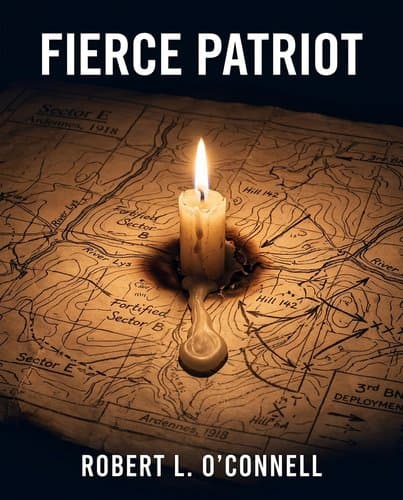
18310279_fierce-patriot
by Robert L. O'Connell
Sherman didn't win the Civil War by being brutal—he won by seeing reality more clearly than anyone else, targeting Confederate will rather than bodies and…
In Brief
Sherman didn't win the Civil War by being brutal—he won by seeing reality more clearly than anyone else, targeting Confederate will rather than bodies and pioneering decentralized command that modern armies still use. O'Connell reveals how his pre-war failures and breakdown forged the perceptual clarity that changed warfare forever.
Key Ideas
Words and deeds gaps reveal true leadership
Judge leaders by the gap between their words and their deeds — Sherman wrote of extermination and used racial slurs, but his actions often showed more nuance; the gap itself is the most important thing to understand about him
Targeting will defeats more than destroying bodies
The most effective military strategy often targets will and psychology rather than bodies — Sherman's March to the Sea succeeded not because it destroyed the Confederate army, but because it proved the Confederacy couldn't protect its own people
Organizational systems outlast individual military campaigns
Organizational innovation outlasts individual campaigns — the Army of the West's 'bottom-up' adaptability, decentralized initiative, and integration of technology (repeating rifles, pontoon bridges) mattered more than any single battle
Clear vision can rationalize dehumanization
Perceptual clarity has moral limits — the same ability to see reality clearly that makes someone effective can also let them rationalize away the humanity of the people they depend on most
Failures forge professional resilience and greatness
Professional resilience often comes from the humiliations that precede success — Sherman's breakdown in Kentucky, his Gold Rush failures, his missed intelligence at Shiloh were not detours from his greatness but the forge that produced it
Invisible helpers enable strategic success despite blindness
The people who help you most are sometimes invisible to you — Sherman's reliance on enslaved informants while viewing freedmen as an 'encumbrance' is a lesson about how strategic blindness and proximity can coexist
Who Should Read This
History readers interested in Military History and Leadership who want a deeper understanding of how we got here.
Fierce Patriot
By Robert L. O'Connell
14 min read
Why does it matter? Because the man history remembers as a destroyer was actually a master of seeing clearly.
Everyone knows what Sherman did to Georgia. The burning, the marching, the deliberate cruelty — the man practically invented the idea of war as punishment. Except his own soldiers called him Uncle Billy, with genuine affection. Except he wept like a child the day the South seceded. Except when the war ended, he offered the Confederacy terms so generous that Washington accused him of treason. Robert O'Connell's Fierce Patriot argues that everything you think you know about Sherman is the wrong shape. The real question isn't what he destroyed — it's how he learned to see reality with a clarity that was almost physiological, the way a pilot reads weather: in the body before the brain. Reading terrain, enemy psychology, and human nature the way other people read large print. And what it cost him when that clarity failed. Which it did. Repeatedly.
The Two Shermans Nobody Reconciles
In the winter of 1860, David French Boyd watched his friend William Tecumseh Sherman pace a small room in rural Louisiana and weep. The news had just arrived that South Carolina had seceded, and Sherman — the superintendent of a military academy he had built almost single-handedly, a man who had spent the better part of a decade trying not to think about this moment — came completely undone. Then, within seconds, something shifted. He stopped crying and turned to Boyd with a prediction so cold and precise it reads like a verdict: the South could not manufacture a locomotive, could barely produce a yard of cloth, and was about to throw itself against the most mechanically powerful nation on earth. 'You are bound to fail,' he told Boyd. Both men stood in the same room. Neither was quite the person he'd been a moment before.
That scene is the whole Sherman problem in miniature. Most people arrive at William Tecumseh Sherman thinking they already have him: the torch-bearing general who burned Atlanta, the brute who invented total war, or at best a blunt instrument whose brutality happened to be pointed in the right direction. What Robert O'Connell's biography insists on is something stranger. The man who wept at secession and instantly calculated its outcome was also the man who filled thousands of pages with racial slurs and wrote casually about exterminating the Plains Indians — yet treated Black leaders in Savannah with a simple, unaffected respect that startled Edwin Stanton when he came south specifically to check on the damage. Sherman's words and his deeds operated on almost entirely separate tracks. O'Connell's argument is that the words are the trap. The only way to find the real Sherman is to set them aside and watch what he actually did, which means accepting that you will rarely get a clean verdict, only a more accurate one. The general who dressed in deliberately disheveled Brooks Brothers uniforms to signal solidarity with his volunteer soldiers was making a calculated theatrical choice. He knew exactly what he was doing. He just also happened to be someone nobody, including Sherman, ever fully figured out.
He Started His Career Treating Soldiers as Pawns — and Then He Didn't
Sherman began his military career as a man who thought soldiers were expendable — and the proof is a dead enlisted man at Fort Pierce, Florida, around 1841. The post surgeon wanted leave, and Sherman volunteered to cover sick call. When a groaning soldier presented himself the next morning, Sherman decided he was faking and ordered a sergeant to run him around the fort until he either recovered or proved his point. The man dropped dead. Nothing happened to Sherman. No reprimand, no inquiry, no stain on his record. The institution simply absorbed it, because the institution had trained him to see it that way.
West Point had drilled into its cadets an aristocratic European tradition in which long-term enlisted soldiers were raw material to be shaped and expended. Sherman's contempt didn't lift even after he met the volunteers of the Civil War. After the Union rout at First Bull Run, he watched two hundred of his men go on strike and met them with three companies of regulars, guns leveled, and called volunteers 'a bad class of men to depend on to fight.' The men who survived his contempt returned it: one captain in the Sixty-ninth New York remembered him as a martinetted tyrant hated by the regiment.
What changed was Shiloh. When the Army of the West met a wall of screaming Confederates in April 1862 and most of them stayed and fought — not because anyone ordered them to but because they chose to — Sherman had to revise his category. These weren't pawns. They were people who adapted faster than their officers did, who dug in instinctively when rifles tripled the killing range without anyone issuing a manual on it. He never forgot that. The parsimonious commander who would later jump naked into a river alongside his men didn't get there through good intentions. He was educated into it, by soldiers who proved they were worth the trouble.
The Man Who Accidentally Started the Gold Rush — and Was Ruined by It
In the spring of 1848, Colonel Richard Mason called Sherman into his office and pointed to some shiny chunks sitting on a table. Sherman picked up the largest piece, bit it, then pounded it flat with an ax. No question: gold, and more of it than he'd ever seen. Within months, he had drafted the official letter to Washington confirming Johann Sutter's discovery and suggested packing an oyster can full of nuggets as proof. The can arrived in December 1848, the day after President Polk told Congress about the 'extraordinary' finds in California. Sherman had just triggered the Gold Rush — and immediately watched it destroy everything around him.
Soldiers deserted by the dozens overnight, racing for riverbeds where a single laborer earned more in a day than the army paid in a month. Each morning's roll call was shorter. One man stole Sherman's personal shotgun on his way out. The general he served under, Persifor Smith, was reduced to scrounging for a single decent meal a day and eventually sent his family back east. The man who would one day move 62,000 soldiers with the precision of a chess master was commanding an evaporating force, watching his authority dissolve not to an enemy but to economics.
Then came San Francisco and the vigilantes, and something that left a permanent mark. When a political assassination galvanized the city's business elite into mob rule in 1856, Sherman — now a militia general — was promised muskets by a U.S. Army general and a naval demonstration by Commodore Farragut. He called out the militia on that basis. Neither the guns nor meaningful naval support materialized. His call produced almost no volunteers, and the newspapers gleefully called it the 'fizzle-call' of the man from the counting house. He resigned his commission without an army or a weapon to his name.
He never forgot either humiliation. The logistics obsessive who later fed and moved armies across Georgia learned that lesson watching soldiers desert for gold. The general who waged a deliberate, grinding war against Southern civilian infrastructure came to believe in controlling material reality after watching material reality laugh at his authority. And the man who went to his grave treating journalists as enemies — reading their dispatches with a rage he never bothered to conceal — dated that hatred precisely to San Francisco, where the press mocked him in print while he stood powerless on a hotel rooftop watching a mob do whatever it wanted.
The Breakdown That Made Him
By the winter of 1861, Sherman had convinced himself that Kentucky was about to fall. Not anxious about it — convinced. He was estimating Confederate strength at five-to-one odds against him, then revising the number upward every few days, telegraphing Washington about an enemy force of numbers 'the country never has and probably never will comprehend.' When he met with Lincoln's Secretary of War in Louisville, he locked the door theatrically and announced he needed 200,000 troops to go on offense. He had 18,000. Two New York reporters who watched him pace the telegraph office until three in the morning, burning through ten cigars a night, twitching, interrupting everyone, unable to finish one thought before starting another, reached their own diagnosis. The Cincinnati Commercial ran the headline — in full caps — that General Sherman was insane. The Ewing family machine mobilized. His wife Ellen caught a train. His brother John, now a senator, made the rounds in Washington. Sherman was quietly relieved of command and sent home to Ohio to rest.
What happened next is the whole story. The breakdown didn't end Sherman's career — it preceded the period that made him. Henry Halleck brought him back, gave him a training command, and eventually passed him to Ulysses Grant's army. At Shiloh in April 1862, Sherman got the shock treatment that fixed something in his head: he'd dismissed every warning of a Confederate advance, told one nervous colonel to take his regiment back to Ohio, and then watched his orderly drop dead beside him from a bullet Sherman hadn't imagined was coming. An enormous enemy force owned the initiative and he'd handed it to them. What he did with that humiliation is the point — he didn't freeze. He reorganized, took fire from every direction, had three horses shot out from under him, and held the Union line together through a day of carnage that left 20,000 men dead or wounded.
That night he went looking for Grant, expecting to find a general already planning the retreat. He found him instead standing alone under a tree in the rain, hat pulled down, chewing a cigar in the dark. Sherman started to say something about their position. Something stopped him. 'Well, Grant, we've had the devil's own day, haven't we?' Grant looked up. 'Yes. Lick 'em tomorrow, though.' That was it. The man who six months earlier had collapsed under the weight of imaginary Confederate divisions now had a commander who didn't do retreat. The oscillating threat filters — too open in Kentucky, too closed before Shiloh — locked into something like calibration. Sherman described the pairing years later with the kind of bluntness that only works when it's completely true: 'He stood by me when I was crazy and I stood by him when he was drunk.' The breakdown was the prerequisite. You don't get the cool head under pressure without the episode that proved it was learnable.
Sherman Won the Civil War by Refusing to Fight It the Way Everyone Else Did
Sherman's real genius was not destruction — it was the understanding that the Confederate will to fight was a more vulnerable target than the Confederate army. He grasped something almost no one else had articulated yet: that you could win a war by making your enemy feel helpless, and that a well-aimed march did this more efficiently than a mountain of corpses.
The Atlanta Campaign illustrates exactly how this worked. When Sherman moved south from Chattanooga in the spring of 1864, he was facing Joseph Johnston's Army of Tennessee dug into ridgelines and mountain spurs across a 120-mile obstacle course. The obvious move was the one his army expected — mass the force, charge the fortifications, take the casualties. Sherman refused. He'd watched enough men get mowed down by rifle fire to grasp what most generals were still arguing about: the rifled musket had made Napoleonic frontal assaults suicidal, and anyone who ordered them now was gambling with lives he didn't have to spend. His solution — use one part of the army to hold Johnston's attention while another sweeps around the flank to threaten his supply line — forced Johnston to abandon his defenses without a climactic fight. At Dalton, Resaca, Cassville, it was the same move, repeated. Johnston called Sherman one of the great strategists in military history. What Johnston might also have noted was that Sherman's flanking pressure worked psychologically as much as militarily: an army that keeps retreating stops believing it can win.
Sherman learned the cost of abandoning this logic exactly once. By June 1864, six weeks of maneuvering without a decisive battle had irritated him. He convinced himself that if he could show he wasn't just a 'flanking general,' he'd shatter Confederate confidence in a single blow. On June 27, at Kennesaw Mountain, he ordered a frontal assault against well-prepared Confederate positions. The temperature was over a hundred degrees, the rebel fire was precise and devastating, and by midafternoon his army had taken roughly three thousand casualties — including his former law partner Dan McCook, who made it to the Confederate trenches before a bullet tore through his lung. The Confederates lost fewer than eight hundred men. Sherman called a halt, let the armies bury their dead under a truce, and went back to flanking. He never did it again.
What followed — the March to the Sea — was the logical conclusion of everything he'd learned. Sixty-two thousand hand-picked veterans, traveling light, marching unopposed through the Confederate heartland: no major battles, relatively few casualties, and a message that hit harder than anything guns could deliver. The Confederacy could not protect its own territory. The government that had demanded so much sacrifice from its people could not stop a Union army from strolling through Georgia and helping itself. Sherman himself put it plainly: even without a battle, an army marching freely through the South would operate on the minds of reasonable people more powerfully than any list of casualties. He was waging war on a belief system. And he understood, earlier than almost anyone, that belief systems break.
The Army He Built Was the Real Achievement
Think of the Army of the West the way you'd think of a jazz ensemble that learned to improvise better than any orchestra could sight-read. Sherman was the bandleader. The music came from the players.
The standard reading of Sherman credits him with a campaign strategy. What O'Connell argues is harder to see and more consequential: Sherman's actual invention was a kind of soldier. Consider what the Army of the West had become by 1864. Sixty percent of these men had arrived from Ohio, Indiana, and Illinois farms, average age twenty-five, none of them trained in anything. They drilled badly, got sick in waves, wore shoes that destroyed their feet, and ate what amounted to lard sandwiches. The officers they elected were neighbors, chosen for popularity over competence. Sherman thought they were useless.
Then the bummers happened. About three thousand men — roughly five percent of the army — went out each day without officers, operating in small parties across the Georgia and Carolina countryside, feeding sixty thousand soldiers while simultaneously running the most effective reconnaissance screen Joe Johnston ever faced. Johnston told Sherman after the war that the bummers covered his flanks so completely he could never push through them far enough to find the main columns. Nobody ordered them to do this. They figured it out because it worked, and word traveled fast through the dense letter-writing network connecting every regiment to every other. When one party was ambushed, nearby foragers swarmed to help — no command structure required, just signal and swarm.
That decentralized intelligence wasn't an accident of Sherman's management. It was the logical output of an army that had been solving its own problems since Shiloh. The rifled musket tripled the killing range and the men responded by digging in before any manual told them to. The repeating rifles Washington bureaucrats refused to issue? The soldiers bought their own, forty-eight dollars each. Sherman's role was to recognize what they were becoming and stop getting in the way — to be, as O'Connell puts it, as much facilitator as dictator. Democratic initiative inside professional structure: genuinely new, and it outlasted every campaign Sherman ever ran.
The Clarity That Made Him Great Also Made Him Capable of This
What do you do with a general whose most dangerous blind spot was also his greatest strategic asset? Sherman's perceptual clarity — his ability to strip away sentiment and see systems — is what made him brilliant at war and capable of something like atrocity in peacetime. The two aren't separate. They're the same cognitive move applied to different targets.
The enslaved intelligence network during the March is where this cuts sharpest. As Sherman's 62,000 men swept through Georgia and the Carolinas, a parallel army was operating invisibly alongside them: farm workers who sidled up to Union columns after dark with news of ambushes ahead, domestic servants who led foragers to hidden Confederate arms, old men who explained the fastest route through unfamiliar swamp. This wasn't occasional help. It was continuous, granular, and strategically decisive. The areas where Confederate guerrillas thrived — western Virginia, Missouri, Kansas — had almost no enslaved population. The Deep South, where Sherman's March succeeded with almost eerie ease, was dense with people who had spent generations learning to move information without being seen. Sherman acknowledged the intelligence was useful. He never grasped that it was essential.
That failure produced the worst single moment of the entire March. A Union corps commander named Jefferson Davis — facing a bogged column and a crowd of freedmen he considered deadweight — ordered the pontoon bridge pulled up behind his troops at Ebenezer Creek, twenty miles from Savannah. Hundreds of people who had walked for weeks to reach this army, who had guided it and fed it and warned it of ambushes, now stood on the far bank as Confederate cavalry closed from behind. Some drowned trying to swim across. Others were captured and returned to bondage. Davis got away with it. Sherman, had he known at the moment, probably would have approved.
Then, in retirement, Sherman proposed inviting 'all the sportsmen of England and America' to the plains for a grand collective buffalo hunt — one sweep to finish the job — applying the same operational logic as the March to the elimination of a species. Strip away the enemy's material base, demoralize completely, achieve decisive results with minimal engagement. It worked on the Confederate mind. It worked on the Plains Indians. The same mental clarity that let Sherman see through one set of human beings' capacity to resist made him unable to see another set of human beings at all.
The Man Who Broke the Confederacy Couldn't Hold His Own Son
In May 1878, Sherman tore open a letter from his son Tom and read: 'I do not intend to become a lawyer. I have chosen another profession — in one word I desire to become a priest — a Catholic priest.' The initial letters Sherman sent back were so incendiary the family later destroyed them. The ones that survived are bad enough. 'He was the keystone of my arch,' Sherman wrote to a friend, 'and his going away lets down the whole structure with a crash.'
Sherman had spent six years engineering that arch with the precision of an Atlanta campaign. He pulled Tom out of a Jesuit prep school, enrolled him at Yale's secular scientific program, then funneled him through Washington University's law school. He selected the firm Tom would join, chose the mentor who would supervise him, and designated the real estate portfolio his son would manage — a complete succession plan, every exit closed. Tom had seen all of it coming, said nothing, and walked out a week after graduation. The man who outmaneuvered Joe Johnston across 120 miles of Georgia mountain country had been completely flanked in his own household.
The Church that had been a low-grade siege since childhood delivered its final blow at the end. In February 1891, dying of pneumonia he'd refused to take seriously, Sherman slipped into unconsciousness. His daughters — raised in the parochial schools he'd argued against, steeped in the faith he'd spent a lifetime treating as enemy action — arranged for a priest to administer last rites. When Sherman died, he died a Catholic. Ellen, who had never stopped campaigning for exactly this outcome, had been dead for three years and still won.
The general who broke Confederate will across half a continent, who understood better than anyone alive how to exhaust an enemy's capacity to resist, never found the equivalent leverage at home. The same clarity that let him read terrain at a glance made him nearly blind to the people he loved most. He never could read a room.
What 'Uncle Billy' Actually Understood
Here is what you're left with, after all of it: a man who understood, better than almost anyone in American history, that wars end when people finally see their situation clearly. He was right about that. He proved it across six hundred miles of Confederate heartland. And then he died in a Manhattan apartment, his son in a cassock he never accepted, a priest murmuring last rites over him that he never asked for, his wife having won the longest campaign of his life from three years in the grave. The same mind that could read Johnston's psychology like a balance sheet, that could look at a buffalo herd and see a supply line, that could weep at secession and within seconds calculate exactly why the South would lose — that mind never once saw his own household clearly. That's not tragedy. That's the son in the cassock, the priest's murmur, Ellen getting the last word after all.
Notable Quotes
“Take your damned regiment back to Ohio. Beauregard is not such a fool as to leave his base of operations and attack us in ours.”
“If you don’t have my army supplied and keep it supplied, we’ll eat your mules up sir—eat your mules up”
“the terrible door of death”
Frequently Asked Questions
- What is Fierce Patriot about?
- Fierce Patriot reexamines William Tecumseh Sherman by focusing on his unusual clarity of perception rather than his legendary ferocity. Robert L. O'Connell draws on Sherman's campaigns, personal failures, and moral contradictions to provide a framework for understanding how perceptual clarity shapes leadership, strategy, and their limits. The book challenges the popular image of Sherman as simply fierce or brutal, instead presenting him as a leader whose effectiveness came from seeing military, psychological, and logistical reality clearly. This reframing offers lessons applicable beyond military history to understanding how perception influences decision-making.
- What does Fierce Patriot reveal about the gap between Sherman's words and actions?
- Judge leaders by the gap between their words and their deeds—Sherman wrote of extermination and used racial slurs, but his actions often showed more nuance; the gap itself is the most important thing to understand about him. This framework challenges binary interpretations where leaders are either wholly good or wholly bad. Instead, examining what someone says versus what they actually do reveals the complexity of their character and choices, providing a more accurate assessment of their true values and the contradictions that define leadership.
- How did Sherman's military strategy work differently from traditional warfare?
- The most effective military strategy often targets will and psychology rather than bodies. Sherman's March to the Sea succeeded not because it destroyed the Confederate army, but because it proved the Confederacy couldn't protect its own people. This psychological approach to warfare—making civilians realize their government couldn't defend them—proved more decisive than direct military engagement. O'Connell illustrates how understanding the human and psychological dimensions of conflict enabled Sherman to achieve strategic objectives with greater efficiency than conventional tactics.
- What does Fierce Patriot teach about the moral limits of leadership clarity?
- Perceptual clarity has moral limits—the same ability to see reality clearly that makes someone effective can also let them rationalize away the humanity of the people they depend on most. Sherman's reliance on enslaved informants while viewing freedmen as an 'encumbrance' exemplifies how strategic blindness and proximity can coexist. O'Connell shows that exceptional perception in one domain doesn't automatically translate to moral clarity about all aspects of one's actions, extending this lesson beyond military history to any domain where expertise and power intersect.
Related Book Summaries

Read the full summary of 18310279_fierce-patriot on InShort