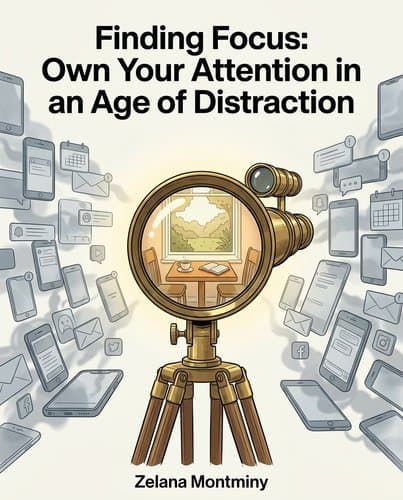
217182348_finding-focus
by Zelana Montminy
Distraction isn't a willpower problem—it's your biology being hijacked by design. Montminy reveals how sleep, exercise timing, and environment redesign can…
In Brief
Finding Focus: Own Your Attention in an Age of Distraction (2025) reframes distraction as a biological system being exploited rather than a personal failure. Drawing on neuroscience and behavioral psychology, it provides practical strategies — from environment design and sleep optimization to habit stacking and time-blocking — that make sustained attention the default rather than the exception.
Key Ideas
Interruptions cost 23 minutes of recovery time
After any interruption — including a single email check — budget at least 20 minutes before expecting to do deep work; the 23-minute recovery cost makes 'quick checks' an expensive habit
Sleep deprivation accumulates undetectably over weeks
Get 7–9 hours of sleep and treat it as cognitive infrastructure: 14 days of sleeping 6 hours or fewer produces the same deficits as two nights of total sleep deprivation, and you won't feel it happening
Exercise opens cognitive window for peak work
Schedule physical activity immediately before your most important cognitive work; the brain's 'cognitive window' opens right after aerobic exercise and closes within hours
Nature restores only when agenda disappears
Spend at least 120 minutes per week in natural environments — it doesn't need to be one long outing; several short park walks accumulate — but leave the agenda behind for the restoration to work
Feeling-based vision filters urgent-seeming requests
Before building a schedule, write a vision statement anchored in how you want to feel rather than what you want to accomplish; this becomes the filter for every 'urgent' request
Separate true importance from time pressure
Apply the urgency matrix: ask whether a task is truly important to your values or just time-pressured, then use the Positive No (Yes! No! Yes?) to protect your priorities without damaging relationships
Design systems replace willpower entirely
Replace willpower with design: use habit stacking (attach new behaviors to existing ones) and temptation bundling (pair things you should do with things you want to do) to make focused behavior the path of least resistance
Phone presence measurably reduces empathy
Limit social media to 30 minutes a day and keep your phone off the table during meals — even a visible, unused phone measurably reduces empathy and trust in conversation
Discomfort signals your curiosity muscle developing
Schedule unstructured thinking time weekly and expect it to feel uncomfortable at first; the discomfort is the signal that your curiosity muscle is being worked
Rest requires disengaging both mind emotion
For genuine rest, choose activities that disengage both cognition and emotion — a walk with no agenda, a power nap, animal interaction — not scrolling, which maintains cognitive load while feeling like a break
Who Should Read This
People working on personal growth in Focus and Neuroscience, especially those tired of generic motivational advice.
Finding Focus: Own Your Attention in an Age of Distraction
By Zelana Montminy
12 min read
Why does it matter? Because the guilt you feel about being distracted is part of the trap.
At a red light, answering a work email, she realized her son had been talking to her the whole time. Zelana Montminy is a psychologist who has spent years watching high-functioning people lose the thread of their own lives, and her argument is both relieving and unsettling: your scattered focus isn't a character flaw to overcome through sheer determination. It's a biological vulnerability being expertly exploited. The fix has less to do with trying harder and everything to do with understanding which levers — sleep, movement, food, environment, habit — actually control the machinery, and learning to pull them yourself.
You're Not Weak — You're Living Inside a System Engineered to Scatter You
Picture a clinical psychologist sitting at a red light, phone in hand, typing out a work email. She finishes, feels the small satisfaction of one more thing crossed off, and only then registers her son's voice — he's been talking to her the whole time. When she turns to look at him, he's staring right at her with a look she recognizes. She'd been running the 'efficient use of a red light' calculation in her head and had completely tuned out the seven-year-old two feet away.
That scene stopped Zelana Montminy cold, and not just because she'd been ignoring her child. She was a psychologist who worked with executives, parents, and students — all of them drowning in the same bone-tired distraction — and here she was, doing the thing she counseled against, modeling it for her son in real time. The guilt was immediate. But this book begins from the premise that the guilt itself is the wrong response, because it points the blame at the wrong place.
Your brain evolved to chase novelty because, for your ancestors, novelty meant survival. That system kept the species alive. What it was never built for was an environment where every email ping and every social media notification is engineered to feel like exactly that kind of survival-relevant signal — designed by teams of behavioral scientists whose explicit job is to trigger your dopamine response before you consciously decide to engage. You are not failing to resist temptation. You are the target of a professionally optimized trap.
And the tax for getting caught in it is steeper than most people realize. Montminy cites research finding that after a single email interruption — just opening and responding, nothing dramatic — it takes an average of twenty-three minutes and fifteen seconds for the brain to fully reorient to the original task. Every 'quick check' quietly borrows against the next half hour of your cognitive life. Multiply that by the dozens of pings a typical day generates and the math stops being about willpower entirely. It becomes a structural problem. Which means the solution isn't trying harder. It's understanding the system well enough to stop letting it run you.
Your Body Is Either Funding Your Focus or Draining It
Focus is less a mental virtue than a biological state — and your body is either building that state or quietly dismantling it around the clock.
Most people treat sleep, food, and exercise as health concerns that operate in a separate lane from cognitive performance. They reach for willpower when attention fades, not realizing that willpower itself runs on biological infrastructure they may have already spent. Zelana Montminy's argument is that these aren't supporting factors — they are the primary levers.
The sleep research makes this uncomfortably concrete. Subjects who stayed awake for seventeen hours showed hand-eye coordination equivalent to someone with a 0.05% blood alcohol concentration. After twenty-four hours, that figure climbed to 0.10% — above the legal U.S. driving limit of 0.08%. The more unsettling finding wasn't the impairment itself. When researchers checked how sleepy participants felt using a standard scale, they reported feeling fine. They were legally too impaired to drive and had no idea. The brain, it turns out, is not a reliable reporter on its own degradation.
The exercise data follows the same logic from a different angle. A high school near Chicago ran an experiment in which struggling readers did aerobic exercise — running at 80 to 90 percent of their maximum heart rate — before their literacy class each morning. By semester's end, those students had improved their reading comprehension by 17 percent, compared to 10.7 percent for students who took standard gym class at a different time of day. When researchers split the class so some students attended literacy immediately after exercise and others attended it several hours later, the early group outperformed the late group by a meaningful margin. The cognitive window opened by movement closes within hours.
The underlying mechanism is a protein called brain-derived neurotrophic factor — neuropsychiatrist John Ratey calls it fertilizer for the brain — which surges during vigorous activity and supports the growth of new neurons, particularly in the regions governing learning and memory. Exercise doesn't just clear your head. It physically remodels the brain's capacity for attention.
The practical implication is less about optimization than reorientation. When focus feels like something you need to summon, the more useful question is whether you've given your biology the conditions to produce it in the first place.
The Environment You Work In Is Shaping What You're Capable of Thinking
The body sets the terms for attention — and so does the environment it moves through. Think of attention as a muscle that contracts under load and needs recovery to contract again. Now ask yourself what you actually do when you hit the wall — when the cursor blinks and the email sits half-written and your brain simply refuses. Most people scroll. They check the news, text someone, swap one screen for another. It feels like stepping back from the work. It isn't.
Montminy draws on a striking body of research to make this distinction concrete. Judges in one study began their day granting parole about 65 percent of the time. As the morning session wore on, that rate fell in a straight line toward zero — not because the cases got worse, but because the judges' cognitive reserves ran down. Then they took a food break. The approval rate snapped immediately back to 65 percent and began its slide again. What looks like a decision-making problem is actually a recovery problem. Rest isn't the reward you get after doing good work. It's the precondition for doing it at all.
The catch is that recovery requires a specific kind of disengagement, and most of what we call downtime doesn't qualify. Scrolling through social media, listening to a friend vent, watching a rapid-cut video — these feel restful because they require no obvious effort. But they still demand that the brain process information, track stimuli, and stay alert. The directed attention system, the part you use to plan, concentrate, and resist distraction, never actually goes offline. Montminy cites research showing that burnout isn't just caused by overwork; it's caused by incomplete recovery during the gaps.
What genuinely works is softer. Psychologists Rachel and Stephen Kaplan found that natural environments engage a different attentional mode entirely — one where your eye follows a branch shifting in wind or light moving across water without any deliberate effort. That effortless engagement gives your directed attention room to quietly replenish. The threshold is lower than you'd expect: 120 minutes per week in natural settings, spread however you like, produces measurable improvements in well-being and cognitive function. The condition is that the time has no agenda. A walk in the park while running a tense phone call through your head bypasses the mechanism entirely. The restoration happens in the absence of striving, not alongside it.
Without a North Star, Algorithms Will Choose Your Life for You
What if you already have a vision — you're just not the one who built it? That's the quieter problem Montminy wants you to sit with. In the absence of a consciously chosen direction, your attention doesn't float freely. It gets claimed. One study of Netflix users found that more than 80 percent of viewing activity is determined by the platform's recommendation engine, not by users' deliberate choices. And when confronted with this, most people shrug and say something like, 'Well, they do know what I like.' That response is the tell. When a curated preference feels indistinguishable from an authentic one, you've lost something important without noticing the loss.
A vision isn't a goals list or a five-year plan. Montminy is specific about this distinction: goals are things to accomplish; vision is about how you want to feel. One of her clients kept returning, unbidden, to a fantasy of dropping everything and moving to Italy. She treated it as an embarrassing daydream, something to suppress and replace with something practical. But when Montminy encouraged her to stay with the image rather than dismiss it, they eventually found what was underneath: a hunger for curiosity, for openness to new people and ideas. That was the real thing Italy had been pointing toward all along. And once she named it, the vision became something she could act on right now, in her actual life — not in some future contingency.
The reason to write that vision down matters too. A goal held only in the mind stays vague; putting it into words and sharing it with someone forces the kind of specificity that survives contact with a busy Thursday. That friction — having to generate the language yourself — is what creates the anchor. On a Monday morning when a new request lands in your inbox and the easier path is obvious, a written vision is already there, competing for the decision. Not a motivational poster. A structural counterweight.
Your Calendar Is Lying to You About What's Important
Busy and productive feel like synonyms, but they operate on opposite logic. Being busy means responding to whatever arrives next. Being productive means protecting what matters from everything that doesn't. Most of us spend our days doing the former while believing we're doing the latter.
Here's what gives the confusion away: the word 'priority' entered English in the 1400s as a singular noun. It meant the one thing that takes precedence — not one of several, not a ranked list, but a single organizing commitment. The plural form didn't appear until the twentieth century, as if we could legislate away the arithmetic. You cannot have five things that all take precedence simultaneously. When everything is priority, nothing is, and the loudest thing in the room wins by default.
The loudest thing is almost always the most urgent — and urgency, it turns out, is a cognitive bias as much as a scheduling reality. In one study, participants consistently chose a lower-paying task with a five-minute deadline over a higher-paying task with a fifty-minute window. The rational choice was obvious. They still took the quick one. The bias was strongest in people who already saw themselves as busy, which means the more frantic your life feels, the more your attention drifts toward trivial speed over meaningful substance, and the more frantic your life becomes. It's a loop that tightens on itself.
Breaking it requires deciding in advance what 'important' actually means to you — not what your inbox has decided, not what a colleague's last email implied was urgent. Montminy suggests mapping your most cognitively demanding work to the natural peaks in your body's 90-minute ultradian cycles, the biological rhythms that shift your brain between focused alertness and lower energy throughout the day. When you feel your concentration slip and an almost physical pull toward distraction, that's not weakness. That's the trough of a cycle, and pushing through it is like driving uphill in the wrong gear. Schedule deep work for the peaks; use the troughs for email, logistics, anything that demands reaction rather than thought.
The final piece is protecting that structure once you've built it. An affordable-housing expert, asked to join a weekly advisory committee she didn't have time for, didn't just decline and leave it there. She led with what she valued, said no to the standing commitment, and offered to attend a single session to share resources instead. Her values were honored. The committee got something real. She kept her week intact. That's not a refusal. That's a priority.
Fractured Attention Is Costing You More Than Productivity — It's Costing You the People You Love
David had been single for years, and it baffled him. Successful, social, clearly capable of warmth — and yet no relationship stuck. His therapist, Zelana Montminy, noticed something during their sessions: he could barely finish a sentence before glancing at his phone. One day she persuaded him to walk outside and keep the device in his pocket. He agreed, reluctantly, and moved through the streets with the slightly lost expression of someone who'd forgotten this was an option. A few weeks later he called her, barely containing himself. He'd stopped at a crosswalk and said hello to a woman standing beside him. Her response: 'Finally. I've stood next to you here for months, but you're always buried in your phone.' They fell in love.
The story is easy to smile at, but the harder version of it is sitting in your own home. Montminy describes a couple who texted and called constantly, who would have told you communication was one of their strengths — and yet both felt chronically misunderstood, undervalued, unseen. Their words were moving back and forth all day without ever landing. When Montminy required them to communicate only in person for a while, using a simple rule — summarize what you just heard before responding — something shifted. The problem was never the quantity of contact. It was that no one had been listening.
Phone-as-distraction framing misses this entirely. We treat divided attention in relationships as a social friction, a minor rudeness, a bad habit to address eventually. What the research suggests is considerably more serious. Brain imaging shows that our hemispheres coordinate less fully during video calls than in person, which is part of why virtual interaction often leaves you strangely depleted after a perfectly pleasant conversation. The longer-term costs compound in ways that show up in tissue: researchers at Brigham Young University found that social isolation carries roughly the same mortality risk as smoking fifteen cigarettes a day, and loneliness correlates with a 26 percent increase in dementia risk over time.
The attention you bring to other people is the relationship itself, accruing or eroding with every exchange. The device in your pocket doesn't just split your focus — it determines, moment by moment, how much of you the people across from you actually get. That same quality of attention, it turns out, is also what makes any kind of creative work possible. Which is where things get interesting.
The Creative Life You Were Born With Was Educated Out of You
You were born a creative genius. That's not a motivational claim — it's what the data shows. In 1968, researcher George Land tested roughly 1,600 four- and five-year-olds for creative thinking and found that 98 percent scored at the genius level. He then followed the same children as they moved through school. By age ten, 30 percent still qualified. By sixteen, 12 percent. When Land administered the same test to more than 200,000 adults, the number had collapsed to 2 percent. The children didn't change. The system they moved through did.
What school rewards is convergent thinking — find the single correct answer, check the box, move on. What it quietly punishes is the opposite: the willingness to generate many possibilities before committing to one, to sit with open questions, to wonder without an immediate destination. By the time most of us reach adulthood, we've absorbed the lesson so completely that we've reclassified our own lost capacity as a personality trait we simply weren't born with. 'I'm just not a creative person' is the scar tissue over a wound that was inflicted, not inherited.
Recovering it starts somewhere most people don't expect: tolerating boredom. In one study, people preferred giving themselves mild electric shocks to sitting alone with their thoughts for ten minutes — that's how thoroughly we've lost access to our own unstructured mental lives. Creativity requires exactly that stillness, the unstructured wandering where your brain makes unexpected connections between things you already know. When every gap in stimulation gets immediately filled with a scroll or a podcast, the creative mind never gets its raw material.
The practical move is almost insultingly simple: schedule time where you're not allowed to be productive. Let your hands unload the dishwasher while your mind goes wherever it wants. Take a walk without earbuds. The discomfort you feel isn't a sign that nothing is happening. It's the atrophied muscle complaining before it learns to move again.
Focus Is a Skill You Build by Changing What Surrounds You, Not by Trying Harder
That reframing comes from psychologist Angela Duckworth's research into self-controlled behavior, and it cuts against almost everything we've absorbed about focus being a matter of grit. Duckworth's team found that the most effective strategy wasn't resisting the pull toward immediate gratification — it was redesigning the situation so the pull weakened. The marshmallow test, a now-famous study in which children were left alone with a single marshmallow and promised a second if they could wait, told us that children who delayed grew into adults with better cognitive performance, financial stability, and stress resilience. What the follow-up research quietly added was this: the children who succeeded weren't the ones who gritted their teeth and stared down the marshmallow. They were the ones who looked away, sang to themselves, or invented a game — anything that changed the structure of the moment so the treat stopped dominating their attention. The skill wasn't resistance. It was architecture.
Montminy builds the whole closing argument of the book on that insight. Habit stacking — attaching a new behavior to something you already do automatically — works because it borrows an existing neural pathway instead of forging a new one from scratch. Once you've got the architecture principle in place, the application almost writes itself: 'I'll spend ten minutes reading before I make my afternoon coffee' costs almost no willpower, because the coffee is already happening. The new behavior rides in on the back of an old one, and over time the two become a single chunk in the brain's habit circuitry. No heroic resolve required.
The practical implication is that the right question isn't 'how do I try harder?' It's 'what would have to be true about my environment for the focused choice to be the easy one?' Your phone in the bathroom instead of on the nightstand. A sketchbook in your bag where your hand used to find your screen. A blocked-out calendar slot that treats deep work as an appointment you wouldn't cancel on someone else.
None of this is passive. Designing the conditions for focus is the work — and it compounds. Each small structural change is a vote for the kind of attention you want to inhabit. Which means reclaiming your focus isn't really about productivity. It's about deciding, in the most concrete terms available to you, who gets to author your days.
The Map You Were Never Given
Montminy was not broken at that red light. She was a capable, caring person operating without a map in a world professionally designed to keep her lost. What the book argues — and what actually lands once you sit with it — is a reclassification of the problem itself. Attention isn't a character trait you either lucked into or didn't. It's a biological resource, subject to the same laws as any other: it can be depleted, protected, restored, and deliberately aimed. Once you see it that way, the question shifts entirely. It's no longer why can't I focus? — a question that leads straight to self-blame — but what have I actually decided to look at? The book closes with a 21-day plan that sequences the changes introduced in each chapter — sleep before scheduling, environment before habit — so the biology is in place before the behavior asks anything of it. That second question still has weight to it. Sit with it for a moment. Then, if you're ready, decide.
Notable Quotes
“They know me better than I know myself!”
“as taking precedence in right, place, or rank.”
“tasks are characterized merely by spurious urgency,”
Frequently Asked Questions
- What is Finding Focus about?
- Finding Focus: Own Your Attention in an Age of Distraction reframes distraction as a biological system being exploited rather than a personal failure. The book draws on neuroscience and behavioral psychology to show how our attention systems are being targeted and undermined. Rather than framing focus problems as individual weaknesses, the author presents distraction as a predictable outcome of biological systems meeting manipulative design. The book then provides practical strategies—from environment design and sleep optimization to habit stacking and time-blocking—that make sustained attention the default rather than the exception. This shifts the focus from willpower to system design.
- What are the key takeaways about sleep in Finding Focus?
- Sleep is critical cognitive infrastructure for focus. The book emphasizes getting 7–9 hours of sleep and warns that "14 days of sleeping 6 hours or fewer produces the same deficits as two nights of total sleep deprivation, and you won't feel it happening." This invisible degradation means most chronically sleep-deprived people don't realize how much their focus suffers. Sleep debt accumulates quickly and impairs attention without obvious awareness. The book treats sleep not as a luxury but as a foundational requirement for sustained concentration, making adequate rest central to the focus strategy rather than something to sacrifice for productivity.
- What practical strategies does the book recommend for improving focus?
- The book provides multiple design-based strategies to replace willpower with system changes. "Replace willpower with design: use habit stacking (attach new behaviors to existing ones) and temptation bundling (pair things you should do with things you want to do) to make focused behavior the path of least resistance." Schedule physical activity immediately before important cognitive work, since the cognitive window opens after aerobic exercise. Environment design, time-blocking, and limiting social media to 30 minutes daily all reduce friction for focus. The author also recommends writing a vision statement anchored in how you want to feel, using it as a filter for requests to protect priorities without damaging relationships.
- How much time does it take to recover from an interruption according to Finding Focus?
- Interruptions are expensive. The book warns that "after any interruption — including a single email check — budget at least 20 minutes before expecting to do deep work; the 23-minute recovery cost makes 'quick checks' an expensive habit." This 23-minute recovery period means that brief interruptions consume far more time than the interruption itself. A five-minute email check actually costs 28 minutes of productivity. Understanding this hidden cost helps explain why multitasking feels productive in the moment but severely damages actual output. The book treats interruption management as central to focus strategy, not a minor productivity hack.
Related Book Summaries
Read the full summary of 217182348_finding-focus on InShort