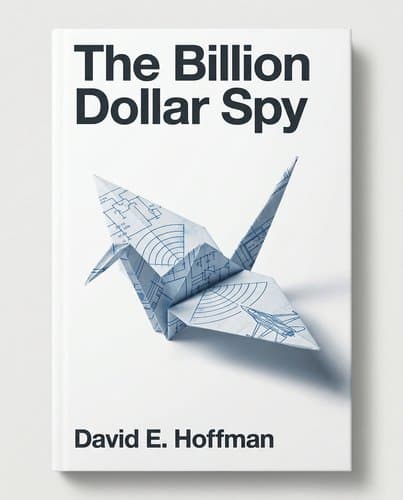
23463183_the-billion-dollar-spy
by David E. Hoffman
A bitter Soviet engineer with a personal vendetta against the KGB became the CIA's most valuable Cold War spy—delivering fighter jet secrets that reshaped the…
In Brief
A bitter Soviet engineer with a personal vendetta against the KGB became the CIA's most valuable Cold War spy—delivering fighter jet secrets that reshaped the air war balance—revealing how one man's conscience, paired with the right handler, outmaneuvered satellites, signals intelligence, and the entire Soviet security apparatus.
Key Ideas
Walk-in persistence overcomes institutional default skepticism
The most valuable intelligence operations often begin with walk-ins the institution initially rejects — Tolkachev approached the CIA five times before anyone listened; the Gerber rules that 'not every volunteer is a dangle' had to be fought for against bureaucratic default to suspicion
Psychology outweighs technology in tradecraft effectiveness
Tradecraft effectiveness depends less on technology than on understanding human psychology: the Jack-in-the-Box worked because the KGB always followed from behind; the brush pass worked because a raincoat draws the eye; the surveillance detection run worked because KGB teams could be lazy and conventional when given no reason for suspicion
Excessive caution paradoxically endangered the operation
Institutional caution and operational security can work against each other — the CIA's refusal to grant Tolkachev the suicide pill he requested damaged the handler-agent relationship at a critical moment and left him feeling disrespected; the same caution that protected the agency nearly ended the operation
Personal relationships essential for operative stability
The transition from personal handler relationships to 'deep cover' bureaucratic process stripped away the human intimacy that kept Tolkachev psychologically stable — his growing isolation in 1983-85 tracked directly with the loss of handlers who knew him as a person
Disgruntled insiders posed greatest operational threat
The greatest threat to the operation came not from Soviet counterintelligence tradecraft but from two fired or disgruntled insiders: the CIA never told the FBI about Howard after dismissing him, and Ames operated for years before detection — a permanent institutional indictment
Intelligence gains divorced from human suffering
Intelligence value and human cost exist on separate ledgers that institutions rarely reconcile: Tolkachev's documents saved an estimated $2 billion in R&D and contributed to a 48-to-zero air combat kill ratio; his wife died making bricks in a Siberian penal colony and the CIA didn't recognize her name when she wrote asking for help
Who Should Read This
History readers interested in World History and Military History who want a deeper understanding of how we got here.
The Billion Dollar Spy
By David E. Hoffman
14 min read
Why does it matter? Because the most important spy of the Cold War was almost never recruited at all.
For decades, the CIA couldn't get a single reliable agent inside the Soviet Union. Not one. The world's most sophisticated intelligence apparatus, and Moscow was essentially a locked room. Then, in January 1977, a Soviet radar engineer started haunting the streets near the American embassy, hunting for diplomatic license plates, pressing handwritten notes into the hands of strangers who mostly ignored him. He wasn't recruited. He wasn't approached. He kept coming back anyway — for eighteen months, through repeated rebuffs and bureaucratic paralysis — because he had decided, alone, that the blueprints in his desk drawer were the most precise instrument of revenge available to him. What he was carrying out of that building, document by document, was the core of Soviet air defense. What drove him there wasn't money or ideology in any simple sense — it was grief, carefully converted into action. This is the story of what one man's private war against a state that had already taken everything from his wife actually cost, and what it bought.
The CIA Couldn't Spy on the Soviet Union — Until an Engineer Decided to Do It for Them
The CIA didn't find Adolf Tolkachev. Tolkachev found the CIA — and spent nearly two years making them take the hint.
For most of the Cold War, running a spy inside Moscow was considered impossible. Richard Helms, who ran the CIA's clandestine operations in the 1950s, compared the prospect to placing agents on Mars. A classified internal review from 1953 admitted flatly that the agency had no reliable intelligence on Kremlin thinking whatsoever. Stalin's security state — informers in every workplace, punishment for unsanctioned contact with foreigners, a secret police hardened by three decades of purges — made standard recruitment a fantasy.
And then Tolkachev tried to volunteer, and the CIA spent eighteen months telling him to go away.
Starting in January 1977, the engineer — a radar specialist at a top-secret military research institute in Moscow — made five separate attempts to hand documents to American diplomats. All were ignored or rebuffed. He prowled streets looking for cars with D-04 license plates identifying embassy staff, often losing his nerve at the last moment out of fear of being seen. When he finally got a letter through in December 1977 describing his access to look-down/shoot-down radar technology — a system that would have neutralized America's entire low-altitude bomber and cruise missile strategy — the defense attaché who reviewed it called it one of the most important intelligence targets in the world. CIA headquarters recommended Option A: do nothing. Director Stansfield Turner agreed.
So Tolkachev tried again. He scratched his home phone number onto a plywood board and stood at a bus stop so a passing CIA car could note the digits. On a dark street in March 1978, he intercepted station chief Hathaway at his car, pressed an eleven-page handwritten letter into his hand — full name, apartment number, work schedule, instructions for calling without detection — said a single word, "Pozhaluista," and vanished.
The operation that followed would become one of the most productive in CIA history. It existed entirely because one man refused to be refused.
The Tradecraft Was a Kind of Genius — Built From Sex Shops, Stage Magicians, and Engine Growls
Two CIA engineers were sent to a sex shop in a seedy Washington neighborhood with instructions to buy inflatable life-sized dolls. The idea was straightforward: when a CIA officer needed to slip out of a moving car undetected, something had to fill the empty seat. The dolls were the obvious solution — until testing revealed they deflated too slowly and were impossible to conceal quickly. The engineers made repeat visits, tried different models, ran into the same problems every time.
Then someone noticed something. KGB surveillance teams in Moscow almost never pulled alongside the cars they were following. They trailed from behind. Which meant the dummy didn't need to be three-dimensional at all — it just needed to look, from a following car's distance and angle, like a head and torso. Illusion only has to work at the viewer's position. The result was a flat, spring-loaded cutout, the Jack-in-the-Box, packed inside a hollow birthday cake and designed to snap upright with a crisp whack the moment a car door swung open. On the night of December 7, 1982, a CIA car carried four people — and, concealed in a cake on the back seat, one paper facsimile of a fifth. The car rounded a corner, the hand brake came up (foot brake avoided; it would have lit the taillights), the passenger door opened, an officer in an old-man mask jumped onto the sidewalk, and the JIB sprang into position. The KGB chase car came around the corner seconds later and counted four figures in the car. It worked.
Cold War tradecraft at its best was the patient exploitation of how attention works. The brush pass — a way of exchanging packages with an agent in the brief seconds of a visual blind spot — was perfected partly by a professional stage magician. When CIA leadership needed convincing, an officer staged a demonstration in a Washington hotel lobby, shaking out a raincoat with one hand while passing a package with the other. The CIA's deputy director watched the whole thing and saw nothing. The technique was approved the following day. On Moscow streets, case officer David Rolph tracked KGB surveillance by sound as much as sight — the V-8 growl of a Volga sedan was distinctive against the four-cylinder traffic, and the KGB's Zhigulis could sometimes be spotted by a triangle of grime on the front grille where the brushes at the KGB car wash reliably missed.
Surveillance can only see from where it stands. Work the angle.
The man those angles were designed to protect was Sergei Motorin — and by the winter of 1982, the question wasn't whether the KGB was watching him, but how long before they closed in.
He Was 'a Dissident at Heart' — But the Real Motivation Was a Murdered Mother-in-Law
But tradecraft explains the how, not the why. For that, you have to go back to December 1937.
On December 10, Sofia Efimovna Bamdas was convicted of belonging to a subversive Trotskyist organization and shot. The charge was that she had visited her father — a Jewish businessman living in Denmark — which was enough. That same evening, Stalin and Molotov approved 3,167 death sentences and went to watch a movie.
Sofia left behind a two-year-old daughter. The girl was sent to a state orphanage, already overflowing with the children of 'enemies of the people.' A nanny named Dunya followed her from institution to institution out of compassion and perhaps fear. The girl's father, Ivan — a newspaper editor who had refused to denounce his wife — was sentenced to a decade in a labor camp north of the Arctic Circle, held without correspondence. He and his daughter weren't reunited until Stalin died, sixteen years after the arrest. He died three years later. The following year, 1957, his daughter Natasha married Adolf Tolkachev.
When Tolkachev told his CIA handler he was 'a dissident at heart,' that was true — but it was shorthand for something more specific and more visceral. His wife had grown up stateless, parentless, erased by a system that murdered her mother for visiting a relative abroad. Natasha became a woman of barely contained fury: the only person in her workplace to vote against the resolution supporting the 1968 Soviet invasion of Czechoslovakia, a circulator of banned Solzhenitsyn manuscripts, someone her colleagues described as constitutionally unable to be insincere. Her ordeal and her hatred became his.
Tolkachev couldn't write dissident pamphlets — his top-secret clearance meant the KGB would liquidate him 'for safety' at the first whisper of suspicion. But the blueprints sitting in his desk drawer at the radar institute were worth more than any pamphlet. His April 1979 letter to the CIA described a twelve-year, seven-stage plan to transfer everything he could access, with the stated goal of damaging the Soviet Union 'to the maximum extent possible.'
The man who spent years circling the American embassy on foot, memorizing license plate numbers, waiting at a gas station for the right moment — he wasn't a mercenary chasing dollars or an idealist seduced by abstract democracy. He was a husband carrying his wife's dead mother with him everywhere he went.
The Billion-Dollar Spy Was Also Just a Father Trying to Get His Son Some Records
Think about what it means to ask your employer for a favor. Now imagine your employer is the CIA, the favor is Western rock records, and you are the most valuable spy in the Cold War. At their first face-to-face meeting in October 1980, case officer David Rolph received twenty-five rolls of film containing Soviet military secrets — and a handwritten list, printed in careful block English letters, of twelve bands: Led Zeppelin, Pink Floyd, Genesis, The Who, The Beatles. Tolkachev explained that his teenage son Oleg shared the passion of his whole generation for Western music, that the records existed in Moscow only on the black market, and that he was personally unwilling to use the black market because 'you can always end up in an unpredictable situation.' The man who walked classified blueprints past Soviet security guards under his overcoat was too cautious to buy contraband albums from a street dealer.
The CIA debated the request with genuine seriousness — could an unexplained stack of Uriah Heep records in a senior defense researcher's apartment raise uncomfortable questions? They bought the cassettes in Eastern Europe so they couldn't be traced back. When Tolkachev also asked for translations of the English lyrics, Rolph filed a cable acknowledging this was an 'unorthodox request' but reported that it had been made in complete earnest. His larger message to headquarters cut through all the institutional hedging: Tolkachev 'has not always been able to provide everything he might like for his son,' and this was his chance to do something for the boy that no ordinary Soviet father could manage. Rolph's position was simple: don't quibble over the music for the billion-dollar spy.
What that cable captures is that Tolkachev's fury at the Soviet system and his love for his son weren't separate things. The same man who laid out a twelve-year plan to destroy Soviet military advantage from within also just wanted his kid to hear the music everyone else was talking about.
The CIA Nearly Killed Its Best Operation Trying to Protect It
By late 1979, Tolkachev had delivered enough material for American experts to conclude he'd saved five years of military research — intelligence that caused the Air Force to reverse direction on a $70 million electronics package. A CIA deputy director, receiving a summary of his latest material, wrote a single word on the routing sheet: 'Fabulous.' Stansfield Turner was simultaneously throttling the operation from Washington.
The clearest case is the suicide pill. Tolkachev had signed out classified documents so far beyond what his current projects required that he knew — and told Guilsher plainly — that if the KGB ever audited the permission sheet, his signature would be the first thing they'd see. He wanted an L-pill not as drama but as logic: if arrested, suicide would prevent the KGB from reconstructing the full scope of what he'd stolen and how he'd done it. The pill protected the operation even in failure. Guilsher and station chief Hathaway both found his reasoning sound and said so directly to headquarters. Turner received the request with a space at the bottom labeled 'APPROVED,' picked up a pen, and wrote 'Not' in front of it. His concern was that L-pills encouraged recklessness — though Tolkachev's recklessness was already manifest, driven entirely by his own fury at the Soviet system, not by any sense of having an escape hatch.
When Guilsher delivered the rejection face-to-face in February 1980, Tolkachev — who had been standing straight and alert — visibly deflated. The cable Guilsher and Gerber sent to headquarters the next morning was unambiguous: the agent had 'suffered a major psychological blow that will adversely affect the future of operation if we do not reverse decision.' They didn't reverse it.
Turner's caution wasn't arbitrary. He'd watched two agents lost in quick succession and imposed a blanket stand-down on all Moscow operations — a freeze so total that a well-placed source the agency had been cultivating for years signaled twice for a dead drop pickup and the station, under orders, did nothing both times. Turner's instinct was to protect the institution from catastrophic failure. The clandestine service's view was that caution carried its own catastrophic cost. Tolkachev, standing crumpled on a Moscow street corner, was the evidence for the second position.
When They Finally Came for Him, He Burned Everything and Held the Suicide Pill Under His Tongue
On the morning of April 27, 1983, after his wife and son left for the day, Tolkachev moved through his Moscow apartment with the focus of a man executing a plan he'd already worked out in his head. The night before, he'd overheard his supervisor relay a call from the KGB's internal security office: a list of everyone with access to the MiG-29 target recognition system — the exact material Tolkachev had handed the CIA six weeks earlier — was to be compiled by end of day. He'd gone home and done the math. If the KGB had his handwritten notes, they needed only to compare them with the handwritten answers on his security clearance form from 1980. A few hours, maybe less. He told his supervisor he wouldn't be in tomorrow and didn't say why.
He loaded everything into his Zhiguli — the Pentax cameras and their clamp, the Discus communications device, the dead drop instructions, stacks of CIA-provided rubles, dissident manuscripts, the shortwave demodulator, and the L-pill concealed inside a fountain pen — and drove fifty miles north out of Moscow to the small village of Doronino, six houses on a country road, where he and his wife kept a dacha. He fired up the iron stove at the center of the house and burned all of it. The rubles, the instructions, the books, the cameras. When the fire cooled, he found that some metal parts from the Discus hadn't burned. On the drive back to Moscow, he threw them out the window into a roadside ditch.
For the next several days, whenever his supervisor summoned him to the office, Tolkachev removed the L-pill capsule from the pen and held it under his tongue. His reasoning was precise: the most likely arrest scenario was that the KGB would grab his hands behind his back the moment he opened the door, before he could reach his pocket. Under the tongue was faster.
No arrest came. And when a CIA analyst later read Tolkachev's detailed account of those days, the analyst identified the thing that had actually frightened him. It wasn't dying. What Tolkachev feared was being caught before he finished — seized mid-operation, mid-damage, the project incomplete. He burned the CIA's equipment not to save his life but to deny the KGB any satisfaction beyond what they'd inevitably get once he was found. The distinction matters. A man afraid of death can be broken or deterred. A man afraid only of being stopped early will do almost anything to keep going.
He had survived every trap the KGB could lay. What he hadn't survived was yet to come.
Two Angry Men Walked Into Soviet Embassies — and Nine Years of Miracles Collapsed in a Traffic Stop
The CIA built the most sophisticated espionage apparatus in Cold War history — and then lost its greatest agent to two disgruntled employees who walked into Soviet embassies in broad daylight, one carrying a photocopy of his CIA badge.
Edward Lee Howard was fired on May 3, 1983, after failing four consecutive polygraph tests. He was escorted out, given a false résumé claiming he'd been a State Department foreign service officer, and told to see a psychiatrist. The agency's own psychiatrist recommended a clean break — no contact, no false hope. Within weeks, Howard was at the Soviet consulate on Phelps Place NW in Washington's Kalorama neighborhood, leaving a note on the receptionist's desk signed 'Alex,' with a photocopied CIA badge enclosed and an offer to sell information for sixty thousand dollars. The CIA, following its habit of keeping its troubles internal, never told the FBI that a trained operative with access to Tolkachev's files had been forced out and was now unraveling.
By the time the CIA finally notified the FBI — in August 1985, after a KGB defector named Vitaly Yurchenko identified a source called ROBERT as a fired Moscow pipeline trainee — Howard had already met twice with Soviet handlers in Vienna and received a hundred thousand dollars. More than two years had passed since his dismissal. A second CIA officer, Aldrich Ames, had also begun selling intelligence to the Soviets in April 1985, weeks before Yurchenko defected, meaning two separate betrayals were converging on Tolkachev simultaneously. The FBI opened a file on Howard, began discreet surveillance, and eventually confronted him in a Santa Fe hotel room. He stonewalled, demanded a lawyer, and walked. Three days later he was in Copenhagen, then Helsinki, then across the Soviet border in a car trunk. He was the first CIA officer ever to defect.
The operational consequence was Tolkachev's arrest on June 9, 1985. Howard had given the KGB enough to identify the approximate source — a spy inside a Soviet aviation and electronics research network — and they had narrowed it to Phazotron, Tolkachev's institute. The KGB had already secretly searched his apartment the weekend before he was seized, finding the L-pill concealed in a fountain pen the CIA had provided. The arrest itself came as a fake traffic checkpoint on a pine-and-birch-lined road: a man in a uniform cape waved down Tolkachev's car, and when Tolkachev stepped out, a second man came from behind, locked an arm around his throat, stuffed a white rag in his mouth, and had three others carry him into a waiting van. Four days later, when the CIA sent case officer Paul Stombaugh to the prearranged meeting site, the KGB was already there waiting — they'd opened Tolkachev's fortochka window as a false signal and parked his car on the street as bait.
CIA headquarters spent weeks trying to figure out what had gone wrong. Analysts drafted cables considering tradecraft errors, laboratory mistakes, missing documents. None of them asked whether someone inside had sold the operation.
The Kill Ratio Was 48-to-Zero. His Wife Died in a Boiler Room.
The accounting is clean: 48-to-zero. In the Gulf War air campaign of 1991, U.S. Air Force pilots shot down 39 enemy aircraft without losing a single plane in air-to-air combat. The kill ratio had gone from 6-to-1 in Korea to 2-to-1 in Vietnam to a number that sounds like a misprint — and the gap between Vietnam and Iraq is partly explained by a lunch-hour spy working by lamplight in a Moscow apartment. Tolkachev had handed the CIA blueprints of the radar systems on every major Soviet fighter of the 1980s: the MiG-23, the MiG-25, the MiG-29, the Su-27. American engineers knew the vulnerabilities before the planes ever flew against American pilots. When Captain Larry Pitts dove after a MiG-25 over Iraq on January 19, 1991 — pulling 12 Gs in a plane rated for 9, the onboard computer screaming a warning he ignored — he was flying a machine whose electronic warfare systems had been tuned precisely to defeat that radar. He had never fired a missile in combat. His fourth try blew the MiG apart. He watched the ejection seat go past his window.
While all of this was being tallied, Natasha Tolkachev was dying in a Moscow boiler room. She had served two years in labor camps, first at a former gulag site southeast of the city, then at a penal colony making bricks. Released in 1987 under a general amnesty, she could no longer work as an engineer and had taken a job monitoring heating equipment. In 1990, stricken with ovarian cancer, she wrote to the American embassy requesting medical help, identifying herself as the wife of the man who had worked, in her phrasing, for the benefit of America and for freedom in their country. The embassy wrote back that they received many such requests. Apparently no one recognized her name. The CIA learned of the letter only years later, from a published account by a family friend.
In 2014, the CIA unveiled a portrait of Tolkachev at its headquarters in Langley, alongside paintings commemorating the agency's greatest operations. A New York artist depicted him at his apartment desk, photographing secret documents under two lamps, a clock reading 12:30 — the end of his lunch hour, the window before anyone expected him back. A senior CIA official described the expression in the painting as fierce determination, intense concentration, and a trace of fear. He had died by execution in October 1986. His wife had died in a boiler room in March 1991. The portrait was hung in 2014. What the agency does with what it owes is a different question than what the intelligence was worth — and those two reckonings don't resolve each other, no matter how clean the kill ratio looks.
What 'For Freedom' Actually Cost
Natasha described her husband's work as done for the benefit of America and for freedom in their country — not for the agency, not for a salary, but for freedom, as though that were a thing she still believed in after everything it had cost her. The embassy staff who received her letter apparently saw no name they recognized. Maybe that's the most honest verdict the institution ever rendered on itself: that the people who spent the most were the last ones anyone thought to find. The portrait went up in 2014. The letter went unanswered in 1990.
Notable Quotes
“I've just walked into a beehive.”
“when you're black, you're black.”
“The man turned around and said clearly,”
Frequently Asked Questions
- What is The Billion Dollar Spy about?
- The Billion Dollar Spy tells the true story of Adolf Tolkachev, a Soviet engineer who secretly provided the CIA with some of the Cold War's most valuable military intelligence. Drawing on declassified documents and firsthand interviews, David Hoffman examines how the operation worked, why it nearly collapsed, and what it reveals about the human dynamics, tradecraft, and institutional failures that define intelligence work. The narrative explores the psychological and organizational factors that made this dangerous espionage operation both effective and fragile.
- What does The Billion Dollar Spy reveal about how intelligence tradecraft actually works?
- Tradecraft effectiveness depends less on technology than on understanding human psychology. Simple techniques like the Jack-in-the-Box worked because the KGB always followed from behind; the brush pass worked because a raincoat draws the eye. However, institutional caution can undermine operations themselves—the CIA's refusal to grant Tolkachev a suicide pill damaged their relationship at a critical moment. Additionally, the transition from personal handler relationships to bureaucratic processes stripped away the human intimacy that kept Tolkachev psychologically stable, ultimately threatening the operation's viability.
- Why was Adolf Tolkachev's intelligence so valuable?
- Tolkachev's documents saved an estimated $2 billion in R&D and contributed to a 48-to-zero air combat kill ratio. As a Soviet engineer with access to advanced military technology, he provided the CIA unprecedented insight into Soviet military capabilities and development programs. His intelligence consisted of some of the Cold War's most valuable military secrets. However, the book reveals that valuable intelligence operations often begin with walk-ins that institutions initially reject—Tolkachev approached the CIA five times before anyone listened.
- What does The Billion Dollar Spy reveal about the human cost of intelligence operations?
- The book illustrates a central contradiction: intelligence value and human cost exist on separate ledgers that institutions rarely reconcile. Tolkachev's intelligence provided billions in defense savings, yet the human price was devastating. His wife died making bricks in a Siberian penal colony after his capture, and the CIA didn't recognize her name when she later wrote asking for help. Furthermore, the greatest threat to the operation came not from Soviet counterintelligence but from disgruntled insiders—the CIA failed to inform the FBI about Howard, and Ames operated undetected for years.
Related Book Summaries



Read the full summary of 23463183_the-billion-dollar-spy on InShort