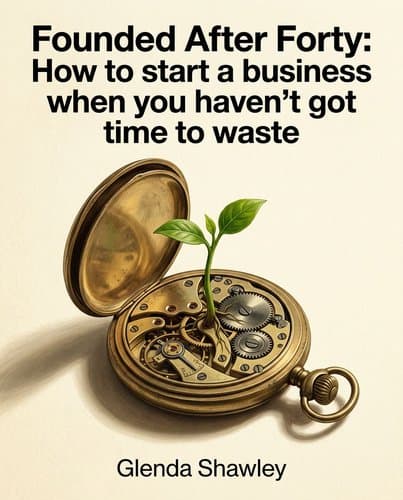
34112535_founded-after-forty
by Glenda Shawley
Experience is your edge, not your excuse. Learn to convert decades of hard-won knowledge into a focused, profitable business—with practical frameworks for…
In Brief
Founded After Forty: How to start a business when you haven't got time to waste (2017) addresses the specific obstacles facing people who come to entrepreneurship later in life — particularly the tendency to mistake experience-earned caution for a reason not to start.
Key Ideas
Your Why Must Attract Customers Specifically
Before finalizing your mission statement, test it against one question: does this give a potential customer a reason to choose me specifically, or does it only give me a reason to start? If you can't answer yes to the first part, it's the wrong 'why' — keep digging.
Find Niche in Supply-Demand Gap
Define your niche by starting with the specific problem you solve, listing every type of person who has that problem, then asking how many of them exist within your local reach and how well their needs are currently served. The gap between demand and existing provision is where you compete.
If Math Fails, Price Too Low
Calculate the exact number of customers you'd need at your current price to hit your income target. If that number feels impossible given your local population or available hours, your price is too low — not your market too small.
Cash Flow Timing Beats Profit Math
Build a cash flow forecast before you build a budget: map not just what you expect to earn and spend, but when the money actually arrives and when it actually leaves. The timing gap is where otherwise profitable businesses die.
Design Your Critical Moments of Truth
Map every touchpoint a customer has with your business from first discovery through to post-purchase, then identify the two or three 'moments of truth' where their entire impression of you is formed — and design those moments deliberately rather than leaving them to chance.
Public Commitment Launches Imperfect Business
Set an actual launch date, write down only the absolute essentials that must be in place before that date, announce it to at least one person who will hold you accountable, and start. Everything else can be built in motion.
Who Should Read This
Business operators, founders, and managers interested in Startups and Business Strategy who want frameworks they can apply this week.
Founded After Forty: How to start a business when you haven't got time to waste
By Glenda Shawley
10 min read
Why does it matter? Because the fears that feel like wisdom at 45 are the last thing standing between you and a business that actually fits your life.
Here's the paradox nobody names directly: the person most qualified to start a business is often the one least likely to start it. Not the 24-year-old with borrowed confidence and nothing to lose — but the 47-year-old who has spent two decades watching organizations run badly, who knows exactly which mistakes drain cash and which hires destroy culture, who has real skills, real networks, and a real reputation. That person often knows too much. Every fear they have is credible, because it's based on something they actually witnessed. The stakes feel genuine because they are genuine. That's Glenda Shawley's argument, and she arrives at it via her own 1992 failure: hard-earned caution isn't a disqualification. It's the material. The person who knows what can go wrong is exactly the right person to build something that won't.
The 'Baggage' You've Spent Decades Accumulating Is the Business
The skills, setbacks, and career detours you've been quietly apologizing for are the raw material of your business — not obstacles to overcome before you can start one.
Monica Castenetto spent a decade in corporate work, then tried to pivot. Garden design, photography, film-making, contemporary dance — none of it stuck. At 42, a brain tumour forced a harder question: what was she actually for? She still didn't have an answer until a chance conversation in which an acquaintance pointed out something obvious from the outside. Psychologists call this the "blind self": qualities so intrinsic to who you are that you stopped noticing them years ago, but plain to anyone watching from outside. What the acquaintance saw was that Monica's breadth across so many different fields made her exceptionally qualified to help others navigate difficulty. She'd never heard the term "life coach." She had to look it up. The credentials she'd been embarrassed by — the corporate years, the failed pivots, the medical crisis — were exactly the preparation.
By midlife you've accumulated professional judgment, field credibility, and a hard-won understanding of what actually goes wrong. From the inside, they look like experience too narrow or too scattered to build a business on. From outside, they look like what a 25-year-old cannot know.
Shawley herself was made redundant from Marks & Spencer in 1991. She'd always wanted to run her own business; the redundancy was the catalyst, not the beginning. The beginning was everything that came before.
The thing you're waiting to outgrow is the business.
Your 'Why' Must Give Customers a Reason to Choose You — Not Just a Reason for You to Start
In 1992, Glenda Shawley had every reason to start a business. She had just taken voluntary redundancy from her management career, her husband's firm was shedding staff, she had a one-year-old daughter, and she was acutely aware of how much her world revolved around the people she loved — and how dangerous that was. The reasoning was clear-eyed: the day would come when her daughter didn't need her. She wanted independence before circumstances forced it. So she started a business, and she drove it hard. She taught retail to English-language students, life skills to young employees, CV writing to job-seekers. She wrote training materials, newsletters, magazine articles. She had as much work as she could handle. She did not have a business.
The failure wasn't motivation. It was direction. Her why (independence, not becoming a financial and emotional burden) was real and it worked on her. But it gave customers nothing to hold onto. No one hires a consultant so that the consultant can achieve independence. People couldn't explain what she did, which meant referrals were scattered. She couldn't explain what she did, which is why she said yes to everything. The why pointed inward, and an inward-facing why is invisible to the market.
The trap runs deepest for people starting businesses after forty. The desire for independence after decades of reporting to someone else is one of the most powerful feelings a person can have. Completely convincing from the inside. But customers buy the reason you exist, not the thing you sell. They buy from the massage therapist whose purpose is freeing people from pain, not because they want a massage. The therapist's personal circumstances don't enter into it.
Jane Hardy's why faced the other direction entirely. Hardy had survived a cardiac arrest (fewer than one in five do) and was made redundant during her recovery. She reframed what had happened: she had lived, and that carried an obligation to give back. She built a networking organisation around helping small business owners succeed. In three years, the membership doubled. People joined because the purpose faced them, not her.
Two jobs. The why has to motivate you through the hard stretches, and it has to give your ideal customer a reason to choose you over someone else. Shawley's 1992 why did the first and left the second entirely undone. Most late starters make the same mistake because the personal motivation, after decades of delay, feels like it ought to be enough.
The Narrower Your Target, the More Customers Can See Themselves in Your Offer
Does restricting who you sell to mean fewer sales? The instinct is to cast wide — the broader the target, the more potential customers. But the opposite is true.
Take the difference between targeting "mothers" and targeting "new mothers with babies under three months old." The first is a niche, but a wide one: the category is too broad for any customer to feel specifically seen. The second is tight. And yet around 700,000 babies are born in the UK each year — the audience isn't thin. Going narrow doesn't mean going broke. A tighter definition makes customers findable and makes your offer recognisable the moment they encounter it.
Shawley calls this the difference between narrow and deep. Both dimensions are independent and both matter. Narrow pins the definition. Deep confirms there are enough people inside it. The new-mothers framing satisfies both: a short, specific window of life, with enough volume to build a business on.
The payoff is practical. When you know exactly who you're serving, you understand the specific problems they want solved — not problems in general, but the pressures of that particular life stage. You know where to find them. You know what language sounds like theirs, not like yours. And if your competitors are targeting broadly, the narrow niche is often uncontested.
The question isn't how many people you're excluding. It's whether the people who remain can immediately see themselves in what you're offering.
Charging Less Is Twice the Work for Exactly the Same Money
Imagine working four extra weeks every year, same hours, same effort, for no additional pay. That's what dropping your hourly rate by 25 percent actually costs.
Shawley runs the numbers explicitly. To earn £50,000 at £100 an hour requires 500 billable hours. At £75, it requires more than 666 — roughly four extra weeks for identical income. But the damage compounds. Assume each customer buys five hours of your time. At £100 you need 100 clients. At £75, you need more than 133. That's 33 extra people to find, onboard, invoice, and follow up with: more marketing spend, more administration, more of every overhead eating into a margin you already cut. A lower rate doesn't reduce the load; it multiplies it in every direction.
The brand signal works the same way. A craftsperson selling a handmade necklace (three hours of work, £30 in materials) for £60 earns under £10 an hour once overheads are counted. But she's also signalling to the premium buyer she's trying to reach that the piece was probably mass-produced somewhere cheap. The underpriced product loses the margin and the customer at the same time.
Most of the founders Shawley interviewed traced early underpricing back to self-doubt, not market research. They convinced themselves customers couldn't pay more, or that a premium price was presumptuous this early. Confidence, Shawley finds, grows with the business, not before it. Which means the period when self-doubt is loudest is also when pricing decisions carry the most weight. A rate set in fear tends to stick, and raising it later turns out to be much harder than setting it right in the first place.
Your Business Can Be Profitable on Paper and Broke in Reality
The call from the supermarket buyer is the call every small business owner dreams about. Twenty-five stores. Three product lines. A minimum of two dozen units per product per store. 1,872 jars to fill, ship, and stock.
Then the founder opens a spreadsheet.
The jars have to be sourced before a single unit can be filled. The raw ingredients have to be purchased. Extra production help has to be hired. All of this money leaves the account immediately, weeks before the first delivery arrives on a supermarket shelf. And then the supermarket holds payment for sixty to ninety days after delivery. The business has just landed its biggest win and has nothing in the account to make payroll.
The gap between profit and cash is where small businesses die while technically succeeding. Profit is an accounting figure: revenue minus costs, calculated once the sale is recognised. Cash is what's in the account today. A business can show healthy margins on every product it sells and still run out of money. For a product business, months can separate the initial outlay from final payment.
A cash flow forecast is how you see this coming: a month-by-month spreadsheet tracking money in and money out, producing a running balance that shows exactly when the account goes thin. A profit-and-loss statement tells you whether the business model works. The forecast tells you whether you survive long enough to find out.
Building one requires honest projections on both sides. On the income side, Shawley describes reviewing a forecast from a retailer whose revenue figures, when reverse-engineered into customer counts, implied every local resident spending £5 in the shop every single day. They were impossible. The test: translate your revenue target into actual customers buying actual things, then ask whether those people actually exist.
The stakes are existential. Build the forecast before the supermarket calls.
Customers Don't Experience Your Service — They Experience Every Moment Around It
Most founders pour their energy into what they deliver and give almost no thought to what surrounds it. The customer doesn't make that distinction.
A few days before arriving at Residence Agnes in Prague, the guest received an email from the hotel manager asking what would make the stay worthwhile. The guest had heard that local taxi drivers overcharged tourists; he mentioned it. The hotel arranged a car from the station and told him exactly what the fare should be. The rooms and breakfast were excellent — but his experience of the entire stay was shaped by that single email, sent before he'd even walked through the door. The touchpoints that shape a customer's impression are often nothing to do with the service itself: whether your phone gets answered, how a booking confirmation reads, what happens when something goes wrong.
The discipline the Prague manager demonstrated is simply asking, at each stage: what does my customer need to know, feel, or experience to take the next step? Maureen Bailey, a curtain-maker, applies this thinking across her whole journey — Facebook photos that show her craftsmanship, home visits with sample books that build trust while letting the prospect compare her against competitors, a quote that specifies every detail. Her message goes beyond aesthetics to heating bills and how well children sleep with blackout linings.
Your core service is necessary. It is not sufficient.
The Research You're Still Doing Is the Last Excuse
At what point does preparation become an excuse? Shawley's answer, having watched would-be founders stall for years, is earlier than most people admit.
The excuses share a structure: more research needed, one more training course, brand identity not yet settled, trading name still unclear, family demands not yet eased. Each is, in part, real — there's always more to learn about your market, and your brand will keep evolving. The problem isn't that the concerns are false. It's that they're infinite, which means they can justify delay indefinitely. Shawley is direct about what that adds up to: the real function of perfectionism is to postpone, not to improve.
The practical remedy is a soft launch — open your doors quietly, trade on a small scale, and let momentum build before you've announced anything loudly enough to make mistakes costly. Errors at small scale are tuition. Errors after a grand announcement are crises.
The deeper remedy is a start date, shared with someone who will hold you to it. Not a target. A date.
And when the doubt persists (when sustained marketing produces no paying clients and the bills don't stop), one of the entrepreneurs Shawley interviewed describes the only move that works: returning to the reason they started. Not for reassurance, but because not continuing felt impossible. "I feel I have NO OTHER WAY but to get through this." That's not stubbornness. It's a reliable sign you're building the right thing.
You Already Know Enough to Begin
Not one of the founders Shawley interviewed had the full picture when they started. Most had the wrong market, the wrong price, or the wrong message — and corrected as they went. Every single one wishes she had begun sooner. Not one would go back. That combination — imperfect start, ongoing correction, no regrets — isn't a coincidence. It's the mechanism. The plan you're still refining wouldn't have survived contact with actual customers anyway. What survives is the willingness to adjust. Luck is something you generate, through work and adaptation, not something that arrives when conditions are finally right. Conditions are never finally right. Pick a date. Tell someone who will ask you about it.
Notable Quotes
“Will this ever generate enough and regular money for me to live on?”
“Only do what only you can do”
Frequently Asked Questions
- What is Founded After Forty about?
- Founded After Forty: How to start a business when you haven't got time to waste (2017) directly addresses obstacles facing people who come to entrepreneurship later in life. It counters the tendency to mistake experience-earned caution for a reason not to start. The book provides practical tools for defining a viable niche, pricing correctly, managing cash flow, and launching decisively, demonstrating how accumulated wisdom becomes an advantage rather than a barrier to successful business creation for mature entrepreneurs.
- How do you define your niche according to Founded After Forty?
- Start with the specific problem you solve, then list every type of person who has that problem. Ask how many of them exist within your local reach and how well their needs are currently served. The gap between demand and existing provision is where you compete. This grounded approach ensures your niche is based on genuine market demand rather than assumptions, helping mature entrepreneurs strategically build a sustainable competitive position by identifying and serving underserved customer segments in their market.
- What approach does Founded After Forty recommend for pricing?
- Calculate the exact number of customers you'd need at your current price to hit your income target. If that number feels impossible given your local population or available hours, your price is too low—not your market too small. This reframes pricing as a strategic business decision grounded in financial targets rather than competitor comparison. For mature entrepreneurs, this approach validates using accumulated judgment to set sustainable revenue expectations that support both business profitability and personal lifestyle goals.
- Why is cash flow forecasting important in Founded After Forty?
- Map not just what you expect to earn and spend, but when the money actually arrives and when it actually leaves. The timing gap is where otherwise profitable businesses die. Build this forecast before creating a formal budget to ensure you understand liquidity constraints and can plan accordingly. For mature entrepreneurs who cannot afford extended startup phases, this approach is critical—it prevents cash flow crises that derail otherwise viable businesses and ensures financial sustainability throughout your venture.
Related Book Summaries
Read the full summary of 34112535_founded-after-forty on InShort