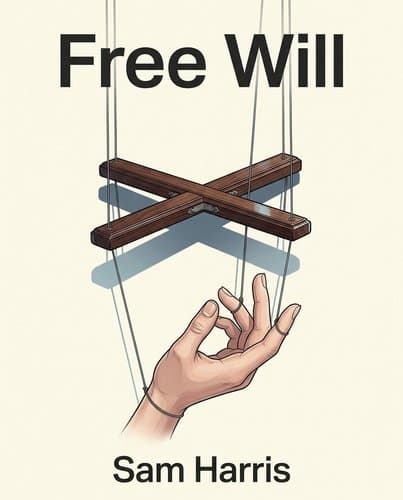
13259270_free-will
by Sam Harris
The moment you feel yourself making a choice, your brain has already made it—so who's actually in charge? Sam Harris dismantles free will with neuroscience and…
In Brief
The moment you feel yourself making a choice, your brain has already made it—so who's actually in charge? Sam Harris dismantles free will with neuroscience and philosophy, then shows how accepting this truth dissolves blame and deepens self-understanding rather than destroying meaning.
Key Ideas
Conscious Choice Arrives After Brain Decides
When you feel yourself deciding, the brain has already decided — the felt moment of choice is a processing delay, not the origin of the action. Noticing this gap is the book's core practice.
Both Compatibilism and Randomness Fail
The two standard escapes from determinism — compatibilism (you're free if you act on your desires) and randomness (quantum indeterminacy opens space for agency) — both fail. Compatibilism doesn't address where desires come from; randomness replaces authorship with accident.
Determinism Does Not Eliminate Causation
Choices are still real causal forces. Determinism is not fatalism: your decision to act is the primary cause of the outcome, even if you didn't originate the decision. Effort and intention matter; they just don't belong to a free author.
Physical Causation Explains All Behavior
When you can see the physical cause of bad behavior on a brain scan, blame evaporates automatically. Harris's argument is that the same physical causation operates in every case — the scan just makes it visible. Extending that response to cases without visible scans is the practical upshot.
Altering Causes Constitutes True Agency
Identifying background causes of your own mental states — low blood sugar, sleep deprivation, a book that arrived at the right moment — is a form of agency. You didn't choose the cause, but you can sometimes alter it. This is what self-understanding actually does.
Retribution Requires False Originating Authorship
Retributive blame — the desire to punish because someone deserved it — requires the person to have been the originating author of their action. Since no one is, the emotional energy of hatred is always aimed at a fiction. Containment and deterrence remain valid; retribution does not.
Who Should Read This
Thoughtful readers interested in Ethics and Neuroscience willing to slow down and wrestle with ideas.
Free Will
By Sam Harris
10 min read
Why does it matter? Because the author of your choices isn't who you think it is.
Right now, you believe you're deciding whether to keep reading. That confidence — the quiet sense of being in the driver's seat — is exactly what this book is going to dismantle. Harris isn't interested in debating whether determinism and freedom can coexist. He thinks that position is a shell game, and he'll show you the hand. What he's building toward is stranger than fatalism and more useful than anything the free will debate has previously produced. Once you see that the self doing the choosing is itself unchosen, blame starts to look like a category error — and compassion stops requiring effort.
Your Brain Already Decided Before You Felt Like Deciding
This morning you wanted coffee. Not tea — coffee. You didn't deliberate for long, maybe not at all. The wanting was just there. And here's where it gets strange: that wanting wasn't something you generated. It arrived.
The feeling of choosing — that sense of weighing options and landing on one — is not the decision. It's the announcement of a decision your brain had already made, handed up to consciousness after the fact.
The neuroscience here is hard to wave away. In a series of fMRI experiments, subjects watched letters cycle on a screen and pressed one of two buttons whenever they felt like it, noting which letter was showing at the moment they decided. Activity in two specific brain regions predicted which button the person would press — reliably, with meaningful accuracy — up to ten full seconds before the subject reported making a choice. Ten seconds is not a rounding error. It's long enough to second-guess yourself, change your mind, and change it back. The whole time you'd feel like you were freely deliberating, the outcome was already written in your neural activity.
The felt moment of deciding is a processing delay. Consciousness receives the result of a computation it had no part in running. You experience the intention as it surfaces — not as it forms.
The voluntary nature of your actions doesn't rescue anything here. There's a real difference between choosing to pick up a magazine and having someone place it in your hands — conscious intention matters, and Harris doesn't deny it. But where the intention itself comes from, what produces it, why coffee and not tea on this particular morning — that part is opaque to you. The intention surfaces; you didn't author it. You are not, in the relevant sense, upstream of your own choices. You are the storm, not the person deciding whether to make it rain.
Compatibilism Is Just Puppetry With Better PR
Compatibilism is philosophy's most successful sleight of hand. It promises to reconcile free will with determinism, and it does — by quietly swapping out the thing you actually cared about.
Here's the compatibilist move: a person is free, they say, when nothing external is forcing them. No gun to your head, no neurological compulsion hijacking your limbs. If you want something and you do it, that's freedom. Desire plus action equals liberty.
Harris asks you to sit with that for a moment. One morning he reached for water instead of juice. He felt entirely at peace with this. No conflict, no coercion, no second-guessing — pure congruence between want and act. By compatibilist standards, this is freedom in its cleanest form. But the thought of juice never entered his head. It simply didn't occur to him. And you cannot freely choose among options that never surface in your mind. The question "why water and not juice?" has an answer buried somewhere in his neural history, his sleep, his habits, whatever his brain was tracking that morning. He had no access to any of it. The choice arrived fully formed.
Compatibilism redefines freedom as "acting on your desires" while staying completely silent about where those desires come from. But that's the whole question. If your desires are produced by prior causes you didn't choose — genetics, upbringing, the particular firing of neurons you weren't consulted about — then calling desire-driven action "free" is just renaming the puppet show.
Harris has a line for this: a puppet is free as long as he loves his strings.
The thing compatibilism abandons while claiming to preserve it is exactly the felt experience that made free will worth arguing about — that sense of being the genuine author of your thoughts, standing upstream of your own choices. It wins the argument by changing what the argument was about.
Randomness Doesn't Save You Either — It Just Makes Things Worse
Imagine someone slips a drug into your morning coffee that triggers a cascade of random neural firing. You reach for a second cup — not because you're tired, not because you love the taste, but because a stochastic chemical event misfired in your brainstem. Would you call that a free choice? You'd probably call it a malfunction. Here's the uncomfortable part: this is exactly the kind of mechanism some scientists propose as the foundation of human freedom.
Biologist Martin Heisenberg, studying fruit fly behavior, observed that certain brain processes — the opening and closing of ion channels, the release of tiny packets of neurotransmitters — occur at random, untriggered by any environmental input. His conclusion was that this randomness makes behavior genuinely 'self-generated,' and therefore free. Harris's response cuts straight through: if your decision to pour that second cup was caused by a random neurotransmitter release, you didn't make that decision any more than you make yourself sneeze. Chance events are precisely the ones you can't take credit for. If anything, they should surprise you — a neurological ambush arriving from nowhere, wearing your name.
Determinism says your choices were locked in by prior causes you never controlled. Randomness says your choices aren't really yours at all — just noise. Both jaws of the same trap. The person hoping quantum indeterminacy might crack open some breathing room has found a trapdoor, not a window.
The fly problem finishes it off. If random quantum events in neural tissue generate genuine agency, then flies — whose neurons operate by the same physics — should have it too. The argument proves too much, which is usually a sign it proves nothing.
Choices Still Matter — Even If No One Is Doing the Choosing
If your choices were already determined before you felt yourself make them, does anything you do actually matter? This is the fear that makes the free will argument feel genuinely dangerous — not just philosophically interesting but personally threatening. If the whole story of your life was written by prior causes you never controlled, then discipline is theater, ambition is decoration, and effort is elaborate confusion.
Harris dismantles this fear, but not gently. The answer isn't that you're free after all. It's that you're asking the wrong question about what makes choices matter.
Your decision to act is the primary cause of what happens next. The effort is the mechanism by which a future gets made. Harris is explicit: if he hadn't chosen to write his book, it wouldn't have written itself. Choices are real causal forces — they produce outcomes that wouldn't otherwise exist. The fact that a choice had prior causes doesn't make it any less the cause of what followed.
The confusion here has a name: fatalism. Determinism is not fatalism. Fatalism says nothing you do makes a difference. Determinism says everything you do was caused — which is a completely different claim, because your doing is part of the causal chain. Sitting back to "just see what happens" is also a choice, with its own downstream consequences, and a surprisingly difficult one to actually sustain. You are not a spectator to your life who happens to narrate it. You are a node through which causes pass, and what comes out the other side depends on what happens at that node.
The cage you feared was always open. The question was never whether you could walk through it. It's that you couldn't have chosen to walk through it one moment before you did.
The Moment You See the Tumor, You Stop Feeling the Hate
Picture a man standing in a courtroom. He killed a woman for no reason that makes any human sense — "just for the fun of it," by his own account. No trauma in his past. No provocation. Good parents, stable childhood, no prior violence. The jury looks at him the way you'd expect: with the clean, unambiguous hatred we reserve for people who seem to have chosen evil from a clear menu of options.
Then an MRI slides back out of a scanner. There's a tumor — roughly the size of a golf ball — sitting in the region of his brain responsible for regulating impulse and emotion. And something strange happens in that courtroom. The hatred drains out of the room. Same man, same act, same dead woman. Now he looks like a victim.
Harris uses this scenario — one of five cases involving a fatal shooting, arranged in order of escalating moral culpability — as a pressure test on our intuitions about blame. In the first four cases, a woman dies at the hands of someone whose brain was shaped by forces ranging from developmental immaturity to childhood abuse to pure psychopathy. In each case, we adjust our outrage based on what we know about the killer's history. Then Case 5 arrives, and we don't just adjust — we collapse entirely. We stop hating him the moment we can point to a physical cause.
Harris's question is why. The tumor made something invisible visible. But the man in Case 4 — no tumor, same killing, same motive — also had a brain doing something unusual. His prefrontal regulation was also, presumably, compromised. His history, his genetics, his neural architecture all converged to produce a man who could kill for amusement. We just couldn't see it on a scan. The scan doesn't change the underlying reality. It changes our willingness to see it.
Everyone on death row got there through some combination of bad genes, bad parents, bad circumstances, and bad ideas. Which of those did they choose? None. They didn't pick their neurology any more than the man with the tumor picked his. The causal chains are less photogenic, but they're equally real. Once you take that seriously, the logic of hating people — as opposed to containing them, treating them, or protecting others from them — starts to dissolve.
This isn't an argument for passivity. Dangerous people need to be separated from the rest of us, and that logic survives the death of free will completely intact. But there's a difference between locking someone away because they're a threat and locking them away because they deserve to suffer. The first is social policy. The second is revenge dressed up as justice, and it rests on a cognitive illusion: the belief that the person in front of you could have been otherwise, if only they'd wanted to be.
Surrendering that illusion isn't losing something. It's what actually seeing another person looks like — tracking the full causal story of how someone became capable of what they did, rather than stopping the inquiry at the point where blame feels satisfying.
Dropping the Illusion Makes You More Compassionate, Not Less Responsible
You're in an argument with your spouse. The mood is sour, the words are sharper than they should be, and you're reading all of it as a genuine conflict of values — this is who we are to each other right now. Then you notice you haven't eaten in six hours. That realization doesn't just explain the irritability; it changes what you can do about it. You go from being someone experiencing a meaningful relational rupture to being someone whose blood sugar dropped — and unlike relational ruptures, low blood sugar has a two-minute fix. Harris's point is that identifying yourself as a biochemical process in that moment isn't degrading. It's the move that hands you a lever.
Tracking background causes expands your range of action rather than collapsing it. When you think your bad mood is just you — your character, your current emotional truth — there's nothing to pull on. When you can see it as a state produced by inputs, you can change the inputs. Harris reports that losing the sense of free will personally increased his capacity for compassion and eroded his feeling of entitlement to whatever success he'd had. Once you really absorb that your own diligence was as much a product of your neurology as your height, contempt for someone whose neurology produced something different becomes hard to sustain.
The political version of this argument is less comfortable than it sounds: if laziness and discipline are both neurological conditions rather than character verdicts, what happens to accountability? Harris doesn't let it dissolve. Research on deterrence consistently shows that the prospect of consequences does change behavior — which means accountability is a real mechanism, not just a moral sentiment. We apply it where it works. Where it doesn't, we adapt the approach. That's not a weakening of the system. It's the system running on better information.
Even Trying to Prove You're Free Proves That You Aren't
Harris performs exactly this experiment in his conclusion — in public, on the page. To demonstrate freedom, he announces he'll write anything he likes. No assigned topic, no demanded words. Absolute latitude. He then drops a rabbit into a sentence. And immediately the demonstration collapses on itself: why a rabbit? Why not an elephant? He has no idea. The rabbit arrived the same way all thoughts arrive — without explanation, without a chooser upstream of it. He tries switching to elephant, which he's free to do. But that choice has the same opaque origin as the first. He can't account for either animal, or for why one feels more right than the other, or for the exact moment the deliberation stops feeling open. His deliberation, the supposed seat of freedom, produces no moment he can point to and say: here, this is where I was actually in charge.
This is the sharpest move in the book. The case against free will is usually made from the outside — neuroscience, determinism, prior causes. Harris makes it from the inside: look directly at what deliberating feels like, and free will isn't hiding in there. We believe we feel free because we haven't looked closely at what we feel. The moment we do, the experience confirms the argument. He captures it in one line: he's free to change his mind, of course — except that he isn't, because his mind can only change him.
What you're left with isn't emptiness — it's a picture of yourself as a process rather than a sovereign, in which thoughts arrive and you are the site of their arrival.
The Stranger Who Has Always Been Making Your Decisions
Here is something worth sitting with. Every flicker of resistance you felt reading this, every moment you thought yes, but — none of that was summoned. It arrived from somewhere you can't locate or reach. The skepticism, the recognition — none of it was summoned. It arrived. Harris isn't trying to take anything from you. He's pointing at what you actually are once you stop insisting on the figure you imagined — the one standing upstream, authoring it all. That figure was always a story the brain told a beat too late. What's left when you drop it isn't a void. It's closer to honesty: thoughts arising, the world moving, and you here in it — without the quiet exhausting fiction that you were ever the one in charge.
Notable Quotes
“If everything is determined, why should I do anything? Why not just sit back and see what happens?”
“just for the fun of it.”
“I don’t know what came over me.”
Frequently Asked Questions
- What is Free Will about?
- Sam Harris's Free Will argues that the experience of authoring your own choices is an illusion. The brain has already decided before you consciously feel yourself deciding—this gap between neural action and conscious awareness is a processing delay, not the origin of choice. Harris then examines what this means for blame, responsibility, and moral judgment. He dismantles both compatibilism (the view that you're free if you act on your desires) and randomness-based defenses (that quantum indeterminacy enables agency). The book concludes that while choices are real causal forces, retributive blame loses its foundation, and moral responsibility must be rebuilt on clearer, non-retributive grounds.
- What does Sam Harris say about blame and moral responsibility?
- According to Harris, retributive blame—punishing someone because they deserved it—requires assuming the person was the originating author of their action. Since no one originates their own thoughts or decisions, the emotional impulse to punish out of retribution is always directed at a fiction. When brain scans reveal the physical cause of bad behavior, blame evaporates automatically; Harris argues this same physical causation operates in every case, whether visible on a scan or not. However, containment and deterrence remain valid responses to harmful behavior. This reframes moral responsibility away from desert and toward practical harm prevention and behavioral change.
- If determinism is true, do your choices still matter?
- No—Harris's argument is explicitly not fatalism. Even if your decision to act wasn't originated by a free author, it remains the primary cause of the outcome. Determinism means your choices were caused by prior events (brain states, genetics, environment), but this doesn't erase their causal power. Your effort and intention matter enormously; they're just not the product of an originating self. When you decide to act, that decision shapes what happens next. The distinction Harris draws is subtle but crucial: your choices are real and causally efficacious, but you didn't originate the decision-making process itself. Recognizing this is actually liberating.
- What does Free Will say about compatibilism?
- Harris rejects compatibilism—the position that you're free if you act on your own desires—as a failed defense. The core problem: compatibilism doesn't address where desires originate. If your desires are determined by factors outside your control (genetics, past experiences, brain chemistry), then acting on them doesn't make you their author. You didn't choose your desires; you enacted them. Harris argues this redefines "free will" rather than defending it. The term becomes meaningless if freedom just means acting without external coercion, regardless of whether you originated the desires driving that action. A genuine defense must explain where authorship begins, and compatibilism cannot.
Related Book Summaries
Read the full summary of 13259270_free-will on InShort