127282631_grief-is-for-people
by Sloane Crosley
Losing someone means losing two people: them, and the version of yourself that only existed inside their orbit. Sloane Crosley dismantles grief's familiar…
In Brief
Losing someone means losing two people: them, and the version of yourself that only existed inside their orbit. Sloane Crosley dismantles grief's familiar platitudes to reveal mourning as a renegotiation with someone whose full complexity only becomes visible once they're gone.
Key Ideas
The self mourned alongside the person
When you lose someone, you lose two people: the person themselves, and the version of yourself that only existed inside that relationship. Naming the second loss is part of mourning.
Grief insomnia is its own phenomenon
Grief insomnia isn't ordinary sleeplessness — it actively argues with platitude. Recognizing it as a distinct state (rather than something to fix with warm milk) is the first step to not being gaslit by it.
Personal grief resists collective story erasure
Collective catastrophe doesn't absorb personal grief — it threatens to erase it. The work of mourning sometimes means insisting on the particularity of your specific loss against the pull of the larger story.
Contradictory qualities coexist in one loss
The qualities you mourn in someone are often inseparable from the qualities that caused harm. Holding both is harder than choosing one, but choosing one is a lie.
Unspoken love still inflicts emotional wounds
Indirect expressions of love — the private bragging, the kept galley, the going door to door — can be as real as the words. But they also place an unfair burden on the person who needed to hear it directly.
Who Should Read This
Readers who connect with first-person stories about Memoir and Resilience and want to see the world through someone else's eyes.
Grief Is for People
By Sloane Crosley
9 min read
Why does it matter? Because the person you grieve isn't the only one who disappears.
Everyone assumes grief is about the missing. The hollow chair, the name you almost text. But Sloane Crosley is interested in a stranger, less nameable loss — the version of yourself that only existed inside one particular friendship, the self who got to be that sharp, that known, that specifically herself. When her mentor and friend Russell Perreault died in the summer of 2019, she lost him. She also lost the person she'd been inside his orbit for seventeen years — the one who earned the dedication page, the diner booth, the bloody tooth dropped on her desk like a challenge. Grief Is for People is what happens when a writer follows that second loss past the wit that deflects it, past the irony that almost protects it, into the place where the only honest thing left is how much it cost.
The World Only Works If You Don't Look Too Closely At It
Picture this: Russell is poking at a male guest's professional history over Sunday breakfast, testing him against Sondheim lyrics while the man blinks himself awake on the porch, having retreated there sometime in the night from the airless room with the yellow wallpaper. Later, Russell will deliver his verdict — keeper, or merely interesting — with either the warmth of a Jewish mother or the frost of a Protestant one. The Connecticut farmhouse, a modest place with peeling paint and fragile plumbing, filled to capacity with Russell's pillboxes and platters and antique gadgets, hosted this scene on a rotating basis for nearly a decade. Weekends dissolved into platters of vegetable terrines, paper lanterns strung over the pond, late-night conversations about Old Hollywood, everyone conked out on wicker furniture. Sloane Crosley had her own room there — yellow wallpaper, banquet hall photos nailed to the walls, a copy of Here at The New Yorker breeding behind her back.
The enchantment was real, but so was the thing baked inside it. Russell's great obsession was the dead: dead Hollywood, dead writers, dead glamour. He ran paperback publicity campaigns for literary estates — Lillian Ross was a cause, Scotty Bowers practically a religion — and he talked about it with the conviction of a manifesto: the dead are more perfect because they're dead, and we owe them our attention before everyone forgets. Crosley would only understand later how that kind of thinking works on a person. Russell didn't call it nihilism. He called it taste.
The farmhouse didn't end with a funeral. It ended with a young man from the South, charming and hungry, who got too close to Russell's partner, then vanished badly, then became the name that must never be spoken. Russell's partner, exercising the rare post-heartbreak option of the geographically voluntary, simply stopped coming into the city. Stopped allowing guests. The kitchen was always being redone. The pool was unavailable. The chicken coop was being torn down. Slowly, over years, the gates closed on everyone. The enchantment didn't shatter. It just ran out.
He Loved You. He Just Couldn't Say It to Your Face.
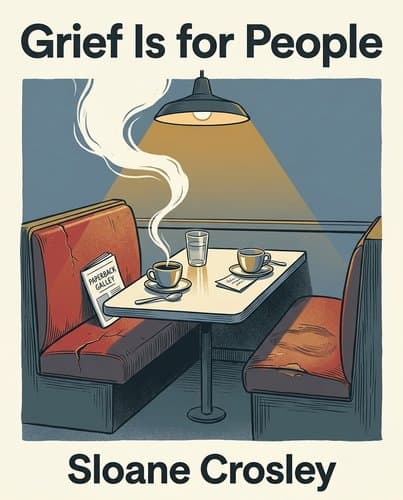
At a diner booth in early 2018, Crosley waited until Russell was seated across from her before sliding over the galley of her new essay collection. She'd timed it deliberately — a booth is a trap, no clean exits. The dedication page read: for Russell. His reaction was something close to anger. He rattled off a list of better candidates, insisted it wasn't too late to change it, and asked, with apparent genuine bafflement, why her. She told him she loved him. He told her she shouldn't have done that. She poured milk into her coffee to stop it from steaming, she writes — "like I wanted to shut it up."
The next morning, he took the galley into the office and went door to door, flipping it open for each colleague as they arrived. Beaming. He kept it at his desk after that, tucked under a note from someone he'd once deemed unfun, available for display as evidence of something he could never quite name out loud.
Russell loved people sideways, in translation, through objects and actions and enthusiasms aimed just slightly away from the person being loved. He told other people he loved Crosley. He showed everyone her dedication. He'd spent years vetting her guests at breakfast, proclaiming them keepers or merely interesting, offering her room as a fixed point in his household. What he couldn't do was receive a direct declaration and return it with one of his own — like the Barbara Pym image: an unsolicited declaration of love lands like a large white rabbit thrust into your arms, and you stand there not knowing what to do with it.
The frustrating thing is that his deflection didn't feel like coldness. It felt like a man whose emotional vocabulary had a missing word, who had worked around the absence for so long that he'd mistaken the workaround for fluency. The kind of person who'd be furious you hadn't asked for an extra towel and then shove you out of a hammock without warning. What he couldn't seem to tolerate was the earnest, the direct, the acknowledged. Earnestness made him uncomfortable in the same way sadness did, which is to say: completely.
Loving someone who can only hold tenderness in his hands when he's showing it to someone else.
A Coup Becomes a Catastrophe on a Single Page-Turn
The James Frey scandal is usually remembered as a publishing industry punchline — the memoir faker, the Oprah dressing-down, the cautionary tale about fact-checkers. What it actually was, for Russell, was the event that made his professional identity illegible to him. And it didn't happen all at once; it happened the way the phone on Crosley's desk lit up on the morning of January 8, 2006, when an eighteen-thousand-word exposé landed on the internet and the calls started coming in every direction at once. A book publicist's phone, she notes, is normally a one-way instrument. That morning it was a switchboard.
Here's what made it specifically corrosive for Russell: he had built an entire professional self around the idea that books deserve better than commerce, that the people behind them are worth knowing, that literary integrity is the one thing publishing trades on when it can't offer anyone a yacht. He'd spent his career escorting Chimamanda Ngozi Adichie and Chinua Achebe across stages, talking obscure books into lecture series. The implicit contract was that he wielded his considerable skills in service of work he could respect. Frey broke that contract without ever acknowledging there was one. He called the office to find out if people were still talking about him. He sent his dental X-rays as proof of nothing in particular. When the Oprah confrontation aired and Crosley texted Russell to ask how he was holding up, he replied: I hate everyone.
The image that crystallizes it is this: sometime after the broadcast, the office started receiving mail. Some envelopes contained white powder, which turned out to be baby powder — this was the early aughts, still inside the radius of the anthrax scares. Russell picked up one such envelope and rushed past Crosley's office with it pinched at arm's length. Then a bloody tooth arrived. He fished it out with a tissue, dropped it on her desk like he was spinning a top, and asked if she thought it was real. The answer didn't matter. What mattered was that this was now the job — sifting through the debris of someone else's bad faith, handling objects a reasonable person shouldn't have to handle, being publicly implicated in a moral failure that had nothing to do with your values and everything to do with your proximity. You can't explain your way out of that without confessing your own powerlessness, and a man whose professional identity depended on his capacity to shape things had just discovered a hard limit on that capacity.
The Same Quality That Made Him Brilliant Made Him a Liability
The HR complaint arrived forty-eight hours after Crosley left the company. It named her directly — there she was in subsection C, her full name and former job title, attached to the incident where Russell called her a 'toothless hooker' for declining to get coffee with him. She confirmed it: yes, he had said that. He said it constantly, to everyone — the assistant whose cardigan he declared looked like she'd walked into Talbots demanding the sluttiest item in the store, the colleague he accused of dressing like a flight attendant on a provincial airline, Crosley herself, asked a hundred times whether she'd gotten dressed in the dark. This was not a department malfunction. It was a personality.
Crosley knows this, and it's what makes the section so hard to settle into. The same man who showed up Monday mornings with cartons of fresh eggs, who wordlessly reached chocolates from grateful authors over cubicle walls, who memorized the right Sondheim lyric for any crisis — that man and the one who said 'toothless hooker' were not two people in tension with each other. They were the same expression of the same thing: an allergy to emotional directness so complete that all his warmth came out sideways, through gesture, through wit, through the particular intimacy of a well-aimed insult that says I see you precisely because it never says I love you. The cruelty wasn't incidental to the tenderness. It was its idiom.
What his accusers experienced as hostility, Crosley had learned to read as fluency in a language Russell had invented for himself. The tragedy isn't that they failed to appreciate him. It's that the translation was always going to be lossy, and he never looked for a better one.
Private Grief Doesn't Care About Collective Catastrophe
Think of grief as a missing person: specific, irreplaceable, with a particular face you keep turning toward in crowds. Now imagine that missing person disappears into a disaster zone — a city on fire, bodies everywhere, the whole world accounting for its dead.
This is what the pandemic did to Crosley's grief for Russell. When New York locked down in March 2020, roughly eight months after his suicide, the collective catastrophe didn't absorb her loss — it threatened to overwrite it. She describes grief insomnia as a presence with opinions: not the apologetic kind that knows you have a big day tomorrow, but the kind that announces, flatly, that time doesn't heal wounds, that whoever promised you that owes you a refund. The city was producing that same insomnia at scale, and the danger was obvious. Her specific, named, unrepeatable loss — this man, this friendship, this particular absence — risked being laundered into the general horror, becoming one dead snowflake in a blizzard, interchangeable with all the others.
She refuses. Near the end of those twelve sleepless days, she walks to Grand Central at 6:45 in the morning. A single attendant pushes a broom across the main concourse. A woman in a turban sprints for a train — the first person Crosley has seen run somewhere in months, a small shock, since running for health and running to catch something are entirely different acts. She boards an empty train parked on the track and fills each seat with a specific person from her life: the dry cleaner, the cellist, the man from the bar, the detective. When only one seat remains, Russell takes it. She tells him the city isn't the same without him. She asks why he didn't tell her how unhappy he was. She rests her head on his shoulder and says she's tired. The conversation is brief and goes nowhere, which is exactly right — grief hallucinations don't resolve, they just visit. But the insistence matters. This is not the pandemic's Russell, absorbed into collective catastrophe and made representative of a generation of losses. This is her Russell, on a specific train, with his leather messenger bag and his particular smell.
The Joke That Became the Contract He Broke
The most devastating document in this book is a text message. In the summer of 2018, when a freelance publicist named Jeanine Pepler died by suicide, Crosley reached out to Russell from a plane about to take off. He responded with what read, at the time, like a dark joke between two people who'd earned the right to make it: no killing yourself without my approval first, and I'll do the same. She agreed. He agreed. They decided, in the register of their friendship — which had always traded in the oblique, the wisecracking, the tenderness disguised as a dare — that they had a pact.
Crosley finds this exchange while lying awake during the pandemic, scrolling back through her phone in the middle of a grief-insomnia night. The joke had already been broken for eight months by then. Russell was gone, and she was reading the evidence that he'd understood, when he made the promise, exactly what it would mean to her if he violated it. That's the thing the text reveals: he knew. He knew her well enough to frame it in the language she'd actually hear — not a solemn vow, but a negotiation, complete with the offer to hear her argument before approving anything. He'd spent years reading her dedications out loud, vetting her guests over breakfast, translating his affection into every available medium except the direct one. He knew what would reach her. And then he didn't call.
The Approval He Never Asked For
The text exchange is the book's last locked door, and what's on the other side isn't betrayal — it's fluency. Russell wrote the pact in the only language Crosley would actually receive: oblique, contractual, darkly funny, impossible to mistake for sincerity and therefore sincere. He knew the translation. He'd spent two decades learning it. Which means his absence wasn't a failure of communication — it was communication, of the most unbearable kind. And then you remember the galley he kept on his desk, the one she'd sent him years earlier with her notes still in the margins. He never mentioned it. He just kept it there. That reads differently now — less like sentiment, more like the same idiom, the same refusal to say the thing directly and the same insistence on saying it anyway. You can't grieve that cleanly. You have to love him through it, which is the cruelest possible ask, and also the most intimate thing he ever said to her.
Notable Quotes
“something like a large white rabbit thrust into your arms and not knowing what to do with it.”
“Don’t get a big head,”
“But I didn’t do anything.”
Frequently Asked Questions
- What does Grief Is for People reveal about the losses we experience when someone dies?
- When you lose someone, you lose two people: the person themselves, and the version of yourself that only existed inside that relationship. This is a central insight in Sloane Crosley's Grief Is for People. Naming this second loss is part of genuine mourning, as it acknowledges that relationships fundamentally shape who we are. Crosley emphasizes how grief involves recognizing not just the absence of the other person, but the disappearance of a version of yourself that can no longer exist. This dual loss framework helps readers understand the profound existential impact of mourning and validates the disorientation many feel after losing someone close.
- What does Sloane Crosley reveal about grief insomnia in her book?
- Grief insomnia, according to Sloane Crosley's book, isn't ordinary sleeplessness — it actively argues with platitude. Recognizing it as a distinct state (rather than something to fix with warm milk) is the first step to not being gaslit by it. This distinction is crucial for those grieving, as it validates their experience and prevents them from dismissing their insomnia as a common sleep problem. By naming grief insomnia as its own phenomenon, readers can honor the uniqueness of their mourning and resist normalizing their grief into something manageable or fixable through conventional remedies.
- How does Grief Is for People address the relationship between personal grief and collective tragedy?
- According to Crosley, collective catastrophe doesn't absorb personal grief — it threatens to erase it. The work of mourning sometimes means insisting on the particularity of your specific loss against the pull of the larger story. This insight acknowledges that when major tragedies occur, individual griefs can become subsumed within larger narratives. Crosley emphasizes that honoring your unique loss and the specific person you've lost is not selfish but necessary work of grief. Maintaining the distinctiveness of your experience protects against losing both the person and the context of your specific relationship to them.
- What does Grief Is for People say about holding contradictions when mourning?
- According to Crosley, the qualities you mourn in someone are often inseparable from the qualities that caused harm. Holding both is harder than choosing one, but choosing one is a lie. This reflects the complexity of mourning complicated relationships where love and hurt coexist. Rather than compartmentalizing the good and bad in a person, Crosley argues for the emotional maturity required to sit with contradiction. This approach validates real human relationships, which are rarely purely good or bad, and honors the genuine experience of those who loved someone complex, flawed, or even harmful.
Related Book Summaries
Read the full summary of 127282631_grief-is-for-people on InShort