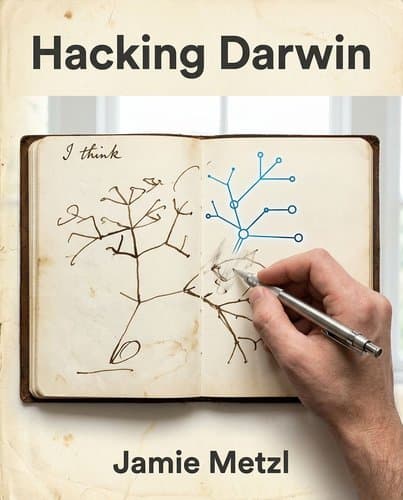
40597264_hacking-darwin
by Jamie Metzl
Biological chance is quietly being phased out—not by government mandate, but by millions of individual reproductive decisions already happening in fertility…
In Brief
Biological chance is quietly being phased out—not by government mandate, but by millions of individual reproductive decisions already happening in fertility clinics worldwide. Metzl maps how CRISPR edits, polygenic selection, and national competitive pressure are converging on a timeline that outpaces humanity's capacity to govern them.
Key Ideas
Disease screening to trait selection: technical progression
Embryo selection using IVF and preimplantation genetic testing is already widespread clinical practice. The step from screening for single-gene diseases to selecting for complex polygenic traits like longevity or IQ is technical, not categorical — the same tools, extended by scale and data.
CRISPR already editing human embryos clinically
CRISPR-Cas9, discovered from bacteria's immune memory system in yogurt cultures, can now edit any strand of DNA with growing precision. Viable human embryos were successfully edited in 2017; the UK has already licensed heritable mitochondrial transfer, meaning genetic changes that pass to all future generations are already happening in clinics.
Stated values diverge from actual reproductive choices
The gap between stated moral values and actual reproductive behavior — only 20% of Americans call Down syndrome termination acceptable in polls, but 67% actually terminate after a positive diagnosis — is the book's best predictor that broad genetic selection will expand quietly, through individual choices rather than collective mandates.
Competitive pressure systematically overrides ethical restraint
Competitive pressure in sports, education, and national security has historically overridden ethical restraint. China already mandates genome sequencing for Olympic hopefuls, and the structural logic of any country attempting a unilateral ban on enhancement leads, by Metzl's analysis, to either authoritarian enforcement or eventual capitulation.
Voluntary choices recreate eugenics without coercion
Aggregate individual reproductive choices — market-driven selection toward culturally preferred traits — can produce population-level genetic homogenization without any law or state directive, recreating eugenics' effects while eliminating its coercion. The corn blight analogy: genetic uniformity is catastrophic vulnerability.
Governance window narrowing as technology spreads
A governance framework for dangerous dual-use technologies is possible — the Nuclear Non-Proliferation Treaty is the model — but it requires building international consensus before competitive pressure makes the race self-sustaining. That window is open and narrowing as genetic tools become cheap enough for garage labs.
Who Should Read This
Science-curious readers interested in Biology and Evolution who want to go beyond the headlines.
Hacking Darwin
By Jamie Metzl
11 min read
Why does it matter? Because the tools to redesign humanity already exist — and the race has quietly begun.
You probably think of genetic engineering the way most people think of nuclear fusion — real science, coming someday, not your problem yet. Jamie Metzl's first move in Hacking Darwin is to collapse that comfortable distance. The tools to rewrite human DNA aren't in development. They exist. IVF clinics are already selecting embryos. CRISPR is already editing viable human embryos in research labs. Countries are already sequencing their populations at scale, convinced that whoever maps the genetics of intelligence first will own the next century. The arms race isn't coming — it started. What's still unresolved is whether anything resembling collective human judgment can possibly keep pace with the competitive instincts that have driven every prior technological race, from nuclear weapons to social media, straight past the guardrails.
The Genetic Revolution Already Has All Its Tools — Only Timing Remains
In 1865, Jules Verne imagined three men launched to the moon inside a cannon-fired projectile. It was wonderful fiction. Not a single technology required for actual space travel yet existed. Nearly a century later, John F. Kennedy walked to a podium in Houston and announced that Americans would land on the moon before the decade ended. The speech sounded like ambition, but it was really engineering. Rockets capable of escaping Earth's gravity existed. Heat shields existed. Guidance computers existed. Kennedy was reading the present and announcing the obvious conclusion. Seven years later, Neil Armstrong climbed down the ladder.
His central claim is uncomfortable in its simplicity: for the genetic revolution, we are living in 1962, not 1865. The standard assumption is that rewriting the human genome belongs to some exciting or alarming future, safely distant. The tools are already in hand.
In vitro fertilization has been clinical practice since 1978. Preimplantation genetic testing (extracting and sequencing cells from embryos before implantation) already screens for thousands of single-gene diseases in fertility clinics. In 2017, researchers at Oregon Health and Science University edited human embryos carrying a mutation linked to sudden cardiac failure using CRISPR-Cas9, a molecular scissor derived from bacteria's own ancient immune system; 72% of the resulting embryos came out disease-free. The edit happened. The embryos were destroyed after three days, but the capability had been established. Separately, scientists have converted ordinary blood or skin cells into stem cells and then into functional egg cells in mice — a step that, applied to humans, would let prospective parents generate hundreds of embryos for genetic selection rather than the fifteen or so available through conventional IVF.
Each of these is a demonstrated result. What remains open is what remained open after 1962: not whether, but when — and, more urgently, which values humanity brings to tools it already holds.
We've Been Selecting Against Genetic Traits for Decades — We Just Called It Something Else
The idea that genetic selection is a looming ethical frontier sounds more credible if you've never heard of Tay-Sachs. In the 1960s, the disease killed hundreds of Jewish children every year — a single mutated gene destroying the nervous system by age two, taking most victims before five. After researchers identified the causative enzyme in 1969, Jewish communities didn't wait for bioethics committees. Synagogues held screening drives. Orthodox matchmakers began steering marriage candidates away from carrier pairs. The goal was explicit: screen the disease out of the next generation. It worked. Tay-Sachs barely registers among Jewish populations today, and the campaign is remembered as a public health triumph — voluntary, population-scale genetic selection, celebrated as a miracle.
The Down syndrome numbers add a harder edge. Only 20 percent of Americans tell pollsters that termination after a Down syndrome diagnosis is morally acceptable. But 67 percent who actually receive that diagnosis terminate. Abstract ethics and the weight of a real pregnancy are different moral experiences. Parents are already making genetic selection decisions at massive scale; they experience them as private, agonizing choices, not as a program.
Metzl's point is blunt: the discomfort people express about genetic selection evaporates when the stakes become personal. That debate has been settled in practice, through synagogue drives and fertility clinic consultations, not through philosophy. The real question is what happens when the tools can select for far more than the diseases we already agree to screen out.
The Starbucks Menu Problem: When Choosing Your Child's Personality Feels Unavoidable
The fertility clinic smells faintly of roses now — soft pastels where antiseptic white used to be, a cappuccino offered before the consultation begins. Ten years ago you came here to screen embryos for catastrophic single-gene diseases. That felt like a straightforward kindness. Today the menu has expanded.
The first new option is easy: longevity, selecting the embryo with the strongest genetic odds against age-related disease. You sign. Height is next; a few extra inches tend to track with higher income and self-esteem. You sign again, feeling faintly guilty, then deciding not to. Then the doctor mentions IQ. She describes a massive Scottish study (every eleven-year-old in the country was tested on a single day in the 1930s, then tracked for six decades) that found higher scores predicted longer lives even after controlling for social class. Around 70% of IQ variance is genetic, she adds. You squeeze the stylus.
"Will my child be happier with a higher IQ?"
"No one really knows," she says.
You sign.
Then she mentions personality. The Big Five: extroversion, neuroticism, openness, conscientiousness, agreeableness. Genetics, she explains, is probably the largest single contributor to where a person lands on each spectrum. Gene variants tied to extraversion and neuroticism have already been mapped across hundreds of thousands of genomes. She isn't selling you anything. She's just presenting options. You think of your sister, who lights up every room. You think of your neighbor, who yesterday kicked his malfunctioning lawn robot. You could, to some degree, steer toward one and away from the other.
Something buckles. This feels different, not like preventing disease but like placing a custom order, specifying every variable down the line. You tell the doctor it feels like designing a child off a menu. "I'm not here to convince you," she says. "I'm just explaining your options."
That's the trap. Every step followed logically from the one before. Preventing a fatal disease is obviously right. Longevity is the disease argument extended. Height? All these embryos are your natural children already; choosing a taller one is the same as not choosing a shorter one. IQ carries real discomfort, but you can't rule out that the traits you actually care about (creativity, compassion, depth) might correlate positively with it anyway. And personality: well, you're already selecting everything else. The door that seemed sealed when you arrived — "I would never design my child" — is standing wide open, and you crossed the threshold one signature at a time.
The reason you can't dismiss this as science fiction is the science already underneath it. A 2015 analysis of roughly 2,750 twin studies across fourteen million pairs in 39 countries found that average heritability across all measured traits sits at about 49%. Half of who we are arrives encoded. Computational geneticist Stephen Hsu used 500,000 genomes from the UK Biobank to predict height from DNA alone, accurate to within an inch. Height today, IQ tomorrow. The fertility clinic of 2035 isn't speculative fiction. It's a waiting room that already exists in embryonic form.
The stylus is still in your hand. You still haven't decided.
Every Society That Has Tried to Opt Out of a Technological Arms Race Has Eventually Failed
Now take that same logic out of the clinic and into the world where those children eventually compete.
Eero Mäntyranta won seven Olympic medals on skis across the 1960s and early 1970s, and when researchers sequenced his genome in the early 1990s, they found a rare mutation in a gene called EPOR that caused his body to produce hemoglobin at rates far above normal. His blood carried oxygen the way other athletes' couldn't. Twenty-nine relatives shared the same mutation. Not all became champions, but the genetic deck was stacked from birth.
Then consider Lance Armstrong, stripped of his Tour de France titles for doing something chemically similar: artificially boosting his hemoglobin to capture the same endurance edge Mäntyranta had naturally. Once you know both stories, the word "cheating" starts to dissolve. Mäntyranta's advantage was genetic luck. Armstrong replicated it through a needle. The outcome was biologically identical. Metzl calls what Armstrong did "Mäntyranta-ing himself" — the label is deliberately uncomfortable, because it reveals that sporting fairness becomes philosophically incoherent the moment we can see what's actually happening in the genome.
The harder argument comes when you scale this logic from sport to nations. Imagine your country bans genetic enhancement entirely, a principled stand widely popular. That choice immediately demands a second one: keeping enhanced people out. Genetic tests at the border. Pregnancy screening for women of fertile age. Prenatal sequencing of every embryo entering the country. Then you must decide what to do when an edited one is detected. Strip citizenship? Jail the mother? Force termination? Follow the ban to its conclusion: enforcing genetic purity requires the full machinery of a totalitarian police state, built and operated by the same citizens whose values drove the ban.
So the country faces three options. Accept permanent competitive decline in health, athletics, cognition, and military capacity, and run the police apparatus you despise. Hold the line until the pressure cracks it (talented people emigrating for enhancement services, soldiers outmatched, parents quietly changing their minds) and eventually call a referendum you lose. Or try to build an international treaty compelling everyone to stop, which may ultimately require threatening military force against nations that refuse. In the twentieth century, roughly 170 countries were invaded by others. Metzl asks whether an invasion to protect the human genetic code would really be so different from the invasions already on that list.
The structure is the same as the nuclear race, the space race, the AI race: competitive pressure doesn't honor principled abstention. The country that opts out doesn't stop the race. It just falls behind in it.
Individual Reproductive Choice, Multiplied by Millions, Becomes Eugenics Without a Law
Is it still eugenics if nobody ordered it?
That's the question Metzl most wants you to sit with. The standard defense of reproductive choice goes like this: historical eugenics was coercive — Indiana's 1907 forced sterilization law, Oliver Wendell Holmes writing "three generations of imbeciles are enough" to uphold it, the Nazi Law for the Prevention of Hereditary Defective Offspring modeled partly on California's statute, Joseph Mengele trained under Otmar von Verschuer, the Frankfurt eugenicist whose program informed the Nazi law. All of that horror was state-directed. Today's embryo selection happens in private clinics, paid for by individuals, guided only by their own values. There's no law. There's no Holmes. The two things can't be the same.
Except the aggregate might be.
A 2018 study reviewed donor choices made by 154 women at a Queensland sperm bank. The pattern: women overwhelmingly selected educated, introverted, analytical donors over extroverted, less methodical alternatives. No coordinator told them to. No policy shaped the outcome. Each chose independently, and every choice pointed the same direction. Scale that across every fertility clinic in every country for thirty years, and the traits a culture values in one generation start disappearing toward the tail of the distribution in the next.
Metzl's sharpest warning isn't that this is unjust. It's that it's dangerous. For eight thousand years, farmers selectively bred corn for yield and ease of cultivation. The resulting crop was productive, uniform, and catastrophically fragile. When a blight arrived that conventional corn had no resistance to, vast harvests failed overnight. Wild chickens and their genetic chaos survived pathogens that decimated domestic breeds. Diversity isn't sentimentality. It's the species' insurance policy against threats it hasn't encountered yet.
The same logic applies to us. A gene variant associated with autism also appears to correlate with mathematical and pattern-recognition abilities. A gene linked to bipolar disorder shows up in disproportionate numbers among creative artists. We don't know which traits filtered out by well-meaning parents might turn out to be exactly what their grandchildren's world requires. Evolution isn't an optimizer — it's a gambler, keeping a range of bets because no one knows which number comes up next.
So the question at the top has no clean answer. Individual reproductive choice really is different from state coercion. That moral distinction matters. And millions of individual choices, shaped by identical cultural biases, can produce population-level effects that no law would dare mandate.
A $1,000 Garage Lab Can Now Edit Genomes — and No Global Rules Yet Exist
By the time Metzl was writing, the lab had moved into the neighborhood. More than fifty community biology spaces operated across the United States; sixty in Europe, twenty-two in Asia. In 2018, a team at the University of Alberta reconstructed horsepox (a dangerous relative of smallpox) from DNA fragments for roughly $100,000, a task that would have been prohibitively expensive just years before. The U.S. intelligence community noticed: in 2016, gene editing appeared on the official list of potential weapons of mass destruction for the first time. James Clapper, then director of national intelligence, wrote that research conducted under different ethical standards "probably increases the risk of the creation of potentially harmful biological agents."
The governing analogy Metzl reaches for is nuclear. The Non-Proliferation Treaty offered non-nuclear states help developing civilian nuclear energy in exchange for forswearing weapons — imperfect, but the world is measurably safer for it.
Previous genetic governance attempts haven't held. The 1997 UNESCO Universal Declaration on the Human Genome and Human Rights was non-binding and bypassed by the countries doing the most consequential research. When He Jiankui announced in 2018 that he'd edited the genomes of twin embryos using CRISPR, international condemnation was swift and then dissolved. No enforcement body existed; no treaty was violated. He went to prison under Chinese law — the ceiling of consequences. Every effort shared the same two flaws: non-binding language, and frameworks built without the countries most invested in doing the science.
What Metzl proposes is different in structure. First, every country builds its own bioethics commission with actual enforcement authority. The UK's Human Fertilisation and Embryology Authority is the clearest existing model: in operation since 1991, it licenses and enforces rules on embryo research and fertility treatment and has kept real teeth despite repeated political pressure. National bodies are achievable because they don't require sovereignty concessions. Second, those bodies feed into a UN-connected global dialogue that offers something concrete in exchange for compliance: shared access to genetic health benefits, the same bargain the NPT made with civilian nuclear technology. Previous frameworks asked countries to constrain themselves with nothing in return. That's why they dissolved when tested.
The window is open. It won't stay that way. The conversation Metzl is calling for doesn't happen in international forums unless it has first happened in classrooms, kitchens, and wherever you're reading this.
The Species Is Already Voting — Whether You're in the Room or Not
The genetic future will not wait for consensus. Nation-states are already sequencing athletes and funding germline research. Fertility markets keep expanding what's selectable. Individual parents are making choices that, multiplied across generations, amount to a design program no one voted for. The decision is being made — by whoever moves first, in whatever direction their incentives point.
What's missing isn't the science. It isn't even the ethical instinct; most people, told the full picture, know something important is at stake here. What's missing is the deliberate, informed, cross-border conversation that could set conditions before the race becomes self-sustaining. The tools, the history, the competitive logic — you've just met all of them. The question is whether you show up to that conversation before others write the terms without you — or arrive later to find the terms already written.
Notable Quotes
“Raise your hand if you are thinking of having a child more than ten years from now,”
“If your hand is in the air and you are a woman, you should probably freeze your eggs. If your hand is up and you are a man, I encourage you to freeze your sperm as soon as possible.”
“No matter how young and fertile you are,”
Frequently Asked Questions
- What is Hacking Darwin about?
- Hacking Darwin examines how advances in genomics, IVF, and gene editing are ending biological chance as the default of human reproduction. It maps the technical and ethical trajectory from embryo screening to heritable genetic enhancement, equipping readers to understand the competitive pressures, governance challenges, and individual choices that will shape the future of our species. The book argues that embryo selection is already widespread clinical practice, and the step from screening single-gene diseases to selecting complex polygenic traits like longevity or IQ is technical, not categorical—the same tools extended by scale and data.
- What are the main technologies for genetic editing and selection discussed in Hacking Darwin?
- Embryo selection using IVF and preimplantation genetic testing is already widespread clinical practice. CRISPR-Cas9, discovered from bacteria's immune memory system in yogurt cultures, can now edit any strand of DNA with growing precision. Viable human embryos were successfully edited in 2017, and the UK has already licensed heritable mitochondrial transfer, meaning genetic changes that pass to all future generations are already happening in clinics. The step from screening for single-gene diseases to selecting for complex polygenic traits is technical, not categorical—the same tools, extended by scale and data.
- What gap does Metzl identify between what people say and what they do about genetic selection?
- The gap between stated moral values and actual reproductive behavior is the book's best predictor that broad genetic selection will expand quietly, through individual choices rather than collective mandates. Only 20% of Americans call Down syndrome termination acceptable in polls, but 67% actually terminate after a positive diagnosis. This discrepancy reveals how individual reproductive decisions diverge from stated ethical positions, creating market-driven normalization. Accumulated individual choices can produce genetic homogenization and potentially recreate eugenics' effects without any law or state directive, as diverse populations shift toward culturally preferred traits through market mechanisms.
- How does Hacking Darwin connect competitive pressure to genetic enhancement?
- Competitive pressure in sports, education, and national security has historically overridden ethical restraint. China already mandates genome sequencing for Olympic hopefuls, demonstrating how real-world competitive dynamics drive genetic enhancement adoption. Metzl argues that the structural logic of any country attempting a unilateral ban on enhancement leads to either authoritarian enforcement or eventual capitulation. He proposes a governance framework modeled on the Nuclear Non-Proliferation Treaty, built before competitive pressure makes the race self-sustaining. That window is open and narrowing as genetic tools become cheap enough for garage labs.
Related Book Summaries

Read the full summary of 40597264_hacking-darwin on InShort