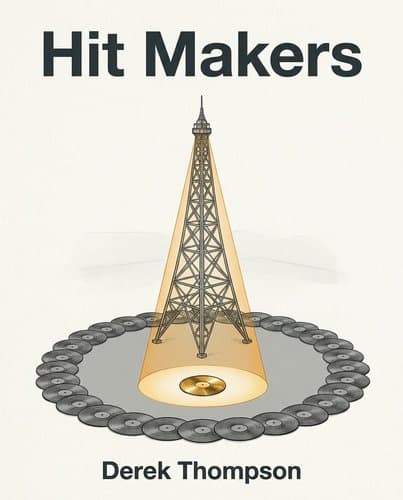
30901608_hit-makers
by Derek Thompson
Hits aren't accidents—they're engineered by pairing the familiar with the unexpected, then routing through networks that already carry an audience.
In Brief
Hit Makers (Febr) examines why certain ideas, songs, and products become cultural phenomena while equally good work disappears. Derek Thompson reveals that hits are engineered through a combination of familiar-yet-novel design and strategic distribution through existing networks — giving readers a framework for understanding popularity and applying its principles to their own creative and marketing decisions.
Key Ideas
Ride existing platforms, don't expect organic spread
Identify your broadcast vehicle before you launch — almost nothing spreads person-to-person; find the existing platform, award, community, or figure whose audience already contains yours, and route through them rather than hoping for organic spread
Safe surprise: familiar form, unexpected content
Apply the MAYA test to any creative decision: is it familiar enough to feel safe and surprising enough to feel alive? Radical novelty fails as reliably as pure imitation — the sweet spot is old structure wearing new clothes
Bowling pin strategy: dense niche dominates
Target the densest, most self-defined cluster you can find, not the largest possible audience — the bowling pin strategy (tight niche first, then expand) consistently outperforms broad launches, and your first audience defines who comes next
Exposure trumps preference statements over time
Read early audience resistance with skepticism: repeated exposure changes preferences, and what people say they want right now isn't what they'll want after six weeks of familiarity — the iPhone had a 30% stated-preference rate before anyone had held one
Multiple attempts trump one perfectly optimized launch
Build a portfolio rather than engineering a single perfect launch — cascade dynamics mean individual hits are structurally unpredictable, so the rational strategy is more attempts with faster feedback loops, not more precise optimization of one bet
Distribution deserves same creative effort as work
Distribution is upstream of quality: above a catchiness or craft floor, the variable that separates hits from forgotten efforts is almost always exposure — which means your distribution strategy deserves as much creative attention as the work itself
Who Should Read This
Business operators, founders, and managers interested in Marketing and Behavioral Psychology who want frameworks they can apply this week.
Hit Makers
By Derek Thompson
10 min read
Why does it matter? Because the work that deserves an audience and the work that finds one are rarely the same thing.
Here's what nobody tells you about the things you love: you probably love them because you were pointed at them, not because they found you. The song you'd call a masterpiece might have died unheard if one radio programmer had made a different call in 1994. The novel you consider a classic sat rejected until distribution, not quality, finally intervened. And the painting you'd swear is objectively great? A dead impressionist's will put it in front of you. Derek Thompson spent years pulling at this thread — why some ideas conquer the world and nearly identical ones disappear — and what he found scrambles every instinct you have about talent and taste. It turns out hits don't emerge. They're routed. Through brains that crave the familiar, and networks that already exist.
Your Favorite Songs Probably Beat Better Songs You'll Never Hear
In 1994, a Cornell psychologist named James Cutting stood in front of Renoir's Bal du Moulin de la Galette at the Musée d'Orsay and felt something he couldn't justify. He recognized the painting immediately — clusters of Parisians dancing in afternoon light — but when he tried to say what made it objectively great rather than just familiar, he came up empty. Then a thought landed: Caillebotte had owned this.
Gustave Caillebotte was a wealthy French impressionist who died in 1894 at 45, leaving the French state roughly seventy canvases he'd spent his life collecting: specifically, his friends' least commercially viable work. He bought what wouldn't sell. His bequest, after years of resistance from critics who called the paintings "filth," finally hung at the Musée du Luxembourg in 1897, the first national exhibition of impressionist art in any European country.
Back at Cornell, Cutting scanned 15,000 reproductions across hundreds of art books. The impressionist canon clustered around exactly seven painters: Monet, Renoir, Degas, Cézanne, Manet, Pissarro, and Sisley. They were precisely the seven most represented in Caillebotte's gift. The painters he hadn't collected had largely vanished.
To test whether exposure was doing the work rather than genius, Cutting flipped the experiment in a new class. Students saw obscure impressionist paintings at a 4:1 ratio over famous ones, a semester of inverted art history. At the end, their preference for the canonical masters reversed in 41 of 51 paired comparisons. A century of Monet's perceived greatness nearly evaporated after six weeks.
Music does the same math, more brutally. HitPredictor scores new songs for raw catchiness before release. Drake's "Hotline Bling" scored 70.25. The Weeknd's "The Hills": 71.39. Both enormous hits. Meanwhile, songs scoring in the 80s and 90s routinely failed to chart. Above a floor of basic competence, catchiness stopped mattering. Distribution did the rest. SoundOut, which runs these tests, has a backlog of songs that cleared 80 and simply disappeared — good enough to chart, never given a platform to do it.
You've never heard them. They were good enough. They just weren't everywhere.
To Sell Something Surprising, Make It Feel Familiar First
When Raymond Loewy stepped off the SS France in New York in 1919, he had forty dollars, a self-tailored military uniform, and a drawing he'd sold to a British diplomat on the crossing for 150 francs — enough to redirect him from electrical engineering toward design. What he saw from the top of the Equitable Building on his first afternoon horrified him: a grimy, boxy, machine-age city. He spent the next four decades fixing it.
By midcentury, Loewy's firm had redesigned the Sears Coldspot refrigerator (annual sales quadrupled from 60,000 to 275,000 units in two years), the Lucky Strike cigarette package (a $50,000 bet against American Tobacco's own executives, won by replacing the green background with white), the Pennsylvania Railroad locomotive, and eventually the interior of NASA's Skylab space station. Cosmopolitan wrote in 1950 that Loewy had "probably affected the daily life of more Americans than any man of his time." He had a theory for why his designs consistently worked, and he called it MAYA: Most Advanced Yet Acceptable.
The logic is simple. Consumers are pulled in two directions at once — toward novelty, which excites them, and toward the familiar, which feels safe. Push too far into novelty and people reject it. Stay too close to what they already know and they're bored. The hit lives in the precise gap: surprising enough to catch attention, familiar enough to feel like it belongs.
MAYA keeps showing up in domains Loewy never touched. In 2014, Spotify launched Discover Weekly, a personalized playlist of thirty songs users had never heard before. The engineering team built it to be entirely fresh. But a bug crept in: the algorithm accidentally included tracks some users already knew. The team caught it, fixed it, pushed the clean version. Engagement dropped. When they investigated, the answer was uncomfortable: the familiar songs hadn't been contaminating the experience. They'd been anchoring it. Without at least one recognizable track, users couldn't tell whether the algorithm understood them at all. The new music felt like a stranger's unsolicited opinions. The team's conclusion was that users needed to see some sign it knew them, too. The fix went back in as a feature.
Every hit you've ever loved without knowing why runs on the same machinery. You weren't just responding to novelty or quality. You were responding to recognition flickering through the unfamiliar — the feeling that something new was also, somehow, already yours. Loewy understood this about refrigerators in 1934. Spotify stumbled onto it by accident in 2014. The gap between them was eighty years of people telling creators, in their purchasing and clicking and listening, exactly the same thing.
Repetition Isn't a Creative Compromise — It's the Mechanism of Meaning
Picture an engineer given the following brief: keep an audience engaged as long as possible, using as little material as possible. You'd expect the solution to come from a recording studio. It came, instead, from a mouse lab.
Ohio State musicologist David Huron found that the sequence keeping a mouse startled longest, with the fewest distinct sounds, looks like this: BBBBC–BBBC–BBC–BC–D. Heavy repetition of a first element, then a new one introduced just before the pattern fully calcifies, then a third to reset everything. Map those elements onto song parts (B is a verse, C is a chorus, D is a bridge) and the sequence becomes the dominant structure of pop music for the past fifty years: verse-verse-chorus–verse-chorus–bridge. The answer to "how do I startle a mouse with the minimum material?" turns out to be structurally identical to "how do I write a hit?" Put on "Born to Run" in your head: verse-verse-chorus is exactly the sequence the mouse told you to expect.
When any stimulus repeats too long, the brain files it as "known, not urgent" and stops registering it. A new element mid-sequence revives the potency of what came before. The chorus hits harder after a second verse because the verse rebuilt the anticipation the first chorus used up.
Repetition is the engine by which unfamiliar sounds become pleasurable ones. We like what we know, and repetition is how that familiarity gets built inside a single song, in minutes, while you're still listening. "People find things more pleasurable the more times you repeat them," Huron found, "unless they become aware that you're being repetitive." The craft is making repetition feel inevitable rather than mechanical — and the blueprint for that was worked out, long before any recording studio existed, on a mouse.
Nothing Actually Goes Viral — It Broadcasts
Almost nothing actually goes viral — not as a complaint about the word's overuse, but as an empirical finding. When Yahoo researchers tracked millions of Twitter messages in 2012, they discovered that 95% of the news people saw came from the original source or one step removed. Nothing spread exponentially across generations of sharing, the way an actual pathogen does. The researchers had a name for what they found instead: broadcast diffusion — one source reaching many people simultaneously, not thousands of people whispering to each other in sequence. Digital blockbusters, they concluded, weren't built from a million one-to-one moments. They were built from a few one-to-one-million moments.
This reframes the question entirely. Not "how do I make something contagious?" but "what is my broadcast vehicle?"
E.L. James had the answer before she needed it. In 2009, she started posting erotic fan fiction on FanFiction.net under the pen name Snowqueens Icedragon, a reimagining of Twilight with Edward Cullen recast as a bondage-inclined CEO. By the time she published it as an e-book in May 2011, she had five million readers and fifty thousand comments. Mainstream New York publishing had no idea any of this existed. The audience was real; the channel was invisible.
Then three distinct one-to-many moments fired. Her FanFiction readers gave the book enough five-star Goodreads reviews to place it second in the site's annual romance award in November 2011, which put it in front of Hollywood executives, who started calling about film rights by December. In January 2012, a Vintage editor named Anne Messitte read the book in one Saturday sitting and spent the next six weeks brokering a deal. On March 18, it debuted at number one on the New York Times bestseller list. By spring, Random House was printing one million copies a week. The book is now the bestselling title in Random House history.
None of that looks like the spread of a cold virus. It looks like a bomb fuse — a long quiet string of existing audience, then one award, then one publisher, then a company with the logistics to stock every airport bookstore in America. Each broadcast reached not two or three people but thousands or millions at once.
Content quality sets a floor, but it doesn't determine how far above the floor you travel. James had an enormous built-in audience and her book still needed Messitte and the Random House machinery. For anyone making something, the strategic question is less about the work than about who carries it.
The Path to Millions Starts With a Dozen Tightly Connected People
Whitney Wolfe walked into a sorority house at Southern Methodist University with a pitch that required the timing of a con artist. She told the women she needed a favor — download this new dating app called Tinder — and also, by the way, she was heading straight to the frat houses next, and every cute guy on campus would be on it within twenty minutes. Then she walked to the fraternities and told them she'd personally watched every girl down the road download the app. "Do not disappoint them," she said. "They're waiting for you."
The guys downloaded the app.
Wolfe flew to the next campus and ran the same play. Before her cross-country tour, Tinder had fewer than five thousand users. By the time she returned, it had fifteen thousand.
The surprise is who she targeted. She bypassed influential individuals and went straight for density: groups already tightly linked to each other, already primed to care what the others were doing. Sororities and fraternities are practically laboratory conditions for this: bounded communities with strong existing bonds and visible social pressure. She commandeered connections that already existed rather than building new ones from scratch.
If you're trying to reach millions, the counterintuitive move is to start with a group small enough to sit in one room. The cluster is already out there, already linked, already primed. The frame is set. You just have to find it, and roll.
Even When You Know Every Rule, the Cascade Is Still a Coin Flip
On April 12, 1954, Bill Haley's band arrived two hours late to their recording session because their ferry grounded on a sandbar in the Delaware River. When they finally reached the converted Masonic Temple in New York City, they spent most of the remaining time laying down a song they'd been hired to record first — a throwaway track about a hydrogen bomb leaving one man as custodian of thirteen women. By the time they got to "Rock Around the Clock," the session was nearly over. The first take was unusable: instruments too loud, Haley's voice buried beneath them. With minutes left, the producers offered a fix — turn off all the instrument mikes, give Haley one shot at the vocals, and splice the two recordings together. He sang it. They packed up and left. Nobody knew if any of it was usable.
The song came out as the B-side. One week on the Billboard chart. 75,000 copies sold — one-tenth what Haley's previous single had moved. Then it vanished.
What rescued it wasn't quality. It was a nine-year-old boy in Beverly Hills who happened to flip the record over, decide the drumbeat was decent if not his favorite, and hand it to a film director visiting his house to discuss a movie about juvenile delinquency. When Blackboard Jungle opened in 1955, "Rock Around the Clock" played over the opening credits. Cities banned the film. Princeton students lit trash fires in campus quads at midnight. On July 2, 1955 — fourteen months after that panicked recording session — the song hit number one. It eventually outsold every single by Elvis, the Beatles, Madonna, or Michael Jackson.
The network scientist Duncan Watts ran simulations of exactly this kind of cascade. In a model world of thousands of connected people, he triggered the same conditions over and over. Nine hundred and ninety-nine times out of a thousand, nothing spread. Once, the whole network lit up. The math was straightforward: if a trigger has a one-in-a-thousand chance of becoming a global cascade, you will eventually see global cascades, provided you keep pulling the trigger long enough.
The psychology of familiarity is real. The power of distribution is real. The mechanics of dense clusters and broadcast moments are real. Knowing them makes you a more deliberate maker. It does not make you a predictor.
The Gap Between a Masterpiece and a Forgotten Effort
Here's what Thompson leaves you with: the system is learnable but not hackable. You can study every cascade, map every broadcast moment, memorize Caillebotte and Haley and Whitney Wolfe's sorority tour — and still not manufacture a hit, because the gap between a trigger and an explosion is a coin flip dressed up as inevitability after the fact. The Mona Lisa hung in the Louvre for four centuries without anyone calling it the greatest painting in the world. Then it was stolen, the theft ran on front pages for two years, and by the time it came back it was an icon — same canvas, different exposure. Obscurity isn't a verdict on quality. It's usually just a verdict on exposure — which is a different problem entirely, and a more solvable one.
Notable Quotes
“I really had an aha moment,”
“I realized that Caillebotte had owned not only the Bal du Moulin, but also many other paintings at the museum that had become extremely famous.”
“especially those works of his friends which seemed particularly unsaleable,”
Frequently Asked Questions
- What is Hit Makers about?
- Hit Makers by Derek Thompson examines why certain ideas, songs, and products become cultural phenomena while equally good work disappears. Thompson reveals that hits are engineered through a combination of familiar-yet-novel design and strategic distribution through existing networks. Rather than relying on organic spread or pure creativity, successful hits combine elements audiences recognize with surprising twists. The book provides a framework for understanding why certain products achieve massive cultural impact while others, despite comparable quality, never gain traction. Understanding these mechanisms allows creators and marketers to apply hit-making principles to their own work.
- What is the MAYA test from Hit Makers?
- The MAYA test is Thompson's framework for evaluating creative decisions. MAYA stands for Most Advanced Yet Acceptable. According to Thompson, "the sweet spot is old structure wearing new clothes." The test asks: is it familiar enough to feel safe and surprising enough to feel alive? "Radical novelty fails as reliably as pure imitation," Thompson argues. Successful hits balance innovation with familiarity—they're different enough to capture attention but grounded enough in familiar concepts that audiences immediately understand them. This tension between the comfortable and the novel explains why incremental improvements often outperform radical reinventions.
- What is the bowling pin strategy in Hit Makers?
- In Hit Makers, Thompson advocates for the bowling pin strategy as the optimal approach to launching success. Rather than appealing to the broadest audience, target "the densest, most self-defined cluster you can find." Thompson explains that "tight niche first, then expand" consistently outperforms broad launches. Your first audience members become advocates who introduce your product to others, shaping the identity that attracts subsequent waves. By targeting a tight community of early adopters rather than attempting mass-market appeal initially, creators set themselves up for sustainable, network-driven growth that builds credibility and momentum organically.
- Why does Hit Makers say distribution matters more than quality?
- Thompson makes a provocative argument: "Distribution is upstream of quality." He explains that "above a catchiness or craft floor, the variable that separates hits from forgotten efforts is almost always exposure." This doesn't mean quality is irrelevant—there's a minimum threshold. But beyond that threshold, success depends on how many people encounter your work. Thompson emphasizes that "your distribution strategy deserves as much creative attention as the work itself." This challenges conventional wisdom: a brilliant product without strategic placement through existing networks will never reach critical mass, making distribution decisions as important as creative ones.
Related Book Summaries
Read the full summary of 30901608_hit-makers on InShort