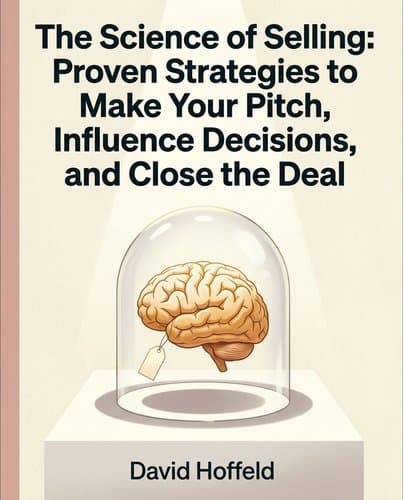
29236540_the-science-of-selling
by David Hoffeld
Every failed pitch is a neuroscience problem: you're presenting solutions to buyers whose brains haven't yet decided why they need to change.
In Brief
Every failed pitch is a neuroscience problem: you're presenting solutions to buyers whose brains haven't yet decided why they need to change. Hoffeld reverse-engineers the six mental gates every purchase passes through and gives you the exact science-backed questions to open each one.
Key Ideas
Diagnose buyer commitment gaps first
Before any conversation, map which of the Six Whys® your buyer hasn't yet committed to — Why Change, Why Now, Why Your Industry, Why You, Why Your Product, Why Spend the Money — and focus there. Presenting features to a buyer who hasn't answered 'Why Change?' is wasted effort.
Dig deeper with three-level questioning
Ask questions in three levels: first-level (facts and situation), second-level (what do you make of that?), third-level (what would it mean for you if this isn't resolved?). Most salespeople stop at level one. The emotional stakes that drive purchase decisions only surface at level three.
Frame urgency as losses not gains
Frame urgency as loss, not gain. Kahneman's research confirms losses have at least twice the emotional impact of equivalent gains. 'You'll lose the 100 calls already credited to you' outperforms 'earn 100 calls if you stay' — but always pair fear of loss with a clear escape route, or the message backfires.
Convert requests into commitment questions
Replace every request with a small commitment. 'Will you call us if your plans change?' produces dramatically different behavior than 'Please call if your plans change.' Scan your sales process for places where you're making suggestions and convert them to commitment questions.
Limit choices to two through four
Never show one option (single-option aversion suppresses purchase intent) and never show more than five (cognitive overload does the same). Somewhere between two and four is the architecture that converts.
Lead with value-priced resources not gifts
When prospecting, lead with reciprocity: offer a report, research, or resource with a stated dollar value — not a 'free gift.' Free gifts are discounted; priced gifts create psychological debt. The Disabled American Veterans organization saw response rates nearly double by adding address labels to mailers.
Name negative emotions to reset perception
To shift a buyer's negative emotional state, name it directly: 'You seem distracted today.' The Hawthorne effect forces cognitive awareness of the state, which typically prompts the buyer to suppress it — clearing the perceptual lens through which they'll evaluate everything else you say.
Link solution to buyer's stated motivators
Replace feature-benefit statements with the Primary Buying Motivator Statement: identify which desire for gain or fear of loss your product addresses, quote the buyer's own words back to them, then link your product to their stated motivator. The sale should always sound like it's solving their problem, not showcasing your product.
Who Should Read This
Business operators, founders, and managers interested in Sales and Persuasion who want frameworks they can apply this week.
The Science of Selling: Proven Strategies to Make Your Pitch, Influence Decisions, and Close the Deal
By David Hoffeld
11 min read
Why does it matter? Because the way you sell right now is probably pushing buyers away — and your training is the reason.
One in nine Americans works in sales. Roughly half of them miss quota every year. The obvious diagnosis — better technique, more hustle, stronger closes — turns out to be wrong in a way that's almost embarrassing once you see it. The research is unambiguous: most of the behaviors salespeople engage in actively reduce the probability of a sale. Scientists figured this out decades ago. Salespeople just weren't reading the journals. David Hoffeld was — and what he found across five scientific disciplines is that buying is a specific neurological sequence, and the entire profession has been interrupting it without knowing. This book maps that sequence: six mental commitments every buyer's brain must make before it purchases, three levels of questions that mirror how humans naturally disclose information, and a counterintuitive finding that small agreements made early in a conversation matter more than any closing technique you've been taught.
The Behaviors You've Been Trained to Use Are Actively Hurting Your Sales
Two experienced sales professionals sat arguing about a rapport-building technique — one of them David Hoffeld, who had climbed through sales manager, director, and VP roles at every organization he'd joined. The other was a colleague he calls Bill, equally decorated, equally certain. Each cited their personal track record as proof. Each named salespeople they'd trained who could confirm their position. The argument went nowhere, because it couldn't: they had anecdote versus anecdote, and anecdote has no tiebreaker.
That conversation broke something open for Hoffeld. Neither of them had anything better to stand on, and he slowly understood that nobody else in the profession did either. Sales methodology, no matter whose name is on it, traces back to one person's experience of what worked, dressed up as principle. Training passes that anecdote to the next generation, who accepts it as received wisdom and passes it down again. The replicable success rate stays unpredictable because nothing in the chain was ever empirically verified.
Hoffeld eventually tested this directly. In a webinar with salespeople from major organizations, he asked a single question: what are your sales behaviors based on? Trial and error got 45%. Expert recommendations got another 45%. Wishful thinking and "unsure" split the remaining 10%. The option "scientific findings on how the brain formulates a buying decision" received zero votes — not a small share, zero.
Behavior built on anecdote has no error-correction mechanism: you can't know whether your techniques are helping or hurting. An HBR study of 800 salespeople found that only 37% were consistently effective. The behaviors of the remaining 63% were actively suppressing their performance. Not neutral. Actively harmful. The Chally Group's research across more than 100,000 decision makers confirmed that the salesperson's behavior, not the product or the company, is the deciding factor between vendors. When those behaviors rest on guesswork, the cost is enormous.
Sales training has long insisted the best salespeople are natural extroverts: outgoing, gregarious, built for the pitch. Adam Grant, a management professor at Wharton, tracked 340 sales reps over three months and found extroverts earning $125 per hour. Introverts came in just below at $120. The highest performers were neither: people who scored squarely in the middle, ambiverts, earned $208 per hour. The reason isn't complicated. Extroverts are often so focused on talking that they stop listening, and a salesperson who doesn't listen can't understand what the buyer actually needs. The expert advice wasn't slightly off. It pointed at the wrong person entirely.
Hoffeld keeps finding the same pattern: the more confident the sales convention, the more likely science has already contradicted it. The problem isn't that individual salespeople are bad at their jobs. It's that the entire profession was built on stories instead of evidence, and almost nobody noticed because everyone was telling the same story.
Every Buyer Must Cross Six Mental Thresholds Before They Can Say Yes — In That Order
Six years of analyzing sales calls across industries, comparing every win against every loss, converged on a single structural finding: every buyer crosses the same six mental thresholds before they can commit to a purchase, and a sale stalls at whichever one they haven't cleared. Hoffeld calls this sequence the Six Whys®.
The first, Why Change?, is the hardest, because the brain defaults to inaction. Staying put feels safer than moving; people feel greater regret for a failed change than for doing nothing and experiencing the same bad outcome. Until a buyer believes their current situation is genuinely costing them, your product is beside the point.
Why Now? comes next, and it's not just the general recognition that delay is risky. The buyer has to see a specific cost to waiting: a competitor who moves first claims the market position; the budget that exists today gets reallocated when the quarter closes; a window that's open right now (a contract renewal, a leadership transition, a regulatory deadline) shuts and won't open again for months. Abstract urgency doesn't move people. A concrete cost to waiting does.
Why This Industry Solution? follows, because buyers frequently consider routing around your category and building a fix themselves. Then comes Why You and Your Company?, and this threshold is about perceived vendor risk, not trust in the abstract. The buyer is calculating what happens if this specific relationship goes wrong — if the vendor underdelivers, turns out to be difficult to work with, or isn't around to support what they sold. Handing real money to someone who hasn't yet earned that right is uncomfortable in a way that's almost physical. Reducing that discomfort is a different task than making a compelling pitch.
Why Your Product or Service? asks for a differentiated reason to choose you over competitors who've already cleared the previous four tests. The sixth Why, Why Spend the Money?, is where Nobel-winning psychologist Daniel Kahneman's research on loss aversion is most useful.
In an experiment, Kahneman showed two groups the same scenario: a disease will kill 600 people; choose between two response plans. The probabilities were mathematically identical in both versions. But one group saw the options framed as lives saved; the other saw them framed as deaths guaranteed. The first group favored the cautious plan; the second reversed to the risky one. Same facts, opposite majorities. Framing the outcome as a loss rewired the calculation entirely. A telecom company later applied this commercially: when customers calling to cancel were told they would lose 100 calls already credited to their account rather than gain 100 new ones for staying, cancellations dropped sharply. Losses weigh roughly twice as heavily as equivalent gains.
That's the mechanism behind Why Spend the Money?. Buyers aren't really answering "what will I gain from this purchase?" They're answering "what am I losing by staying where I am?" Framing the purchase as an escape from a loss (the ongoing cost of the status quo) is measurably more persuasive than leading with features and benefits.
The buying decision is built incrementally throughout every conversation. Each Why resolved moves the buyer forward; each one left unaddressed surfaces later as an objection. The close is a readout of the commitments earned along the way, or not.
The Buyer's Emotional State Isn't a Factor in the Decision — It Is the Decision
Think of a camera filter applied to every shot you take — not changing the subject, but changing how it reads. Warm tones make a face look inviting; cool tones make the same face look clinical. The subject hasn't moved. The filter has. A buyer's emotional state works the same way on every piece of information you deliver: it doesn't change the data, it changes how the data lands.
The clearest evidence comes from where emotions should matter least. A study in the Proceedings of the National Academy of Sciences examined judicial parole decisions, rulings that are supposed to rest entirely on case facts and legal criteria. When judges were in a positive emotional state, they granted parole roughly 65% of the time. When they were tired or hungry, the rate dropped to nearly zero. The emotional state didn't nudge the outcomes; it practically determined them. None of the judges reported feeling influenced. From their perspective, they were reading the cases and ruling on the merits.
Buyers work the same way. People in a positive state don't perceive themselves as evaluating generously — they think the world actually looks better. Which means a buyer who arrives in a negative state isn't evaluating your product skeptically; they're evaluating everything skeptically. When they can't find high value in your offer, they don't blame their mood. They blame your product. The objection you're trying to overcome may not exist. It's a symptom of a state you haven't addressed yet.
The three strategies Hoffeld offers to shift that state all follow the same logic: they work because they trace how the brain actually functions. Naming a buyer's distracted energy directly ("You seem like you have something on your mind. Is now still a good time?") typically prompts them to consciously suppress it. Asking about topics tied to positive memories (family, travel, a recent win) floods the brain with the emotions attached to those memories. Even changing body posture or inducing a smile produces measurable neurological effects; smiling increases blood flow to the brain and generates genuine feelings of pleasure. None of this is manipulation. It's meeting the brain where it already operates.
Most Sales Questions Stop One Level Before the Information That Actually Drives the Decision
The buyer has just said that permissions management is the feature that most impressed his team. A reasonable answer to a reasonable question. Then the salesperson asks something different: what would it mean for the business if they couldn't effectively control who accessed what? The buyer's tone shifts. A few months earlier, he explains, someone had accessed sensitive data through a gap in their current system. He'd nearly lost his job over it. The permissions feature isn't a preference among several — it's the entire reason he's in the room.
That answer was sitting there through every earlier exchange, invisible. And it changes everything about how the sale goes.
Hoffeld's framework rests on a single observation: buyers disclose information in layers, and most salespeople stop two layers short. The scientific basis comes from 1973 research by University of Utah professor Irwin Altman and University of Texas professor Dalmas Taylor, who established that people reveal information sequentially, like peeling an onion, not randomly or all at once. One layer opened exposes the next. The implication for selling is direct: you don't need more categories of questions, you need to go deeper.
The three levels work like this. First-level questions surface facts, behaviors, and situations: the basic shape of a buyer's circumstances. They're necessary but reach only the outermost layer, and most salespeople live there. Second-level questions ask buyers to assess or explain what they've just said — not just what a problem is, but what they make of it. A Harvard fMRI study found that answering opinion-prompting questions activates reward and pleasure centers in the brain. Buyers don't merely tolerate these questions; neurologically, they enjoy answering them.
Third-level questions reach the emotional core: what does the buyer stand to gain, or fear losing, if nothing changes? In the permissions example, the salesperson didn't manufacture an emotional response. He simply went deep enough that the buyer could finally articulate what was already there. These questions don't impose an emotional frame; they follow the sequence the brain uses naturally when disclosing what actually matters.
What changes at the third level is more than what the salesperson learns. A buyer who has just described the job he nearly lost isn't only providing information. He's being heard. The conversation doesn't feel like an interrogation. It feels like talking to someone who wants to understand. That's the practical payoff: not just better intelligence going into the close, but a buyer who arrives there feeling understood rather than worked.
The Most Powerful Close Happens in the First Five Minutes, Not the Last
In 1966, two behavioral scientists knocked on doors in a California neighborhood with a simple request: would you allow a large "DRIVE CAREFULLY" billboard in your front yard? They showed homeowners a picture of how the sign, clearly oversized and obstructive, would dominate their lawn. Seventeen percent said yes.
Two weeks earlier, the same researchers had visited a different neighborhood with a much smaller ask: would you display a three-inch "BE A SAFE DRIVER" sign in your window? Nearly everyone agreed. When they returned to that neighborhood with the billboard request, 76 percent said yes. A trivial prior commitment had nearly quintupled compliance with a major one.
Jonathan Freedman and Scott Fraser, Stanford psychologists who ran the study, concluded that once people agreed to something small, they began to see themselves differently — as the kind of person who cares about safe driving, who acts when asked. That revised self-image governed the next decision. The commitment didn't predict behavior; it changed the person who had to behave.
The traditional model says: build rapport, present the product, then ask for the decision at the end. That sequence is structurally backwards. A single closing ask skips the very mechanism that makes decisions feel natural. Every small yes through the conversation is the brain laying down track; the final decision just runs along it. Without prior commitments, there is no track.
Hoffeld calls the small asks "commitment trial closes," but the sequence starts earlier. First comes the involvement question, something like "How would having this feature change your team's efficiency?" The buyer builds the case in their own words. Once they've answered, the commitment question follows: "Based on what you've learned, is there any reason you'd invest in software that didn't include this feature?" The involvement question loads the chamber; the commitment question fires it. Asking the commitment question alone is the single-close problem restated at smaller scale.
None of this is manipulation. It follows the sequence the brain uses to reach any decision: affirm the value, commit to the value, act on the commitment. A salesperson who does this throughout the conversation isn't pushing the buyer — they're removing the friction between what the buyer has already decided and what they'll eventually say out loud.
How You Structure the Choice Does More Persuasive Work Than Anything You Say
Sheena Iyengar and Mark Lepper set up a jam tasting booth at an upscale Menlo Park grocery store and ran two versions of the same display. Twenty-four varieties produced a 3 percent purchase rate. Six varieties produced 27 percent — a 900 percent increase. The jam didn't change. The number of options changed. The structure was the presentation.
The structure of your presentation is doing more persuasive work than the content of it. Not slightly more, dramatically more, because the brain doesn't evaluate options in isolation; it evaluates them relative to everything surrounding them.
Hoffeld encountered the same dynamic with a salesperson who brought an iPad to every meeting and scrolled through more than a hundred near-identical product configurations, convinced the breadth was an advantage. He had her cut to four options per session, swapping in alternatives only when a buyer explicitly wanted more. Sales rose 30 percent. The product hadn't improved. The cognitive load on the buyer had dropped.
This is the practical criterion the prior chapters build toward: when evaluating any sales behavior, the question isn't "does this make a good argument?" It's "does this reduce the mental work required for the buyer to say yes?" Anchoring high before revealing price, letting characters speak directly in a story rather than paraphrasing them, presenting two options instead of one — none of these change what you're offering. They change how easily the buyer's brain can arrive at the decision you want. When you present three price tiers with an anchor high, or ask a buyer to choose between two options rather than decide whether to buy at all, you're not being clever; you're reducing the cognitive work required to say yes.
The Criterion That Replaces Every Sales Argument
Here is what Hoffeld hands you: a test. Before this book, the only way to settle an argument about a sales behavior was to find someone with a longer track record or a bigger sample of anecdotes. That was never a real answer. It was just a louder version of guessing. Now you have something that doesn't depend on whose experience you trust: neuroscience has mapped how the brain builds a buying decision, step by step, and any behavior you're asked to adopt either fits that map or it doesn't. The question you now have — does this align with how the brain actually builds a decision? — doesn't go stale. It applies to the next thing your manager recommends, the next training you sit through, the habits you've been carrying for years without examining. Some will survive. Many won't. Either way, you'll know why, and that's more durable than any tactic.
Notable Quotes
“for having integrated insights from psychological research into economic science, especially concerning human judgment and decision-making under uncertainty.”
“psychological principles that govern the perception of decision problems and the evaluation of options.”
“typically, losses have at least twice the impact of equivalent gains so that people would require a 50 percent chance of gaining at least $200 to make up for a 50 percent of losing $100.”
Frequently Asked Questions
- What is The Science of Selling about?
- The Science of Selling applies behavioral science, psychology, and neuroscience to reveal how buyers actually make purchasing decisions. David Hoffeld provides a research-backed framework that aligns every step of the sales process with how the human brain is wired to commit. Rather than relying on traditional sales techniques, the book teaches evidence-based strategies for pitching, influencing decisions, and closing deals. It covers question sequencing, urgency framing, and choice architecture. The core insight is that presenting features without ensuring a buyer has committed to foundational questions—like Why Change?—wastes time and effort.
- What is the Six Whys framework in The Science of Selling?
- The Six Whys® framework identifies six sequential commitments a buyer must make before purchasing: Why Change, Why Now, Why Your Industry, Why You, Why Your Product, and Why Spend the Money. David Hoffeld emphasizes that before any conversation, you must map which Whys your buyer hasn't committed to and focus there. "Presenting features to a buyer who hasn't answered 'Why Change?' is wasted effort." Most salespeople skip these foundational commitments and jump to product details. This framework ensures your pitch addresses the actual objections blocking the sale rather than wasting time on irrelevant information.
- How does The Science of Selling recommend asking sales questions?
- The Science of Selling recommends a three-level questioning strategy to uncover emotional buying motivators. First-level questions focus on facts and situation; second-level questions ask "what do you make of that?" to invite interpretation; third-level questions ask "what would it mean for you if this isn't resolved?" Most salespeople stop at level one and miss critical information. "The emotional stakes that drive purchase decisions only surface at level three." This structure ensures you're addressing the real concerns motivating buyer behavior rather than surface-level information.
- What psychological principles does The Science of Selling recommend?
- The Science of Selling applies multiple psychological principles to boost sales effectiveness. Frame urgency as loss rather than gain—losses have at least twice the emotional impact of equivalent gains. Replace requests with commitment questions: "Will you call us if your plans change?" produces dramatically different behavior than "Please call if your plans change." Limit choice architecture between two and four options, avoiding single-option aversion and cognitive overload. In prospecting, lead with reciprocity by offering valued resources; "Free gifts are discounted; priced gifts create psychological debt." To shift negative emotional states, name them directly—"You seem distracted today"—triggering awareness. Finally, use Primary Buying Motivator Statements linking products to buyers' stated concerns.
Related Book Summaries
Read the full summary of 29236540_the-science-of-selling on InShort