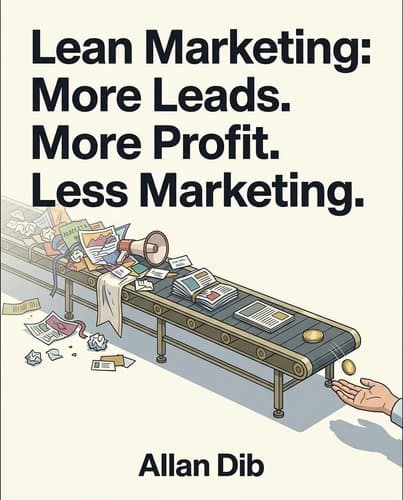
203939843_lean-marketing
by Allan Dib
Most marketing fails because entrepreneurs lack systems, not talent—scattered effort never compounds. Allan Dib reveals how to build marketing infrastructure…
In Brief
Most marketing fails because entrepreneurs lack systems, not talent—scattered effort never compounds. Allan Dib reveals how to build marketing infrastructure that converts the 97% not ready to buy today into tomorrow's customers, using niching, flagship assets, and automation that works while you sleep.
Key Ideas
Dominate Your Niche Before Expanding
Niche before you scale: identify the specific intersection of geography, problem, and customer awareness stage where your offer creates the most value, and dominate that sliver before expanding. Amazon started with books; Facebook started with college campuses.
Tag Data Obsessively From Day One
Tag obsessively in your CRM from day one — even data that seems irrelevant now (location, interest category, lead source) becomes essential when you want to segment a campaign or open a new channel in three years.
Express Value in Three Simple Lines
Replace your hero section with three lines: here's what I've got, here's how it makes your life better, here's what I do next. If a 12-year-old can't understand the value proposition, rewrite it.
Lead With Valuable Free Resources
Build a flagship asset that delivers 'results in advance' — a guide, tool, or resource that demonstrates your expertise and captures the 97% of your market not ready to buy today. Give away your best stuff first.
Monetize Educational Content With Super Signature
Add a Super Signature to every value-providing email: a P.S. listing three specific ways to work with you. It makes every educational email commercially productive without making it feel like a sales pitch.
Automate Approvals Through Dead Man's Switch
Install a Dead Man's Switch for any recurring marketing task that requires your approval — if you don't respond within 48 hours, it proceeds. Your schedule should never be the bottleneck for your marketing momentum.
Run Five-Point Diagnostic on Failures
When a campaign fails, run the five-point diagnostic before drawing conclusions: people aren't clicking, aren't opting in, aren't opening emails, aren't visiting the sales page, or aren't buying. Only one of these is broken. Find it.
Measure Lifetime Value as True Profit
Measure LTV as profit, not revenue (subtract COGS and processing fees). This is the number that determines how large a moat you can build — and how much you can afford to spend to acquire each customer.
Who Should Read This
Business operators, founders, and managers interested in Marketing and Business Strategy who want frameworks they can apply this week.
Lean Marketing: More Leads. More Profit. Less Marketing.
By Allan Dib
12 min read
Why does it matter? Because your marketing isn't failing from lack of effort — it's failing from lack of infrastructure.
Most entrepreneurs assume the fix is more — more creativity, more hustle, a bigger ad budget, a better logo. So they hire agencies that produce beautiful work nobody buys, run campaigns that vanish without a trace, and wonder why talent isn't translating into traction. Here's the uncomfortable truth: your marketing isn't failing because you lack imagination. It's failing because you lack infrastructure. Marketing without infrastructure is just expensive improvisation — and improvisation doesn't compound. What this book argues, with impatience after watching too many capable people burn money on the wrong problems, is that marketing is actually a manufacturing process. It has diagnosable failure points, measurable outputs, and systems that can run without you standing over them. Fix the structure, and everything else gets easier. Keep ignoring it, and no amount of creativity will save you.
Good Work Doesn't Sell Itself — and Pretending It Does Is Costing You
Allan Dib is sitting in the back of a car somewhere in León, Mexico, exhausted after five weeks of back-to-back speaking events across North America, trying not to catastrophize about the fact that his driver is armed. He'd been binge-watching Breaking Bad. He imagined cartels. He imagined taking a bullet and sliding down the side of a car. None of it happened — instead, he checked into a hotel with his name stitched onto the hand towel, and the next day strangers whispered his name in hallways and waited in long lines for a photograph. It was at this conference, surrounded by people who had built careers dismantling manufacturing waste, that someone first told him what he was actually doing: lean marketing.
Sit with that image for a second. Same person. Five weeks apart. The difference wasn't talent or budget or a better logo. It was structure. Dib's argument is blunt: good work doesn't sell itself. Nurses and teachers are proof. By almost any measure of merit, they've earned their status. By the market's measure, they haven't. The world is not a meritocracy, and businesses that behave as if it is tend to stay invisible.
The trap that catches smart people specifically is what Dib calls the midwit problem. Picture a bell curve. On one end, someone too unsophisticated to overthink things — they just try stuff. On the other end, someone wise enough to know that simplicity works. Both end up in roughly the same place. The midwit in the middle has the most dangerous trait: enough intelligence to build an airtight case for why something won't work. They spot the contradictions, catalogue the objections, and never build anything. That's the context for something a mentor once asked Dib: "Would you rather be right or rich?" The midwit always chooses right.
What's actually missing in most businesses isn't better marketing — it's any marketing infrastructure at all. Just a series of disconnected attempts: a logo redesign here, a website project there, a short-lived ad campaign. Each tool gets blamed when nothing connects. The rest of this book builds the system those tools are supposed to plug into.
The Market You Choose Matters More Than the Product You Build
The most valuable move available to most struggling businesses isn't improving the product. It's changing who they're selling it to.
Consider a content creator who was good at generating social media buzz through story-driven posts. Solid craft, modest income — because he was selling to local coffee shops and dry cleaners, businesses that couldn't pay much and didn't particularly value what a compelling narrative could do for them. The pivot wasn't in the work. He started targeting companies weeks away from going public, where a well-constructed story could swing a market valuation by hundreds of millions of dollars. He stopped charging fees and started taking small equity positions. When those companies listed, he walked away with multimillion-dollar paydays. Same skill. Completely different world. The market you choose doesn't just affect how much you earn — it determines whether your work has any leverage at all.
Product-market fit isn't something you build into the product. It's something you find by placing the product in front of people who are already in pain and already looking for relief. Dib calls this 'tapping into demand rather than generating it.' Generating demand is what Colgate did with toothpaste in 1873 — decades of spending to convince people their breath stank. Nobody has that runway.
The psychological dimension is more destabilizing. Ask someone why they're buying a Mercedes and they'll tell you it's a reliable car with good engineering. But push deeper — why that car? why does that matter to you specifically? — and you land somewhere else entirely: peer status. The car is just the delivery mechanism. What the buyer is actually purchasing is the moment a colleague sees them pull into the parking lot. Features don't sell. Capsules don't sell. What sells is the thing inside the capsule, and most marketers spend their entire careers describing the capsule.
Before you touch your product, your pricing, or your advertising, you need to answer a harder question: what does your specific target market desperately lack, and does what you do actually relieve that? If the answer is unclear, no amount of craft will compensate. You're not in a creativity problem. You're in a targeting problem — and that's a much easier thing to fix.
Your CRM Is Not a Filing Cabinet — It's the Beating Heart of Your Business
Think of a CRM as a silent staff member who reads every email your prospects open, tracks every page they visit, and quietly updates their file without being asked. Most businesses treat it like a Rolodex — names in, names out, nothing else. That's roughly the same as hiring someone to take excellent notes and then locking them in a room where no one can talk to them.
Dib's Fakeville real estate scenario shows what's actually at stake. A realtor has three contacts: Brian, hunting for a beach holiday home; Jenny, a local upgrader open to beach or forest; and David, an out-of-town investor who cares only about rental yield. A new beach house hits the market — beautiful, premium-priced, low yield. Send that listing to all three and David gets an email that wastes his time and erodes his trust. Send it only to contacts tagged 'beach' and both Brian and Jenny get something relevant while David's inbox stays clean. Later, a high-yield forest property comes up. Query for 'forest' or 'yield' tags and Jenny and David both hear about it while Brian is spared the irrelevance. One database. Three completely different conversations. Nobody receives a message that makes them feel like a bulk-mail recipient.
There's a discipline behind this worth naming: the over-tagging rule. Even if a data point seems useless right now, collect it. An online-only business may see no reason to record physical location — until the day it opens a storefront and needs to know which five thousand contacts live within driving distance. The tags you skip today are the filters you can't run tomorrow.
The logic extends to behavior. When a prospect keeps returning to David's kind of listing — high-yield, high-risk — three times in a week, that's not browsing. That's intent. A properly configured CRM spots the pattern, scores him as a hot lead, and fires a task to a salesperson automatically, without any human having to notice. This is what makes thousands of personalized conversations possible without you in the room for each one. The CRM stops being a cabinet and starts behaving like a radar.
Words Are Code — Write Them Like Lives Depend on It
January 25, 1990. First officer Mauricio Klotz is circling JFK in a Boeing 707 that is quietly running out of fuel. Weather has held the plane in a holding pattern for over an hour. The tanks are nearly empty. So Klotz keys the radio and tells air traffic control, 'I think we need priority.' A few exchanges later: 'We're running out of fuel.' Then: 'We can hold about five minutes, that's all we can do.' The controller, managing dozens of delayed aircraft in deteriorating weather, hears the ambiguity and keeps juggling. Sixty-five people die when Avianca Flight 52 crashes twenty miles short of the runway — not from a mechanical fault, not from a fuel leak, but because no one said 'Mayday.' Controllers are trained to drop everything the moment that word appears. It never did.
Dib uses this disaster to diagnose a failure pattern he sees constantly in marketing: timidity mistaken for politeness. Websites that say 'learn more.' Emails that hint at a next step rather than naming one. Landing pages that generate awareness and then stop, as if awareness were the goal. It isn't. You're aware that vegetables are good for you. You haven't necessarily eaten any today.
The fix isn't charisma or creative flair. 'Click here,' 'download now,' 'reply to this email' work precisely because they leave nothing to interpret. Your prospect shouldn't have to expend a calorie figuring out what you want them to do next. People don't act on implication. They act on instruction.
That principle runs deeper than CTAs. Imagine two versions of the same product page. One opens with a spec sheet. The other opens with a sentence that names the feeling of the problem — the 3am anxiety, the wasted afternoon, the meeting that went sideways again. Both pages end with identical information. One of them closes the sale. Emotion makes the decision; logic performs the cover-up afterward. Once you understand that, you stop trying to write sentences that sound good and start writing sentences that pull the reader to the next one — each line a small act of momentum, until they're already reaching for their wallet.
Stop Renting Your Audience — Build Assets You Actually Own
Imagine you spend three years building a house on rented land. You renovate, you furnish, you landscape. Then one morning the landlord changes the locks. Everything you built is still there — you just can't get to it anymore.
That's the exact position of anyone whose marketing lives primarily on social media. The platforms own the land. You're a tenant. And landlords — whether they're Meta, LinkedIn, or TikTok — have a long history of changing the rules without notice, restricting accounts for reasons that are opaque and often arbitrary, and suppressing content from creators who don't feed the algorithm on its preferred schedule. You can spend years cultivating an audience on Instagram and lose access overnight because of a competitor's complaint or an automated system flagging the wrong word. That audience was never yours.
Owned assets work differently. An email list, a website, a book — these are yours in a way a social profile never is. Content Dib published years ago on platforms he controls still pulls in high-quality leads today. A post that earned a thousand likes last Thursday is already buried. The distinction isn't philosophical; it has a direct effect on your lead flow the moment a platform decides it doesn't like you.
The most powerful form of an owned asset is what Dib calls a flagship asset — something that delivers real value to your ideal prospect before they spend a cent. The Michelin brothers figured this out in 1900. They made tires. They also published a restaurant guide. The logic was almost embarrassingly direct: if drivers knew where to eat, they'd drive more; more driving meant more tire wear; more tire wear meant more customers. By genuinely helping people, they served their own commercial interest so elegantly that nobody minded. More than a century later, a Michelin star can make or break a restaurant's reputation. The tire company built one of the most trusted institutions in fine dining — not by talking about tires, but by solving a real problem for real people first. That's results in advance: you demonstrate value before anyone pays, and trust arrives through experience rather than assertion.
Social media has a role in this system, but it's the megaphone, not the message. Build the asset first. Own the relationship. Then use the rented channels to drive people back to ground you actually control.
'Start with Why' Is a Management Consulting Wet Dream — Start with Buy Instead
Brand is an accounting concept, not a personality exercise. The sooner you understand that, the sooner you can stop paying consultants to facilitate workshops about your core values and start doing the one thing that actually builds a brand: selling.
Here's the accounting definition. When a company is acquired for more than the value of its physical assets — the inventory, the equipment, the real estate — that gap has a name: goodwill. If a buyer pays ten million dollars for a business sitting on eight million in tangible assets, the two-million-dollar difference is what the brand is actually worth. That's it. A brand is the premium a customer will pay above commodity price. If they won't pay it, you don't have a brand, regardless of how much you spent on your logo or how many offsites you held debating your mission statement.
Which is why the entire 'Start with Why' industry is such a spectacular detour. Simon Sinek's framework became a corporate ritual — two days in a hotel conference room, a purpose statement that sounds noble and can't be measured, and a flight home feeling like you accomplished something. Phil Knight didn't build the Nike brand by articulating his why. He built it by loading shoes into the trunk of his car and driving to track meets. Steve Jobs didn't build Apple by hosting vision workshops — he sold circuit boards to hobbyists out of a garage. The brand came later, after years of accumulated customer experience. It was a result, not a strategy.
The mechanism is behavior over time. Every interaction your customer has with your business either deposits into their goodwill account or withdraws from it. Knight showing up at track meets, knowing runners by name, remembering what they complained about last season — those were deposits. They compounded, slowly, into something that eventually showed up as a line item on Nike's balance sheet. Businesses that rely on hype and pressure make constant withdrawals; the only way to compensate is to slash prices. Businesses that consistently deliver make deposits, and eventually those deposits compound into the ability to charge more than anyone else for roughly the same thing. That premium is the brand. You can't shortcut it with better fonts. The only way to build it is to behave well, repeatedly, until your customers would feel the loss if you disappeared — and that takes years, not a weekend retreat.
Your Own Calendar Is the Biggest Bottleneck in Your Marketing Operation
How much of your marketing is stalled right now because something is waiting on you?
Most founders assume their close involvement in marketing is quality control. It isn't. It's a growth ceiling — and the symptoms are obvious in hindsight. Everyone on the team says yes to every idea, because they're conditioned to defer. Every decision queues up waiting for your attention. You check your phone on vacation while your family stares at the horizon without you. You feel indispensable. What you've actually built is a machine that stops running the moment you do.
Dib calls this Superman Syndrome, and its real cost isn't burnout — it's that it prevents smart people from leading and caps what the business can become. The fix isn't working harder. It's designing the system so your absence doesn't stall it.
The concrete version of this is something Dib calls a dead man's switch. When his team produces a piece of content, it goes into a queue for his review. If he hasn't responded within 48 hours, it publishes automatically. One policy, and the entire marketing engine stops depending on his schedule. He still reviews most content — the point isn't abdication, it's that he's no longer a bottleneck by default. The system runs between his check-ins rather than waiting for them.
The same logic extends to email. Dib's structure uses automated welcome sequences and long-term evergreen emails for relationship-building, plus a single device called the super signature: a P.S. at the bottom of every value-providing email listing three specific ways to work with you. In practice it looks something like: "P.S. Three ways I can help: [free workshop], [the book], [book a consult]." The main email stays genuinely useful. The offer sits quietly at the bottom for the reader who's ready. The 97 percent of your audience who aren't buying today stay warm on their own timeline, and when they're finally ready, they already know exactly what to do.
The throughline is the same in both cases: the founder's job is to build the infrastructure, not to be it.
Marketing Has Only Five Things That Can Go Wrong — Find the One That's Broken
Marketing has exactly five things that can go wrong — and if you don't know which one is broken, you're not running a marketing operation, you're running a superstition.
Here's the complete list: people aren't clicking your ad, people who click aren't opting in, people who opt in aren't opening your emails, people who open your emails aren't visiting your sales page, people who visit aren't buying. That's it. Every failed campaign traces back to one of those five links snapping. So when you hear someone say 'marketing doesn't work in my industry,' what they've actually announced is that something on that list broke and they decided to blame the whole enterprise rather than find the crack.
Dib borrows the analogy from lean manufacturing: the Andon cord. On a Toyota production line, any worker can stop the entire assembly the moment they spot a defect. Not their manager. Not quality control. Any worker. The line halts, a board lights up, and an analysis starts immediately — root cause first, fix second, restart third. Manufacturers don't declare that 'manufacturing doesn't work.' They find the defect and eliminate it. Your marketing funnel deserves the same treatment. A campaign underperforms, you pull the cord, you check each link in sequence, you fix the one that's failing.
The deeper insight hiding inside this framework is about time horizon. Churn, revenue, and profit are lagging metrics — they tell you what already happened, the way a bruise tells you where you hit the table. By the time they appear on a financial statement, the window to intervene has closed. The leading metrics — daily opt-ins, ad click rates, email open rates — are the early warning system. If your opt-ins drop sharply this week, you have a problem today that will appear in next month's revenue numbers whether you act now or not. The lean marketer catches it today.
All of this diagnostic work serves one master number: lifetime value. Fix the broken link, improve conversion at that step, and LTV rises — because every customer who makes it through the funnel intact is worth more over time. That number determines how much you can afford to spend acquiring a customer, how much you can invest in keeping them, and how large a buffer you can build against competitors. Everything else — every conversion rate, every click-through, every satisfaction score — is a subordinate clue pointing toward that single figure. Find the broken link, fix it, and watch what compounds.
The Only Question Worth Asking Before Tuesday
Here is the uncomfortable truth underneath everything you've just read: you already know enough to start. You probably knew enough before page one. The problem has never been a shortage of frameworks — it's that understanding something feels so much like doing it that the brain accepts the counterfeit. Inspiration has a half-life. It peaks somewhere around the last chapter and starts decaying the moment you close the book and check your phone. The smart people Dib has watched fail at marketing weren't confused. They were fluent — fluent in strategy, articulate about funnels, conversant in lifetime value — and completely, expertly stuck. Pick one system from everything here. Not three. One. Build it badly. Run it before it's ready. The gap between the person who figures it all out and the person who wins isn't IQ. It's this: open a doc right now, name your one-page marketing plan, and write the first sentence — who you're targeting, and why everyone else is ignoring them.
Notable Quotes
“What the fuck am I doing here?”
“the woman in the red dress,”
“P.S. Whenever you’re ready, here are three ways I can help you…”
Frequently Asked Questions
- What is Lean Marketing about?
- Lean Marketing: More Leads. More Profit. Less Marketing (2024) argues that small business marketing fails due to missing systems rather than missing effort. Allan Dib provides a practical framework for building durable marketing infrastructure that compounds into predictable, scalable growth. The book emphasizes strategic niche selection, rigorous CRM tagging, lead-capture assets, and diagnostic frameworks. By focusing on systems and strategic positioning, businesses can achieve sustainable growth without increasing marketing spending or effort. The approach prioritizes dominating a specific market segment before scaling beyond it.
- What is the niche-first strategy in Lean Marketing?
- According to the book, niche before you scale means you should "identify the specific intersection of geography, problem, and customer awareness stage where your offer creates the most value, and dominate that sliver before expanding." The framework highlights successful examples like Amazon starting with books and Facebook starting with college campuses. Rather than serving everyone immediately, businesses should identify their highest-value segment and establish market dominance there first. This concentrated approach builds credibility, generates referrals, and creates the foundation for intelligent scaling.
- Why does Lean Marketing emphasize CRM tagging?
- The book stresses that you should "tag obsessively in your CRM from day one — even data that seems irrelevant now (location, interest category, lead source) becomes essential when you want to segment a campaign or open a new channel in three years." Systematic tagging transforms the CRM from a passive contact repository into a strategic asset that compounds in value over time. Comprehensive segmentation enables precise targeting and campaign personalization when launching new products or services. Small businesses often overlook this foundational work, but it proves critical for sustainable growth.
- What specific tactics does Lean Marketing recommend for scaling?
- Lean Marketing recommends several high-leverage tactics for sustainable growth. Simplify your value proposition so a 12-year-old can understand it, build a flagship asset that delivers "results in advance" to capture unready buyers, and add a Super Signature to emails listing three specific ways to work with you. Install a Dead Man's Switch to prevent your schedule from bottlenecking momentum. When campaigns fail, run the five-point diagnostic to identify whether people aren't clicking, opting in, opening emails, visiting the sales page, or buying. Measure LTV as profit, subtracting COGS and processing fees.
Related Book Summaries
Read the full summary of 203939843_lean-marketing on InShort