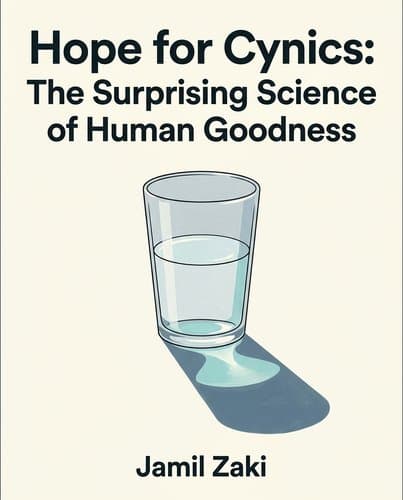
204593731_hope-for-cynics
by Jamil Zaki
Cynicism feels like clear-eyed wisdom but research proves it makes you less accurate, less healthy, and less successful than optimists.
In Brief
Hope for Cynics: The Surprising Science of Human Goodness (2024) challenges the assumption that distrust is a sign of intelligence, presenting research showing cynicism is both factually inaccurate and socially corrosive.
Key Ideas
Suspicion Correlates With Worse Detection
Run a 'cynical genius' check: if you find yourself choosing the most suspicious person in the room as the most trustworthy analyst, you're likely making the same error 85% of people make — distrust correlates with worse, not better, detection of deception
Count Real Interactions, Skip Forecasts
Track your actual social interactions for one week (encounter counting) — not your predictions about them. Research consistently shows our forecasts are darker than reality; your own data will likely correct the distortion faster than any argument
Visible Trust Generates 300% Returns
Distinguish between 'loud trust' and blind trust: make your trust visible and uncalculating when you extend it. Data from 23,000 people across 35 countries shows a single dollar of additional trust pays a 300% return — because it signals belief in the other person, which they tend to honor
Media Profits from Conflict Headlines
When consuming news, ask whether the source profits from conflict — every negative word in a headline increases clicks by 2%, creating a structural incentive to make human behavior look worse than it is. Supplement with solutions journalism (organizations like Solutions Journalism Network or Reasons to Be Cheerful)
Outliers Cannot Define Entire Groups
Notice 'welfare queen' logic wherever it appears — the pattern of using one extreme outlier to justify treating an entire group as suspects. The surveillance and proof-of-need bureaucracy this produces almost always costs more than the fraud it prevents
Cynicism Is Environmental, Not Fixed
Treat your cynicism as an environmental product, not a personality trait. The Brazilian fishing village research shows that cynicism and trust are shaped by the structural demands of your environment — which means they can be changed by changing the environment
Who Should Read This
Curious readers interested in Social Psychology and Positive Psychology and the science of how the mind actually works.
Hope for Cynics: The Surprising Science of Human Goodness
By Jamil Zaki
13 min read
Why does it matter? Because the cynicism you think is protecting you is actually the thing holding you back.
Most of us quietly believe that distrust is intelligence — that the person who assumes the worst has simply done the math faster than everyone else. It feels like experience talking. Like you've finally stopped being a sucker. But what if that hard-won skepticism is costing you money, shaving years off your life, and slowly hollowing out every relationship you value — while delivering almost none of the protection you think it buys? Jamil Zaki is a Stanford psychologist who spent years running a lab publicly dedicated to human goodness while privately convinced people were mostly rotten. What pulled him out wasn't therapy or optimism or a spiritual awakening. It was data — stubborn, uncomfortable evidence that our suspicion of each other is both wildly inaccurate and quietly catastrophic. This book is his case for something more rigorous than cynicism, and more honest than hope.
Cynicism Isn't Your Sharp Edge — It's Your Blind Spot
Most of us carry cynicism like a credential. The world has knocked us around enough times that we've stopped being surprised, and we take quiet pride in that. Distrust feels like discernment. But here's what the data actually show: the people we instinctively trust to find the truth are statistically worse at finding it.
Researchers gave people a simple hiring scenario. A company had been burned by dishonest new employees, so someone needed to screen future candidates more carefully. Two managers were available, equally qualified on paper. Sue assumed the best about people by default. Colleen assumed the opposite — that given the chance, most people would take advantage. Who would you assign to spot the liars? Eighty-five percent of participants chose Colleen. The reasoning was intuitive: someone already expecting deception would be harder to fool.
The reasoning was also wrong. Psychological research drawing on more than 200,000 people across thirty nations — led by Olga Stavrova at Tilburg University — found that cynics consistently score lower on tests of cognitive ability, problem-solving, and mathematical reasoning. When researchers tested lie detection specifically, cynics performed worse than non-cynics. The Colleens of the world, the ones we'd confidently station at the door, are the least equipped to catch anyone.
Scientists call the gap between our assumptions and reality here the cynical genius illusion. We've built a cultural portrait of the bitter, clear-eyed skeptic who sees through everyone, and the cheerful, trusting fool who gets taken in. The portrait is backward. Cynicism doesn't sharpen perception — it narrows it. When you've already decided people are out to get you, you stop gathering new information. Think of the manager who passes on a strong candidate because something felt off, or the person who brushes off a stranger's genuine offer as an angle they haven't figured out yet. You've reached your verdict before the evidence comes in.
That's not intelligence. That's a closed file. The hard thing to sit with is that cynicism can feel like experience talking — like you've earned your distrust honestly. But the data suggest you've also been paying a price you probably don't know you're paying.
Cynics Aren't Born — They're Manufactured
Andreas Leibbrandt needed a cheap way to visit his partner's family in Brazil, so he turned the trip into a research project. What he found upended something most of us assume without knowing we assume it: that our distrust is ours — grown from experience, earned through disappointment, a kind of scar tissue. It isn't. It gets manufactured around you, and then moves in.
Leibrandt studied two fishing villages forty miles apart. The lake village was solitary by design — men launched boats at 3 a.m. and spent the day alone, competing for the same patches of water. The ocean village was cooperative by necessity — the swells were too heavy, the equipment too large, for anyone to survive going it alone. Otherwise the communities were near-identical in size, income, and religion. Leibbrandt had both groups play a standard trust game, sending money to a stranger who could return it, double it, or pocket it. Lake fishermen sent less than 30 percent and got back even less. Ocean fishermen sent 40 percent and got back nearly half — investors actually came out ahead.
Here's the part that changes everything: new fishermen in both villages started with the same levels of trust. The workplace reshaped them over time. The lake didn't attract cynics; it built them. The ocean didn't recruit the generous; it produced them.
Cynicism isn't a personality trait you developed or a rational conclusion you reached — it's a predictable output of the environment you're inside. The environments most of us inhabit have been quietly engineered in the direction of the lake.
We Systematically Misread How Kind People Actually Are
How accurate is your picture of other people? Not your friends or coworkers — humanity in general. When you imagine the average stranger, how trustworthy do you actually think they are?
Zaki ran a simple test. He surveyed a thousand Americans about what happened to global kindness during the pandemic years. Most said it had dropped. They were wrong by a wide margin. The World Happiness Report found that volunteering, charitable giving, and helping strangers all rose significantly between 2020 and 2022. A separate meta-study tracked cooperation across sixty thousand people over six decades and found it climbed nine percent. The story most of us carry — that people are getting meaner, more selfish, less trustworthy — isn't a conclusion drawn from the evidence. It's a conclusion drawn from something else entirely.
That something else has a structural explanation, and it runs through your phone. Researchers analyzed over a hundred thousand headlines and found that each additional negative word increased click-through rates by two percent. Media companies noticed this long before the researchers did. The algorithm isn't neutral; it's been tuned, year by year, to serve you the most alarming version of events, because alarming events get clicks. Between 1990 and 2020, violent crime in the US fell by nearly half. Over that same period, Gallup polled Americans about crime trends almost every year, and in all but two surveys, the majority said crime was getting worse. The gap between reality and perception wasn't an accident — it was manufactured, one anxious headline at a time.
Evolution already primed you to notice threats over kindness. Media companies then built a business model on top of that wiring, feeding it exactly what makes it spike. The result is a worldview that feels like lived experience but is actually a product. You weren't wrong to trust your gut. You just didn't know someone had been working on your gut for years.
Your Distrust Actively Creates the Betrayal You Fear
In December 2001, Boston's firefighters started a new year under a new contract. For years, the city had treated them like a hostile witness — a newspaper exposé had accused the department of bleeding public funds, and the incoming chief responded by treating every injured firefighter as a probable fraud, forcing them to prove they weren't faking before a doctor and putting them on desk duty while they healed. No raises, either. After two years of protests and ugly standoffs outside the mayor's events, a deal was struck. Sick leave, previously taken as needed, would now be capped at fifteen days per year, and the chief made clear he'd be watching.
The result: in 2001, the entire department had taken around 6,400 sick days. In 2002, they took more than 13,000. Mysterious illness swept the ranks on the Fourth of July, Labor Day, and New Year's Eve. Stations went dark for days. The number of firefighters who took precisely fifteen sick days — the maximum allowed — jumped nearly tenfold. The chief had built a system designed to catch cheaters, and by doing so, had built an army of them.
Distrust isn't a passive shield. It's an instruction. When the chief told his firefighters 'I think you're liars,' they had one clean way to respond. The cynic reads the aftermath as confirmation. But the aftermath was manufactured.
The reverse is equally true, and here the numbers are stark. In a trust game played by more than 23,000 people across 35 countries, participants could send money to a stranger — whatever they sent was tripled, and the stranger could return as much or as little as they chose. Every additional dollar an investor sent paid back a 300 percent return, because recipients who felt trusted stepped up to meet that expectation. Economists call this earned trust: high expectations, reliably fulfilled. Stinginess sent a different signal and got a different answer.
The firefighter story and the trust game are the same story told from opposite ends. Your distrust doesn't describe the world — it edits it. And if you're willing to send a different signal, the world edits back.
Loneliness Is the Tax Cynicism Charges You Every Day
On New Year's Eve, Japanese artist Atsushi Watanabe was watching a streaming site when another viewer posted: 'The last time I saw the sky was Sea Day.' That was July. Watanabe realized, with horror, that the same was true for him. He had been in his room for nearly six months — surrounded by snacks, bottles of his own urine, and the certainty that the world outside had nothing for him. The cynical competition of art school had done it: a cutthroat environment where harassment was routine and rankings were everything. Rather than risk further humiliation, Watanabe had stopped risking anything at all.
His logic felt like protection. It was actually a tax.
The research on social interaction is almost embarrassingly consistent: we predict these moments will be far worse than they turn out to be. In studies of Chicago and London commuters, fewer than one in four said they'd willingly talk to a stranger on their commute — they expected awkwardness, rejection, silence. When researchers instructed them to do it anyway, most described it as a highlight of their day. The shark attack they'd been dreading almost never came.
Jamil Zaki's lab at Stanford found the same distortion at scale. Students were asked to rate themselves, then to imagine their average peer. When they described themselves, the campus looked warm: 85% wanted new friends, and 95% said they enjoyed helping peers in distress. When those same students described the typical person sitting next to them in class, that person was cold, judgmental, and indifferent. Two campuses, same zip code. The imagined one kept students from reaching out to the real one.
That's the trap loneliness sets. You withdraw to protect yourself from people you've decided are unfriendly. Because you've withdrawn, you never collect the evidence that would prove you wrong. The fear stays pristine, untested, and grows. Meanwhile, the isolation itself becomes the damage. Loneliness raises mortality risk as much as smoking fifteen cigarettes a day. It also makes you physically sicker — measurably, down to how much mucus you produce when exposed to a cold virus.
Watanabe's way out started with one conversation — his mother, a coffee table, and hours of talking they'd both been avoiding for years. The world he'd been certain was closed turned out to be waiting.
Institutions Built on Suspicion Destroy the Very Thing They're Trying to Protect
Imagine you hire a security guard specifically because you fear shoplifters, but the guard's visible suspicion — following customers, demanding receipts mid-aisle, patting down anyone in a hoodie — drives away honest shoppers while teaching the actual thieves exactly which behaviors trigger attention. You've built a system that generates the problem it was meant to prevent.
Institutional suspicion runs on the same logic. Under Steve Ballmer, Microsoft required every six months that managers sort employees into winners and losers, with the bottom tier culled regardless of overall team talent. The engineers adapted rationally. Rather than collaborate, they avoided working alongside talented peers who might outrank them. One engineer described learning to seem friendly while deliberately withholding just enough information to keep colleagues slightly behind him. Rumors spread. Credit became contested. Cooperation — the actual engine of good work — was the first casualty. The surveillance was meant to find underperformers; instead, it manufactured them. When Satya Nadella took over and replaced that system with one that evaluated people partly on how well they supported colleagues, the culture's entire logic flipped. The market cap grew tenfold.
The same trap runs through public policy. In 1976, Ronald Reagan began campaigning on the story of a Chicago woman who used dozens of aliases to steal hundreds of thousands in public benefits. The story was real — but that woman, Linda Taylor, was also a suspected murderer and child trafficker, an outlier so extreme she barely qualifies as data. Reagan repeated the story until she became a symbol of an entire class. Fraud investigations jumped 700 percent over the following decade. Auditors found almost nothing: a 2018 analysis found just fourteen fraudulent households per ten thousand in the food stamp program. The manhunt was expensive, demoralizing, and largely pointless.
But it worked politically, because the myth of the scheming poor person licenses what follows: a twenty-six-page application to access food stamps, interrogations about when a child was conceived, forms that tax mental bandwidth. Research by Sendhil Mullainathan and Eldar Shafir found that navigating scarcity depletes cognitive capacity roughly as much as missing a full night of sleep. The requirements aren't neutral administration. They're preemptive punishment administered to everyone, for a crime almost no one commits.
This is the wider stake. Cynicism isn't just a personal miscalibration — it's a political tool. Convince people the poor are cheats, the workers are slackers, the neighbors are grifters, and you've neutralized the pressure for anything to change. Suspicion is the sedative authoritarians and apologists for inequality have always reached for first.
Political Polarization Is a Trick — And We Keep Falling For It
The political divide you feel is real. The size of it almost certainly isn't.
Researchers studying American partisanship found a consistent pattern they call false polarization: we systematically imagine the other side as a fringe that barely exists. Democrats estimate that only 35 percent of Republicans believe Americans should learn from history and fix past mistakes. The actual figure is 93 percent. Republicans think only 40 percent of Democrats respect the Constitution. The real number is 80 percent. Both sides are steering by a portrait of the other that shares almost no resemblance to the actual person.
This misperception doesn't form in a vacuum. It gets manufactured. A specific class of people — cable news executives, partisan influencers, ideological entertainers — profit directly from keeping you convinced that your neighbors are monsters. Their main tool is what researchers call 'nut picking': lifting the most extreme person in any group and presenting them as the average. You're meant to see every conservative as a militia organizer and every progressive as a campus agitator. The fringe gets promoted to the mean, and the actual majority — which, on dozens of policy questions, quietly agrees with itself — disappears.
This is where the stakes grow larger than any single election. Emile Bruneau and Colombian researcher Andrés Casas found something startling in the aftermath of Colombia's 2016 peace referendum, when Colombians narrowly voted down a deal to end fifty years of civil war. The people most likely to reject peace were urbanites who had never met a guerrilla fighter and absorbed only the propaganda version of the conflict. Those who lived near the violence — who had actual information — voted for the deal. Bruneau and Casas then showed urban Colombians humanizing video interviews with ex-FARC members, many of them peasant farmers who joined after watching their families get killed. Support for reintegration shifted significantly and held three months later. Not because they were tricked. Because they finally had accurate information.
Vladimir Putin's propagandists understood the inverse of this. RAND researchers who studied Russian state media found it wasn't designed to convince citizens of any particular truth — it deliberately contradicted itself, cycling through incompatible claims. The goal wasn't belief. It was exhaustion. After watching it, Russians reported feeling politically hopeless. 'I don't see any reason to get involved,' one said.
Cynicism about politics isn't a sign of sophistication. It's the intended product. When you're convinced nothing can change and everyone on the other side is beyond reach, you stay home — and the people engineering that conviction are counting on it.
Climate Doomerism Is Cynicism With a Scientific Veneer
Climate despair feels like the rational response to the data — and that's exactly what makes it dangerous. The real problem isn't that doomers are wrong about the warming, the disasters, or the gap between Paris targets and actual trajectories. The problem is that doomerism smuggles in a second claim that has nothing to do with atmospheric chemistry: that people are too selfish and shortsighted to do anything about it. That claim isn't science. It's a story with an author.
The author is Garrett Hardin. His 1968 essay imagining herdsmen overgrazing a shared pasture until it turns to dust became the intellectual foundation of climate fatalism — and it was written by a man who spent his later career advocating forced sterilization, letting famine kill off poorer nations, and declaring multiethnic societies a disaster. His assumption of bottomless human greed wasn't derived from data. Hardin admitted he simply asked readers to imagine a pasture. He never checked whether real ones worked that way. Elinor Ostrom did, and won a Nobel Prize for it. She studied Valencia's irrigation collectives, which had allocated scarce water across competing farms for seven centuries, and Switzerland's Alpine meadows, where villages had grazed shared land without destroying it for longer still. Communities, it turned out, could manage common resources just fine — when they built the right rules.
Hardin was wrong about human nature. He was useful to the people who needed him to be right. The 'carbon footprint' — that number you feel guilty about when you fly — was invented by British Petroleum in a 2004 advertising campaign specifically designed to reframe the climate crisis as a problem of individual carelessness, not corporate extraction. The math on actual responsibility tells a different story: two-thirds of industrial carbon emissions over the past century and a half trace back to just ninety companies. When everyone is to blame, no one especially is — and BP continued devoting only two cents of every dollar to renewables while the rest of us calculated our personal scores.
Doomerism is cynicism with a scientific veneer, and it serves the same function cynicism always does: it keeps you passive while someone else runs the table.
Hope Is a Skill You Can Build — Not a Feeling You Have to Wait For
After Emile Bruneau received his brain cancer diagnosis — fresh from surgery, a tumor just removed from his skull — he convened a group of researchers at his home and issued them a challenge: go to war-torn places, speak with suffering people, put science to work for peace. Watching that, most of us would assume we're seeing something we either have or we don't. A disposition. A gift. The product of a life we didn't live.
Zaki's argument is that we're wrong. Hope isn't a feeling you wait around to have. It's closer to what Bruneau's widow Stephanie meant when she said grief is a muscle: the weight doesn't shrink, but you get stronger at carrying it. You build the capacity through practice.
The practices Zaki offers are specific enough to start tonight. The first he calls values-affirmation, which sounds like corporate wellness but isn't: you write down what actually matters to you and why. The point isn't motivation. When you're grounded in your own priorities, you're less threatened by evidence that contradicts what you believe, which means you can actually update when you're wrong. The second is encounter counting. Spend one day tracking your real social interactions — negative to positive — then compare the results to what you predicted. Most people find their predictions were gloomier than the data. You've been navigating by a broken compass, and your own evidence fixes it faster than any argument could. The third is trusting loudly: when you extend trust to someone, say so out loud. Tell them you're acting this way because you believe in them. Zaki's trust-game research shows that recipients who feel genuinely trusted return more. Making the trust visible and explicit changes what happens next.
The distinction Zaki draws between optimism and hope is what makes the whole framework hold. Optimism insists things will be better. Hope only requires that they could be — that the future isn't foreclosed. Given the evidence, that turns out to be the more accurate position. You don't need Bruneau's temperament to hold it. You need the right habits.
What Emile Knew That the Data Confirms
Here's what's worth sitting with: Emile Bruneau spent his career studying people who hated each other — Israelis and Palestinians, Americans and Arabs, Hungarians and refugees — and what he kept finding wasn't that hatred was natural. It was that it required work. Sustained effort. Propaganda, manufactured scarcity, years of curated fear. At one point he traced a single hate campaign in Hungary and found it cost the government more in media coordination than the refugee program it was opposing. Hatred is expensive. Kindness is closer to the default. That's not sentiment — it held up across dozens of countries, hundreds of studies, sixty years of cooperation data. The skeptical position, followed far enough, arrives somewhere most skeptics don't expect: the evidence for human goodness is stronger than the evidence against it. Which means hope isn't the soft option. It's the rigorous one. So write down what you value. Count your real interactions for a day — the ones where someone actually showed up. Tell someone you trust them, and say why. You don't have to feel optimistic first. Do those things, and you'll have handed yourself the same data Bruneau spent a career collecting.
Notable Quotes
“view[s] people very positively, and her default expectation is that everyone she meets is basically trustworthy.”
“people will try to get away with everything they can.”
“the power of accurate observation is commonly called cynicism by those who haven’t got it.”
Frequently Asked Questions
- What is 'Hope for Cynics' by Jamil Zaki about?
- "Hope for Cynics" (2024) challenges the widespread belief that distrust signals intelligence, presenting scientific evidence that cynicism is both inaccurate and socially damaging. Jamil Zaki introduces "hopeful skepticism"—an evidence-based approach to trusting others while remaining critically aware. The book draws on research across cultures and contexts to demonstrate how distorted perceptions of human behavior shape our relationships and social systems. Zaki provides practical tools and insights from behavioral science to help readers correct these distortions, build more cooperative connections, and embrace a more accurate understanding of human nature. Rather than promoting blind trust, the work advocates for trust grounded in evidence.
- What are the key takeaways from 'Hope for Cynics'?
- The book offers six main insights: first, distrust doesn't improve lie detection—"if you find yourself choosing the most suspicious person in the room as the most trustworthy analyst, you're likely making the same error 85% of people make." Second, track actual social interactions rather than predictions; our forecasts are darker than reality. Third, "make your trust visible and uncalculating when you extend it"—one dollar of additional trust returns 300%. Fourth, supplement negative news coverage with solutions journalism, since "every negative word in a headline increases clicks by 2%." Fifth, avoid using extreme outliers to justify treating groups as suspects. Finally, view cynicism as environmental, not innate—it can be changed by altering structural conditions.
- What does 'Hope for Cynics' say about cynicism and intelligence?
- "Hope for Cynics" directly challenges the assumption that cynicism indicates intelligence. Research presented in the book shows that "distrust correlates with worse, not better, detection of deception"—meaning skeptical people are actually less effective at identifying lies than trusting individuals. The book argues that 85% of people make this error, confusing cynicism with discernment. Zaki introduces the concept of "hopeful skepticism" as an alternative that combines critical thinking with evidence-based trust. This approach enables readers to maintain analytical rigor while avoiding the blind spots that cynicism creates. Intelligence lies not in maximum suspicion, but in calibrating trust appropriately based on actual evidence.
- What practical strategies does 'Hope for Cynics' recommend to reduce cynicism?
- Zaki recommends several practical strategies. First, conduct an "encounter counting" exercise: track your actual social interactions for one week rather than relying on predictions. Research shows "our forecasts are darker than reality; your own data will likely correct the distortion faster than any argument." Second, examine your news consumption and supplement outlets that profit from negativity with solutions journalism sources. Third, recognize cynicism as an environmental product, not a fixed trait. The book cites research showing "cynicism and trust are shaped by the structural demands of your environment—which means they can be changed by changing the environment." This suggests that reducing cynicism involves both individual practices and systemic changes.
Related Book Summaries
Read the full summary of 204593731_hope-for-cynics on InShort