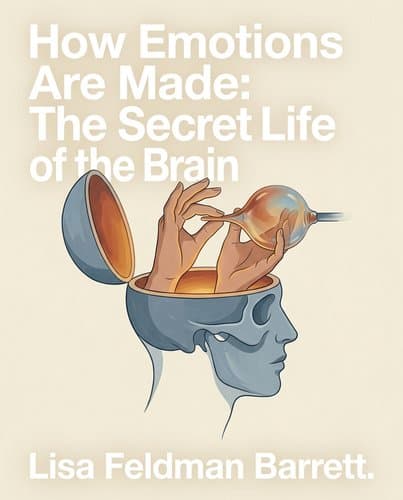
23719305_how-emotions-are-made
by Lisa Feldman Barrett
Your emotions aren't reactions to the world—they're predictions your brain constructs using past experience and cultural concepts, meaning you can literally…
In Brief
How Emotions Are Made: The Secret Life of the Brain (2017) challenges the common assumption that emotions are hardwired reactions, arguing instead that the brain actively constructs them from past experience, bodily signals, and cultural concepts.
Key Ideas
Emotions Are Brain Constructions, Not Readouts
Your emotions are not detected by your brain — they are constructed by it, using past experience, bodily sensation, and cultural concepts as raw ingredients. This means they can be built differently.
Body Budget Directly Affects Emotional State
Affect (the background hum of pleasant/unpleasant, calm/agitated) is a prediction about your body's needs, not an accurate readout of them. Keeping your body budget balanced — sleep, food, movement, social connection — is the most direct lever you have on how you feel.
Precise Words Create New Emotional Categories
Expand your emotion vocabulary deliberately. Learning precise words for emotional states — in any language — seeds new predictive categories your brain can use. 'Feeling bad' is a blunt instrument; 'remorseful,' 'apprehensive,' 'deflated,' and 'dread-ridden' are surgical tools.
Recategorized Anxiety Changes Body Physiology
Recategorization works physiologically, not just psychologically. Labeling pre-exam anxiety as 'my body preparing' rather than 'I'm going to fail' measurably changes inflammatory markers and performance outcomes. The reframe isn't self-deception — it's a more accurate description of what your aroused nervous system is actually doing.
Curiosity Prevents Mistaking Predictions for Reality
Affective realism — feeling something as a property of the world rather than of your own predictions — is not a flaw to overcome but a feature of how the brain is wired. The best defense is intellectual curiosity: staying genuinely uncertain about whether your gut read is accurate before acting on it.
Skepticism Toward Emotion Detection Claims Required
The classical view of emotion is embedded in medical diagnosis, legal sentencing, and security screening. Being aware of this means questioning diagnoses that map symptoms onto gender stereotypes, and skepticism toward any technology that claims to 'read' emotions from faces.
Who Should Read This
Curious readers interested in Neuroscience and Cognitive Psychology and the science of how the mind actually works.
How Emotions Are Made: The Secret Life of the Brain
By Lisa Feldman Barrett
13 min read
Why does it matter? Because the emotions you think are happening to you are actually being made by you.
You already know what fear looks like. You've seen it — that wide-eyed, open-mouthed mask — in movies, in textbooks, on emoji. You can spot it on a stranger's face across a crowded room. Except: a century of experiments, conducted on tens of thousands of people, has failed to find a single consistent biological fingerprint for that expression, or for any emotion. Women who arrive at emergency rooms with classic heart attack symptoms get sent home with anxiety diagnoses, and die. Intelligence analysts misread foreign leaders as bluffing when they're not, and wars begin. Your brain has been confidently perceiving emotions it was actually constructing all along. Barrett spent her career trying to confirm what everyone assumed was true, and couldn't. What she found instead is stranger and more useful: every feeling you've ever had was assembled on the fly by a brain running predictions. Which means you're not at the mercy of your emotions. You're their author.
A Century of Science Failed to Find What You Think Is Obvious
At a neuroscience conference, a colleague roughly the size of a linebacker pulled back his fist and offered to punch Lisa Feldman Barrett in the face. He wanted to show her what real anger looked like. What he actually showed her — red-faced, jabbing a finger at the air, coiled like he might actually do it — was something she'd been arguing from the podium: that anger doesn't come in one form.
Barrett had spent years chasing what seemed like it should be easy to find: the biological signature of an emotion. The premise she started with — the one most of us carry without questioning — is that emotions are hardwired responses, universal across humanity, readable in the face and measurable in the body and locatable in the brain. Anger comes with a scowl. Fear widens the eyes. The amygdala fires. The heart rate shifts in a specific, predictable way. These are supposed to be the fingerprints.
Except they don't hold up. Four separate meta-analyses — together covering more than 220 physiology studies and roughly 22,000 subjects — went looking for consistent bodily signatures that would distinguish one emotion from another. They found none. Anger doesn't reliably produce a specific pattern of heart rate, sweating, and skin temperature that sets it apart from fear or sadness. The body produces many different physiological states during anger, depending on the person and the situation. Variation is the consistent finding, not uniformity.
The brain tells the same story. A woman known in the research literature as SM had a rare disease that destroyed her amygdalae — the structures long considered the brain's fear circuit. She watched horror films without flinching and walked through a haunted house unfazed. Scientists treated this as confirmation: no amygdala, no fear. Then they asked her to breathe air enriched with carbon dioxide. She panicked. The supposed fear center was gone, but fear wasn't. Meanwhile, identical twins with the same genetic disease and the same amygdala damage showed completely different fear responses — one with deficits similar to SM's, the other with essentially normal fear. Same DNA, same damage, different outcomes.
What Barrett found, after searching the face, the body, and the brain, is that emotions aren't reflexes with signatures. They're categories — messy, variable, named more by family resemblance than shared biology. Which raises a harder question than it first appears: if your brain isn't running a built-in emotional program when you feel afraid or furious, what is it actually doing?
Your Brain Is a Prediction Machine, Not a Reaction Machine
What exactly is it doing? Lisa Barrett has an answer — and the clearest way she found to explain it was with a story that embarrassed her.
She was sitting across from a man she'd just decided she was attracted to. Her face kept flushing. Her stomach was doing something complicated. She agreed to a second date, walked home, and immediately got the flu. For the next seven days she lay in bed with a thermometer, having apparently mistaken a fever for romantic interest.
Barrett doesn't tell this story as an embarrassing footnote. She tells it as the whole argument. Her brain hadn't malfunctioned. It had done exactly what brains always do: taken ambiguous physical sensations — heat, flutter, distraction — and asked what was the most plausible explanation given the current situation. The answer it landed on was attraction, not influenza, because she was on a date. In a different context — lying in bed with chills — the same sensations would have produced an obvious instance of feeling sick. Context decided which emotion got constructed.
This is the inversion Barrett is driving toward. We tend to think the sequence runs: something happens, the body responds, the emotion appears. The actual sequence is nearly the opposite. Your brain is predicting constantly — building a model of what is probably happening, including what is probably happening inside your body — before any sensation arrives. Your body-budgeting circuitry is already issuing instructions to the heart, lungs, and adrenal glands based on what it anticipates you'll need next. The sensations you feel are mostly outputs of these predictions, not incoming reports from your organs. You feel what your brain has already decided you should be feeling.
The visual cortex offers the starkest proof. There are roughly ten times as many neural projections running from the cortex down to the thalamus as there are running up from the eyes. The brain is mostly talking to itself, then checking that talk against a small trickle of incoming data. Perception isn't detection. It's a hypothesis, tested against reality.
Barrett's flu date shows where this gets consequential. When the brain constructs an emotion, it isn't reading off a pre-written script triggered by events. It's making its best guess about what your bodily state means, given everything around you. Get the context wrong — or give the brain a misleading context, like a coffee shop date — and the emotion that gets built will be wrong too. Not as a failure, but as a feature. You are the architect of your own emotional experience. The building just goes up faster than you can watch.
Emotions Are Not Universal — They Are Culturally Assembled Concepts
Maria Gendron drove twelve hours into northern Namibia, then navigated bush tracks toward the Angola border using mountains and the sun as landmarks. At night she slept on top of her Land Rover to avoid snakes and scorpions. Her destination was a Himba village — one of the few remaining communities with minimal exposure to Western culture — and she'd brought 36 photographs of actors posing what Westerners treat as the standard emotional expressions: smiling, scowling, wide-eyed, pouting.
The Himba sorted the photos into two main piles. Smiling faces together, wide-eyed faces together, a few mixed piles for the rest. Not six emotion categories. Two. And when asked what the wide-eyed faces showed, they didn't say "fearful." They said "looking" — a description of behavior, not a mental state. Smiling faces weren't "happy"; they were "laughing." The Himba weren't misidentifying emotions. They were sorting the images the way someone would who had never learned that a wide-open eye is supposed to signal an internal feeling called fear.
This is uncomfortable for the classic story about universal emotions. For decades, researchers showed people posed facial photographs alongside a short list of emotion words — happy, sad, angry, afraid — and subjects worldwide chose the expected match about 85% of the time. The conclusion seemed obvious: emotions are universal, recognizable across all cultures. But the word list was doing enormous invisible work. By presenting "fear" as one of six options, researchers were handing subjects the conceptual key they needed to unlock the face. Remove the word list and ask people to label freely, and that 85% drops to 58%. Temporarily disable access to emotion concepts — by having subjects repeat a word like "anger" until it becomes meaningless sound — and performance falls to 36%. Nearly two-thirds of judgments collapse.
The people who couldn't sort faces into "fear" and "anger" weren't failing a test. They were demonstrating that emotion perception isn't a built-in decoding ability. It's a skill assembled from concepts — learned categories that tell your brain what a pattern of sensations means. Give someone the concept "fear" along with its cultural scaffolding (what causes it, what it signals, how to respond), and wide eyes start looking frightened. Without that concept, they look like someone paying close attention.
The implication is stranger than it first appears. Emotions are real — but real the way money is real, or the way a weed is different from a flower. Not properties sitting in faces waiting to be detected, but categories that require a perceiver equipped with the right conceptual tools. The Himba weren't wrong about the photographs. They were right, from inside a different conceptual world.
You Feel What Your Brain Believes, Not What the World Contains
Your affect — that background hum of feeling good or bad, calm or agitated, what Barrett calls the brain's ongoing feeling-tone — is not a readout of what's happening in your body or your world. It's a prediction your brain generated before anything arrived.
Here's what makes this concrete. Israeli researchers tracked a group of judges over the course of parole hearings and found that a prisoner's chance of being released hovered around 65 percent right after the judges had eaten, then dropped steadily toward zero as the session wore on, then snapped back to 65 percent after the next meal break. The judges weren't reviewing worse cases before lunch. They were experiencing their own interoceptive state — low blood sugar, fatigue, the subtle urgency of hunger — and their brains were attributing that feeling to the prisoner in front of them. The defendant felt risky. The case felt unpromising. The judges experienced their hunger as a moral judgment, and acted on it accordingly.
Barrett calls this affective realism: the brain's tendency to treat its own internal predictions as facts about the outside world. You don't experience your hunger as hunger when you're focused on a defendant — you experience the defendant as undeserving of another chance. The feeling isn't attached to you; it's attached to him. Affective realism also shows up in more consequential rooms. Philadelphia police shooting records from 2007 to 2013 found that in roughly half the cases where unarmed people were killed, officers had misidentified a cell phone or a waistband adjustment as a weapon. The affect came first. The threat was constructed around it.
The mechanism runs deeper than mood coloring perception. Your body-budgeting circuitry — the regions that predict your heart rate, cortisol levels, glucose needs, and blood vessel dilation — is the loudest system in your brain, issuing predictions outward to every other system, including your visual and auditory cortex. What you feel shapes what you see and hear. The outside world barely gets a word in. Most of the signal in any brain-imaging experiment reflects intrinsic activity — the brain's ongoing self-talk — not the photos or sounds being presented.
Neurosurgeon Helen Mayberg made this literal. Working with patients in agony from treatment-resistant depression, she sank electrodes into a key node of the interoceptive network and switched the current on. The patients reported immediate relief. Switch it off: the dread returned. Toggle it on: gone again. The feeling wasn't coming from the world — it was being generated by a predictive circuit, switchable as a light.
You feel what your brain already believes you should be feeling. The world is mostly a passenger confirming or nudging those predictions, not driving them.
The Science of Emotion Has Been Running on a 100-Year-Old Misreading
The story of how we got here starts with a mistake, and then another mistake built on top of it.
That's what Barret found when she traced the classical view of emotion back to its sources.
Darwin is the natural starting point, and this is where things get strange. His greatest contribution to biology was destroying the idea that each species has a fixed, ideal form. Before Darwin, a greyhound that ran unusually slow was simply a bad greyhound — a deviation from the essence. Darwin showed that variation within a species is the whole point: it's the raw material natural selection works on. No ideal type exists. The evolutionary biologist Ernst Mayr described this as freeing biology from "the paralyzing grip of essentionism" — the belief that living things have fixed, essential natures that variation merely obscures. And then, thirteen years later, Darwin wrote The Expression of the Emotions in Man and Animals — and did exactly the opposite. He assigned emotional essences to species, claimed insects express jealousy and love when they rub their legs together, and suggested emotional imbalance could cause frizzy hair. The man who dismantled essentialism in biology quietly reinstalled it in the emotional world, apparently without noticing.
From that crack, a larger fracture spread. William James — whose thousand-page Principles of Psychology is still foundational to the field — is widely credited with arguing that each emotion category has a distinct bodily signature. Generations of researchers have hunted through heart rate and respiration looking for those signatures. The problem: James never said that. What he actually wrote was that each individual instance of an emotion involves a unique bodily state. His own example: fear of getting wet is not the same fear as fear of a bear. Two fears, same label, completely different physical experience. That's not a universal fingerprint — it's a claim about irreversible variation. A philosopher named John Dewey then grafted Darwin's essentialism onto James's anti-essentialism, named the result after James, and the inversion moved forward into the present, including into influential theories of emotion you've almost certainly encountered.
The foundation was never solid. It was built on a misreading of a misreading.
Getting Emotions Wrong Has Consequences You Can Measure in Lives
The classical-versus-constructed emotion debate might sound like something professors settle over coffee. It isn't. The stakes show up in hospital records, courtroom transcripts, and body counts.
Start with the quieter version. When a woman over sixty-five arrives in an emergency room reporting chest pressure and shortness of breath, her doctors — shaped by a culture that codes women as more emotional, more anxious, more prone to psychosomatic complaints — are more likely to send her home with an anxiety diagnosis. A man with identical symptoms gets treated for heart disease. The classical view of emotion, with its assumption that feelings are universal and readable and that women naturally have more of them, is baked into clinical intuition. Women over sixty-five die of heart attacks at higher rates than men as a direct consequence. The misreading isn't exotic. It's in the triage decision.
Scale that error up. Before the Gulf War, Saddam Hussein's half-brother sat across from American negotiators and read their faces, their posture, the micro-signals he believed revealed what people were actually feeling. He concluded the Americans weren't serious about attacking. He told Saddam. Saddam stayed. The war happened. Roughly 175,000 Iraqis died, along with hundreds of coalition soldiers — a catastrophe seeded, at least in part, by one man's certainty that he could read emotion from behavior. The same certainty Barrett spent her career dismantling.
What both cases share is a belief that emotion is something you can detect — in a face, a voice, a set of symptoms — if you're paying close enough attention. Barrett's research shows this belief is wrong at the level of basic mechanism. Emotion isn't transmitted from one person and received by another. It's constructed by the perceiver, using concepts assembled from their particular culture and history. Get those concepts wrong, or apply them across a cultural gap they weren't built to cross, and what feels like clear perception is confident error. The confidence is the problem. It forecloses the doubt that might save a life.
Your Emotional Vocabulary Is Your Emotional Range
What would it mean to actually get better at emotions — not at suppressing them or soldiering through them, but at having them more precisely? The answer Barrett arrives at is disorienting at first: it means expanding your vocabulary.
The brain constructs emotions by predicting what a set of sensations probably means, given your situation and everything you've learned before. What predictions are even available depends on the concepts you carry. If your working categories are 'feeling good' and 'feeling terrible,' that's the resolution your brain has to work with — a two-pixel image of your inner life. Someone who can distinguish dread from melancholy, irritation from contempt, anticipation from anxiety, has a finer-grained toolkit. Their brain can predict more precisely, which means it can calibrate the body's response more precisely, which turns out to have measurable physical consequences. People with richer emotion concepts go to the doctor less, take fewer medications, and spend fewer days in the hospital.
The fastest way to add new concepts, Barrett argues, is through words. Not because labels are magic, but because a word invites your brain to start noticing a pattern it had no category for before. The Dutch term gezellig — the specific warmth of being home with people you love, a feeling that belongs to the shared situation rather than any individual — doesn't translate neatly into English. But once you have the word, you have a hook. The next time you're at a friend's kitchen table on a winter evening, you might reach for it — and something that would have dissolved into vague contentment instead gets filed, sharpened, built into a concept you can actually use. You've given yourself a new tool. And that tool is genuinely available the next time your body sends ambiguous signals.
This is what Barrett means when she says emotional intelligence is about the richness of your conceptual toolkit, not your ability to read other people's faces. You can't expand the range of your emotional life by trying harder to detect what's already there. You expand it by building new categories — through words, through reading, through paying deliberate attention to experiences you'd otherwise let pass unnamed. The range of what you can feel is not fixed. It's the current size of your vocabulary, and vocabularies grow.
The Architect You Already Are
Here is what Barrett's argument finally asks of you: not that you stop trusting your emotions, but that you take authorship of them seriously. Your emotional life was built from ingredients you mostly inherited without knowing — the concepts your language gave you, the culture that decided which feelings were nameable and which weren't, the body budget you keep or neglect. None of that is fixed. The parole judge who ruled against every defendant reviewed before lunch wasn't a bad person; he was a depleted one, making predictions his brain dressed up as justice. Sleep changes your predictions. A new word for an old feeling changes them — which is why the Himba, with no single term for blue and green, aren't being poetic when they see those colors differently; they're working with different materials. Staying genuinely curious about whether your read of a situation is accurate — rather than assuming you already know — changes them too. You've been constructing your emotional world all along. The only question is whether you'd like to do it more deliberately.
Notable Quotes
“Are you saying that in a frustrating, humiliating situation, not everyone will get angry so that their blood boils and their palms sweat and their cheeks flush?”
“automatically with little effort? Or would you answer”
“in each case, or simply,”
Frequently Asked Questions
- What is the main argument of How Emotions Are Made?
- The main argument is that "Your emotions are not detected by your brain — they are constructed by it, using past experience, bodily sensation, and cultural concepts as raw ingredients." This challenges the assumption that emotions are hardwired reactions. Instead, Barrett argues the brain actively constructs emotions from these ingredients, meaning they can be built differently. This constructionist view gives you agency to reshape how you feel through expanding your emotional vocabulary, maintaining your body budget, and reframing physical sensations. The book draws on neuroscience and psychology to support this revolutionary perspective on emotion.
- What are practical tools to change how your emotions are built?
- The book offers three concrete strategies. First, expand your emotion vocabulary deliberately—learning precise words for emotional states seeds new predictive categories your brain can use. Second, maintain your body budget through sleep, food, movement, and social connection, which is "the most direct lever you have on how you feel." Third, practice recategorization: labeling pre-exam anxiety as "my body preparing" rather than "I'm going to fail" measurably changes inflammatory markers and performance. These methods are physiologically grounded, not psychological tricks—they work by changing how your brain constructs experience.
- Why is expanding emotional vocabulary important according to this book?
- Expanding emotional vocabulary creates new predictive categories your brain can use. Barrett emphasizes that "Learning precise words for emotional states — in any language — seeds new predictive categories your brain can use." She illustrates the power: "'Feeling bad' is a blunt instrument; 'remorseful,' 'apprehensive,' 'deflated,' and 'dread-ridden' are surgical tools." By learning precise language for subtle emotional states, you give your brain refined instruments to construct and manage emotions. This isn't merely semantic—different words map to different bodily patterns and neural configurations, giving you measurable control over emotional response.
- What does the book say about skepticism toward emotional diagnoses and technology?
- Barrett warns that "The classical view of emotion is embedded in medical diagnosis, legal sentencing, and security screening," creating biased outcomes. She urges questioning diagnoses that map symptoms onto gender stereotypes and skepticism toward any technology claiming to 'read' emotions from faces. She also introduces affective realism—our tendency to feel something as a property of the world rather than our own predictions—as "a feature of how the brain is wired." The best defense is intellectual curiosity: staying genuinely uncertain about whether your gut read is accurate before acting on it.
Related Book Summaries

Read the full summary of 23719305_how-emotions-are-made on InShort