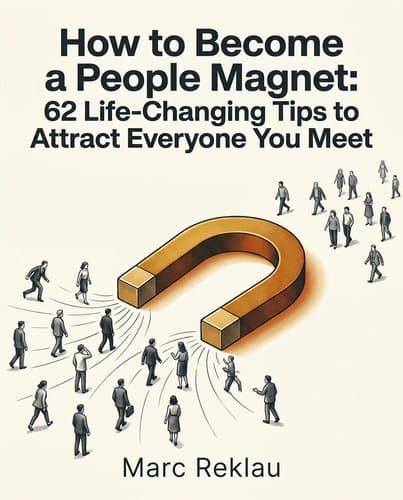
50841095_how-to-become-a-people-magnet
by Marc Reklau
Likability isn't charisma—it's a learnable skill built on one insight: people care about themselves first. Master 62 concrete techniques to shift your…
In Brief
How to Become a People Magnet: 62 Life-Changing Tips to Attract Everyone You Meet (2019) distills the psychology of likability into 62 practical techniques built on a single insight: people are drawn to those who make them feel seen and valued.
Key Ideas
Understand what people want from interactions
Before any meeting or conversation, ask: 'What does this person want from this interaction?' Then shape your contribution around that — not what you want to say.
Shift focus from yourself to others
Swap 'I,' 'my,' and 'mine' for 'you' and 'your' in everyday conversation. The linguistic shift is small; the relational effect is disproportionately large.
Praise specific behaviors not the person
Praise behavior, not the person, and make it specific: 'The way you opened that meeting shifted the dynamic immediately' lands differently than 'You're a natural leader.'
Lead corrections with your own failures
When correction is unavoidable, lead with your own relevant failures first. Admitting you made the same mistake disarms defensiveness before it forms.
Convert adversarial exchanges into collaboration
Replace 'I'm going to prove this to you' with 'I might be wrong, but let's look at it.' Six words that convert an adversarial exchange into a collaborative one.
See the insecurity behind difficult behavior
When someone seems arrogant or difficult, ask yourself: 'Is this confidence, or is this someone who needs to feel seen?' The answer usually changes what you do next — and the outcome.
Who Should Read This
People working on personal growth in Networking and Persuasion, especially those tired of generic motivational advice.
How to Become a People Magnet: 62 Life-Changing Tips to Attract Everyone You Meet
By Marc Reklau
10 min read
Why does it matter? Because the social skills you think are either natural or fake are actually just behaviors — calibrated to how people actually work.
Some people make you feel, within sixty seconds of meeting them, like they've been waiting to talk to you specifically. You've probably chalked this up to personality — a gift, an accident of wiring. Marc Reklau spent years testing that assumption across sales calls, restaurant floors, and thousands of awkward first meetings, and what he found is both simpler and stranger than charisma: every technique that actually works traces back to one insight about human psychology. A single, slightly unflattering premise that most people resist accepting about themselves. Once you sit with it, the whole project of being more likable stops feeling like performance — and starts looking like calibration. The question worth carrying in: what is it? The discomfort is easier to explain — it says something slightly unflattering about you too.
People Are a Thousand Times More Interested in Themselves Than in You — and That's Not Cynicism, It's the Foundation
Here's the uncomfortable thing Reklau states on the first page and never walks back: the person you're trying to impress, persuade, or connect with is a thousand times more interested in themselves than in you. Not a little more interested. A thousand times. He says it twice, adds "no judgment here" both times, and then immediately turns the lens around — "I bet you are too, right?" That move converts what sounds like an accusation into a shared condition. You're not being told you're surrounded by narcissists. You're being told you are one, exactly like everyone else, and that this changes everything.
Most people approach people skills as either something you're born with (a warmth or magnetism you can't manufacture) or a set of techniques you layer on top of normal behavior. Both get it wrong. The techniques work because they're calibrated to something already true. People are oriented toward themselves the way objects are oriented toward gravity. You don't fight gravity by being more charismatic. You work with it.
That's what happens when you stop trying to be interesting and start being interested. When you replace "I," "my," and "mine" with "you" and "yours" in a conversation, or ask someone how their family is doing and actually wait for the answer, you're not performing warmth — you're aligning with a force that's already running. The person in front of you has a favorite subject, and it's themselves. Hand them that subject and they experience the conversation as unusually good. They leave thinking you're perceptive, genuine, easy to talk to. You didn't charm them. You gave them what they were already looking for.
The stakes Reklau attaches to all this come from a line he borrows from salesman-turned-author Les Giblin: getting genuinely good with people takes you 85% of the way to professional success and 99% of the way to happiness. Most people optimize for intelligence, skills, credentials. That's the wrong axis. Anyone who's watched a less technically gifted colleague get promoted on pure likability knows this already. Not because people are shallow, but because almost nothing in human life happens without other people in the room.
Stop Being the Protagonist of Every Conversation You're In
The person everyone wants more of at a networking event is usually the one who spent the whole night asking questions — not because they were charming, but because they handed people their favorite subject and stepped back. You walked in with that subject already loaded. They just aimed the light.
The practical lever is almost embarrassingly low-tech. Reklau's prescription: audit your pronouns. Phase out "I," "my," and "mine." Swap in "you" and "yours." Not as a trick — as a diagnostic. "What do you think?" instead of "here's what I think." "How did that affect you?" instead of how it affected you. When you feel the pull toward self-disclosure — and you will feel it, because everyone does — catch it, then do the opposite.
Here's what that looks like: someone tells you about a rough week at work, and your first instinct is "I know exactly — same thing happened to me last month." That's the pull. The pivot is four words: And then what happened? The person talking feels heard. You stop competing for the stage. The conversation runs on their terms. These questions work because they signal the thing most people aren't offering: that you're listening to understand, not queuing up your next point.
Once you catch the pull a few times, the techniques stop feeling like effort. You're not performing interest. You're giving people the thing they walked in wanting — and the person who never stood in the spotlight is the one everyone wanted more of at the end of the night.
Praise Doesn't Just Reward Who Someone Is — It Creates Who They Become
Robert Rosenthal walked into an elementary school in the late 1960s with a clipboard and a plan. His team administered intelligence tests to the students, then sat down with the teachers and delivered the results. Students A, B, and C, they said, had scored extraordinarily well. Genuine academic superstars, buried in regular classrooms. The teachers were told to keep quiet: don't tell the students, don't treat them differently. They were even informed they were being observed, to make sure they followed the protocol.
At the end of the year, Rosenthal's team returned and tested everyone again. Students A, B, and C had once more scored off the charts. No surprises — except for one: the first test had been a lie. Those three students had been randomly selected. They were completely ordinary. Rosenthal's team had invented the "superstar" designation and handed it to the teachers. The belief the teachers carried (that these specific children had hidden intellectual firepower) produced outcomes the children themselves knew nothing about.
This is the Pygmalion effect — the documented pattern where belief in someone's potential tends to produce it — and it's the hardest thing to accept about praise. Praise doesn't just reward behavior that already exists. It generates behavior that didn't. When you believe in someone's potential and express it (through what you expect, how you speak to them, the signals you send without noticing), people grow into the version of themselves you've described. The teachers thought they were just teaching. They were sculpting.
Goethe wrote the same thing two centuries before Rosenthal ran a study to prove it: treat people as they ought to be and you help them become what they're capable of becoming. Reklau's prescription follows directly: if you want to develop a specific quality in someone, speak to them as though they already have it.
What makes praise fail is vagueness. "Good job" is nearly useless. It signals you noticed something positive but didn't care enough to say what. Specific praise works differently: tell someone exactly what they did and why it mattered, and you give them a target, not just a compliment. Say "your work is excellent" instead of "you're a great guy." One gives them something to repeat; the other feels nice and evaporates. Praise the action, not the person.
Reklau points out something most people resist: sincere, specific acknowledgment benefits the giver as much as the receiver. You offer it, you watch the other person respond, and that experience is genuinely rewarding. Mark Twain said he could last two full weeks on one good compliment. I still remember the exact words a manager said to me once, years back, about something specific I'd done. I hadn't asked for it. I couldn't have predicted it. You can do that for somebody else any day you want, and it costs nothing.
Reklau's daily practice is blunt: find three different people every day and say something genuinely kind to each. Not pleasantries. Something real, about something specific. Do it long enough and you stop scanning for what's wrong with people and start looking for what's working. That shift changes how you move through rooms, and it changes what people become around you.
The Book That Calls Itself Manipulation — and That's the Most Honest Thing About It
Most self-help books handle the manipulation question the same way: they don't. They wrap influence techniques in the language of "connection" and "authentic leadership" until the underlying mechanics disappear. Reklau does something different.
The moment he lays out his core influence framework (figure out what someone wants, then show them how doing what you want gets them there), he stops and names it directly: "That's manipulating at its best." Then the analogy: this power is like electricity, like the atom. It can build or destroy. Choose wisely. That's the entire moral framework — one sentence, one shift of responsibility, then we move on. No elaboration on where the line is. Just the acknowledgment that a line exists, and the question of which side you're on is now yours to carry.
That kind of honesty is rare in the genre. The usual move is to rebrand: "influence," "authentic persuasion," "value-driven selling." Reklau just says manipulation, and the word lands with weight because he means it. But naming it surfaces a tension the book never circles back to resolve.
Here's where that tension lives: Chapter 4 makes agreement the single most important people skill. Someone tells you something you know is wrong. The instruction is to agree anyway — "any fool can disagree," Reklau writes. The governing question he poses: "Do I want to be right, or be at peace?" Nod. Reflect back. Choose peace. Then Chapter 16 arrives and tells you that agreeing with people just to please them is rooted in insecurity. Be real. Say what you actually think. Stop performing.
So: someone tells you something false. Chapter 4 says agree with them. Chapter 16 says that's insecurity. Both instructions are in the book. Neither references the other. There's no framework for when agreement is wisdom and when it crosses into sycophancy — when technique is serving the relationship and when it's replaced it. You're left holding both and sorting it yourself. The book gives you a conflict and calls it your conscience.
This probably isn't accidental. The techniques throughout are designed to work beneath rational evaluation. Take the yes-question technique: before your real ask, you open with two or three questions that can only land one way. "You care about your team's time, right? And you want this project to land well?" By the time the actual request comes, the other person is already nodding. The mirroring technique works the same way: match your companion's posture, gesture, and pace in real time. Something shifts in the room they can't quite name. They feel understood, feel close to you, not because of anything you said but because their body told them so.
That's what makes the "choose wisely" moral framework feel thin: you're being handed tools that bypass the other person's judgment and advised to have good intentions. The tools don't require good intentions to work.
What makes the manipulation acknowledgment the most honest thing in the book is that it doesn't try to close the question. Most of this book moves fast, confident, breezy, like someone who's run these plays and watched them land. Here, briefly, Reklau stands still. He names what he's handing you. He says the power is real, the destruction is possible, and the choice is yours. Then he keeps walking.
That's not a complete ethics. But it's truer than most of the genre manages.
The One Test That No Technique Can Pass for You
The Volkswagen plant in Puebla, Mexico is enormous enough that people navigate it by car, a small city of assembly lines, warehouses, and internal roads. One afternoon, Reklau borrowed his boss's car to run an errand and, not paying attention, clipped a curbstone with the front tire. He drove back, parked, and said nothing. Three hours passed.
The boss returned to an office full of people who'd all used the car that day, and a flat tire. Everyone looked at the floor. The air went tight. Reklau could have done what the room seemed to be doing — stare down, wait it out, let the ambiguity absorb the guilt. For two full minutes, that's exactly what happened.
Then he spoke. "It might have been me. I hit the curbstone."
The room exhaled. His colleagues, who had been studying the floor, immediately started ribbing him — the relief converted instantly to humor. His boss didn't fire him or lecture him. He said: "Well, the least you can do is help me change the tire." They went out and changed it. Later, the boss told Reklau he was grateful. "This incident took our relationship to another level. He knew he could trust me."
This is the moment the rest of the book's advice can't manufacture. Every technique in these pages (asking about people's interests, giving specific praise, mirroring someone's posture, framing requests around what they already want) works by calibrating to human nature rather than fighting it. But all of that scaffolding disappears at the moment when saying nothing is easy and costs you nothing and everyone is already looking at the floor. There's no technique for that moment. There's only what you actually do.
What Reklau notices isn't just the reputational payoff. He points out that the calculus runs inward too. Every promise you break, to anyone, for any reason, sends a signal to yourself: my word isn't worth much, so neither am I. The people who lie to impress others usually don't believe they're enough as they are. The broken commitment isn't just a data point in someone else's trust calculation; it's evidence you're filing about yourself, and it compounds. Integrity, in this framing, isn't a virtue you practice for others. It's the structure of your own self-concept, built one kept or broken commitment at a time.
The book's 62 tips are real: specific, tested, and traceable to something true about how people work. But they rest on a foundation that no tip can supply. Practiced with genuine intent, actually curious about the person in front of you, actually meaning what you say, actually stepping up when it would be easier not to, the behaviors stop being tactics and become habitual. You stop calculating whether to give the specific compliment (not "good work" but "you caught the thing everyone else missed") and it just comes out. You stop deciding whether to admit the mistake and just admit it. At that point, what started as technique has become character, which is the only version that works long-term. People don't build trust with your strategy. They build it with you.
The Technique That Finally Stops Feeling Like One
Here's what the book never quite says but earns the right to imply: you can't fake your way to being someone people want around. Not because sincerity is a virtue but because people are too good at reading the gap between what you project and what you actually feel. The tells are everywhere — a follow-up question that doesn't track what was just said, praise that arrives two beats too late, curiosity that evaporates the moment the other person stops being useful. Technique leaks when it isn't backed by something real.
But genuine intent without practice leaks too. Caring about someone doesn't automatically make you good at showing it. That's the actual work — running the behaviors long enough, with real attention, that the line between method and character stops being visible. Not just to other people. To you.
Notable Quotes
“what's in it for me?”
“for a while and substitute it with a word that will make you a very sought after conversational partner: The word”
“What can I do for YOU?”
Frequently Asked Questions
- What is 'How to Become a People Magnet' about?
- 'How to Become a People Magnet: 62 Life-Changing Tips to Attract Everyone You Meet' (2019) by Marc Reklau distills the psychology of likability into practical techniques. The book's central insight is that people are drawn to those who make them feel seen and valued. Reklau provides 62 concrete tools for becoming someone others genuinely want to be around, covering everything from phrasing praise and handling disagreement to reframing difficult personalities. The book transforms abstract concepts of social attraction into actionable strategies applicable to everyday interactions, professional relationships, and personal connections.
- What are the most important linguistic strategies for relationships in this book?
- One of Reklau's most impactful recommendations is swapping 'I,' 'my,' and 'mine' for 'you' and 'your' in everyday conversation. 'The linguistic shift is small; the relational effect is disproportionately large.' Additionally, when offering praise, 'Praise behavior, not the person, and make it specific: 'The way you opened that meeting shifted the dynamic immediately' lands differently than 'You're a natural leader.'' These linguistic adjustments redirect focus from yourself to the other person, making them feel valued and heard while compounding over time to create deeper, more authentic connections.
- How should you handle disagreement according to 'How to Become a People Magnet'?
- Reklau provides specific frameworks for turning conflicts into opportunities for connection. Before correcting someone, 'lead with your own relevant failures first. Admitting you made the same mistake disarms defensiveness before it forms.' When presenting a differing viewpoint, replace adversarial language with collaborative framing. Instead of 'I'm going to prove this to you,' use: 'I might be wrong, but let's look at it.' 'Six words that convert an adversarial exchange into a collaborative one,' preserving the relationship while still addressing disagreement productively.
- How does the book suggest interpreting difficult or arrogant personalities?
- Reklau offers a reframe for dealing with people who seem arrogant or difficult: 'Is this confidence, or is this someone who needs to feel seen?' This question shifts your approach from judgment to empathy. Understanding that difficult behavior often stems from unmet needs for recognition changes how you respond. Rather than matching defensiveness, you can tailor your interaction to help them feel valued and understood. This perspective creates space for connection even in challenging relationships and often leads to more positive outcomes than traditional confrontational approaches.
Related Book Summaries

Read the full summary of 50841095_how-to-become-a-people-magnet on InShort