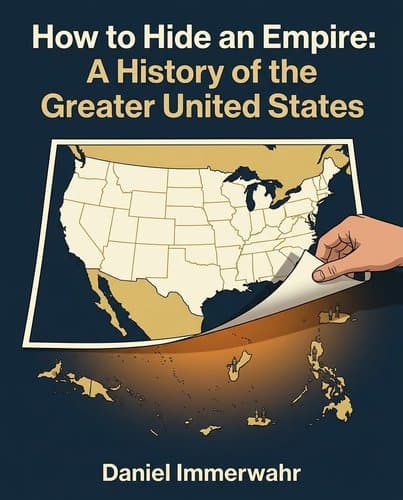
40121985_how-to-hide-an-empire
by Daniel Immerwahr
America erased its own empire from maps, speeches, and textbooks — and four million of its citizens still live without voting rights as a result.
In Brief
America erased its own empire from maps, speeches, and textbooks — and four million of its citizens still live without voting rights as a result. Immerwahr reconstructs the hidden history of US territories from the Philippines to Puerto Rico, revealing how that deliberate amnesia still shapes foreign policy and democracy today.
Key Ideas
Geography as Political Choice
The 'logo map' — America as a contiguous landmass from coast to coast — is a political construct enforced in real time. FDR edited the Philippines out of the Infamy speech on the morning he delivered it. Recognizing this as a choice rather than a fact changes how you read every claim about what is or isn't 'American.'
Four Million Without Constitutional Protection
The Insular Cases (1901), which ruled that constitutional rights don't apply in 'unincorporated territories,' were decided by the same justices as Plessy v. Ferguson. Plessy was overturned in 1954. The Insular Cases remain good law. Four million people in Puerto Rico, Guam, American Samoa, and the US Virgin Islands currently have no vote for president and no meaningful congressional representation.
Names Encode Empires
What the US calls the 'Spanish-American War' was actually the end-stage of wars Cuba and the Philippines had nearly won on their own. The US excluded its allies from peace negotiations, erased their contributions from the historical record, and used that erasure to justify taking their territory. Calling it by its accurate name — the Spanish-Cuban-Puerto Rican-Philippine-American War — changes what the conflict was about.
Seven Hundred Thousand, Erased
The Philippine-American War (1899–1913) was longer than Vietnam and killed roughly 775,000 people — mostly from disease in reconcentration camps the US had just condemned Spain for using in Cuba. It is absent from most US history education. Knowing it changes the baseline for evaluating American military conduct and for understanding why 'longest US war' is a contested category.
Eight Hundred Bases, One Empire
The US operates approximately 800 overseas military bases; Britain and France together operate about 13. This basing network is the mechanism of American power in the post-colonial era. Osama bin Laden stated his primary motive — US troops on Saudi holy land — clearly and repeatedly for a decade before 2001. The 'why do they hate us?' confusion was a product of not knowing about the empire of bases.
The Pencil Never Stopped
When you encounter debates about 'who counts as American' — in hurricane relief allocation, immigration enforcement, presidential eligibility, or disaster response — look for the logo-map logic underneath it. The confusion consistently tracks back to places and people the mental map has excluded since 1941. The same editorial pencil that crossed out 'Philippines' in 1941 is still drawing the same map.
Who Should Read This
History readers interested in World History and Military History who want a deeper understanding of how we got here.
How to Hide an Empire: A History of the Greater United States
By Daniel Immerwahr
10 min read
Why does it matter? Because the map every American carries of their country was drawn to hide an empire.
You think you know what America looks like. The lower 48, maybe Alaska and Hawaii floating in their boxes. That shape is so familiar it feels like a geographic fact.
It isn't. In 1941, one in eight Americans was a colonial subject — legally part of the United States, excluded from the census count, invisible on every map, and erased from the most famous presidential speech ever delivered. When FDR drafted his "Day of Infamy" address, he crossed out the Philippines by hand. Sixteen million U.S. nationals were about to fall under Japanese rule, and he deleted them from the story before the ink dried.
That pencil stroke was a habit, not a slip. This book follows where it leads: through a forgotten war, a cancer researcher who confessed to murder and won a Time magazine cover, a terrorist attack, and a presidential birth certificate that should have surprised no one who knew the actual map.
The Map in Your Head Was Drawn by a Presidential Pencil
The morning after Japan's attack, Franklin Roosevelt sat with a draft of his address to Congress. His first version described the events as "bombing in Hawaii and the Philippines." Then he crossed out the Philippines references. Then (and this detail is worth holding) he added the word "American" in front of "island of Oahu." Not just Oahu. American Oahu.
That pencil stroke was doing legal and moral work simultaneously. The Philippines was, legally, as American as Oahu. Sixteen million U.S. nationals lived there. Japan destroyed the largest concentration of U.S. warplanes outside North America, then invaded and occupied the country for years. At Pearl Harbor, they bombed and left. In the Philippines, they stayed.
Roosevelt's reasoning wasn't cynical so much as coldly practical. Pre-war polls showed that few mainland Americans supported defending the Philippines. The territory was geographically remote, demographically foreign, and headed for independence. Hawai'i was closer, whiter, and a plausible candidate for statehood. So Roosevelt elevated Hawai'i to "American" and demoted the Philippines to a footnote, buried in a list that lumped U.S. and British territories together without indicating which was which.
In Manila, crowds gathered around radios to hear the speech. Roosevelt spoke at length about Hawai'i and the American lives lost there; the Philippines got a single line. For the Filipinos listening, it mapped the war: close to Washington, far from Manila. The sirens were still wailing, and there were no air-raid shelters.
What Roosevelt did to that speech, census officials and atlas publishers had been doing for decades. On the eve of that war, nearly 19 million people lived in U.S. territories — one in every eight Americans, statistically more than the one in twelve who were Black. Had the census included them, the largest U.S. minority would have been Asian, not Black; Manila would have ranked among the country's principal cities; the geographic center of population would have moved from Indiana to New Mexico. Instead, the census counted only "the United States proper," and 19 million people disappeared from the national portrait.
The shape of America you carry in your head was assembled by choices like these: a pencil stroke, a census exclusion, an atlas convention. What looks like geography is actually an argument. And the people edited out were the ones who paid for it.
America Built Its Empire by Taking Land While Carefully Leaving the People Out
The arithmetic is in the Mexican War. When U.S. forces occupied Mexico City in 1848, Congress briefly considered absorbing all of Mexico. Senator John C. Calhoun, one of slavery's most powerful defenders, stopped it not on principle but on demographics. "We have never dreamt of incorporating into the Union any but the Caucasian race," he declared on the Senate floor. So the country took only the sparsely settled northern desert: California, Utah, New Mexico, Arizona. The deal enlarged U.S. territory by 69 percent while adding less than 1.5 percent to its population. One newspaper captured the logic without embarrassment: the United States had secured "all the territory of value that we can get without taking the people."
The same calculation ran through every major acquisition. Grant's bid for the Dominican Republic failed because senators objected to a country "occupied by another race, of another color." Alaska barely passed because critics didn't want what one publication called "Exquimaux fellow citizens," and it passed only because there weren't many of them. The census reinforced the entire system by refusing to count Native Americans until 1890, then hiding the total on page 963 as a parenthetical — by that point indigenous people had been reduced to 0.57 percent of the population, a rounding error produced by two centuries of disease and removal.
Then Spain's empire collapsed in 1898, and the arithmetic stopped working. The Philippines alone held roughly 8 million people — more than ten percent of the U.S. population at the time, nearly equal to the country's entire Black population of 8.8 million. Unlike Native Americans, they weren't disappearing, and white settlers weren't moving in to dilute them. For the first time, the United States had seized densely populated territory it couldn't quietly absorb. A system built on taking land without people had finally run out of empty land.
The 'Spanish-American War' Was Actually Won by the Armies We Then Colonized
The United States didn't win the Spanish-American War. Cuba and the Philippines had already won it.
By January 1898, Cuban commander Máximo Gómez, three decades into his fight against Spain, said victory was a year away at most. He was right: Spain's army in Oriente Province couldn't relieve its besieged forces in Santiago because Cuban soldiers had them surrounded. When Roosevelt's Rough Riders landed at Daiquirí, the beach was clear because the Cuban army had just driven the Spanish off it. Commodore Dewey, with fewer than 1,800 men, cabled the Filipino revolutionary Aguinaldo to come "as soon as possible," then watched, night after night, as Filipino forces took city after city his ships couldn't touch.
Roosevelt landed on that Cuban beach and declared his allies "utter tatterdemalions" who "accomplished literally nothing."
The erasure was the architecture of the outcome. Spain signed the Treaty of Paris with the United States alone. No Cuban, Filipino, Puerto Rican, or Guamanian representative had a seat at the table. Spain sold the Philippines for $20 million; Puerto Rico and Guam came free. The Spanish governor-general had been explicit: he was "willing to surrender to white people but never to Niggers." Filipino soldiers who had besieged Manila for two and a half months were locked out as their supposed allies walked in unopposed.
In the Insular Cases of 1901, the same nine justices who had decided Plessy v. Ferguson ruled that constitutional protections don't apply in "unincorporated territories," a category invented for the occasion. Plessy was overturned in 1954. The Insular Cases remain good law. Today, roughly 4 million people in Puerto Rico, Guam, American Samoa, and the U.S. Virgin Islands cannot vote for president and have no meaningful congressional representation. Some hold citizenship that Congress can revoke by statute. American Samoans aren't citizens at all (legally "U.S. nationals"), though they enlist in the Army at higher rates than any other territory. The empire that took land while avoiding people had finally taken people — then built a courthouse around them to make sure they stayed.
The Philippine War Was Longer Than Vietnam, Left 775,000 Dead, and Almost No American Knows It Happened
On a February night in 1899, Private William Grayson was patrolling the Manila suburbs when he encountered Filipino soldiers coming the other way. He ordered them to halt. They ordered him to halt. "I thought the best thing to do was shoot," he later remembered, and he did, killing three men. He ran back shouting: "Line up, fellows. The niggers are in here all through these yards." By morning, the United States had mounted a full offensive.
What followed lasted fourteen years (longer than Vietnam) and produced this piece of soldier's folk art: a parody of "The Battle Cry of Freedom," the old Union anthem, with new words. "Get the good old syringe boys and fill it to the brim / We've caught another nigger and we'll operate on him / Shouting the battle cry of freedom." The syringe forced water into a prisoner's mouth and nose until his body swelled and he gave up what they wanted. The officer most associated with the practice was tried, fined, and suspended for one month.
775,000 Filipinos died in the war, more than in the Civil War, mostly from disease amplified by reconcentration: herding rural populations into fortified camps, cutting off food, burning crops outside the perimeter. That was the same tactic Spain had used in Cuba, the stated justification for American entry into the war in the first place. Manila recorded the world's highest infant mortality rate. The Filipino death toll came from postwar estimates, not wartime records.
An anti-imperialist coalition — Mark Twain, Andrew Carnegie, the presidents of Harvard, Cornell, Stanford, Michigan, and Northwestern — put the question to voters in 1900. Twain proposed a new flag: red, black, and blue, with the stars replaced by a skull and crossbones. The imperialists won with a larger margin than 1896. The question never came before voters again.
Three decades later, a Harvard-trained Rockefeller Institute researcher named Cornelius Rhoads arrived in Puerto Rico. He accidentally left a letter on a hospital stenographer's desk describing Puerto Ricans as "the dirtiest, laziest, most degenerate and thievish race" and noting he had "done my best to further the process of extermination by killing off 8 and transplanting cancer into several more." He was never tried. A second letter, which the colonial governor called "even worse than the first," was suppressed and has never surfaced. Rhoads went on to oversee chemical weapons testing on 60,000 American soldiers, win the Legion of Merit, make the cover of Time, and have a prestigious cancer research award named for him — given every year for twenty-three years, until a biologist from Puerto Rico complained. The award committee said they were "totally shocked."
That's how you hide an empire.
By VJ Day, More People Lived Under the US Flag Abroad Than on the American Mainland
By the time Japan surrendered, the United States held more people under its flag overseas — 135 million — than lived on the American mainland. The Second World War is remembered as a war fought to defend freedom at home. It was fought, mostly, on American colonial soil.
That arithmetic shows most clearly in Manila, February 1945. General Robert Beightler commanded the 37th Infantry Division, driving 16,000 Japanese naval forces out of a city of over a million civilians. Beightler's division ran on maximum artillery. He was proud of it. "To me," he explained, "the loss of a single American life to save a building was unthinkable." But those buildings were inhabited. The Philippine General Hospital, sheltering seven thousand civilians alongside a handful of Japanese soldiers, was shelled for two days straight. During one hour on February 23, the walled district of Intramuros received three tons of explosives per minute.
Final count: 1,010 mainland Americans killed. 16,665 Japanese. Roughly 100,000 Manilans — a hundred Filipino deaths for every American. Mainland casualties were recorded to the last digit. The Filipino toll was extrapolated, after the fact, from figures submitted by undertakers.
After the liberation, a GI walked down a Manila street handing out Hershey bars. When a Filipino boy answered his questions in fluent English, the soldier was startled. "How'd ya learn American?" He had crossed the Pacific, been briefed, shown maps, told exactly where to go and whom to shoot. No one had told him he was fighting to save a U.S. colony, or that the people there were, legally, the same kind of Americans he was.
He thought he was invading a foreign country.
The Empire Didn't End After WWII — It Became the World's Infrastructure
Imagine an empire that requires no flag, no colonial governor, no word "empire" anywhere in official documents. One that runs on screw thread angles, programming languages, and base leases. Invisible by design. Almost impossible to resist, because you can't hold a protest against a measurement standard.
That's what the United States built after 1945. When the Philippines became independent in 1946 and formal colonialism began collapsing worldwide, the American empire didn't end — it molted. Large, contested territories were traded for roughly 800 overseas military bases. Synthetic rubber and plastic made tropical plantations economically obsolete: one U.S. factory employing 1,250 workers replaced a plantation of 24 million trees. The British, meeting in bomb-damaged London in 1945, surrendered their screw thread angle to American specifications. The first president of the new International Organization for Standardization was American. English became the language of international aviation in 1944 because the United States flew 70 percent of the world's passenger miles. Colonies could revolt. Screw thread angles don't.
The consequences of the base network arrived through one family. In the 1930s, a one-eyed Yemeni bricklayer named Mohamed bin Laden arrived at the Aramco oil camp at Dhahran, a U.S. company town rising from the Saudi desert, and became the Saudi government's preferred contractor. His firm built classified U.S. military installations across the kingdom. Four sons studied civil engineering in the United States. One of them, Osama, learned the family trade, then radicalized at a university where a leading Islamist's brother taught.
Osama's grievance was specific. For a decade before 2001, he stated it plainly: U.S. troops were occupying the land of Mecca and Medina. After a truck bomb killed nineteen U.S. airmen at a Dhahran housing complex in 1996, the Air Force commissioned a $150 million fortified compound deeper in the desert. The contractor hired to build it was the Bin Laden family firm.
The family that built the bases. The son who tried to destroy them. September 11 was retaliation against an empire of bases. Bin Laden had said so, explicitly, for a decade. Washington heard something else entirely.
An empire without colonies is invisible right up until the moment it isn't.
The Hidden Empire Keeps Producing Headlines You Think Are Disconnected
The hidden empire keeps producing consequences. You've read about them. You just didn't know where they came from.
Barack Obama was born in Honolulu in 1961, two years after Hawaii became a state — no eligibility problem, unlike John McCain. But his Hawaiian birthplace still got weaponized. In 2007, Hillary Clinton's chief strategist Mark Penn sent an internal memo calling Obama's Pacific roots "a very strong weakness" and advising the campaign to "explicitly own 'American'" — because Obama, born in the Pacific, somehow didn't. The birther conspiracy started among Clinton supporters before crossing party lines. By mid-2009, 58 percent of Republicans either believed Obama wasn't a natural-born citizen or weren't sure. In 2011, Donald Trump announced he'd hired private investigators to find the real birth certificate, dominated news cycles for months, and built the national platform that eventually carried him to the White House.
The mechanism was sixty years old. Look at the other babies born in Honolulu that same August day: Arakawa, Kamealoha, Nagaishi, Caberto. Any of them would have triggered the same suspicion. The logo-map had been stamping "foreign" on Pacific faces for decades, drawing America's border at the lower 48 and keeping the territories permanently outside the frame. When a mixed-race man with a Pacific island birthplace ran for president, the machinery ran automatically. Nobody had to coordinate. The map did the work.
The map is still doing the work. When Hurricane Maria knocked out Puerto Rico's power grid in 2017, only a slim majority of Americans knew Puerto Ricans were citizens. The island got fewer federal personnel, less coverage, and a fraction of the charitable giving that followed Harvey and Irma. The empire assembled in 1898 still decides who gets help and how fast.
The List That Changes What You See
Rhoads won awards for the same cancer work he claimed to have used as a murder weapon. Every pencil stroke in the logo-map carried the same logic downstream: infant mortality rates that never made the wire services, torture protocols exported from Manila to Abu Ghraib, hurricane response times calibrated to territories with no senators. The empire didn't need anyone to coordinate it. The map did the work.
That's what makes this harder to shake than a standard critique of American power — it's still running. Puerto Rico went dark for months after Maria. Guam wakes up under nuclear threat without a vote. A conspiracy about a Hawaiian birth certificate put a president on defense for four years. The pencil never stopped moving. You just weren't told it was there.
Notable Quotes
“The facts of yesterday and today speak for themselves,”
“speech. But did they? JAPS BOMB MANILA, HAWAII was the headline of a New Mexico paper; JAPANESE PLANES BOMB HONOLULU, ISLAND OF GUAM was that of one in South Carolina. Sumner Welles, FDR's undersecretary of state, described the event as”
“Eleanor Roosevelt used a similar formulation in her radio address on the night of December 7, when she spoke of Japan”
Frequently Asked Questions
- What is "How to Hide an Empire: A History of the Greater United States" about?
- "How to Hide an Empire" reveals that the US constructed a vast overseas empire of territories, military bases, and subject populations, then systematically erased it from maps, speeches, and collective memory. This deliberate erasure continues shaping contemporary debates over citizenship, disaster relief, and American identity. The book demonstrates how the 'logo map' — America as a contiguous coast-to-coast landmass — functions as an enforced political construct rather than geographical reality. Understanding this erasure helps explain why current conversations about who counts as "American" remain contested and how historical amnesia continues to influence contemporary policy decisions.
- What are the Insular Cases and why do they still matter?
- The Insular Cases (1901) ruled that constitutional rights don't apply in unincorporated territories, decided by the same justices who ruled on Plessy v. Ferguson. While Plessy was overturned in 1954, the Insular Cases remain good law today. Four million people in Puerto Rico, Guam, American Samoa, and the US Virgin Islands currently have no vote for president and no meaningful congressional representation as a result. Understanding their persistence reveals how the empire's legal structures continue shaping American governance and citizenship rules today.
- Why is the Spanish-American War considered misnamed?
- The conflict called the "Spanish-American War" involved Cuba and the Philippines, which had nearly won their independence before US intervention. The US excluded these allies from peace negotiations and erased their contributions from records, using that erasure to justify taking their territory. The accurate name reflects all participants: the Spanish-Cuban-Puerto Rican-Philippine-American War. This reframing reveals the conflict was fundamentally about American imperialism and territorial expansion. Understanding the true name changes how Americans evaluate their nation's pivotal moment of expansion and its methods of power consolidation in the Pacific and Caribbean regions.
- What is the 'logo map' and how does it shape American politics?
- The 'logo map' is the political construct showing America as a contiguous landmass from coast to coast, enforced in real time through editorial decisions. FDR edited the Philippines out of the Infamy speech on the morning he delivered it. Recognizing this as a choice rather than fact changes how to read every claim about what is or isn't "American." This editorial logic continues shaping contemporary debates over citizenship, disaster relief, and immigration, affecting millions in territories the mental map has systematically excluded since 1941.
Related Book Summaries

Read the full summary of 40121985_how-to-hide-an-empire on InShort