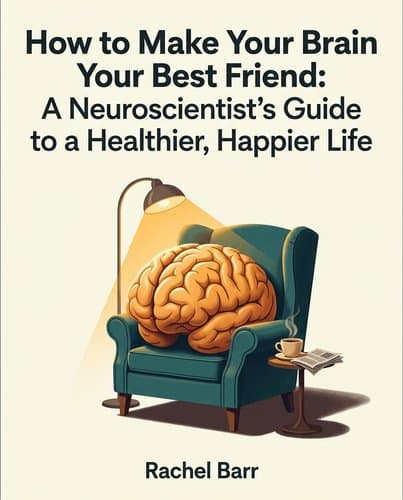
216247550_how-to-make-your-brain-your-best-friend
by Rachel Barr
Your brain isn't broken—it's running 200,000-year-old survival software in a world it was never designed for. This neuroscientist reveals how to stop fighting…
In Brief
How to Make Your Brain Your Best Friend: A Neuroscientist's Guide to a Healthier, Happier Life (2025) explains why the brain's ancient survival wiring so often works against modern life — and how understanding that mismatch lets you work with your brain rather than against it.
Key Ideas
Authenticity matters more than purchased signals
When your self-image feels hollow despite doing all the right things, check whether your identity signals are purchased or earned — the ACC fires alarm bells when projected identity and lived experience don't match, and no amount of the right gear resolves that gap
Sensory attention interrupts cortisol stress cycles
Microdose delight deliberately on hard days — not as a reward, but as a neurobiological intervention. A few seconds of genuine sensory attention (not Netflix, not wine) interrupts the cortisol cycle that your hippocampus can no longer brake on its own
Engineer weak ties to break isolation
If you're lonely and withdrawing further, that's not a character flaw — it's your brain in self-preservation mode, misreading neutral faces as hostile. The exit is structural: engineer low-stakes social contact (weak ties count) rather than waiting to feel ready
Rehearse self-compassion to shape sleep memory
Focus consciously on something self-compassionate right before sleep. The hippocampus preferentially consolidates recent memories during slow-wave sleep — which means whatever you're rehearsing at bedtime is what gets immortalized
Imperfect exercise still generates neurogenesis
Exercise doesn't need to feel good every time to work. The 'rule of thirds' (look forward to it 1/3, neutral 1/3, dread it 1/3) is both realistic and sufficient. The neurogenesis benefit in the dentate gyrus doesn't require enthusiasm
Physical distance outsources willpower to environment
Put your phone physically out of reach when working or with others — not as discipline, but as environmental design. The dopamine system responds to unpredictable rewards more intensely than guaranteed ones, which means the scroll will always beat your willpower if the device is within reach
Craft meaning within your current role
Look for job crafting opportunities before looking for a new job. Meaning doesn't require a role change — it requires finding one action within your current role that connects to something larger than the task itself
Who Should Read This
Curious readers interested in Neuroscience and Mental Health and the science of how the mind actually works.
How to Make Your Brain Your Best Friend: A Neuroscientist's Guide to a Healthier, Happier Life
By Rachel Barr
11 min read
Why does it matter? Because your brain isn't broken — it's just running ancient software in a world it was never built for
You've been told your brain needs fixing. Better sleep hygiene, a gratitude journal, a 5 a.m. wake-up, cold plunges, yet another productivity app — and somehow, despite doing everything right, you still feel like you're losing. Here's what nobody in the optimization industry wants you to know: you were never broken. That anxiety spiraling at 2 a.m., that loneliness in a room full of people, that inability to put the phone down — those aren't character flaws or failures of discipline. They're a Paleolithic survival system running exactly as designed, just in a world it was never built for. Your brain is doing its job. Magnificently, exhaustingly, sometimes catastrophically — but its job. Once you stop fighting it and start understanding what it's actually trying to tell you, that changes everything.
The Identity Trap: Why Buying the Right Water Bottle Leaves You Feeling Empty
Picture a prehistoric hunter returning to camp, chest adorned with a necklace of teeth from the animals he'd tracked, outrun, and managed not to be eaten by. His companions see the necklace and register something important: that string of teeth means something. It represents hours of accumulated skill, near-misses, and hard-won competence. The necklace works as an identity signal because it's backed by a life.
Now picture you, adding an expensive insulated water bottle to your Amazon cart at midnight because every wellness account you follow seems to have one. The brain processes that purchase the same way it processes the necklace — as an identity signal, a shorthand for belonging to a particular tribe. Neuroscientist Rachel Barr explains that this isn't vanity or gullibility; it's pattern recognition. When the brain sees the same object paired repeatedly with the same type of person, it draws a connection. Ubiquity becomes perceived social norm. The water bottle starts to mean health, discipline, a certain kind of life.
The problem lives in a small region of the prefrontal cortex that Barr calls the brain's editor-in-chief. Its job is to weave your memories, behaviors, and experiences into a coherent story of who you are — and it depends entirely on the hippocampus, the memory system, to supply the raw material. When you actually live a skill into existence, the hippocampus ships those memories straight to the editor's desk: identity update, please integrate. When you buy a signal instead, those confirming memories never arrive. The editor is left trying to write a chapter with no source material. Just a receipt.
That's when a second region steps in. Barr describes it as an internal fact-checker, and unlike the editor, it isn't trying to build anything — it's auditing what's already there. It notices the gap between the identity you're projecting and the experiences you've actually accumulated, and it registers that gap as conflict. Not metaphorical conflict. The discomfort is neurologically real, running through the same circuitry involved in physical pain. The nagging sense that the new gym kit isn't quite making you feel like an athlete isn't a confidence problem. It's your fact-checker flagging a mismatch between the story you're telling and the evidence on file.
Once you understand the mechanism, the fact-checker stops feeling like an accuser. It's a progress tracker — a system that goes quiet not when you buy the right thing, but when your actual experience catches up to your self-concept. That's a completely different relationship with your own ambitions.
Delight Isn't Frivolous — It's Your Brain's Emergency Brake
Delight is a neurobiological intervention. Not a reward for good behavior, not a luxury you earn after the hard work is done — something your brain requires the way a car requires brakes.
Here's the mechanism. Tucked inside the hippocampus are receptors that exist specifically to notice when your stress response has done its job and can stand down. They sense circulating cortisol, and when levels stay high for long enough, they signal the adrenal glands to ease off. Think of them as brake pads. Under chronic stress — not tiger-level survival stress, but the daily grind of passive-aggressive Slack messages and curmudgeonly receptionists — those pads wear thin. Enough erosion and the braking system stops working. Cortisol stays elevated. Stress makes you more vulnerable to stress. The car has no way to slow down.
This is where most advice stops and tells you to book a vacation. But Barr points to a more inconvenient truth first: when your mood is low, your brain doesn't crave restoration. A Harvard and MIT study tracking the daily habits of 28,000 smartphone users found that people in low moods reliably reach for what Barr calls hollow cravings — wine, television, comfort food. These feel like relief but function like running the engine hotter. They offer a moment of wanting without genuine replenishment, which is why you can finish a season of something and feel emptier than when you started.
The alternative isn't heroic. It's small and sensory and immediate. Barr calls it microdosing delight: giving your nervous system a few seconds of genuine, present-tense absorption — the warmth of sun on your face mid-commute, the specific way a good coffee smells, an animal doing something absurd. These moments work because they're not stressful, and the body interprets 'not stressful' as 'no longer in danger.' That signal is enough to nudge the adrenal glands. Manual brakes, applied from the outside.
The brain can't distinguish between a saber-toothed tiger and a scheduling conflict that's gone three rounds. You have to be the one to tell it the emergency is over, and you can do that in about thirty seconds, wherever you are.
Loneliness Makes Your Brain a Liar — And Then Makes It Worse
Why does loneliness feel like a personality failing? As though the socially capable person would simply try harder, show up more, stop making it weird? That framing puts the fix squarely on motivation — just push through the discomfort and the connections will follow. Barr's neuroscience makes a different, more uncomfortable argument: loneliness doesn't wait passively for you to fix it. It actively rewires the brain in ways that make fixing it harder.
Here's what should happen, evolutionarily speaking. A brain registering social isolation ought to sharpen the tools it needs to escape that isolation — better at reading facial expressions, more empathic, less likely to misread a neutral glance as hostility. That's the upgrade loneliness logically demands. The brain doesn't install it.
Instead, the lonely brain enters what Barr calls self-preservation mode: heightened threat detection, a hair-trigger amygdala, neutral expressions read as sneers. Social interactions stop feeling like connections to make and start feeling like battles to survive. Empathy erodes. Suspicion rises. The very skills needed to rebuild connection are degraded by the state that makes connection necessary. This is what Barr means when she says the brain is a liar — it tells you other people are the threat, precisely when other people are the cure.
The risks that follow aren't theatrical. Loneliness is comparable to the behaviors most associated with early death: elevated dementia risk, cardiovascular damage, higher rates of suicide. And because the lonely brain has become a threat-detection machine prone to misreading social signals, the normal advice — go out more, say yes more, be more open — runs directly into a nervous system that has learned to flinch.
Cynicism, withdrawal, the exhausting hypervigilance in social situations — these aren't character flaws. They're documented outputs of a brain doing exactly what a chronically stressed threat-detection system does. Which shifts the question from 'what's wrong with me?' to 'what does the structure of my life actually allow?' Motivation can't override a neurological self-protection loop. The exit has to be built differently.
Sleep Isn't Rest — It's the Only Time Your Brain Does Its Real Work
Someone types a company-wide email, hits send, and then — stomach dropping — notices they've written "poop in anytime" instead of "pop." That moment is now immortal. The banking password you needed yesterday has already gone fuzzy, but the hippocampus will cheerfully surface this particular gem at 3am for years. Rachel Barr uses exactly this scenario to explain what happens during slow-wave sleep: the hippocampus acts like a curator on Christmas morning, sorting the day's memories and distributing them to the relevant corners of the cortex. Genuinely useful things — a deadline mentioned in passing, a new PIN — are often too loosely encoded to survive the night. The humiliating ones, vivid and emotionally charged, get wrapped carefully and preserved. This logic becomes a practical tool: because the brain consolidates whatever it's dwelling on just before sleep, what you choose to focus on in those last minutes matters. Rehearsing regret is the same as filing it permanently. Choosing self-compassion gives the hippocampus something better to work with.
Once slow-wave sleep finishes its curation work, the brain moves into REM — and the dynamic shifts entirely. Barr describes REM as couples therapy between two brain regions with fundamentally different personalities: the amygdala, which runs on raw emotion, and the hippocampus, which is obsessive about context and consequence. Left alone, they'd talk past each other. In REM, the prefrontal cortex steps in as mediator, grounding charged feelings in reason, softening memory's sharper edges. Cut that session short, and the amygdala shows up to the next day already activated. Barr puts the increase in amygdala reactivity at around 60% after disrupted sleep — enough to turn a mild frustration into a disproportionate reaction, or a neutral expression into a perceived slight.
The 5am hustle culture is counterproductive rather than merely unpleasant for exactly this reason. The longest REM phases happen at the end of the night. Setting an early alarm doesn't shorten sleep slightly — it amputates the part where emotional regulation actually gets done. The brain that shows up to the day hasn't finished its maintenance cycle. You're not saving time. You're borrowing cognitive and emotional capacity you'll spend the whole day repaying.
Your Brain Evolved to Move, Not to Think — Which Explains a Lot
Sleep reshapes memory, but the brain needs to be worth reshaping in the first place. That's where movement comes in.
At 23, Rachel Barr was tapping her foot. Not from impatience — deliberately, compulsively, because fidgeting burns calories and every calorie counts. She was surviving on turkey and broccoli, skipping meals, training obsessively, and convinced that whatever anyone saw when they looked at her was the same inventory of flaws she catalogued in herself every few minutes. It would be years before she recognized what she was doing. What eventually shifted things wasn't a motivational epiphany. It was a university powerlifting team populated almost entirely by people who had no interest in getting smaller.
Surrounded by athletes chasing strength rather than shrinkage, something changed — not dramatically, but incrementally. She started reading nutritional labels for protein content. Carbohydrates stopped being the enemy when she needed them to lift well. The scale began reflecting muscle gain rather than defeat. One changed environment, one shifted frame of reference, and the whole system reoriented.
Barr came to understand this through the lens of hippocampal biology — specifically, what the hippocampus needs to keep emotional regulation from collapsing. Deep within it sits the dentate gyrus, one of the only brain regions in adults that can grow brand-new neurons. Barr calls these cells enthusiastic interns: undertrained, eager, and useful precisely because they're fresh. Their inexperience is a feature. Because they haven't been assigned to any existing fear pattern, they give the hippocampus what it needs to draw finer distinctions — to recognize that the clown at your birthday party is not the clown from the fistfight, that this Tuesday isn't last Tuesday, that the situation you're in is different from the one that hurt you. Without new neurons, the amygdala generalizes: a pattern that once meant danger starts attaching itself to everything adjacent to it. With them, the brain can separate signal from noise.
Movement is what prompts the dentate gyrus to produce these neurons — not as a side effect, but as its primary trigger. The brain evolved in service of a body in motion, and without movement, the hippocampus operates on a deficit. Mood dysregulation, looping anxious thoughts, stress that accumulates without relief — these aren't attitude problems. They're what a hippocampus sounds like when it's under-resourced.
The fitness industry's answer has consistently been more intensity, which is exactly the wrong prescription for anyone whose relationship to exercise is already fragile. High-intensity circuits, especially early on, build negative emotional associations that outlast the workout — and those associations are what kill consistency. Barr's powerlifting team didn't fix her by pushing harder. It fixed her by making the environment feel safe enough to stay.
The Scroll Isn't Rotting Your Brain — But It Is Hacking a Very Old Vulnerability
Imagine a slot machine designed by someone who also had access to your entire social life, your professional anxieties, and your ex's holiday photos. That's a reasonably accurate description of what's in your pocket. But before you spiral into digital guilt, here's the more useful framing: the phone isn't doing anything new to your brain. It's doing something very old, with unusual precision.
In the 1930s, B.F. Skinner discovered something counterintuitive about rats and reward. When a lever reliably delivered food pellets, the rats ate steadily. When it delivered pellets unpredictably — sometimes yes, sometimes nothing — the rats became obsessive. They pressed the lever more, not less, because the uncertainty transformed every pull into a potential win. What Skinner had stumbled onto was a fundamental feature of how dopamine works: the brain doesn't just respond to rewards, it responds most intensely to the possibility of rewards. Unpredictability is the accelerant.
Social media apps arrived at the same architecture. The timing isn't random — it's tuned. Likes are batched and released in bursts rather than delivered the moment they arrive, because a cluster of notifications produces a stronger dopamine response than a steady trickle. Every scroll is a lever pull. Sometimes there's something worth seeing; usually there isn't; occasionally something genuinely delightful appears. The not-knowing is what keeps your thumb moving. You can't override this with discipline, because the pull isn't coming from laziness or weak character. It's coming from dopamine circuitry calibrated by millions of years of evolution to chase uncertain rewards. The rats weren't undisciplined either.
Barr's intervention, then, isn't motivational — it's structural. You can't easily rewire a reward circuit, but you can make the lever harder to reach. Deleting apps, putting the phone in another room, downloading usage-limiters: these aren't extreme measures. They're the only port of entry available, because the vulnerability isn't a flaw you developed. It's a feature that predates you by several hundred thousand years. The slot machine is very good at its job. The only winning move is to leave the casino floor.
Meaning Isn't a Luxury — It's What Your Prefrontal Cortex Uses to Make Any Decision at All
Meaning is not a philosophical luxury you get to pursue once the practical problems are solved. It's cognitive infrastructure — and without it, your prefrontal cortex can't function efficiently.
Here's the problem your brain faces every morning: the number of possible actions available to you is, for practical purposes, infinite. Whether to check your phone before getting up. Whether to exercise. Whether to reply to that message, take that job, end that relationship, start that project. The prefrontal cortex filters all of this into an actual decision — but it can't evaluate infinite options on their own terms. It needs a higher-order values system to pre-sort the candidates, narrowing possibility down to something manageable. That system is what Barr calls meaning. Without it, even small decisions become exhausting, because nothing has been pre-weighted. Every choice has to fight for attention from scratch.
Barr offers one example that does more work than a dozen statistics. A hospital cleaner, technically responsible for floors and surfaces, started quietly rearranging the artwork in patients' rooms — moving pieces to angles that comatose patients might perceive, watching for any flicker of response. Nothing changed on the job description. Everything changed in how the prefrontal cortex engaged with the work, because the values framework — this matters, this is connected to something larger — was now present to filter and motivate each decision. The role didn't grant the meaning. She built it in herself.
That's the reframe. Meaning isn't waiting at the end of the to-do list, available once everything else is sorted. It's the cognitive filter that makes sorting possible at all. Build it in, and the brain has something to navigate by. Leave it out, and you're scrolling the menu of your life without knowing what you're hungry for.
The Brain You Have Is the One Worth Understanding
Rachel Barr wrote this book because she ran out of time to say something important to her mother. That origin matters — not as backstory, but as instruction. The tools here are deliberately small: thirty seconds of sunlight, a phone left in another room, one moment before sleep that isn't self-recrimination. But the thing underneath them isn't small at all. Once you genuinely understand that your anxiety isn't weakness, your loneliness isn't failure, and your distraction isn't laziness — that they're the entirely predictable outputs of a brain doing its honest best with software that predates the problems it's being asked to solve — the self-blame loses its structural support. It doesn't dissolve overnight. But it stops feeling like evidence. And meaning, it turns out, isn't the reward you collect after you've sorted everything else out. It's what makes sorting possible in the first place. Your brain isn't the obstacle you've been managing around. It's the oldest navigation system you have. These tools just make it finally readable.
Notable Quotes
“Fidgeting burns calories, and every calorie counts,”
“why couldn’t I save her?”
Frequently Asked Questions
- What is "How to Make Your Brain Your Best Friend" about?
- This 2025 neuroscience guide explains why the brain's ancient survival mechanisms often conflict with modern life and how understanding this mismatch helps you work with your brain rather than against it. Rachel Barr draws on neuroscience research to deliver practical strategies for improving focus, mood, sleep, social connection, and motivation. The book bridges the gap between how our brains evolved to function and the demands of contemporary living, offering actionable interventions grounded in neurobiology rather than self-help platitudes. It's designed for anyone feeling stuck despite doing everything "right."
- What are the key practical strategies in "How to Make Your Brain Your Best Friend"?
- The book offers neuroscience-grounded strategies to work with your brain's wiring. Key tactics include: microdosing delight deliberately (genuine sensory attention, not Netflix) to interrupt cortisol cycles; engineering low-stakes social contact rather than waiting to feel ready when lonely; consolidating self-compassionate thoughts before sleep so the "hippocampus preferentially consolidates recent memories during slow-wave sleep"; exercising even when you dread it, as neurogenesis benefits don't require enthusiasm; keeping your phone physically out of reach to combat dopamine-driven scrolling; and pursuing job crafting within your current role before seeking a new one.
- Why do you feel hollow despite doing all the right things, according to this book?
- When your self-image feels hollow despite achieving externally, check whether your identity signals are purchased or earned. The anterior cingulate cortex (ACC) "fires alarm bells when projected identity and lived experience don't match, and no amount of the right gear resolves that gap." You can own perfect credentials or possessions, but your brain detects the mismatch between who you're projecting and who you actually are. This neurological disconnect creates persistent unease that material success cannot fix—only genuine alignment between internal and external identity resolves it.
- How does this book explain loneliness and social withdrawal?
- "If you're lonely and withdrawing further, that's not a character flaw — it's your brain in self-preservation mode, misreading neutral faces as hostile." The book recommends you "engineer low-stakes social contact (weak ties count)" rather than waiting to feel emotionally prepared. Your brain's threat-detection systems, evolved for ancient survival, now trigger unnecessary isolation in modern environments where strangers are neutral, not dangerous. This structural approach—deliberately creating contact opportunities before your emotional state shifts—works with your neurobiology instead of fighting it. The exit from withdrawal cycles is behavioral design, not willpower.
Related Book Summaries
Read the full summary of 216247550_how-to-make-your-brain-your-best-friend on InShort