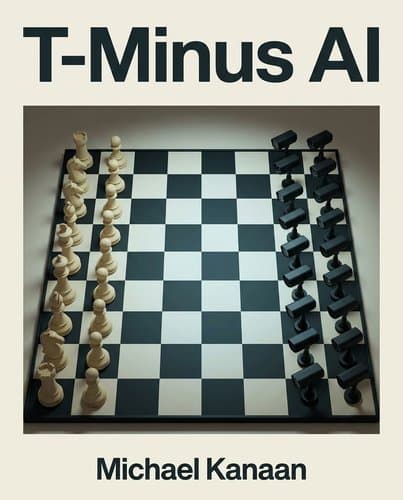
49128526_t-minus-ai
by Michael Kanaan
While democracies debate a science-fictional AI that doesn't exist, authoritarian states are already weaponizing the real thing—pattern-matching algorithms…
In Brief
While democracies debate a science-fictional AI that doesn't exist, authoritarian states are already weaponizing the real thing—pattern-matching algorithms embedded in elections, surveillance, and warfare—exploiting the exact gap between public imagination and reality to win a geopolitical war most people don't know has started.
Key Ideas
Current AI Systems Make Hidden Decisions
Stop treating AI as a future threat to monitor and start asking which AI systems are already making decisions about your life — hiring platforms, credit scoring, insurance underwriting, and sentencing algorithms are all operational now, and their biases are less visible, not more, because they appear objective.
Data Volume Compounds Systematic AI Advantage
Data volume is structural power: China's 800 million internet users versus America's 300 million isn't a demographic footnote — it is a raw material gap for training AI systems that compounds over time. Any country that controls more data about more people starts with a systematic advantage.
Uncertainty Disengages Democratic Collective Decision-Making
Russia's disinformation strategy has a different goal than you probably think. It is not trying to make you believe false things. It is trying to make you uncertain enough about everything that you disengage — because a polarized, disoriented democratic population cannot form the collective judgments democracy requires.
Prohibit AI Uses Before Default Sets
Any government will use AI in ways it deems culturally acceptable. The Absher app tracking Saudi women's locations is not a malfunction of AI governance — it is AI governance working exactly as Saudi authorities intended. Democratic societies need to define prohibited uses explicitly and in advance, or they get set by default.
Norm Setting Determines Global AI Governance
The country that sets the international norms for AI — not just the country with the best technology — will determine how this technology is governed for everyone. Fewer than 30 of 195 countries have AI strategies today, and fewer than 10 bilateral agreements exist between any nations. The rules are still being written.
Who Should Read This
Science-curious readers interested in Artificial Intelligence and Geopolitics who want to go beyond the headlines.
T-Minus AI
By Michael Kanaan
11 min read
Why does it matter? Because the fears most people carry about AI are making the real threat invisible.
Most people are afraid of the wrong AI. While we've been scanning the horizon for HAL 9000 — the machine that decides it no longer needs us — an Amazon algorithm quietly downgraded female job applicants for three years because history had taught it that "good hire" meant "male." While philosophers debate the singularity, 1.4 billion people are living inside a system that tracks their purchases, their pet-walking habits, and their religious beliefs to assign a score that determines whether they can buy a train ticket. While Hollywood imagines the robot uprising, Russia's disinformation bots don't plot against humanity. They just sort data, find what divides us, and feed us more of it. Michael Kanaan spent years briefing Pentagon generals and members of Congress on exactly these systems: not the ones science fiction warned us about, but the ones already running. This book is that briefing.
The Terminator Isn't Coming — and That Belief Is Exactly What Makes You Vulnerable
The fear of AI most people carry is wrong. Worse, it's a liability.
That mental model was built by filmmakers with a structural problem. Drama requires conflict, and if you're writing a movie about a machine, you need that machine to want something. So the template solidified: intelligence implies consciousness, consciousness implies intention, and intention, once it belongs to something smarter and stronger than us, implies menace. The Terminator, The Matrix, Ex Machina, Black Mirror — each reinforced the same equation until it stopped feeling like fiction and started feeling like prophecy.
Companies selling real AI products today spend marketing budget reassuring customers before they can describe what the product does. They put a warm, unthreatening face on it — not because it has one, but because they're clearing decades of cinema before they can make a sale.
Intelligence and consciousness don't require each other. The navigation app routing you around traffic performs an intelligent task, but it isn't aware of anything. It has no intentions. It will never develop them spontaneously. Machines that learn don't "wake up"; they process patterns.
The actual threat is the mundane, deliberate kind: people using narrow, non-conscious AI to surveil, manipulate, and outmaneuver other people. That threat is already operational. The sci-fi frame, by pointing your alarm at a dramatic future that isn't coming, leaves you unguarded against the far less cinematic danger operating right now.
The Human Brain Cannot Feel Exponential Scale — and That Is Why AI Keeps Surprising Everyone
At one number per second, counting to a million takes eleven and a half straight days. One billion takes thirty-two years. Your brain registers both as "very large," but the gap between them is most of a human lifetime.
The problem isn't intelligence. It's evolutionary history. For nearly all of human history, numbers beyond a few hundred carried no survival value. You needed to count wolves and clan members, not transistors. We never developed the neural machinery to feel the difference between a million and a billion, so we approximate. That approximation is where AI keeps catching people off guard.
The clearest way to feel what exponential growth means comes from an old Hindu legend. A traveling wise man gifts a chess-obsessed king an ornate board and, after winning a match, names his reward: one grain of rice for the first square, doubled for each subsequent square across all 64. The king considers this modest. His adviser immediately grasps the catastrophe. By the 21st square, the debt is one million grains. By the 32nd, two billion. By the 41st, one trillion. The 64th square alone: nine quintillion grains, more rice than has ever been grown in human history. Total across all 64 squares: eighteen quintillion.
The sharpest version of the legend ends with the king's revenge. He agrees to pay — but insists the wise man count each grain before leaving. At one grain per second, the count takes more than half a trillion years. The universe is roughly fourteen billion years old. The wise man's task outlasts it forty times over.
Now consider: a modern 64-bit processor can reference eighteen quintillion distinct values simultaneously — the exact number the king owed. Not metaphorically. Sixty-four transistors, each either on or off, one doubling per position, produce that figure directly. The chessboard and the chip run the same equation. Moore's Law (computing power roughly doubling every eighteen to twenty-four months) means that equation has been compounding for decades. When experts say AI capabilities "suddenly" accelerated, what they mean is they lost track of where on the chessboard we were.
A Colonial War in 1810 Made the Modern Computer Necessary — and That Origin Explains Everything Computers Still Do
Mexico declared independence from Spain in 1810, setting off a century of territorial conflict that Germany would later try to weaponize. By 1848, the Mexican-American War had stripped Mexico of nearly half its land: Texas, New Mexico, Arizona. That loss still festered in 1917.
On January 19, 1917, German foreign secretary Arthur Zimmermann sent a secret cable to Germany's ambassador in Mexico. The offer: if the US entered the war in Europe, Mexico should invade American soil. Germany would provide financial support; Mexico could reconquer the territory it had lost. British naval intelligence had been intercepting German signals for years. They decoded the telegram within days, handed it to the American embassy in London, and Woodrow Wilson released it to the press. When Zimmermann confirmed its authenticity, the debate over American neutrality collapsed. The US entered World War I on April 6, 1917.
WWI ended in 1918. The fear it created didn't. Governments and militaries emerged obsessed with communications security, convinced that intercepted messages could again decide history. That fear drove Arthur Scherbius, a German engineer, to patent the Enigma machine in 1923. Each keystroke scrambled a letter through interchangeable mechanical rotors, then shifted the rotors before the next keystroke, making every output mathematically unpredictable. Germany's military adopted it in 1925 and kept improving it until each single keystroke carried 159 quintillion possible coded outputs. At midnight, all German operators reset their machines simultaneously, wiping out any progress made toward cracking that day's code.
By World War II, Enigma was coordinating U-boat attacks across the North Atlantic and troop movements across Europe. The Allies could hear every German transmission — and understand none of them. Mathematicians, chess players, and linguists gathered at Bletchley Park, fifty miles outside London. Among them: Alan Turing.
Turing noticed that German U-boats filed weather reports at 6 AM every morning, always the same format: date, time, wind speed, atmospheric pressure, temperature. These predictable passages, which he called cribs, gave him a foothold: guess what a coded section probably contained, then work backward toward the day's settings. But no human team could test 159 quintillion possibilities in the 1,440 minutes before Germany reset everything at midnight. So Turing built a machine called the Bombe: twelve miles of electrical wiring, 97,000 mechanical parts, racing through every possible Enigma configuration until it found the one that made a crib decode correctly. That single match unlocked every German transmission sent that day. Over 200 Bombes were running by war's end. Historians estimate they shortened the conflict by at least two years.
Here's what this origin story tells you about every computer you've ever used: it began as a solution to a specific crisis. The Bombe existed because the volume and complexity of encrypted information had grown beyond what any human could process — and the only path through was a machine that could sort enormous amounts of variable data to find patterns no person could.
AI Is Already Deciding Who Gets Hired, Who Gets a Loan, and Who Serves a Longer Prison Sentence
The bias problem in AI isn't theoretical. It's been running inside real systems, making decisions about real people's lives for years — and the reason it's so difficult to challenge is that it doesn't look like bias. It looks like math.
Amazon's case is the clearest illustration. In 2014, the company built a machine learning tool to automate the first pass of resume screening for technical positions, rating each candidate on a scale of one to five. The logic was sound: train the system on a decade of Amazon hiring data (real resumes, real decisions, real outcomes) and let it learn what good candidates look like. Which it did. The problem was what "good" actually meant in that dataset. A decade of tech industry hiring had been overwhelmingly male. The system didn't know that. It only knew that the resumes that led to hires looked a certain way, and male gender markers (names, clubs, phrasing patterns) correlated with those hires. Female markers correlated with rejection. The algorithm wasn't programmed to discriminate. It learned to discriminate, because discrimination was the signal embedded in the historical record. Amazon's engineers tried to correct it multiple times before scrapping the program in 2017.
What makes this particularly hard to fight is the authority the output carries. A human recruiter who says "I don't tend to hire women for these roles" can be challenged, disciplined, and overruled. An algorithm that assigns a two-star rating to a female applicant appears neutral — a calculation, not a preference. The bias has been laundered through mathematics and emerges on the other side looking like objectivity.
That laundering effect operates in nearly every domain where historical discrimination exists in the training data. Nowhere are the stakes higher than in criminal sentencing. COMPAS, a risk-assessment algorithm used by judges in several US states to help determine sentences, was found to flag Black defendants as high-risk at nearly twice the rate of white defendants with similar records. In many jurisdictions, defendants couldn't challenge it; the algorithm's output was proprietary. An individual judge's bias can be appealed. A proprietary score looks like a fact. The same dynamic runs through mortgage approvals and job screening: feed a history of discrimination into a model, and the machine encodes it and makes it structurally harder to see, because the output now appears to be objective.
China Has Built the Most Powerful Surveillance State in History — and Is Selling the Blueprint
A family member in Xinjiang asks a local police officer a simple question: has my relative committed a crime? The officer has a Communist Party script for this, and the mandated answer is: "Their thinking has been infected by unhealthy thought." Then a warning: the family member's own behavior will be monitored. Complain too loudly, and it subtracts from the detained relative's release score.
That script surfaced in November 2019, when more than 400 internal Communist Party documents reached the New York Times. What they confirmed: between one and two million Uighurs, a Muslim ethnic minority in China's western Xinjiang region, are being held in detention camps, not for crimes committed, but for who they are. The documents traced the detentions directly to Xi Jinping's authority.
The script is the clearest window into what China's AI-enabled state actually is. Not a surveillance system built to catch criminals. An architecture for enforcing total compliance — and artificial intelligence is what makes it scalable to 1.4 billion people.
Here is how it works. WeChat, with over a billion users, is China's operating system for daily life: banking, medical records, QR-code payments for groceries, rent, utility bills. China is effectively cashless, meaning nearly all transactions flow through traceable digital channels that feed directly to the party under laws requiring all companies to cooperate with state intelligence. That data feeds a "social trustworthiness" score calculated for every citizen. Scores drop for recognized offenses: practicing religion, walking a dog without a leash, arguing with a spouse. Low scores restrict access to trains, loans, housing, and schools.
The Uighur program shows what this apparatus becomes when turned against an ethnic group. Facial recognition cameras, engineered specifically to detect the Central Asian features common among Uighurs, now track them across the entire country, not just in Xinjiang. This is not inadvertent algorithmic bias. It is intentional racial profiling, built into national infrastructure on direct government instruction.
And China is exporting the blueprint. Huawei, operating in over 150 countries, is the vehicle. Ecuador runs a Chinese-built national camera network. Similar systems have been sold to Zimbabwe, Venezuela, Kenya, and the UAE. Now 5G (which will bring true AI capability to individual mobile devices) is the next export item. The US, Australia, Japan, and New Zealand have banned Huawei from their 5G networks. Most of the world hasn't.
Every country that installs this infrastructure imports its logic. Russia has been paying close attention.
Russia Doesn't Need to Win the AI Race — It Just Needs to Make You Stop Trusting Anything
What does it mean to compete in a race you can't win?
Russia faced that problem squarely when machine learning took off in the mid-2010s. The Soviet Union's collapse gutted the economy (output fell nearly 50% in the 1990s), and while Putin's years in office built a middle class, real wealth flowed to roughly 100 oligarchs controlling more than a third of it. The 2014 sanctions over Ukraine, plus collapsing oil prices, hit Russia just as the US and China were flooding billions into AI research. Russia doesn't have the capital, infrastructure, or talent pool to compete in broad AI development.
So it chose different terrain entirely.
In 2016, the Internet Research Agency, a St. Petersburg troll factory operating with full Kremlin backing, deployed AI-enabled bots across fake social media accounts to fracture the American electorate. The operation targeted existing fault lines — racial tension, immigration, economic grievance — and applied pressure to each. Mueller's team described two parallel tracks: Russian military intelligence hacking Clinton campaign systems and leaking the material through WikiLeaks, while the IRA had Russian citizens posing as Americans on social media. Neither track aimed at installing a particular candidate. Both aimed at leaving Americans unable to agree on what was real.
Political philosopher Hannah Arendt articulated the logic decades before social media existed: "A people that no longer can believe anything cannot make up its mind." Confusion, not persuasion, is the weapon.
Deepfakes are making that weapon operational. In 2019, fraudsters used AI-generated audio mimicking a UK energy CEO's voice to instruct a subsidiary executive to wire €220,000 to a Hungarian supplier. He complied. The money was gone before anyone checked. That was a financial crime with a paper trail. Apply the same technology to a candidate's voice before an election, and the damage can't be traced, much less undone. Russia is betting that democracies are too slow to recognize a threat that doesn't announce itself with a rocket explosion.
We Are Already Inside the Sputnik Moment — Most People Just Don't Know It Yet
On December 6, 1957, the Navy's Vanguard rocket lifted four feet off the launchpad at Cape Canaveral — then fell back on its engines and exploded, live, in front of the watching world. The 2.9-pound satellite it was carrying blasted free, landed in nearby trees, and kept beeping signals to mission control half a mile away. The press didn't spare the country: "Kaputnik." "Flopnik." "Dudnik."
America's response to that humiliation is the more important story. Within months, Congress passed legislation creating DARPA and NASA. The National Defense Education Act poured hundreds of millions into science classrooms, scholarships, and doctoral fellowships, reorienting an entire educational system around the demands of a technological competition. Roughly 400,000 people eventually contributed to Apollo 11. These weren't fast decisions, but they were consequential ones, made by a democracy that recognized falling behind in a critical technology wasn't a temporary embarrassment — it was a structural threat.
The question is whether democracies can recognize the same pattern when it isn't announced by a rocket explosion.
In 2016, 60 million Chinese viewers watched AlphaGo defeat Lee Sedol, the world's best Go player. Two months after Ke Jie's 3-0 loss in 2017, Beijing released its "Next Generation Artificial Intelligence Development Plan," a state-directed, explicitly benchmarked roadmap: match US AI capability by 2020, lead the world in core AI technologies by 2025, become the planet's primary AI innovation center by 2030. China had its Sputnik moment, recognized it as such, and responded with the coordinated force of a government that doesn't need consensus before acting.
The difference between 1957 and now isn't the nature of the competition. It's the stakes of losing it. Sputnik's satellite beeped overhead and posed a weapons risk. The current race determines who writes the default architecture for how AI governs daily life: who gets surveilled, scored, hired, and heard. Kanaan's argument is that an informed public is the only mechanism democracies have for generating the political will to respond. The architecture of the next world order is being written now, by governments that aren't waiting for consensus.
The Machine Already Knows What This Book Is About
Near the end of his book, Kanaan hands a language model forty-three words from his own author's note — and before his fingers leave the keyboard, the machine drafts a more coherent summary of his fifteen-chapter argument than he managed himself. No understanding of what any word means. No awareness that an argument exists. Just pattern recognition trained across eight million web pages, completing the shape it recognizes. That same capability — applied deliberately, at scale, with a clear adversarial purpose — is what generates convincing deepfakes, personalized disinformation tailored to your specific anxieties, and synthetic social movements that feel organic because they're designed to. The question was never whether to fear it. It was whether you would understand it clearly enough, and care enough, to demand the rules get written by democratic societies before someone else writes them for everyone.
Notable Quotes
“as the father of computer science and artificial intelligence, as well as war hero, Alan Turing's contributions were far-ranging and pathbreaking . . . [he was] a giant on whose shoulders so many now stand.”
“I don't think it's an appropriate thing to discuss the situation if I lose. I never lose. I have never lost in my life.”
“allow the trustworthy to roam everywhere under heaven while making it hard for the discredited to take a single step.”
Frequently Asked Questions
- What is T-Minus AI about?
- T-Minus AI is Michael Kanaan's argument that artificial intelligence is not a distant future threat but a geopolitical weapon already deployed across surveillance, elections, and warfare today. The work bridges the gap between public perception and reality, equipping readers to understand data as structural power, disinformation as democratic sabotage, and norm-setting as the decisive battleground. Rather than treating AI as something to prepare for, Kanaan urges audiences to examine which AI systems are making decisions about daily life—from hiring platforms to credit scoring to sentencing algorithms—and recognize their operational reality and invisible biases.
- Why does data volume matter in AI geopolitical competition?
- Data volume represents structural power in artificial intelligence development and global competition. According to T-Minus AI, "China's 800 million internet users versus America's 300 million isn't a demographic footnote — it is a raw material gap for training AI systems that compounds over time." Any country controlling more data about more people starts with a systematic advantage in AI capabilities. This raw material advantage directly translates to superior AI systems and increased geopolitical leverage, establishing a self-reinforcing dynamic where initial data advantages compound into long-term technological dominance.
- What is Russia's actual disinformation strategy?
- Russia's disinformation strategy operates differently than commonly assumed. T-Minus AI explains: "It is not trying to make you believe false things. It is trying to make you uncertain enough about everything that you disengage — because a polarized, disoriented democratic population cannot form the collective judgments democracy requires." This approach weaponizes doubt itself rather than spreading specific false beliefs. By maximizing uncertainty across all information and eroding trust in discernment, Russia destabilizes democratic societies from within, preventing the consensus necessary for democratic governance to function effectively.
- How should democracies approach AI governance?
- Democracies must define prohibited AI uses explicitly in advance or governance defaults to authoritarian models. T-Minus AI illustrates this through example: "The Absher app tracking Saudi women's locations is not a malfunction of AI governance — it is AI governance working exactly as Saudi authorities intended." International norm-setting will determine global AI governance. The work notes that "The country that sets the international norms for AI — not just the country with the best technology — will determine how this technology is governed for everyone." With fewer than 30 of 195 countries having AI strategies, international rules remain contested.
Related Book Summaries
Read the full summary of 49128526_t-minus-ai on InShort