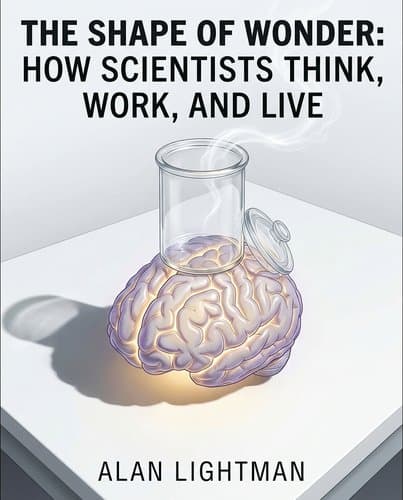
228143084_the-shape-of-wonder
by Alan Lightman, Martin Rees
Scientists and meditators describe the same 'oneness' experience for a measurable reason: your brain literally loses the ability to distinguish self from world.
In Brief
Scientists and meditators describe the same 'oneness' experience for a measurable reason: your brain literally loses the ability to distinguish self from world. Learn how ecstatic states can be deliberately engineered—and why understanding the neuroscience before institutions do may be the most urgent literacy of our time.
Key Ideas
Meditation Dissolves the Brain's Self-Other Boundary
The feeling of 'oneness' in deep meditation has a specific physical mechanism: the superior parietal lobe — the brain region that distinguishes self from environment — goes quiet, and the brain literally loses the ability to draw that boundary. This is reproducible and has been observed across religious traditions.
Ecstatic Brain States Are Reproducibly Achievable
The brain's ecstatic circuitry is not incidental to survival — it is deeply motivating, even compulsively so. Understanding that these states are neurochemically driven means you can approach them intentionally rather than waiting for them to happen to you.
Altered State Techniques Enable Control or Freedom
The same techniques that produce flow, insight, and feelings of connection can be — and have been — inverted for compliance, disorientation, and control. Before adopting any protocol for inducing altered states, ask who developed it and toward what original end.
Neurotechnology Follows Path Toward Institutional Capture
Tim Wu's 'Cycle' — the pattern by which open technologies become captured, centralized industries — applies to neurotechnology with far higher stakes than social media. The timeline between discovery and institutional control is shorter than most people assume.
Scientific Humility Strengthens Trustworthy Neuroscience Claims
Scientific humility is not a sign of a weak argument — it's a prerequisite for a trustworthy one. The fMRI reliability crisis doesn't destroy the book's central claims, but knowing about it makes you a more capable evaluator of the next wave of brain science headlines.
Cognitive Liberty Needs Legal Rights Protection
Cognitive liberty — the right to own your own neurochemistry — is not yet a legal or cultural norm. The first step toward protecting it is recognizing that it is a thing worth protecting.
Who Should Read This
Science-curious readers interested in Neuroscience and Mindfulness who want to go beyond the headlines.
The Shape of Wonder: How Scientists Think, Work, and Live
By Alan Lightman & Martin Rees
10 min read
Why does it matter? Because the transcendence you've been chasing is already wired into your brain — and someone else is trying to own the switch.
You probably think peak experiences choose you. That the monk meditates for forty years, the athlete hits the zone by accident, the mystic gets lucky. What if that's wrong — not slightly wrong, but completely, structurally wrong? Neuroscientists have now mapped the specific electrical signatures and chemical cascades that produce those moments of oneness, clarity, and boundless capability. They know which part of the brain goes quiet, and which levers to pull. That knowledge is either the most democratizing development in human history or the most dangerous, depending on whether it lands first in the hands of someone trying to liberate you or control you. The line between those two outcomes is razor-thin, and institutions have been racing toward it for decades. They're closer than you'd find comfortable.
Transcendence Is a Hardware Feature, Not a Spiritual Gift
Mystical experience is not a gift handed down to the spiritually elect. It is a neurological event, and your brain — yes, yours — already contains the circuitry to produce it.
Consider what neuroscientist Andrew Newberg found when he slid Franciscan nuns and Tibetan monks into brain scanners during deep meditation. At the peak of their practice, a region called the superior parietal lobe — the area that continuously updates your brain on where your body ends and the rest of the world begins — went quiet. Not metaphorically quiet. The neural traffic that normally maintains your sense of a bounded self simply dropped off. Without that signal, the brain cannot draw the line between 'me' and 'everything else.' The feeling of dissolving into something larger, of union with the cosmos, of what mystics across every tradition have called Oneness — it has a mechanism. The scanner showed it.
This is the shift that stepping outside the jar makes possible. Psychology, for all its power, mostly works from the inside — it expands what you believe is possible, enlarges the container. Neurobiology does something structurally different: it lets you read the ingredients on the label from outside the jar entirely. The question stops being 'why do some people have transcendent experiences?' and becomes 'what exactly is happening in the brain when they do?' That is not a subtle distinction. One question is answered with biography and theology. The other is answered with measurements — and measurements can be reproduced.
That reproducibility is the uncomfortable, exhilarating implication sitting at the center of all this. If Oneness is the predictable result of deactivating one identifiable brain region, then the experience is not a reward for decades of disciplined practice. It is a hardware feature. Ancient meditators found one path to that switch through years of training. Scientists are now mapping others. The mystic and the neuroscientist, it turns out, have been working on the same problem from opposite ends of the same corridor — and they are closing in on the same door.
The Brain Has Knobs and Levers — Here's What Happens When You Turn Them
Think of a mixing board in a recording studio — dozens of faders and knobs, each controlling a specific frequency. For most of human history, the brain has been exactly that: a board no one knew how to read. Ancient meditators learned, through years of trial and error, that certain practices could shift something. They couldn't see the faders moving. They just noticed the music changed.
Neuroscience can now see the faders.
The brain cycles through distinct electrical frequencies depending on what it's doing. Beta waves dominate ordinary waking life — the buzzing, slightly anxious hum of a mind managing a to-do list. Ease the beta fader down into alpha and the mental chatter recedes. Pull the theta fader up and something stranger happens: the barrier between conscious intention and the brain's deeper associative machinery grows thin. This is where insight lives — where the answer to a problem you've been grinding on for days surfaces unbidden in the shower. Push the frequency sharply up into gamma and you hit the signature of flow, that state of frictionless, absorbed focus that athletes and artists describe as operating outside of time.
These aren't metaphors. They're measurable electrical events, and researchers are learning not just to observe them but to induce them.
The USC Institute for Creative Technologies made this operational. Scientists there paired EEG monitors, webcams, and video game sensors to track the neurological signatures of distress in real time — and then manipulate them. Soldiers with PTSD, instead of spending months in talk therapy trying to narrate their way toward recovery, entered data-driven environments where the system read their physiological state and adjusted the intervention accordingly. If trauma lives in the body's electrical and chemical patterns, you address it there, not by asking someone to find the right words for it.
SEAL Team Six and Google have absorbed the same logic, each independently arriving at a conclusion that would have sounded strange in 1990: elite performance is less a talent you're born with than a neurobiological signature you can train toward. They stopped asking who is naturally gifted and started asking what states they need to reliably produce — and how.
The implication, once you sit with it, is vertiginous. Self-transcendence isn't the exclusive property of the spiritually disciplined or the congenitally brilliant. It's an engineering problem. The mystics found the destination; neuroscience is now building the road.
The Government Discovered the Pleasure Switch Before the Scientists Could Publish
In 1953, a University of Pennsylvania neuroscientist named John Lilly had a problem: everyone wanted what he'd built. Representatives from the CIA, NSA, FBI, Army, Navy, Air Force, and State Department all showed up at his lab door within the same short window — a convoy of acronyms chasing the same discovery. What Lilly had done was solve the two main engineering obstacles to switching on pleasure inside a living brain. He'd designed tiny stainless-steel sleeves that could be tapped into a skull and threaded with fine-gauge electrodes, causing almost no tissue damage. He'd also built a machine that pulsed current through neural tissue bidirectionally, stimulating without burning. The result: a brain you could dial up like a thermostat. Male monkeys given control of the device would trigger it continuously for sixteen hours, sleep for eight, then immediately start again. They chose the electrode over food, over social contact, over everything else. Pleasure, Lilly had discovered, wasn't just rewarding — it was totalizing.
The government's interest made a dark kind of sense once you understood where it came from. A few months earlier, a captured U.S. Marine pilot named Frank Schwable had appeared on Chinese radio and confessed to deploying biological weapons — a PR disaster for the Pentagon. The CIA's solution was to invent a concept: 'brainwashing.' The word was seeded into newspaper editorials to suggest that Schwable's confession was the product of communist mind-manipulation, not genuine testimony. It worked brilliantly as propaganda. The problem is that the CIA then half-believed its own story. Having convinced the public that totalitarian states could hijack individual will through advanced psychological techniques, the agency felt compelled to develop those very techniques itself — as a defensive countermeasure against a threat it had fabricated. The circular logic sealed itself into classified funding and ran for decades.
Lilly watched the convoy arriving at his door and made a choice. Rather than hand his findings to military sponsors who were transparently interested in compliance rather than healing, he published openly. He wanted the knowledge distributed before anyone could lock it down. It was an early version of what activists now call cognitive liberty — the principle that your own neurochemistry is not territory any institution gets to annex.
That framing is what makes the story stick. The mechanisms that produce transcendence — the deactivated sense of a bounded self, the flood of reward circuitry, the suspended critical filter — are the same mechanisms that produce total compliance. There's no version of 'how to reliably generate ecstatic states' that doesn't also double as a manual for control. Lilly understood this in 1953. The question his decision poses is still open: who controls the frequency, and toward what end?
The State Created the Counterculture It Was Trying to Suppress
Here's what the 1960s counterculture actually was: an accidental byproduct of a CIA control experiment that got away from its handlers.
In the early 1960s, the agency was paying college students $75 a session to swallow LSD under clinical observation — trying to map the drug's potential as a compliance tool. One of those students was Ken Kesey. He didn't just take the money and go home. He started pocketing the chemicals, sharing them with friends, eventually gathering the loose network that became the Merry Pranksters — whose concerts would give the Grateful Dead their audience and their ethos. The CIA had been trying to find a lever to pull inside the human mind. Kesey handed that lever to a generation of people who pointed it in the opposite direction. The state's experiment in control became the seed of a movement built around expanded consciousness as personal liberation.
There's a temptation to stop the story there, because it's a satisfying arc: the institution fumbles, the people win, freedom spreads. But the military read that outcome as a loss it intended to recover. By the 1980s, classified programs like the Trojan Warrior Project were training Green Berets alongside Tibetan monks and biofeedback researchers, methodically reconstructing the same territory Kesey had wandered into by accident. The brass had watched the counterculture demonstrate what altered states could do to group cohesion, morale, and the dissolution of fear — and they wanted those effects back under controlled conditions.
Then comes the detail that reframes the whole arc. The techniques developed for opening minds — inducing states of connection, trust, and reduced defensiveness — were later inverted and used on prisoners. In Iraqi detention units, sensory disorientation protocols included looping the theme song from Barney on continuous repeat. The same understanding of how sound and rhythm and neurological overwhelm could bypass rational resistance, the same toolkit that once facilitated transcendence, was now being used to break people down. The tool had no fixed moral character. The ethics traveled entirely with whoever was operating it.
Even the Festival of Freedom Has a Surveillance File
Somewhere on the Nevada playa, in the middle of a dust storm, a federal agent in infrared goggles is watching you dance. That is not a metaphor. The FBI ran sustained, multi-year undercover intelligence operations at Burning Man — the annual desert gathering famous for radical self-expression and temporary community — deploying surveillance technology more typically aimed at foreign operatives. Whatever you thought Burning Man was, the Bureau had a different read: the world's single densest concentration of people voluntarily experimenting with altered states, and therefore a national security matter worth years of resources.
The logic, once you follow it, is grimly consistent with everything that came before. The previous sections traced how the same techniques that open minds can be reversed to break them — the CIA's LSD experiments becoming the counterculture becoming classified military programs becoming Barney on loop in an Iraqi detention unit. Burning Man sits at the far end of that same arc. The festival attracts more people deliberately pursuing ecstatic states in a compressed physical space than anywhere else on earth. If you were an institution that had spent sixty years trying to understand and control what happens when the brain's self-boundary dissolves, you'd be watching too.
The FBI's file on a desert festival isn't an anomaly. It's a data point in a pattern legal scholar Tim Wu traced across every information technology: each begins open and experimental, then consolidates into a closed system held by a small number of powerful institutions. Radio went through it. Television went through it. The internet is going through it now. But Wu's cycle applied to a communications platform means losing convenience, maybe losing access. When the platform is the human nervous system itself — when the technology operates at the level of perception, reward, and the sense of a bounded self — the stakes of capture are different in kind. Losing the open phase doesn't mean your favorite channel gets paywalled. It means someone else holds the dial on your capacity for awe, for connection, for the feeling that the world is larger than your individual fear.
The optimistic and the alarming readings of where this goes don't cancel each other out. They're both correct. The same democratization that puts flow states and meditation neuroscience into the hands of veterans and schoolchildren also refines the toolkit available to anyone willing to invert it. The line between liberation and exploitation here isn't a wall — it's a choice made, over and over, by whoever's holding the dial.
The Evidence Is Shakier Than the Argument Needs It to Be — and That's Worth Knowing
The neurobiological case made across these pages is genuinely compelling — and some of the studies underpinning it may be wrong. That's not a reason to dismiss the argument. It is a reason to hold it differently.
In June 2016, a paper landed in the Proceedings of the National Academy of Sciences with an uncomfortable finding: the software algorithms most widely used to decode fMRI brain scans contained significant errors, and those errors may have generated false positives in up to 70 percent of studies conducted before 2015. Think about what that means in practice. The images of meditating monks with their superior parietal lobes going quiet, the flow-state signatures researchers claimed to read in the brains of elite performers — a substantial portion of that imaging work may have been measuring artifacts of bad code rather than actual neural activity. Kotler and Wheal know this. They disclose it. They also continue the argument, betting that the core claim about neurobiological knobs and levers will survive the methodological correction even if specific studies don't.
That's a defensible bet, but it's still a bet. And it sits alongside another disclosure worth noting: many of the scientists, athletes, and thinkers whose work fills these pages sit on the advisory board of the Flow Genome Project — Kotler and Wheal's own organization. The relationships are unpaid and acknowledged, but they exist. The inspiring version of each subject is, not coincidentally, the version the book presents.
None of this collapses what you've read. It does change your relationship to it. The framework of ecstasis — the neurological mechanics of self-transcendence, the institutional hunger to control those mechanics, the stakes of losing the open phase — holds even if individual studies need to be rerun. But frameworks can become their own kind of jar. So here's something concrete: the next time you feel that particular pull toward an experience, a group, or a practice that promises transcendence, you can ask which of the four flow triggers it's using and who controls the dial on each one. That question doesn't dissolve the experience. It just means you're the one asking it. You can't protect what you can't name. Now you have the name.
The Switch Already Exists — The Question Is Whose Hand Is on It
The monks and mystics didn't have access to something you lack. They had access to the same three pounds of neural tissue you're carrying right now, and they found — through decades of disciplined searching — a path to a switch that was always there. What changed across those centuries isn't the hardware. What changed is the number of institutions that can now read the label on the jar, and the sophistication with which they can reach inside.
That's the thing worth sitting with. The capacity for awe, for dissolution, for the feeling that the boundary between you and everything else is a suggestion rather than a fact — that capacity is yours. It has always been yours. But here's the uncomfortable part: knowing the name doesn't make you free of the people who've spent seventy years learning it too. It just means you're no longer the only one in the room who knows what's being contested. What you do with that is up to you. It always was. That's the tension, not the resolution.
Notable Quotes
“an all-out campaign to smear the Koreans [with] a new form of war crime, and a new form of refinement in atrocity techniques, namely mind murder, or ‘menticide.’”
Frequently Asked Questions
- What is The Shape of Wonder about?
- The Shape of Wonder (2025) maps the neuroscience of ecstatic experience—states of awe, flow, and transcendence—revealing their biological mechanisms and how they can be intentionally cultivated. The book also examines the risks of these same states being exploited for control, equipping readers to think critically about cognitive liberty and the coming wave of neurotechnology. By understanding how scientists think, work, and live through moments of wonder, readers gain both practical tools for accessing these states and protective frameworks for maintaining autonomy in an age of advancing brain science.
- What does The Shape of Wonder reveal about the brain mechanisms behind feelings of oneness?
- The book reveals that the feeling of 'oneness' in deep meditation has a specific physical mechanism: the superior parietal lobe — the brain region that distinguishes self from environment — goes quiet, and the brain literally loses the ability to draw that boundary. This is reproducible and has been observed across religious traditions. Understanding this mechanism transforms how we view ecstatic experience: what was once exclusively spiritual or mystical now rests on measurable neuroscience, enabling people to approach these states intentionally and strategically rather than waiting passively for them to occur.
- How can techniques for producing altered states be misused according to The Shape of Wonder?
- The book warns that the same techniques that produce flow, insight, and feelings of connection can be — and have been — inverted for compliance, disorientation, and control. Before adopting any protocol for inducing altered states, readers should ask who developed it and toward what original end. This caution is essential because neurotechnology risks following Tim Wu's 'Cycle'—the pattern by which open technologies become captured, centralized industries—with stakes far higher than social media. Understanding how these techniques can be weaponized helps readers distinguish between protocols developed for well-being and those designed for manipulation.
- What is cognitive liberty and why is it important in The Shape of Wonder?
- Cognitive liberty — the right to own your own neurochemistry — is not yet a legal or cultural norm. The Shape of Wonder emphasizes recognizing that it is a thing worth protecting, especially as neurotechnology advances. Scientific humility is not a sign of a weak argument — it's a prerequisite for a trustworthy one, and understanding the fMRI reliability crisis makes readers more capable evaluators of brain science headlines. The book argues that defending cognitive liberty requires this combination of scientific literacy and critical thinking.
Related Book Summaries


Read the full summary of 228143084_the-shape-of-wonder on InShort