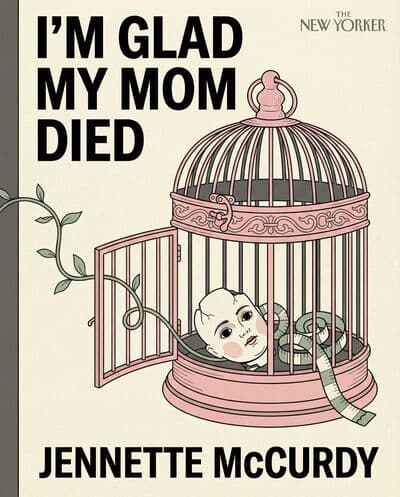
I’m Glad My Mom Died
by Jennette McCurdy
Think about your last birthday. You probably blew out the candles and made a wish for something you actually wanted—a better job, a trip to Europe, maybe just some peace and quiet. Now, imagine being twenty-two years old, staring at a cake, and realizing you have absolutely nothing to wish for. Not because you have everything, but because you don’t exist. Every desire you’ve ever had was actually your mother’s desire. Every pound you lost, every line you memorized, every 'spontaneous' smile was for her audience. You aren’t a person; you’re a project. We often talk about 'closeness' in families like it’s a universal good, but sometimes closeness is just a polite word for a cage. When your entire worth is built on pleasing a person who is never satisfied, the only way to find yourself is to let that version of you die. It’s messy, it’s dark, and it’s going to hurt. But if you’ve ever felt like your life isn’t actually yours, you know that the truth is the only thing that can set you free. Let’s look at how that cage is built—and how to break it.
In Brief
Jennette McCurdy's memoir exposes how her mother's obsessive control—from grooming an eating disorder to orchestrating a child acting career—left her without an identity of her own. By dethroning her mother's saintly image after her death, McCurdy begins the painful work of discovering who she actually is.
Key Ideas
Idealized abusers block trauma recognition and growth
Romanticizing an abusive parent as a saint prevents the victim from identifying their own trauma and stunts emotional development.
Parents weaponize eating disorders for control and profit
Eating disorders can be groomed by parents as a collaborative project to maintain control, delay maturity, and ensure professional marketability.
Entertainment industry replicates abusive family control dynamics
The professional world of child entertainment often mirrors abusive household dynamics by rewarding compliance and ignoring physical or mental health crises for the sake of profit.
Narcissists weaponize illness and success for control
Narcissistic parents weaponize their own illnesses and the child's financial success to ensure a state of permanent indebtedness and loyalty.
Healing requires abandoning performance for authentic choice
True healing involves moving from performing for others to making quiet, internal choices for oneself, often requiring the abandonment of former identities and careers.
Who Should Read This
Adult children of narcissistic or controlling parents, people recovering from eating disorders, former child performers, and anyone who has confused enmeshment with love and is learning to set boundaries
Summary
Introduction
Think about your last birthday. You probably blew out the candles and made a wish for something you actually wanted—a better job, a trip to Europe, maybe just some peace and quiet. Now, imagine being twenty-two years old, staring at a cake, and realizing you have absolutely nothing to wish for. Not because you have everything, but because you don’t exist. Every desire you’ve ever had was actually your mother’s desire. Every pound you lost, every line you memorized, every 'spontaneous' smile was for her audience. You aren’t a person; you’re a project. We often talk about 'closeness' in families like it’s a universal good, but sometimes closeness is just a polite word for a cage. When your entire worth is built on pleasing a person who is never satisfied, the only way to find yourself is to let that version of you die. It’s messy, it’s dark, and it’s going to hurt. But if you’ve ever felt like your life isn’t actually yours, you know that the truth is the only thing that can set you free. Let’s look at how that cage is built—and how to break it.
The Problem: The Invisible Cage of Maternal Enmeshment
Imagine your mother tells you she has a secret. It’s not a fun secret, like a hidden stash of Halloween candy. It’s a biological pact. She tells you that you can stay 'small' and 'special' together if you just stop eating. To a kid, this doesn’t sound like an eating disorder; it sounds like love. This is how the invisible cage is built. It starts with the normalization of things that should be horrifying. You might think 'family first' is a noble motto, but in a toxic home, it’s a weapon used to ensures you never develop a backbone. When a parent uses their own illness or fragility to keep you under their thumb, you don’t grow up. You just become a highly specialized life-support system for their ego.
Take the 'health exam' as a prime example of this boundary-shredding. Imagine being seventeen and having your mother perform invasive physical checks on your body under the pretext of 'checking for cancer.' It’s framed as care, but it’s actually a total theft of bodily autonomy. To survive, you learn to dissociate. You turn your body into a shell and send your mind somewhere else—maybe to a theme park ride or a TV set. You learn that your skin and your secrets aren't actually yours. They belong to her.
This creates an identity vacuum. If you spend every waking second managing someone else’s volatile emotions, you never learn how to have your own. You become an expert at reading the room and a failure at reading yourself. You might be the breadwinner for the entire household, but you’re still sitting in a booster seat because your mother needs you to be her baby. It’s a state of arrested development designed to keep the money flowing and the attention fixed on her.
So why is this so hard to see? Because society loves 'dedicated' moms. We see a mother who is hyper-involved in her daughter's career and we call it 'supportive.' We don’t see the crying fits used to guilt a child into submission or the way a parent’s dream can become a child’s nightmare. The cage is invisible because it looks like a hug from the outside, but on the inside, you’re suffocating. Breaking out requires more than just moving out; it requires a radical realization that your loyalty is being used against you. But the house isn't the only cage. Sometimes, the entire industry you work in is helping her hold the keys. Let's look at how that works next.
The Secondary Abuser: Industry Validation of Trauma
You’ve probably seen those child stars who seem 'wise beyond their years' and thought they were just talented. The reality is often much darker: they’re just well-trained. The entertainment industry functions like a secondary abuser, a giant machine that rewards you for the same self-destructive behaviors your toxic parent loves. If you’re compliant, if you don’t eat, and if you suppress your emotions to hit your marks, the industry calls you a 'professional.' They don’t care if you’re dying inside as long as the ratings are up and you’re easy to manage on set.
Here’s where it gets really twisted. You find yourself working for powerful figures—let’s call the archetype 'The Creator'—who mirror the exact same toxicity you face at home. You go from a house where you’re terrified of stepping out of line to a set where a grown man screams at boom operators and fires children on a whim. The dynamics are identical. You feel that same familiar edge, that desperate need to please, that terror of being replaced. In this environment, your trauma isn't a bug; it's a feature. Your inability to say 'no' makes you the perfect employee.
And when things start to fall apart? The industry has a solution for that, too: shush money. Imagine being offered $300,000 to never speak about your experiences. They don't call it a bribe, of course. They call it a 'thank-you gift.' It’s a legal way to buy your silence and keep the machine running. Your agents and managers, the people who are supposed to protect you, will probably tell you to take it. They’ll laugh at each other’s jokes and nod along, failing to see that they’re just another layer of the cage.
But here’s the catch: external success is a terrible bandage for internal decay. You can have the spin-off show, the magazine covers, and the bank account, but if you're still a puppet, you're still broke. The industry validates the 'perfect' version of you while the real you is rotting away in a dressing room. Realizing that your career is just a high-paying extension of your mother's control is the first step toward walking away. But before you can walk away from the job, you have to face the person who put you there. You have to stop calling her a saint.
The Framework: Dethroning the ‘Saint’
Most people find it impossible to say anything bad about their mothers, especially if their mother is dead. We have this cultural rule that death turns every parent into a saint. But if your parent was abusive, that rule is a death sentence for your own recovery. Healing starts with the agonizing, radical act of 'dethroning' the person you were taught to worship. You have to trade the comfortable lie of her 'perfect love' for the ugly, unvarnished truth of the harm she caused. It’s like tearing down a statue in the middle of your mind to finally see the rubble underneath.
You might find yourself defending the indefensible. You might tell yourself that when she taught you to starve yourself at eleven, she was just being 'kind' and 'helpful' for your career. That’s the brainwashing talking. Dethroning the saint means calling it what it was: child abuse. It means realizing that a mother’s 'sacrifice' is often just a bill she expects you to pay for the rest of your life. When you stop romanticizing her, you start realizing that you don't owe her your misery as a tribute.
This shift is messy. You might fire a therapist for suggesting your mom was abusive. You might binge and purge until you vomit blood just to numb the 'uncomfortable blob' of realization hitting your chest. That’s because your identity is tied to being her 'good' daughter. If she’s not a saint, then who are you? You’re someone with a lot of repressed anger, and that’s terrifying. But anger is better than numbness. Anger is a sign that you finally value yourself enough to be pissed off about what happened to you.
Think about her headstone. It’s probably covered in twenty different adjectives like 'brave' and 'playful.' It’s a billboard for a person who didn't actually exist. True grief isn’t about missing the saint; it’s about mourning the mother you deserved but never had. It’s about admitting that her death didn’t just bring sadness—it brought relief. The relief of no longer being watched. Once you accept that she was a complex, often cruel human who failed you, the spell starts to break. Now, you can finally start looking at the damage she left behind in your own body. Let’s talk about the beauty trap.
Implementation I: Dismantling the Beauty Trap
Imagine your body is a house, and your mother is the decorator who refuses to let you change a single thing. Every time you try to put up a new picture or paint a wall, she reminds you that the house doesn't belong to you—it belongs to the neighborhood. This is what happenes when a parent turns your appearance into a 'collaborative project.' You learn to view puberty not as a natural milestone, but as a personal failure of discipline. Every developing curve is a betrayal. Every pound gained is a 'secret' you’ve failed to keep.
To dismantle the beauty trap, you have to realize that your eating disorder wasn't a choice you made; it was a script you were given. Maybe she taught you how to count calories before you could do long division. Maybe she framed anorexia as a 'special tool' just for the two of you. This isn't just about food; it's about control. By keeping you small, she keeps you dependent. By keeping you 'childlike,' she keeps your career marketable. It’s a business strategy disguised as a diet.
The physical reality eventually catches up with the aesthetic lie. You can only ignore the decay for so long. Imagine being on a high-stakes press tour, flying halfway around the world, and having a tooth literally fall out into an airplane toilet because your stomach acid has dissolved it. That’s not 'blossoming'; that’s rot. While agents tell you that you’ve 'never looked better,' your body is literally falling apart. The industry fetishizes the narrow window of thinness that accompanies self-destruction.
Recovery means stopping the ritual. It means refusing to let food be a 'good' or 'bad' moral choice. It means sitting through the intense fear of a 'puffy face' because you know that fear isn't yours—it’s her voice in your head. It’s a non-linear, disgusting process of crying over a worksheet while snot drips onto your plate of spaghetti. But you have to eat the spaghetti. You have to reclaim your body as a place where you live, not a prop for an audience or a tribute to a dead woman. But the body isn't the only thing she controlled. She also had her hand in your wallet and your medical records.
Implementation II: Financial and Medical Divestment
Have you ever felt like you owed someone your entire life just because they were 'there' for you? Narcissistic parents are experts at weaponizing indebtedness. They treat their 'sacrifices' like a high-interest loan that you can never quite pay off. They use their own health crises or your financial success to build a 'medical-financial complex' that keeps you tethered to them. You aren't a daughter; you're an ATM with a pulse, and she's the only one with the PIN.
Financial autonomy is the first step toward actual freedom. It’s not just about having money; it’s about who controls it. If you have a shared bank account at twenty-one, or if your mother is your manager taking a cut of every check, you don’t have a career—you have a chore. You discover that your professional milestones were never about your talent; they were about securing the family's financial stability. The moment you start making money, you stop being a child and start being a solution to her problems.
Then there’s the medical manipulation. Hypochondria-by-proxy is a hell of a drug. Imagine your mother using her own cancer diagnosis as a tool to guilt you into staying in an industry you hate. She explicitly tells you that your 'bad behavior'—like wanting a boyfriend or a solo trip—is making her cancer come back. This is the ultimate 'umbilical cord' of guilt. She uses the threat of her death to ensure your subservience. It's medical 'emotional' blackmail, and it's designed to make you feel like a monster for wanting a life.
To break free, you have to cut the cord. You have to stop being the 'fixer' for her finances and her health. This means identifying when 'closeness' is actually a forced intimacy used to keep you from growing up. It means realizing that her happiness is not your responsibility. You can't fix her cancer, and you can't fix her bank account. The only thing you can fix is your own future, and sometimes that means walking away from the very thing that made you famous in the first place.
Implementation III: The Courage to Walk Away
Imagine you’ve spent eighteen years building a skyscraper. You’re at the top, the view is great, and everyone is cheering. Then you realize the foundation is made of toxic waste and the whole building was designed by someone who wanted to keep you trapped in the penthouse. Do you stay because you worked so hard? Or do you have the courage to jump? True healing often requires the complete abandonment of the identity you forged in the heat of your abuse. You have to be okay with 'un-success' if the alternative is exploitation.
Walking away from a career as a famous actress might seem crazy to people who only see the highlights. But they don't see the powerlessness. They don't see that your career was never your choice; it was a vicarious project for a woman who lived through you. When you're an actor, your face, your body, and your time belong to agents, producers, and the 'Creator.' You're a prop. To find yourself, you have to stop being a prop. You have to be willing to let the credits roll for the last time.
This creates a terrifying void. If you aren't the girl from that show, then who are you? For a long time, you might not have an answer. On your twenty-second birthday, you might realize you have no goals because your only goal was 'keep Mom alive.' Now that she's gone and the show is canceled, you're standing in an empty room. This is where the real work begins. You have to build an identity from scratch, piece by piece, without an audience watching.
You have to choose yourself over the 'gift' of fame. It’s a quiet moment of internal resolve, not a grand spectacle. It’s a phone call with your 'whole team' where they tell you a show is canceled with heavy hearts, and you feel... nothing. Or rather, you feel relief. You start to realize that your life is finally in your own hands, rather than belonging to an agent or a dead mother. You're choosing to be a person instead of a product. Now, how do you handle the quiet of a life that actually belongs to you?
Implementation IV: Rituals of Private Choice
Recovery isn’t a movie montage where you suddenly start smiling and jogging on a beach. It’s actually a series of very small, very boring, very private choices. It’s findng value in things that have absolutely no commercial utility. If you’ve spent your life performing for an audience, the most radical thing you can do is something just for you. No cameras, no social media post, no 'Creator' giving notes. Just you and a chocolate chip cookie at a party, eating it because you want it, not because you're planning to purge it later.
You have to re-learn how to be in a room. Think about therapy as a casting session. At first, you’ll try to give the 'right' answers to get the 'job' of being a good patient. You’ll perform 'recovery.' But a good therapist will catch you. They’ll tell you that this has to be your choice, not another performance for someone else's benefit. You have to establish internal boundaries after your external ones have been shredded for decades. You have to stop asking 'what do they want?' and start asking 'what do I need?'
This involves practical, real-world reintegration. Maybe it’s going grocery shopping without a calculator. Maybe it’s enjoying a conversation without tracking how many calories the other person is eating. These are the rituals of a private life. You move away from the manufactured identity of a child star toward a person who actually pays attention to their own feelings. You might find yourself standing in sinking stilettos at a high-end party, looking at a celebrity like The Rock, and deciding you don't need to 'network.' You just want to stay present and enjoy your food.
True recovery is found in the quiet pride of making a healthy choice that no one will ever clap for. It’s the shift from surviving trauma to actively seeking a life that feels good on the inside, regardless of how it looks on the outside. You’re no longer the girl on the screen; you’re the woman in the grocery store aisle who finally knows what she likes. It’s a long way from the hospital bathroom where you first tried to purge. And it all starts with a very blunt realization.
Getting Started: The First Steps of Post-Enmeshment
So, how do you actually start? You start by refusing to lie. You start by admitting that you’re glad she’s dead. That sounds horrific to people who had 'normal' parents, but for you, it’s the first honest thing you’ve said in years. You have to handle the 'Saintly Parent' narrative from the public and your extended family with a cold, hard 'no.' You don't have to participate in the romanticization of your own abuser just to make other people comfortable. Recovery isn’t a linear triumph; it’s a daily rejection of old habits.
You have to be prepared to 'dethrone' her every single day. When you're walking away from the grave while a cheesey pop song plays in the background, you have to decide that you’re never coming back. Not to the cemetery, and not to the person you were when she was alive. You have to mourn the childhood she stole, not the woman she pretended to be. It’s about accepting the messiness and the anger as part of the process. You aren't 'betraying' her by telling the truth; she betrayed you by making the truth so ugly.
Avoid the 'inspirational' trap. Most memoirs want to give you a tidy ending where everything is 'forgiven' and 'peaceful.' Don't do that. Give yourself the right to be average, to be messy, and to be unfinished. The first step of post-enmeshment is a blunt realization: your life purpose wasn't to keep her alive or make her happy. Your life purpose is just to live. It sounds simple, but for someone who spent twenty-two years as a prop, it's the hardest thing you'll ever do.
Whispering weight goals to a comatose mother was the final act of your 'old self.' That person is gone. The person you are now doesn't need to whisper. You can speak out loud. You can say that it was abuse. You can say that it wasn't okay. And most importantly, you can say that you're finally, for the first time in your life, doing exactly what you want to do. The pedestal is empty, and the cage is open. Walk out.
Notable Quotes
“I know if I say this, there's no going back. But I've been going back my whole life, and I'm done.”
— Jennette McCurdy, McCurdy on finally committing to telling the truth about her mother's abuse
“My therapist says I need to separate the two things: my mom and my eating disorder. But I can't. They are the same thing.”
— Jennette McCurdy, On how her mother deliberately cultivated the eating disorder as a tool of control and bonding
“I always thought I understood what it meant to be enmeshed with someone, until I started therapy and realized I didn't even know where she ended and I began.”
— Jennette McCurdy, Describing the total erasure of personal boundaries that defined her relationship with her mother
Frequently Asked Questions
- What is I'm Glad My Mom Died about?
- It is Jennette McCurdy's memoir about growing up as a child actress under the total control of her narcissistic mother, who groomed her eating disorder, violated her boundaries, and weaponized illness to maintain power. After her mother's death, McCurdy confronts the abuse and begins building an identity of her own.
- Is I'm Glad My Mom Died worth reading?
- Yes, it is a sharp, darkly funny, and brutally honest memoir. McCurdy writes with remarkable clarity about maternal abuse, eating disorders, and the exploitative child entertainment industry. Despite the heavy subject matter, the book is accessible and often unexpectedly humorous.
- Why is the book called I'm Glad My Mom Died?
- The title captures McCurdy's radical honesty about the relief she felt when her controlling mother died. Society expects grief and reverence for deceased parents, but for survivors of parental abuse, death can bring the first real freedom they have ever known. The title rejects the cultural demand to canonize abusive parents.
- Does I'm Glad My Mom Died discuss eating disorders?
- Yes, eating disorders are central to the book. McCurdy reveals that her mother introduced calorie restriction when she was eleven, framing anorexia as a shared secret and tool for maintaining her child star marketability. The book traces her journey through bulimia, physical deterioration, and eventual recovery through therapy.
- What does Jennette McCurdy say about child acting?
- McCurdy describes the entertainment industry as a secondary abuser that rewarded the same compliance her mother demanded. She details being screamed at by producers, pressured by agents, and offered hush money. She ultimately quit acting entirely, viewing her career as an extension of her mother's control rather than her own choice.
Related Book Summaries


Read the full summary of I’m Glad My Mom Died on InShort