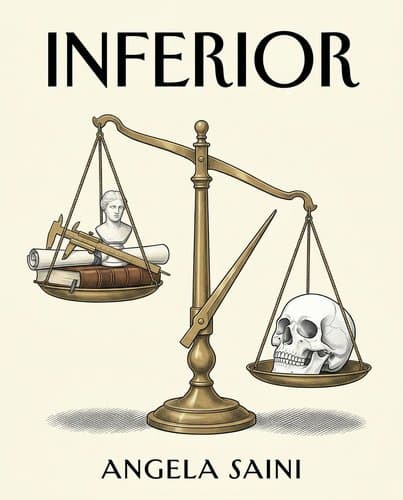
31869108_inferior
by Angela Saini
Science didn't discover that women are inferior — it assumed it, then built studies to confirm the assumption. A forensic dismantling of three centuries of…
In Brief
Science didn't discover that women are inferior — it assumed it, then built studies to confirm the assumption. A forensic dismantling of three centuries of biased research, revealing which sex differences are real and which were manufactured by the institutions that excluded women from science altogether.
Key Ideas
Three critical questions challenge sex research
Before accepting a headline about innate sex differences in the brain or behavior, ask three questions: Was the study independently replicated? Were both sexes included in the original design? Did the press release accurately represent what the paper actually showed? All three failures appear in celebrated, widely cited research.
Robust sex differences sharpen research critique
Some sex differences are robust and real — the female immune advantage, the X-chromosome survival buffer, and prenatal testosterone effects on toy preferences in CAH girls are well-supported by cross-cultural, replicated evidence. Acknowledging this sharpens the critique of sloppy research rather than undermining it.
Male drug research bias harmed women
The male-default in medical research wasn't corrected until 1993 and its effects persist: women are 1.5x more likely to have adverse drug reactions partly because standard doses were calibrated on male subjects. Ambien's recommended starting dose for women was halved in 2013 — more than 20 years after the drug came to market.
Primate selection bias shaped evolutionary narratives
The evolutionary case that male dominance is 'natural' depends entirely on which primate you study: chimpanzees support it, bonobos (equally our closest relatives) disprove it through female coalition dominance. For 40 years, evolutionary psychology built its models on the species that confirmed the hypothesis.
Grandmother hypothesis explains human evolutionary success
The grandmother hypothesis — that post-menopausal women's labor enabled shorter birth intervals, improved grandchild survival, and may have driven human migration out of Africa — is supported by data from multiple hunter-gatherer populations and offers a more evidence-based account of human longevity than the 'uselessness of older women' assumption it replaces.
Who Should Read This
Science-curious readers interested in Biology and Evolution who want to go beyond the headlines.
Inferior
By Angela Saini
11 min read
Why does it matter? Because the science you've heard about gender was shaped by three centuries of excluding the people it was supposed to explain.
We tend to trust science precisely because it seems indifferent to what we want to be true. Peer review, replication, data — the whole apparatus is designed to keep human preference from corrupting the result, which makes the question harder than it should be: what do you do when the apparatus itself was built by people who'd already decided the answer? For nearly three centuries, the institutions that produced our knowledge of human biology — the royal academies, the medical schools, the journals — formally excluded women from participation. Then they used the resulting research to explain why women were, by nature, less capable. Inferior is an investigation into how that happened, how the conclusions outlasted the exclusions, and how the scientists who finally went back to the original data found something the field had been quietly avoiding for decades.
The Institution That Spent Three Centuries Excluding Women Was Never a Neutral Witness on What Women Can Do
In a manuscript room at Cambridge, Angela Saini holds three yellowing letters, the ink faded, the creases brown. One is from Caroline Kennard, a Boston suffragist who wrote to Charles Darwin in December 1881 assuming she could get him to set the record straight. Someone at a women's meeting had cited his work to argue that female inferiority was "based upon scientific principles." Kennard wrote to ask Darwin to correct them.
Darwin was months from death. His reply came in a hand so illegible someone had to transcribe the whole thing alongside the original. The content was worse than the penmanship. "I certainly think that women though generally superior to men in moral qualities are inferior intellectually," he wrote, adding that the laws of inheritance made it unlikely women could ever become the intellectual equals of men. He wasn't correcting a misuse of his work. He was confirming it.
Kennard fired back. Her second letter is noticeably less tidy than the first. Working-class women had always been breadwinners, she pointed out — the difference between the sexes wasn't how much labor they performed but which kinds society permitted them. Men had every professional advantage; women had been barred from universities, the professions, most forms of public life. "Let the environment of women be similar to that of men and with his opportunities," she wrote, "before she be fairly judged, intellectually his inferior."
She was right about the mechanism. But she was arguing with the wrong man. Darwin's views weren't a personal eccentricity; they reflected the institution he represented. The Royal Society of London, founded in 1663 and the most prestigious scientific body in the English-speaking world, would not elect a woman to full membership for another 282 years, until 1945. As historian Londa Schiebinger notes, for nearly three centuries "the only permanent female presence at the Royal Society was a skeleton preserved in the society's anatomical collection." Cambridge awarded degrees to women only in 1921. Harvard Medical School turned them away until 1945, nearly a century after the first woman applied.
Here is the problem embedded in every study, every brain scan, every evolutionary theory claiming to explain what women are and aren't capable of: the institution generating those findings spent most of its existence deliberately keeping women out. Not through the prejudice of individual scientists who could be corrected by the evidence, but as a matter of policy, built into membership rules, degree requirements, hiring practices. When it eventually did begin studying women, it did so without women in the room. When Eliza Burt Gamble, a Michigan schoolteacher who spent a year in the Library of Congress, published a point-by-point scientific response to Darwin in 1894 — catching, among other things, his flat contradiction between condemning large gorilla bodies as evolutionarily limiting and praising male human body size as evidence of superiority — the book was widely reviewed and praised for its prose. It had zero scientific impact. A 1915 review in the American Journal of Sociology was more direct: "Those silly women and their silly ideas."
Science isn't an imperfect institution that slowly corrects for individual bias. On the question of women, the institution was the bias.
Your Brain Is Wired Differently From a Man's — Except the Press Release Made That Up
The finding that men's and women's brains are wired differently was announced to the world in 2014 by a university press release, not the paper itself.
The research came from Penn's Perelman School of Medicine — nearly a thousand people, brain connections mapped using imaging technology that could track white matter pathways at scale for the first time. The resulting images were striking: blue lines threaded inside each hemisphere of the male brain, orange zigzags bridging the two halves of the female one. The Atlantic declared that male and female brains "really are built differently." What the press release added was the practical takeaway: men are better at single tasks, women at multitasking. Pithy. Relatable. Ruben Gur, the paper's lead author, tells Saini he has "no scientific evidence to support" that claim and genuinely doesn't know how it got into the release his institution sent out. Coauthor Ragini Verma told the Guardian the results had "matched a lot of the stereotypes that we think we have in our heads" — which is, if you pause on it, a confession dressed as a discovery.
The press release isn't the only way a finding can outrun its evidence. A second operates at the measurement stage itself. In 2000, a Cambridge team published a paper claiming two-day-old newborns already showed sex-typed preferences — boys preferring a mechanical mobile, girls a human face. It was cited over three hundred times; Lawrence Summers, then president of Harvard, invoked it in 2005 to suggest women might be innately less suited to mathematics. The researcher running the daily sessions was a twenty-two-year-old postgraduate who had been lifeguarding in California before joining the lab. She knew which babies were boys and which were girls because the maternity ward hung pink and blue balloons. Without being blind to that variable, even unconscious micro-adjustments (angling her face a fraction longer toward a girl) could produce the finding. The study has never been replicated.
The third is the hardest to dislodge: foundational studies whose errors go unchallenged because too many careers depend on them. Angus Bateman's 1948 fruit fly experiment, the claim that females are naturally passive and males naturally promiscuous, was cited eleven thousand times before Patricia Gowaty published a 2012 replication showing Bateman had counted mothers as parents less often than fathers, a biological impossibility. He traced parentage through visible mutations in offspring: each parent carried a different genetic marker, and you counted them only if their marker showed up in the next generation. The method was more reliable for confirming fathers than mothers, so females were systematically missed, inflating the apparent gap in reproductive success between the sexes. When Saini contacted Don Symons, who built his career extending Bateman's principles, he said he hadn't read the replication. Robert Trivers, who popularized the experiment in 1972, told her: "I have not read the God Jesus paper."
Three mechanisms, one pattern: the conclusion arrived before the evidence, and the field arranged itself around protecting it.
The Lab Ran on Male Subjects — and Women Were the Ones Who Paid for It
Imagine a pharmaceutical company that calibrates every drug dose on men, then distributes those doses to women on the assumption the bodies are functionally equivalent. That is not a hypothetical. Until Congress passed the NIH Revitalization Act in 1993, most clinical trials excluded women — ostensibly to protect them from experimental risk, but the effect was that dosing was calibrated on male physiology and applied to everyone. The results showed up not in medical journals but in pharmacy recalls.
The case that forced a reckoning was zolpidem, sold in the United States as Ambien. By 2011, Ambien was one of the most prescribed sleep aids in the country, with about sixty million prescriptions dispensed that year, and it had been on the market since 1992. Two decades in, a 2014 pharmacokinetics study finally ran the numbers by sex: fifteen percent of women still had enough of the drug in their bloodstream eight hours after a dose to impair driving. For men, three percent. The drug wasn't acting differently in female bodies — it was clearing more slowly from smaller frames with higher fat-to-muscle ratios. But that variable had never been formally tested before the drug launched. In 2013 the FDA halved the recommended starting dose for women. The drug had been prescribed at the wrong dose, for women, for twenty-one years.
That case was not an outlier. A 2001 estimate found women are roughly one and a half times as likely as men to experience adverse drug reactions. A year earlier, a government audit found that eight of the ten drugs pulled from the US market since 1997 had posed greater health risks to women. The bodies these drugs were tested on weren't representative. The patients paid the bill.
Some Differences Are Real — Which Is What Makes the Question More Important, Not More Settled
The methodological rot doesn't mean the differences aren't real.
Some are, and the starkest is the one you'd least expect given the cultural story of female fragility. The female survival advantage is among the most thoroughly documented facts in biology. Women outlive men in every country with reliable records, across centuries, regardless of social conditions. The pattern is so consistent that Steven Austad, chair of biology at the University of Alabama Birmingham, spent years combing through demographic data from 38 countries specifically to find the exception. He found none. Sweden in 1800: women lived to 33 on average, men to 31. By 2015, women were reaching 83, men 79. When Austad looked at the Gerontology Research Group's verified list of supercentenarians, people confirmed past 110, he found 46 women and two men. A finding this universal, this stable across radically different environments and centuries, cannot be an artifact of funding bias or experimenter expectation. It's signal.
What makes it remarkable is what hasn't followed. "When I first started looking into this," Austad tells Saini, "I expected to find a huge literature on it, and I found virtually nothing." One of the most robust features of human biology (women consistently outlasting men) has received almost no serious scientific attention. Meanwhile, decades of resources and headlines went to brain-wiring diagrams that turned out to be entirely explainable by the elementary fact that larger brains require proportionally more white matter. The sex difference that fit the cultural story attracted the investigation. The one that didn't fit (women as the biologically tougher sex) sat quietly unremarked.
Saini's sharpest point is the asymmetry itself. Biology clearly matters: Cambridge psychologist Melissa Hines studied girls with congenital adrenal hyperplasia, a condition that exposes them to elevated androgens before birth, and found significant differences in toy preference and play behavior, replicated by seven or eight independent teams. Hines is careful about the magnitude: roughly equivalent to the sex difference in height. Real, but modest. And because these girls are raised as girls socially, the prenatal hormone exposure is what differs, making CAH studies a cleaner test of biological influence than most research that can't separate hormones from upbringing. Some differences are genuine.
The question is which ones. Neuroscientist Daphna Joel's 2015 analysis of brain-scan data from over 1,400 people found that only 0 to 8 percent of individuals have a brain consistently "masculine" or "feminine" across all measured regions; between 23 and 53 percent show features prevalent in both sexes. Average differences between groups exist. Joel doesn't deny that. But the category barely describes any individual brain. Most dramatic brain-difference claims dissolve when researchers control for body size, check effect sizes, or simply require replication. The survival advantage holds across every such test. The problem was never that scientists went looking for sex differences. It was that institutional incentives decided which ones were worth pursuing — and kept missing the one that ran in the wrong direction.
We Built Our Evolutionary Origin Story on the Ape That Proved Our Point
Amy Parish, who spent twenty-five years documenting bonobos in captivity, points to one named Makasi crouched alone at the edge of the San Diego Zoo enclosure. He's nursing his hand — missing skin on the fingers, comparable damage to the toes — caused by a female named Lisa. He was nursery-reared, which means no mother in the group to intervene, no protection. He sits there looking cowed, licking the wound.
Bonobos and chimpanzees are our two closest living relatives; the last common ancestor we share with each diverged roughly six million years ago. But for forty years, every evolutionary model of human origins was built on chimpanzees — patriarchal hierarchy, male coalition, sexual coercion of females, infanticide as reproductive strategy. The logic felt airtight: male chimps dominate, female chimps spend three-quarters of their time alone and are correspondingly vulnerable, and this arrangement had been consistent enough across the data to seem like the natural order. The story wrote itself.
When Parish began noticing females systematically attacking males across multiple zoos, each institution had its own individual explanation: this male was spoiled by a female keeper who nursed him back to health, that male was constitutionally timid. One German zoo didn't believe women were suitable ape keepers at all. But when she pulled veterinary records across facilities, the pattern was uniform. She confirmed it held in wild populations too.
The mechanism is specific. Bonobo females are physically smaller than males, but they form tight coalitions with unrelated females. When a male approaches a food source, two or three females move together to block him — not so much fighting as making clear the math doesn't work in his favor. Male chimps build alliances with other males; bonobo females build alliances with each other, and those alliances tip the balance. Makasi has no mother to anchor him to a coalition, no female kin who will intervene. That's why he's sitting alone with raw skin on his fingers.
For four decades, the case for evolved male dominance rested on one primate that confirmed it, while the other — equally our closest relative — was quietly not studied. The choice of which one counted as evidence was never neutral.
The People Who Made Human Longevity Possible Were the Grandmothers Science Said Shouldn't Exist
The simplest explanation for why humans outlive their evolutionary cousins may be that post-menopausal women worked harder than anyone wanted to admit.
Evolutionary biology spent decades treating menopause as a puzzle — why would natural selection keep women alive past the point they could reproduce? That question assumes fertility is the only thing that makes a woman evolutionarily useful. Kristen Hawkes, an anthropologist at the University of Utah, went to Tanzania in the 1980s to study the Hadza, one of the last pre-agricultural hunter-gatherer societies, and found the answer in front of her. Older women — grandmothers, aunts — were foraging as much food as younger women, caring for grandchildren, and allowing their daughters to have shorter gaps between babies. Hawkes titled her 1989 paper "Hardworking Hadza Grandmothers." Data from 3,000 Finnish and Canadian women confirmed it: every ten post-menopausal years a woman survived produced two additional grandchildren.
Anthropologist Adrienne Zihlman cites a story from Elizabeth Marshall Thomas, who lived with Kalahari hunter-gatherers: a young widow and her two children fell ill during an epidemic and couldn't walk when the group shifted camp. The woman's elderly mother — small, past childbearing age — put her daughter on her back, one grandchild in a sling across her chest, another on her hip, and walked 35 miles to the new camp.
The countertheory was published in 2013 by Rama Singh. His argument — the "patriarch hypothesis" — runs like this: because men can go on fathering children with younger women well into old age, natural selection favored male longevity; women simply inherited long lives as a genetic byproduct, their post-reproductive decades not selected for at all. Singh admits it generated "a lot of bad letters." Demographer Rebecca Sear called it circular: men don't prefer post-menopausal women because they're post-menopausal, not the other way round.
Hawkes now speculates that grandmothering may date back two million years and may have enabled Homo's spread out of Africa — meaning what the "Man the Hunter" hypothesis frames as an adventure of male hunters may have been carried on the backs of women long past their fertility.
What Good Science Finds When It Finally Asks the Right Questions
Social psychologist Carol Tavris once observed that feminism didn't corrupt science — it improved it, by forcing the field to study people rather than assume them. These are the scientists Saini spent years tracking down: neuroscientists who found that no individual brain is consistently male or female across all its regions, Patricia Gowaty counting fruit flies that Bateman miscounted for sixty years, Kristen Hawkes watching grandmothers carry their families across thirty-five miles. None of them argued that biology is fiction. They argued it deserves honest study. The distinction matters. Three centuries of structural exclusion isn't a footnote you can set aside before evaluating the data. It is the condition in which the data was produced. And when you actually look — when you read the original papers, run the replication, ask where the mothers went — what you find isn't less interesting than the old story. It's considerably more.
Notable Quotes
“a much higher percentage of the brain is devoted to white matter.”
“females have the same volume, or even greater volume, of corpus callosum, which is the largest body of white matter, the nerve fibers that connect the two hemispheres.”
“Male and Female Brains Really Are Built Differently,”
Frequently Asked Questions
- What is Inferior about?
- Inferior examines how centuries of male-dominated science produced flawed, biased research on women — and how those myths are now being corrected by better evidence. The book equips readers to critically evaluate claims about innate sex differences, separating robust findings from assumption-driven science. It reveals how the male default in research design and medical practice has had real, measurable consequences for women's health, from drug dosing to disease prevention. Saini combines historical analysis with contemporary science to show both where we went wrong and where better evidence is correcting the record.
- What health harms did male-dominated medical research cause?
- Male-dominated medical research has produced measurable harms. Women are 1.5x more likely to have adverse drug reactions partly because standard doses were calibrated on male subjects. The male-default in medical research wasn't corrected until 1993, and its effects persist today. A striking example: Ambien's recommended starting dose for women was halved in 2013 — more than 20 years after the drug came to market. This reveals how assumptions embedded in research protocols create downstream health consequences that go unrecognized and uncorrected for decades, affecting millions of women.
- How does Inferior distinguish real sex differences from myths?
- Inferior distinguishes between robust, evidence-based sex differences and myths. Some differences are real — the female immune advantage, the X-chromosome survival buffer, and prenatal testosterone effects on toy preferences in CAH girls are well-supported by cross-cultural, replicated evidence. However, many celebrated claims lack foundation. Before accepting headlines about innate sex differences, ask: Was the study independently replicated? Were both sexes included in the original design? Did the press release accurately represent what the paper actually showed? All three failures appear in widely cited research, yet rigorous examination reveals which differences hold up under scrutiny.
- What does Inferior reveal about evolutionary psychology?
- Inferior exposes how evolutionary psychology selectively used evidence to support predetermined conclusions about male dominance. The evolutionary case that male dominance is 'natural' depends entirely on which primate you study: chimpanzees support it, bonobos (equally our closest relatives) disprove it through female coalition dominance. For 40 years, evolutionary psychology built its models on the species that confirmed the hypothesis, ignoring contrary evidence from equally relevant primates. This selective reasoning extends to human evolution: the grandmother hypothesis—that post-menopausal women's labor improved child survival—offers evidence-based explanations for human longevity, replacing outdated assumptions about older women's value.
Related Book Summaries

Read the full summary of 31869108_inferior on InShort