220715005_invisible-rivals
by Jonathan R Goodman, Robert A. Foley
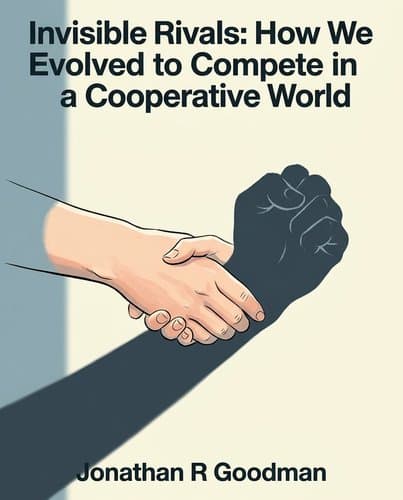
Humans didn't evolve to cooperate—we evolved to appear cooperative while competing invisibly beneath the surface. Drawing on evolutionary biology, this book…
In Brief
Humans didn't evolve to cooperate—we evolved to appear cooperative while competing invisibly beneath the surface. Drawing on evolutionary biology, this book reveals how our noblest instincts double as camouflage for self-interest, and how to design institutions, relationships, and incentives that account for this hidden truth.
Key Ideas
Altruism Must Impose Real Cost
When evaluating apparent altruism — in leaders, institutions, or philanthropists — ask whether it meets the biological definition: does it cost the actor anything in terms of reproductive fitness or genuine capital? If not, you're looking at signaling, not sacrifice.
Distributed Responsibility Erodes Moral Intuition
Market structures don't corrupt ethical behavior — they reveal what was always there by spreading guilt thin enough to make it invisible. When a harmful decision involves multiple parties, your moral intuition becomes unreliable.
Protect the Institutional Skeptic Role
The people most likely to detect manipulation and resist authoritarian drift tend to occupy the 'front row' of any institution — curious, questioning, willing to push back. Protecting that function structurally matters more than hoping for individual moral courage.
Incentivize Cooperation Beyond Reputation Effects
Behavioral cooperation in experiments is highly sensitive to observation — a poster of eyes increases donations, anonymity collapses them. Design incentive structures that reward cooperation when no one is watching, not just when reputation is on the line.
Design Systems Around Baseline Defection
Don't try to eliminate free-riding; design around it. Systems that assume perfect compliance (Paris Accord, welfare programs, carbon markets) are more fragile than systems that model for a baseline defection rate and build in resilience accordingly.
Self-Interest Emerges From Specific Conditions
The binary between 'humans are basically good' and 'humans are basically selfish' is itself exploitable — both comfortable certainties create blind spots. The more useful frame is: under what conditions, and with what disguise, does self-interest override cooperation?
Who Should Read This
Science-curious readers interested in Evolution and Behavioral Economics who want to go beyond the headlines.
Invisible Rivals: How We Evolved to Compete in a Cooperative World
By Jonathan R Goodman & Robert A. Foley
12 min read
Why does it matter? Because the person performing cooperation most convincingly might be the one extracting the most from it.
You already know where you sit on the dial. Maybe you lean toward the cynical end — everyone's in it for themselves — or maybe you're more hopeful, convinced that cooperation is what separates us from the rest of the animal kingdom. Either way, you're working with the same basic framework: selfish or generous, competitive or kind. That binary isn't just wrong — it's the exact vulnerability that gets exploited. The person who takes from you while looking you in the eye and calling it teamwork doesn't register as a threat because they've learned to speak the language of cooperation fluently. We didn't evolve past selfishness. We evolved to hide it behind the behaviors we most admire in each other. This book is about how that happened, why we're wired to miss it, and what it costs us every time we don't.
The Man Who Proved Altruism and Was Destroyed by It
In January 1975, a handful of people gathered in a London squat to bury a man who had spent the last years of his life giving everything away. George Price was a biologist who, working alongside William Hamilton, had cracked one of evolution's hardest problems: a mathematical proof of how genuine altruism could emerge from a world governed by self-interest. Then, apparently convinced by his own result, he began to live it. He donated his possessions, his home, his money. He moved in with the homeless people he was trying to help. He died by suicide, his wrists cut, in a rented room he could barely afford. The man who proved altruism possible was consumed by the attempt to practice it.
Hold that image alongside a different one. Dan Price, a Seattle tech CEO, announced in 2015 that he was raising his company's minimum salary to $70,000 and slashing his own pay to match. The press called it heroic. His employees wept. He became a symbol of exactly the cooperative, prosocial capitalism that optimists argue is latent in human nature, waiting to be unlocked. Years later, multiple women accused him of sexual assault. Former employees described manipulation behind the generous facade. The virtue had been performing work that the virtue itself obscured.
Two men named Price. One ruined by sincerity, one allegedly enriched by its simulation.
This is the trap in every debate about whether humans are fundamentally selfish or fundamentally cooperative. Both camps assume the question is one of degree — how much selfishness survives, how much cooperation emerges. But the more unsettling possibility, the one this book builds its case around, is that advanced social intelligence gave us a third option entirely: using the performance of cooperation as a competitive weapon. Selfishness didn't disappear. It learned to wear the costume.
The binary of good versus bad, selfish versus altruistic, is not just wrong in theory. It is practically dangerous. Build institutions around the assumption that people are basically decent and you create a system optimized for the person who has learned to appear that way. The rival you cannot see is the only rival you cannot defend against.
The Noble Savage Never Existed — and Neither Did the Brute
Exploitation isn't a feature of complex societies that corrupts an earlier innocence. It's a constant across every human society we've ever documented. What shifts is the mechanism, not the fact.
The Aché of Paraguay are frequently cited as a model of primitive generosity — and in one sense, fairly so. Hunters distribute meat through the whole group, not just to their own families. But the same Aché society that pooled resources this way also practiced infanticide at rates that should stop any romantic reading cold: roughly one in seven boys killed at birth, and nearly one in four girls. Communal sharing and systematic killing coexisted without apparent contradiction, because they served different functions in the same survival logic. The sharing built alliances; the killing managed dependency. Neither was about virtue.
Among the Cheyenne of the Great Plains — and this wasn't aberration, it was structure — a wife judged disobedient or unfaithful could be 'put on the prairie' by her husband, where she would be gang-raped by the men of his warrior society and sometimes killed. Among the Khoekhoen of southern Africa, elderly chiefs held the power of life and death over younger men and performed ritual humiliations — urinating on them, calling them women — to enforce dominance by elders. These weren't failures of an otherwise cooperative system. They were the system, the means by which certain individuals extracted more than others while the group's cooperative surface stayed intact.
Rousseau was wrong: there was no pre-state paradise where people treated each other as equals. But the Hobbesian counter-image — the brutish, every-man-for-himself savage — is equally false. Every society cooperated. Every society also had people who used the architecture of that cooperation to take more than they gave. The noble savage and the brute are both comfortable fictions. The reality is harder to sit with: we have always been both at once.
Language Is the Ring of Gyges — and We've All Been Wearing It
Plato's thought experiment is almost offensively simple: if you slipped on a ring that made you invisible, would you still behave well? Most of us want to say yes. Most of us are wrong. What the ring does is remove the cost of selfishness — no reputation damage, no retaliation, no social consequence. Take away that cost and the 'good person' starts to look a lot like everyone else. The question isn't whether we're good. It's whether goodness and self-interest are actually different things once the watching stops.
Language is already that ring. Not because it lets us disappear, but because it lets us narrate. You can distribute meat generously while quietly taking the choicest cuts first. You can build a coalition against the camp bully by framing your moves as justice. You can signal loyalty to a group while calculating exactly when to defect. The person behaving selfishly and the person behaving cooperatively can produce identical public performances. That's not a corruption of language. That's what language, in a social species, selects for.
A 240-million-year-old turtle fossil — Triassic, before dinosaurs dominated — was found to have osteosarcoma. Cancer in a creature from before complex vertebrates evolved their social lives. What cancer does is defect from the body's cooperative project: a single lineage of cells stops contributing and starts taking, extracting resources from surrounding tissue while flying the body's own molecular flags to avoid immune detection. The invisible rival isn't a modern invention. It is what life does when defection is more profitable than cooperation and the defector can stay hidden.
Humans built this logic into our own evolution. The self-domestication hypothesis holds that our ancestors gradually eliminated the reactive aggressor — the alpha who dominated through open violence and intimidation. Over roughly twenty thousand years, smaller coalitions with projectile weapons could bring down even the most physically dominant individual. Overt bullying became fatal. But eliminating the bully didn't produce the cooperative paradise the theory implies. What it produced was selection pressure for a different kind of competitor: someone intelligent enough to want the same things the bully wanted, patient enough to pursue them slowly, and skilled enough with social signals to look like a cooperator the whole time. Proactive aggression, the kind that plans and conceals rather than erupts, was not what we selected against. It was, quietly, what we selected for. Survival of the nicest is a comforting story. Survival of the best-disguised is what the evidence suggests.
Billionaire Philanthropy Fails the Only Definition of Altruism That Matters
What would it actually cost a billionaire to be altruistic? Not morally — biologically. Evolutionary biology has a precise answer: altruism requires a fitness cost, meaning the giver's reproductive capacity must genuinely diminish. If I hand a homeless person twenty dollars and feel nothing but a warm glow, I haven't been altruistic by this definition. The cost is negligible. My future is unchanged.
Now scale that logic up. Giving away a fraction of a fortune so vast it can't be spent in a lifetime, while funding a reproductive strategy of that scale, is not altruism — it costs nothing that evolution recognizes as a cost. Elon Musk has pledged large portions of his wealth to charitable causes, as have Jeff Bezos and a roster of others who signed the Giving Pledge, the movement through which ultra-wealthy individuals promise most of what they own to philanthropic ends by the time they die. Sam Bankman-Fried signed it too, before defrauding his customers of billions. The gesture looks like sacrifice. But consider what the wealth actually permits. Musk, by his own account, believes he has a duty to spread what he considers superior genes. He has nine or more children. The rising cost of housing and childcare — documented pressure on birth rates across the developed world — simply doesn't apply to him.
The evolutionary record has seen this before. Population geneticists estimate that roughly half a percent of all living men are direct descendants of Genghis Khan. The mechanism was resource and social power converted into disproportionate reproduction: his commanders were rewarded with women from conquered populations, and the biological record is essentially a map of military reach. The warlord's army is gone. Billionaire capital is different in form, identical in function. We don't need to impute bad motives to anyone. The logic doesn't require intent. It only requires that resource capital, at sufficient scale, breaks the demographic rules that constrain everyone else — and that the public performance of generosity keeps the reputational cost of that asymmetry invisible.
This is what evolutionary biology means when it distinguishes costly signals from cheap ones. A signal is honest when faking it is genuinely expensive. Giving away money that leaves your reproductive future entirely intact is the cheapest signal available. No signatory of the Giving Pledge has yet paid the cost that would make the pledge, by the only definition that cuts through the narrative, real.
Morality Is Often a Response to Surveillance, Not a Genuine Preference
In 1996, Stephen Glass was the kind of journalist every editor wanted: tireless, eager, gifted at finding stories that felt perfectly shaped for the page. Over the following two years at the New Republic, he published piece after piece that editors loved and readers shared. The stories were almost too good, it turned out, because he had fabricated most of them — two-thirds, by the eventual count. What made it possible wasn't technical skill at forgery. It was social skill. Glass studied each editor's blind spots and enthusiasms, performed anxiety and earnestness in exactly the right registers, and made himself so likable that checking his work felt vaguely rude. He wasn't exploiting a loophole in the system. He was exploiting the normal human tendency to trust people who appear to deserve it. Competence and goodness looked identical from the outside, so he only needed to perform one.
That confusion is the subject of a body of experimental research that consistently reaches the same uncomfortable place. In a version of the dictator game, participants were given ten dollars and a second player to share with. Standard results show moderate generosity. But when researchers added a third option — pay one dollar and simply leave, with the second player never knowing anyone had anything — one-third of participants took it. They weren't refusing to share; they were paying to avoid being seen refusing. The preference wasn't for keeping the money. It was for not being observed keeping it. In a separate study, placing a photograph of watchful eyes in the room where participants made charitable donations was enough to significantly increase giving. Not a moral lecture, not a financial incentive — just the feeling of being watched. Morality, in these results, looks less like a disposition people carry around and more like a response they produce when the social conditions call for it.
Glass's editors weren't naive. They were operating in an environment optimized for trust, where suspicion was socially costly and performance was indistinguishable from sincerity. He understood that before they did. Most invisible rivals do.
Remove the Critical Thinkers and the Middle Becomes the Most Fervent
Ron Jones gave his California high school students a slogan in 1967 — strength through discipline, strength through community — and within three days two hundred of them had joined a movement he hadn't planned to start. By day five, they believed they were part of a national political force. Jones called it off in an auditorium reveal: you just demonstrated how fascism takes hold. Later, describing the experiment to researchers and journalists, he made an observation that cuts deeper than the headline. He always knew which students would resist — the front-row thinkers who asked inconvenient questions. So he watched what happened when, absorbed into the movement's energy, they disengaged. The middle rows moved forward. And those students, the ones who'd never been the type to lead or push back, became the most fervent loyalists of all.
The same architecture runs through every system where exploitation scales. The Paradise Papers documented ultra-wealthy individuals paying effective personal tax rates around half a percent — not through lawlessness but through a legal infrastructure built specifically to reward those who stop noticing. The transition from tangible assets to intangible financial instruments wasn't just a tax story; it was a visibility story. When wealth lives in cattle, everyone can count the cattle. When it lives in layered financial structures, the front-row thinkers are the only ones who can follow it — and they're also the first ones the structure is designed to ease out. What remains isn't passive. It's actively invested in the norms that replaced the old ones.
Jones's classroom is a model of why the fix everyone reaches for — more critical thinking, more civic education — misses what the system is actually doing. Becoming more suspicious doesn't help; suspicion reads as disloyalty inside the movement and gets you pushed back to the margins or out entirely. Becoming more trusting doesn't help either — that's precisely the condition the structure depends on. The immune system isn't missing because everyone failed their civic duty. It's missing because it was the first thing the institution learned to clear out. By the time you notice the absence, the middle has already moved up, and they believe.
The Goal Isn't to Eliminate Cheating — It's to Design for the 30%
The answer to invisible rivalry isn't vigilance and it isn't better values. Both responses feed the problem they're trying to solve — relentless suspicion poisons the cooperation that makes societies function, while demanding that people simply be more honest hands a weapon to anyone skilled at performing honesty. The real move is institutional design that assumes defection will happen and builds resilience around that assumption.
Oncologists learned this the hard way. For decades, the dominant approach to cancer was maximum-force eradication — aggressive chemotherapy calibrated to kill every last malignant cell. It often worked, briefly. Then resistant cells, no longer competing with the majority the drugs had wiped out, proliferated faster than before. The treatment had cleared the field for the very thing it was trying to destroy. A newer approach, called adaptive therapy, abandons eradication as a goal. Oncologists manage the tumor instead — keeping the population of defecting cells stable, preventing the conditions that allow resistant variants to take over. The host survives longer. Not because the cancer is gone, but because the system stopped pretending it could be.
The book applies this logic directly. Welfare systems collapse not because free riders exist — they always will — but because designers model for a world where they shouldn't. When a small percentage of people claim benefits they don't need, the political response is to tighten the system for everyone, punishing the majority who are genuinely in need while rarely catching the sophisticated cheaters. Climate agreements break down the same way: the Paris Accord's credibility depends on near-total compliance, so any defection — any country that takes the credit while missing its targets — reads as a reason to abandon the project entirely. Model for 100% cooperation, and a 30% cheat rate looks like catastrophic failure. Model for 30%, and the same rate is a managed cost, not a collapse.
What this requires is not cynicism but honesty about what institutions are for. The Maasai pastoralists studied by anthropologists understood it intuitively: their cattle-sharing systems didn't break down when some members asked for animals they didn't strictly need, because the system was built around genuine scarcity, not the fantasy of perfect reciprocity. Designing for human nature as it actually operates — deceptive and self-interested in a fraction of cases, genuinely cooperative in most — is the only architecture that doesn't hand the 30% a structural advantage. The alternative is what we keep building: systems so brittle that the first defector who walks through the door brings the whole thing down.
What You Do With the Ring
Plato assumed the ring was hypothetical. He was wrong. You are already wearing it — have been since the first time you framed a self-serving decision as a principled one, since the first institution rewarded the appearance of cooperation over the thing itself. The question was never whether you'd use it. The question is whether you're willing to build as if you know you will. That's what the adaptive therapy model actually asks of us: not to become better people, but to stop designing for the people we imagine ourselves to be. Welfare systems, climate agreements, newsrooms, movements — they fail not because the 30% arrived uninvited, but because the architecture assumed they wouldn't come at all. The hard-won answer here isn't cynicism. It's something more difficult: honesty precise enough to be useful. Not a cure, but a structure built by people who know they're already wearing the ring.
Notable Quotes
“A Cheyenne man could put his wife ‘on the prairie’ if she committed adultery or was disobedient, or simply to change his luck in war or hunting.… A woman put ‘on the prairie’ was gang-raped by the members of her husband’s soldier society, and sometimes beaten and killed.”
“power of life and death,”
“I didn’t have a plan,”
Frequently Asked Questions
- What is "Invisible Rivals" about?
- "Invisible Rivals: How We Evolved to Compete in a Cooperative World" (2025) draws on evolutionary biology and behavioral science to explain how human cooperation and self-interest are not opposites but camouflaged partners. The book reveals mechanisms by which altruism, institutions, and social norms conceal competitive motives, giving readers a framework for detecting exploitation and designing more resilient cooperative systems. Written by Jonathan R Goodman & Robert A. Foley, it examines how market structures and social systems amplify hidden competitive drives while obscuring moral responsibility.
- What are the key takeaways from "Invisible Rivals"?
- The book provides six core insights: First, when evaluating altruism, ask "does it cost the actor anything in terms of reproductive fitness or genuine capital? If not, you're looking at signaling, not sacrifice." Second, "Market structures don't corrupt ethical behavior — they reveal what was always there by spreading guilt thin enough to make it invisible." Third, protect institutional "front row" members who question authority. Fourth, design systems rewarding cooperation without observation. Fifth, "Don't try to eliminate free-riding; design around it." Sixth, recognize that assuming humans are "basically good" or "basically selfish" creates blind spots.
- Is "Invisible Rivals" worth reading?
- Yes, "Invisible Rivals" is worth reading if you seek nuanced understanding of human cooperation and competition beyond simplistic assumptions. The book draws on evolutionary biology and behavioral science to challenge naive ideas about institutional ethics and altruism. It's particularly valuable for leaders, policymakers, and system designers who need practical frameworks for detecting hidden competitive motives disguised as cooperation. The authors move beyond binary thinking about human nature to offer tools for recognizing when self-interest overrides cooperation and how to build more resilient systems.
- How does "Invisible Rivals" explain the relationship between cooperation and self-interest?
- "Invisible Rivals" explains that human cooperation and self-interest "are not opposites but camouflaged partners." Rather than opposing forces, the book reveals mechanisms by which "altruism, institutions, and social norms conceal competitive motives." Self-interest operates invisibly within cooperative systems; market structures don't create unethical behavior but "reveal what was always there by spreading guilt thin enough to make it invisible." The book argues that understanding this relationship requires asking under what conditions self-interest overrides cooperation and how that camouflage operates. Design and incentive structures matter more than assuming innate human nature.
Related Book Summaries
Read the full summary of 220715005_invisible-rivals on InShort