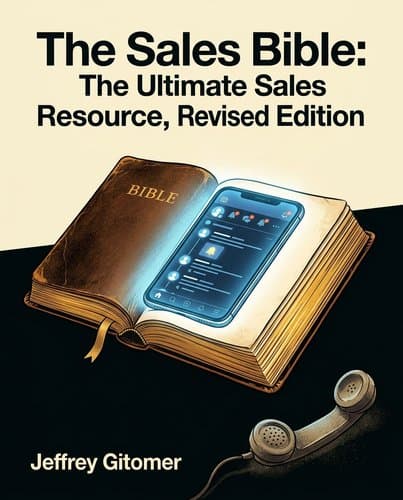
202194_the-sales-bible
by Jeffrey Gitomer
Your next customer is Googling you right now—and your LinkedIn profile, YouTube channel, and email list will either close the deal or end it before you ever…
In Brief
Your next customer is Googling you right now—and your LinkedIn profile, YouTube channel, and email list will either close the deal or end it before you ever speak. Gitomer reveals how to build a digital presence so authoritative that prospects call you first.
Key Ideas
Google Yourself Before Your Sales Call
Audit your digital first impression before your next sales call: Google yourself, check your LinkedIn profile completeness (use all 2,000 Summary characters with keywords), and ask whether a stranger could judge your expertise from your Twitter feed alone
Daily Value Posts Build 90-Day Reputation
Commit to one value-based post per day—not a status update, but a thought that answers: how will the reader use this to learn, earn, or improve their work? Consistency over 90 days builds the reputation that inbound calls come from
LinkedIn Group Ownership Proves Niche Authority
On LinkedIn, own at least one group in your niche—it's the only place on the platform where you can message more than 50 members at once, and group ownership signals authority to prospects scanning for experts
YouTube Library Works While You Sleep
Build a YouTube library starting with what you already know: customer testimonials, your best idea of the week, your core philosophy. Early and unpolished beats absent. YouTube is 'always open'—your video works while you sleep
Email List: Your Only Owned Asset
Start an email list today, even if it's 50 people. Gitomer started with 21,000 names from 1,000 phone calls and built it to 300,000 over nine years. Your email list is the only digital asset you own outright—platforms disappear, algorithms change, inboxes don't
Your Personal Brand Outlives Your Employer
Separate your personal brand from your employer online. Write under your own name, share human value (not company news), and build a Google ranking that travels with you. Your next employer will check it before they read your resume
Who Should Read This
Business operators, founders, and managers interested in Sales and Marketing who want frameworks they can apply this week.
The Sales Bible: The Ultimate Sales Resource, Revised Edition
By Jeffrey Gitomer
10 min read
Why does it matter? Because your prospects are already judging you before you dial.
Right now, a prospect is pulling up your LinkedIn profile. They're scanning your last tweet, checking if your blog has been updated since 2019, measuring whether you're worth their time—and you haven't even dialed their number yet. The cold call didn't die quietly; it got replaced by something structurally opposite: instead of you chasing people, you build something worth finding. Jeffrey Gitomer's framework is blunt about the math: one percent of cold calls convert. One percent. Meanwhile, 500 million people are already assembled on platforms waiting to discover someone worth following. The question this book forces you to answer isn't whether social media is real business—it is—but whether you've been too comfortable with the old chase to build the new gravity.
Your Prospects Have Already Decided Before You Call
Richard Brasser spent weeks doing something that looked, from the outside, like nothing. He was reading a tech CEO's Twitter feed—studying the rhythm of it, the 75-25 split between professional insights and personal observations, noticing which threads the man returned to, which ideas he couldn't let go of. When Brasser finally moved, the action was almost invisible: a single retweet, tagged with the phrase "great opinion by top thought leader." A few days later, the CEO reached out to thank him. Brasser replied, mentioned he'd admired the man's work for years, and suggested coffee next time he was in New York. The CEO said sure. They met. No gatekeeper ever knew it happened.
That story is uncomfortable if you've spent your career on the phone, because it exposes something most salespeople haven't admitted yet: the judgment has moved. It no longer happens when you introduce yourself. It happens before you dial. Before your prospect picks up, they've already run your name through Google, scanned your LinkedIn recommendations, checked whether you have a YouTube channel, and decided—based on what they found—whether you're worth two minutes of their time. Your online presence isn't a supplement to your sales process. It is your first impression, and right now it's happening without you in the room.
Gitomer calls it the new pre-call checklist—the one your prospects are running on you. Google ranking. LinkedIn connections. Twitter activity. YouTube presence. And if any of those signals are thin or absent, the cold call that follows is already fighting uphill—not because your pitch is weak, but because the credibility check failed before you opened your mouth. The 1% cold-call success rate isn't just a depressing statistic. It's the tax on showing up unprepared to a judgment that already happened.
The fix isn't complicated, but it requires honesty about where you've been spending your time. What Brasser did before the retweet—weeks of reading, pattern recognition, genuine attention—that's the infrastructure. One value-driven tweet per day. A blog paragraph that says something genuinely useful to your market. Customer video testimonials posted where prospects can find them. The question isn't whether your prospects are looking you up. They are. The only question is what they're finding.
Social Media Isn't for Kids—It's Where IBM Wins Customers While You Wait
Social media is where serious companies win customers, right now, while their competitors are still drafting a policy for legal to review. IBM wasn't treating it as a branding experiment — the company was actively doubling its investment in employee social participation, betting that customers connect with real people faster than they connect with corporate messaging. Starbucks was using customer feedback on its platforms to develop actual products: the little green splash-stopper stick on your coffee lid came from a social media suggestion, not from an R&D lab. Comcast was handling individual customer service complaints on Twitter, in public, where both the problem and the resolution were visible to everyone watching. These aren't edge cases or pilot programs. They're core business activity happening on channels where many salespeople have never shown up.
Gitomer is blunt about what's really going on when a company bans social media or stalls for a corporate strategy to materialize. Management that blocks salespeople from these tools is making a quiet bet that its competitors won't notice the open door. It's telling employees, customers, and rivals something it probably didn't mean to say out loud — that it doesn't trust its own people. The competition isn't waiting. They're posting, connecting, and being found while your team is working through an approval chain.
The math is simple: cold calls convert at roughly one percent. Every day you're absent from social, your prospects are finding your competitor instead.
LinkedIn Is a Search Engine—Treat It Like One
When did you last update your LinkedIn summary? If the answer involves the word
A Single Tweet Can Be Worth More Than a Hundred Cold Calls
Think of Twitter as a trade show floor that never closes. Every day, thousands of your exact prospects walk through — and the only question is whether they stop at your booth or keep walking. Most salespeople treat it like a bullhorn: product announcements, company updates, nothing worth forwarding. The ones building real pipelines figured out something different. A single well-crafted tweet functions like a handshake that scales.
Gitomer's formula fits on a napkin: half of Twitter success comes from creating messages worth sharing, the other half from giving people somewhere to go. The first half is where almost everyone fails. There's a real difference between tweeting that you're stuck in traffic and tweeting that testimonials from loyal customers are the most powerful sales tool on your team. One disappears in seconds. The other gets forwarded and attached to your name by strangers you've never met — strangers who are, increasingly, your next customers.
Sandy Carter understood this before most of her colleagues had created accounts. An IBM vice president, she was the only person in a room of 200 seasoned sales professionals with more than a thousand followers. When she tweeted "Analytics is the new black," four or five enterprise customers contacted her directly to schedule executive briefings. She didn't pitch them. She didn't cold-call them. She said something genuinely interesting, and they came to her. One tweet. Multiple sales conversations.
That's the whole game. The self-promoter blasting quarterly numbers at people who didn't ask generates noise. Carter generated inbound. The difference isn't platform or timing or follower count — it's whether you're saying something worth the other person's time.
One quality tweet per day. Compounding, daily.
YouTube Is the Salesperson Who Never Sleeps
Walt Ribeiro teaches music. On any given day, a typical music teacher sits across from maybe ten students, collects their fees, and goes home. Ribeiro built a YouTube channel instead—and now reaches thousands of students daily, earns more than most of his peers, and does it while he sleeps, because YouTube doesn't close at five o'clock. No studio booking. No production crew. Just a camera, specialized knowledge, and the discipline to show up consistently on video.
That's the embarrassing truth most salespeople haven't sat with yet: you could have a version of that. A library of short customer testimonial videos, filmed on your phone, running on YouTube around the clock—answering objections, demonstrating credibility, doing the trust-building work that currently happens only when you're physically present. Every hour you don't have it, a prospect is searching for someone in your category and finding your competitor instead.
The mental block is production quality. You're imagining a camera crew and a script department. Gitomer and guest contributor Julien Smith are describing something completely different: one to four minutes, real and unpolished, posted consistently. Smith's point is blunt. The earliest uploads from creators who now have millions of subscribers are almost unwatchably raw—and that rawness is what made people trust them. Audiences trust imperfect more than they trust corporate-slick. What kills credibility isn't a shaky camera. It's a blank channel.
The playbook is simple enough to start today. Film customers talking about results they've gotten. Record the best idea you had this week. Build a series, because each new video gives viewers one more reason to hit Subscribe, turning a one-time visitor into a long-term audience. Ribeiro didn't compete with other music teachers. He competed with magazines. That reframe is worth borrowing: your YouTube library isn't a supplement to your sales calls. It's a 24/7 presence making the case for you before you ever dial.
The Glue Is What Turns Followers Into Buyers
Your social media profiles are not the destination. They are the spokes. The destination—the place where scattered attention turns into actual revenue—is a blog you own and an email list nobody can take from you.
Gitomer made this discovery the hard way. In early 2001, he and his team spent weeks calling a thousand customers, manually asking each one for an email address. They gathered 21,000 names—a number that would be nearly impossible to collect that way today, when people guard their inboxes like a second wallet. Then September 11th happened, the world went dark, and he launched anyway. The first issue of Sales Caffeine went out in November 2001. The response hit immediately: readers forwarded it, strangers subscribed, and the week he bundled in an offer to buy one of his books, hundreds sold overnight. Two decades later, that list has grown to more than 300,000 active subscribers and graduated from a part-time task to a full-time operation inside his company. He calls it his single most valuable business asset—not his Twitter following, not his YouTube channel, but the list. Because the list is the one thing no platform algorithm can throttle, no policy change can bury, and no competitor can poach.
Seth Godin is proof that this compounds. He maintained an audience of tens of thousands on Twitter having posted fewer than a thousand times—a number dwarfed by accounts that tweet a dozen times a day and still struggle to be heard. The reason: nine years of blogging behind him, a searchable, accumulated body of thought that gave every new reader a reason to stay. Google Godin and you get a decade of ideas you can spend an afternoon inside. Google a prolific tweeter with no blog and you get a scroll. One of those is a body of work. The other is a feed. That kind of authority doesn't live on any single platform. It lives in the documented record of what you know and what you believe, built consistently over time.
Which brings the conclusion into focus. Everything you build on a third-party platform is rented. Your Facebook page lives at Facebook's discretion. Your LinkedIn connections belong to LinkedIn's terms of service. When Gitomer talks about "glue"—the connective tissue that makes Facebook, LinkedIn, Twitter, and YouTube function as a system rather than a scatter—he means the blog and the e-zine are the hub. Every post, tweet, and video is a spoke pointing back to something you own. That's the only architecture worth building.
Your Reputation Now Outlasts Your Job Title
What happens to your reputation the day you leave your job? If your entire online presence is built around your company's name, your title, and your employer's LinkedIn page, the answer is: it disappears with your badge. Most professionals won't notice this until they're sending resumes into silence.
Gitomer's advice is blunt: mentally separate yourself from your employer before circumstances force the issue. Strip the company name from your personal social media and build around what you actually know. Take Marcus Sheridan, who turned his struggling pool company around by answering customer questions online under his own name — not his brand's. The content traveled because the expertise was his. No sales pitch, no logo, just useful knowledge delivered consistently. This matters the moment you imagine your next job search. A prospective employer isn't waiting for your references. They're Googling you before the interview is scheduled, and what they find — or don't — tells them more than any recommendation letter from a manager you've already left behind. References speak to what you did. A documented online presence speaks to who you are and what you know right now.
The hierarchy underneath all of this is a sequence, not a slogan: value first, connections second, money as a by-product. Here's how that plays out in practice. You post something genuinely useful — a clear breakdown of a trend, an honest observation from the field — and ask for nothing. People share it. They remember your name. Months later, one of them needs exactly what you sell, and they don't shop around because they already decided you were credible. That credibility doesn't reset when you change jobs. It compounds. Write the way you'd actually say it out loud and each post adds a layer to a reputation no org chart reassignment can touch. The person who builds that body of work over years doesn't start from zero on Monday morning. They walk into every new opportunity already trusted.
The Compounding Asset No One Can Take From You
Every platform Gitomer describes runs on the same quiet logic: reputation compounds. The tweet sent today gets forwarded next month. The YouTube video posted this year gets discovered next year. The email list you start building on Tuesday becomes, nine years from now, the asset you'd trade nothing for. The cold call, by contrast, dies the moment the other person hangs up — and you're back at zero by morning.
Whether you can keep affording the alternative is the real provocation here: a reputation defined entirely by silence, reset every Monday, invisible to every prospect who searched for you and found someone else instead. Think about what Monday morning feels like for the person who built that list, that archive, that searchable trail of credibility — versus the person who didn't. One of them wakes up a little warmer than the week before. The other picks up the phone.
Frequently Asked Questions
- What are the main topics covered in The Sales Bible?
- The Sales Bible addresses how digital presence and personal branding drive modern sales success. The revised edition focuses on leveraging LinkedIn, YouTube, email lists, and consistent content to build authority so prospects seek you out rather than requiring aggressive outreach. Key topics include auditing your digital first impression, creating daily value-based content, owning LinkedIn groups to signal expertise, building YouTube libraries of testimonials and ideas, starting email lists as owned assets, and separating your personal brand from your employer's. The book emphasizes that consistent digital value-building over 90 days creates inbound sales opportunities and establishes credibility that travels with you throughout your career.
- How should you build your digital presence according to The Sales Bible?
- Start by auditing your digital first impression—Google yourself, optimize your LinkedIn profile using all 2,000 Summary characters with keywords, and evaluate whether your Twitter feed demonstrates expertise. "Commit to one value-based post per day—not a status update, but a thought that answers: how will the reader use this to learn, earn, or improve their work? Consistency over 90 days builds the reputation that inbound calls come from." Build a YouTube library with testimonials and your best ideas, starting unpolished rather than delayed. Launch an email list, which represents "the only digital asset you own outright—platforms disappear, algorithms change, inboxes don't." Finally, write under your own name and build personal brand equity independent of your employer.
- Why does The Sales Bible emphasize LinkedIn group ownership?
- LinkedIn groups serve a unique strategic advantage in The Sales Bible approach to building authority. "On LinkedIn, own at least one group in your niche—it's the only place on the platform where you can message more than 50 members at once, and group ownership signals authority to prospects scanning for experts." This capability distinguishes groups from other LinkedIn features, allowing direct communication with a sizable audience without algorithmic limitations. Group ownership establishes credibility by demonstrating expertise and commitment to your niche community. It positions you as a thought leader and authority figure, making prospects more likely to engage with your content and services when they encounter your personal brand elsewhere.
- What does The Sales Bible say about email lists and personal branding?
- Email lists represent critical assets in The Sales Bible's modern sales strategy. "Your email list is the only digital asset you own outright—platforms disappear, algorithms change, inboxes don't." Even starting small yields long-term value; Gitomer built his list to 300,000 over nine years beginning with 21,000 names from 1,000 phone calls. Additionally, the book emphasizes building a personal brand separate from your employer's brand. "Write under your own name, share human value (not company news), and build a Google ranking that travels with you." This separation ensures your expertise remains portable throughout your career, and your next employer will check your personal brand before reading your resume, making personal brand equity a lasting competitive advantage.
Related Book Summaries
Read the full summary of 202194_the-sales-bible on InShort