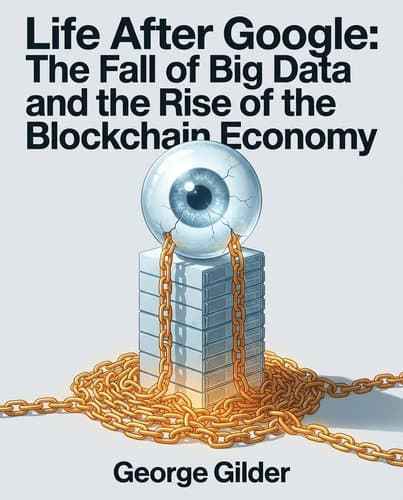
32073021_life-after-google
by George Gilder
Google's "free" internet isn't a gift—it's a philosophical trap that strips away price signals, identity, and truth, leaving a system structurally incapable of…
In Brief
Google's "free" internet isn't a gift—it's a philosophical trap that strips away price signals, identity, and truth, leaving a system structurally incapable of security. Blockchain isn't crypto speculation; it's the architectural rebellion that restores irreversible time and individual sovereignty to a web built only for copying.
Key Ideas
Security Requires Architectural Foundation
The internet's security crisis is structural, not tactical. No password manager, regulation, or security app fixes a protocol that was built for copying pages, not protecting transactions. The next system must put security at the architectural layer — device-level identity first, network functions second.
Free Platforms Extract Hidden Costs
'Free' is not a consumer benefit — it's a price signal suppressor. When you can't see what something costs, markets can't allocate resources efficiently. Before using any free platform, ask what's being seized instead of money: almost always it's your time, your attention, and your data.
Price Signals Drive Competitive Success
Google's competitive losses — product search to Amazon (52% vs. 26%), cloud to AWS (57% vs. 16%), voice to Amazon — are not strategic mistakes. They are the structural invoice for eliminating price signals. Companies that won't charge real prices eventually lose to companies that will.
Blockchain Creates Immutable Truth Layer
Blockchain is a truth machine, not a copying machine. Its 10,000x computational cost over Markov chains is a feature: you pay that premium to make records indelible rather than probabilistic. The internet's fake news and phishing problems are symptoms of having no ground-state truth layer — blockchain is the architectural fix.
AI Accelerates Search, Not Understanding
AI 'superintelligence' is a category error. AlphaGo, language models, and recommendation engines succeed by accelerating deterministic search through bounded solution spaces — not by understanding. Consciousness is the source of thought, not its product, and no volume of matrix multiplications produces surprise, the thing Shannon proved is what information actually is.
Distributed Computing Outpaces Data Centers
The economics of centralized data centers are already being undermined. Gaming GPUs at $580 deliver more compute than $5,000 enterprise chips. The distributed 'sky computing' model — aggregating idle compute across laptops and phones, governed by blockchain tokens — is cheaper and more creative than The Dalles. The window for incumbents is narrowing.
Who Should Read This
Business operators, founders, and managers interested in Artificial Intelligence and Futurism who want frameworks they can apply this week.
Life After Google: The Fall of Big Data and the Rise of the Blockchain Economy
By George Gilder
9 min read
Why does it matter? Because the internet you were promised was quietly replaced by its opposite — and the gap has a name.
The internet was supposed to end unwanted advertising. Power would flow downward — to individuals, not platforms. Nobody would see an ad they hadn't chosen. What arrived instead was a search engine that gives you everything for free and charges you in time, attention, and a creeping sense of surveillance. Most people assume this was a business decision. It was a philosophical one.
Google isn't a company that made convenient tradeoffs. It's the living expression of a specific theory of reality — one that treats human minds as inefficient processors, creativity as an optimization problem, and "free" as an architecture rather than a price. That theory is now losing ground. And what's building in its place is less about cryptocurrency speculation than about a more fundamental question: who controls the concept of truth?
The Internet You Were Promised Was Replaced by Its Opposite — and That Gap Has a Name
You're trying to read a book you've already purchased. Before you can begin, you need a username and password — a combination that doesn't match their records. They've sent a reset link to an email address that no longer exists. To change it, you need to verify your identity. To do that, you need to unlock your Macintosh drive. To unlock your drive, you need a password you haven't used in eighteen months. Meanwhile, iTunes wants a security patch, which requires your Apple ID, which is tied to the old email. Your eyes haven't touched a single page.
George Gilder opens Life After Google with exactly this sequence — a mock-bureaucratic maze every reader recognizes as their own life. The internet was never built for commerce. It was designed to copy files and forward email: open, distributed, no security layer needed. When Amazon, eBay, and Apple tried to run transactions across it, the system buckled. The industry's answer was to build walls. PayPal, iTunes, Facebook, Google Cloud — each one a walled garden, a private fortress. Security through enclosure.
The result is the opposite of what the internet promised. In 1994, Gilder predicted that networked computers would mean no one ever saw an unwanted advertisement. What arrived instead was a surveillance cloud where money and power collect at the top. The password maze isn't a design flaw. It's the design.
When Everything Is Free, You Pay With Something More Valuable Than Money
Free costs more than anything else on the internet. Not in the sense that you're secretly paying (though you are), but in the precise economic sense: when price is removed from a transaction, the signal that reveals actual demand disappears with it. Prices are how markets stay honest. Without them, you can't know what you have, what you owe, or where the ceiling is.
The consequences became concrete. By 2017, Amazon controlled 57 percent of the cloud-services market. Google had built the most technically accomplished computing infrastructure on the planet — transoceanic cables carrying 144 terabits per second, data centers no competitor could match — and still held only 16 percent. Google's response was to post YouTube videos and run conference presentations explaining, accurately, why its infrastructure was superior. It was superior. It still lost.
The gap wasn't technical. Amazon had spent twenty years learning how to take money from strangers, from individual book buyers to Fortune 500 procurement departments. The friction of billing, security, legal liability, contracts: Amazon understood all of it through practice. Google had spent the same two decades learning how to avoid that friction entirely. Its services were free, its billing minimal, its relationship with users mediated almost entirely through the ad-targeting machine. When businesses needed a cloud partner and had to sign a contract and cut a check, they went to the company that knew how.
The structural cost of free isn't surveillance or data harvesting. Those are symptoms. The root is that a business which never charges never learns the discipline that charging imposes. Price signals carry information: which features are worth building, which users are worth keeping, which promises are worth making. Strip them out, and you're navigating blind.
Google Is Not Just a Company — It Is a Philosophy About What Reality Is
September 1930, Königsberg. David Hilbert, the era's reigning mathematician and a native son of the city, is about to address Germany's scientific elite. His message: mathematics, built on deterministic mechanical principles, will eventually answer every question. "We must know, we will know" — a confidence later carved into his tombstone.
At a smaller pre-conference running that same week, a twenty-four-year-old student named Kurt Gödel sat at the edge of the room. Short, shy, and consumed by anxiety about his health, he seemed like a loyal foot soldier in Hilbert's army. Then he spoke.
In a few minutes, Gödel dismantled the entire program. Every logical system — including the grand project to reduce all of mathematics to mechanical logic, assembled in Whitehead and Russell's Principia Mathematica — necessarily contains propositions that cannot be proved within the system itself. No self-contained logic can be complete. The mathematicians talked on, but Hilbert's vision was already dead. The only one who grasped this was John von Neumann — Hilbert's own protégé — who pulled Gödel aside afterward to ask questions.
What mattered was not just what Gödel destroyed but how. To prove the limits of logic, he encoded every axiom and symbol as a number — which meant he had, inadvertently, sketched the blueprint for a computing machine. From that seed grew Turing's universal machine, then Shannon's information theory: the definition of a bit as a unit of surprise, content the machine could not have predicted on its own. Determinism produces no information at all.
Google's entire architecture runs in the opposite direction. Its theory of knowledge — "big data" — holds that enough data, analyzed comprehensively enough, can replace human reasoning; its theory of mind follows directly: the brain is a logic machine a faster processor will surpass. Its economic model makes everything free, because private data is the raw material and charging would slow its collection. All of it flows from the same belief: reality is deterministic, a problem of insufficient processing power rather than irreducible surprise.
That is the worldview Gödel demolished in Königsberg. Google, worth nearly a trillion dollars, is built on its ruins.
The Machine That Beats You at Go Has Never Understood the Game
The determinism Gödel had already bounded in Königsberg found a new stage in 2017: AlphaGo Zero defeated every prior version of itself 100 games to zero, including the version that had already beaten humanity's best Go player. Had machine intelligence finally crossed into the genuine article? Go is a deterministic game with no hidden information and a bounded solution space. A processor iterating at millions of cycles per second simply exhausts positions no human lifetime could reach. By the same logic, a pocket calculator is superhuman at long division, and nobody is convening emergency summits about that.
The deeper problem is what "information" actually means. Claude Shannon, who built the mathematical foundation beneath all modern computing, defined information as surprise — bits that couldn't have been predicted before they arrived. A perfectly deterministic system generates no surprise by definition: the answers are always embedded in the inputs before the calculation begins. The machine doesn't discover anything; it executes a sequence someone else designed.
Leibnitz made the argument three centuries before the first transistor. Scale a mechanical system up to the size of a building and walk through it: you find gears, levers, cogs, not cognition. The understanding has to come from outside the machine, because no arrangement of mechanism produces the thing that makes mechanism meaningful. The assumption that enough mechanism eventually becomes mind is the materialist superstition. Turing hit the same wall from inside mathematics: any logical system requires what he called an "oracle" that cannot itself be a machine, a source of interpretation the system cannot supply from within its own operations. The oracle doesn't run on the system; it stands outside, supplying the meaning that turns symbols into knowledge.
AlphaGo knows nothing. A conscious programmer defined what "winning" meant, fed it the rules, structured the reward. The intelligence in the room was always human.
In the Coming Internet, You Will Own Your Data, Charge for Your Attention, and Prove Your Identity Without Exposing It
Consider the difference between a bank vault and a locked filing cabinet. A vault's security is its walls — the steel, the depth, the hinges. The cabinet's security is an afterthought, bolted onto something built for other purposes. Cut the hinge, pry the drawer, the padlock becomes irrelevant. Every major internet breach of the last two decades has been a filing cabinet: security applied from above to a system designed, at its foundation, to share.
Gilder calls this the barn-door law, his first rule of the cryptocosm (his name for the blockchain-era internet that inverts every Google principle): security is architecture, not retrofit. It cannot be patched on or improvised from above. Once you see this, the entire Google model reads as a structural failure, not a policy failure.
Google's internet treats everything as copyable, movable, and free — the barn door already open. Security arrives as a network function applied from the center, which is why your passwords live on someone else's server and why that server is, periodically, stolen. The cryptocosm starts at the opposite end: your device, your keys, your identity. Gilder's load-bearing metaphor is DNA: you are "unbreakably encrypted by biology," a unique genetic entity no algorithm can blend or average away. The cryptocosm reproduces this in code. A public key encrypts a message; only the matching private key decrypts it, and the private key cannot be calculated from the public one. Easy to verify, impossible to reverse-engineer. Power flows to whoever holds the private key, which is to say: to you.
Brendan Eich's Brave Browser is this architecture made operational. Rather than harvesting behavioral data, Brave blocks tracking by default and inverts the transaction: advertisers pay users directly in Basic Attention Tokens (units of cryptocurrency earned for choosing to see their ads). Publishers receive a direct cut, bypassing the intermediaries who currently absorb 99 percent of digital advertising growth. The user's browsing history never leaves the device. The advertiser reaches someone who opted in. The publisher gets paid. This separates the cryptocosm from a monetary ideology: it's a structural response to a structural failure, already running in a browser you can download today.
The New Internet Is Being Built at Fry's Electronics, Not in Data Centers
Stephen Balaban is standing at the Fry's Electronics checkout line with an armful of video game processors, watching his credit card go through one more time. He's buying Nvidia gaming chips meant for 4K renders and late-night raids — not enterprise hardware, not the kind of thing Google would put in a data center. He's doing it anyway, because he did the math.
The math is simple and devastating. Nvidia's flagship machine-learning processor, the Tesla, cost $5,000 and delivered 10.6 teraflops. The gaming equivalent, the GeForce GTX 1080 TI, cost $580 and delivered 11.3. On the one metric that matters for deep learning, floating-point operations per dollar, the gaming chip was twenty-four times better. When Nvidia's representatives warned Balaban the gaming chips "weren't meant for a datacenter," he recognized the language: the same fear, uncertainty, and doubt IBM had once spread about cheap alternatives, back when Nvidia itself was the upstart.
Lambda Labs, the AI company Balaban had built with his brother out of a Chinatown room, ran its Dreamscope image-filter app on Amazon Web Services. The app went viral (millions of downloads in a single day) and nearly killed the company. AWS bills hit forty thousand dollars monthly. Balaban spent sixty thousand dollars instead to build his own server cluster from scratch, buying gaming boards in bulk until he'd cleared the Bay Area's entire supply, triggering a minor crisis for local crypto-miners. At 4:27 a.m. on February 13, 2016, in a rented garage in the Bay Area, the first server came online. Four GPU modules per machine, 225.2 teraflops total — enough to appear on the list of the world's top supercomputers.
Georges Harik — the tenth employee Google ever hired, the man who built AdWords — looked at what Balaban had assembled and suggested the obvious next move: compete with Google in the cloud. Not as an ideological statement. As a business. By November 2017, Lambda's Deep Learning DevBox (four gaming-grade GPUs in a rack, ten thousand dollars) was generating nearly five hundred thousand dollars a month in revenue, having started at twenty-five thousand dollars seven months earlier.
The alternative to Google is a Taiwanese gaming board on a wire rack in a California garage, running the same computation as a corporate data center for a fraction of the cost. The decentralized internet isn't coming. It arrived at Fry's. Someone just had to clear the shelf.
Satoshi's Greatest Invention Was Also His Greatest Error
Imagine a metal as scarce as gold but utterly useless — dull grey, poor conductor, no ornamental value — except for one property: it can be transmitted over a communications channel. If it acquired any value at all, it would become the most valuable element in existence, a medium for moving wealth anywhere without a trusted third party.
Satoshi's answer to Gilder's skepticism in their dream dialogue: bitcoin is that substance. Proof-of-work creates something genuinely new — a digital object that can't be reproduced without real expenditure of time, the one factor that stays objectively scarce when everything else can be digitized. The invention is real.
The error is adjacent to it. Satoshi looked at gold and drew the wrong lesson. Gold standards worked not because money supply tracked gold supply. Between 1775 and 1900, US currency grew 163 times while the world's gold supply grew 3.4 times. Gold was the measuring stick; credit and banking judgment were the medium. Satoshi collapsed them. Airline pilot and self-taught monetary historian Mike Kendall ran the arithmetic: had bitcoin grown at gold's historical 1.6 percent annual rate, it would reach 116 million units by 2140, not 21 million. The hard cap is far more deflationary than gold ever was, making bitcoin a volatile speculation rather than a stable unit of account.
The flaw doesn't erase the achievement. Bitcoin remains a refuge from governments that fabricate money, and the blockchain endures as infrastructure for what comes next. But the next monetary system must do what Satoshi's couldn't: hold the measuring stick steady while the medium breathes.
The Question Is Not Whether the New System Arrives — It's Whether It's Built on Truth or Copying
Gödel spent a few minutes at the edge of the Vienna Circle, said almost nothing, and left. He'd already shown that any formal system capable of describing arithmetic contains truths it can't prove. No processing power closes that gap. The proof is human, and it stays human.
That gap is the distance between two very different machines. A Markov chain moves forward by forgetting: each step keeps only a statistical shadow of what came before, compressed into probability weights. That's why it's fast. The blockchain moves at roughly ten-thousandths of that speed, because every hash carries the full weight of every transaction that preceded it. That slowness is not a defect. It's the price of truth — what it costs, computationally, to say this happened, here, then, and cannot be undone.
The internet you have now was built on the Markov principle: copy freely, forget origins, treat history as overhead. Gilder's argument is that this era is ending. Not because someone decided it should. Because Gödel's gap never closed.
Notable Quotes
“The instrument that mediates between theory and practice, between thought and observation, is mathematics; it builds the connecting bridge and makes it stronger and stronger. Thus it happens that our entire present-day culture, insofar as it rests on intellectual insight into and harnessing of nature, is founded on mathematics.”
“we do not know and will not know”
“For us [mathematicians] there is no ignorabimus, and in my opinion none whatever in natural science. In opposition to the foolish ignorabimus our slogan shall be: 'We must know, we will know'”
Frequently Asked Questions
- What is Life After Google mainly about?
- Life After Google argues that Google's dominance rests on a flawed philosophy — treating information as free and consciousness as computation. George Gilder shows how the internet's security failures and distorted markets are structural consequences of eliminating price signals. He makes the case that blockchain-based, distributed systems are the architectural replacement for centralized data monopolies. The book challenges the assumption that 'free' is always beneficial, revealing how eliminating price signals distorts markets and creates fundamental security vulnerabilities.
- Why does the internet have a structural security problem?
- The internet's security crisis is structural, not tactical. No password manager, regulation, or security app fixes a protocol that was built for copying pages, not protecting transactions. The next system must put security at the architectural layer—device-level identity first, network functions second. These architectural changes differ fundamentally from current approaches that attempt to patch an inherently insecure system. True solutions require embedding security as a foundational design principle rather than applying fixes afterward.
- How does "free" distort markets in Life After Google?
- 'Free' is not a consumer benefit — it's a price signal suppressor. When you can't see what something costs, markets can't allocate resources efficiently. Before using any free platform, ask what's being seized instead of money: almost always it's your time, your attention, and your data. This principle reveals why platforms can exploit users while appearing free. Understanding these dynamics is essential for recognizing that 'free' services extract value through hidden rather than transparent pricing mechanisms.
- What does Gilder argue about artificial intelligence and consciousness?
- AI 'superintelligence' is a category error. AlphaGo, language models, and recommendation engines succeed by accelerating deterministic search through bounded solution spaces—not by understanding. Consciousness is the source of thought, not its product, and no volume of matrix multiplications produces surprise, the thing Shannon proved is what information actually is. These systems excel within constrained domains but do not represent genuine intelligence or consciousness. This distinction fundamentally reframes expectations about current AI capabilities and challenges popular assumptions about machine superintelligence.
Related Book Summaries
Read the full summary of 32073021_life-after-google on InShort