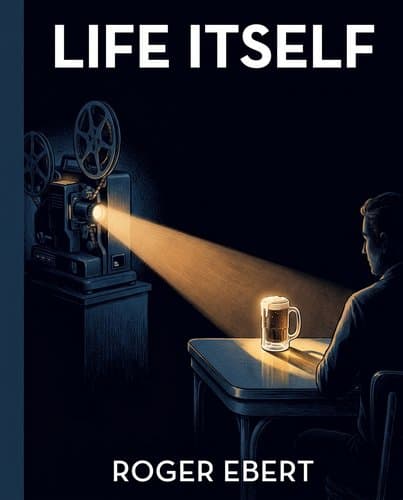
10836585_life-itself
by Roger Ebert
Roger Ebert spent decades giving voice to other people's stories—until cancer took his jaw and forced him to confront his own. This memoir reveals how love…
In Brief
Roger Ebert spent decades giving voice to other people's stories—until cancer took his jaw and forced him to confront his own. This memoir reveals how love, memory, and a lifetime of paying close attention become the only sustenance that outlasts the body.
Key Ideas
Rituals Are Identity's True Infrastructure
The rituals and relationships you build in ordinary life — a regular bar stool, a standing lunch order, a friend who recites Gatsby from memory — are not peripheral to identity; they are the infrastructure that holds the self together when the body fails
Unglamorous Specificity Holds Recovery Together
Accountability in recovery is almost never dramatic: Ebert's sobriety was held together by a former Playboy bunny handing him pills with coffee each morning. The unglamorous specificity of the help matters as much as the intention
Responsibility With Acceptance, Not Regret
Honesty about failure is not the same as self-flagellation: Ebert's admission that his own internet research likely caused his worst surgical outcomes is devastating, but it sits alongside acceptance rather than regret — a useful model for holding responsibility without being consumed by it
Attention Paid Sustains the Body
Memory is not a passive archive but an active source of sustenance: Ebert discovered, unable to eat or drink, that a novel could unlock a sixty-year-buried sensory experience more vividly than the original — suggesting that attention paid to ordinary moments compounds over a lifetime
Own Your Ambition, Drop the Act
The 'accidental life' is often partly a performance: Ebert insisted his career happened to him, but the evidence of his drive — the fanzines, the Great Lead Theory, the award carried to a dying father — suggests that acknowledging ambition directly might have served him better than the humility narrative he preferred
Who Should Read This
Readers who connect with first-person stories about Memoir and Resilience and want to see the world through someone else's eyes.
Life Itself
By Roger Ebert
11 min read
Why does it matter? Because the life you think you're watching turns out to be the one you're living.
You probably assume a film critic's memoir is about movies. This one isn't — or not mostly. Roger Ebert spent fifty years in the dark watching other people's stories flicker past, then cancer took his jaw, his voice, his ability to eat or drink or speak, and suddenly the man who'd narrated everything was left alone with himself — the camera finally pointed at the narrator. What he found there — the green onion smell of a basement in Urbana, a dog named Blackie abandoned to a backyard winter, the weight of a frosted root beer mug against his father's hand — turned out to be more than memory. It was the whole infrastructure of a person. Life Itself is the book he wrote in that silence, and it will make you rethink what you've been building while you still have the voice to describe it.
The World Is Sharper When You're Born Into It Mid-Sentence
There's a moment Roger Ebert describes that most people will recognize even if they've never been able to name it. He's standing in the hallway of his childhood home at 410 East Washington Street in Urbana, Illinois — or rather, he's standing in what used to feel like a hallway. As a boy, he ran its full length at a sprint before launching himself airborne onto his bed. When he returned as an adult with Chaz in 1990, the hallway was a few yards long. And then the feeling arrived: a tingling wave moving through his whole body, the sensation of reality realigning itself.
He'd felt it before — maybe ten times in his life. At a drugstore as a kid, opening a nudist magazine and discovering that all women had breasts. Standing still while his father told him he had cancer. The moment he proposed to Chaz. And in a screening room in Cannes when the helicopters banked over a Vietnamese village to the sound of Wagner's Ride of the Valkyries in Apocalypse Now.
That list is the whole argument of this memoir before it even begins. A childhood hallway, a magazine, a cancer diagnosis, a proposal, a movie scene: Ebert doesn't sort these by category. They belong together because they produced the same sensation in the same body. Cinema and lived experience were equally capable of stopping time and sending a wave from his scalp to his feet. When he says he was born inside the movie of his life, that wave is what he means.
A Dog Named Blackie Taught Him the First Thing He'd Ever Need to Know About Loss
The family dog got exiled to the backyard because of carpeting. Not cruelty — just the logic of a 1940s household that had recently Installed Wall-to-Wall Carpeting, a phrase Ebert recalls with the capitalization audible, as if his father were reading from a municipal ordinance. The carpet was new. Dogs were hard on carpet. The math was simple. So Blackie, a beagle-spaniel mix, moved into a repurposed playhouse in the yard while the rest of the family stayed warm inside. That first summer it almost worked — the boy and the dog running the neighborhood together, chasing bikes, attending Little League games, building a life. Then autumn arrived, and Blackie's friends were let indoors one by one, and the Illinois winter came down hard.
Ebert remembers standing over a hot air register to thaw his feet after school while Blackie sobbed in the frozen yard. The sound carried. He'd open a storm window and call out that everything was okay, knowing it wasn't. He knew he had betrayed his dog and that there was nothing to be done about it.
Then came the trip to visit a cousin. Then came the car ride home from the airport. Then came his mother saying, your father has something to tell you — and before a word was spoken, Ebert already knew. Blackie had run away, his father said. Got hit by a car. The driver had even called with condolences. It was a complete story, neatly assembled. The boy in the back seat sat very still and said nothing, because he knew it was a lie and also knew that saying so would change nothing. Something broke in him, he writes — not grief exactly, but the discovery that the adults who loved you were capable of inventing a tidy fiction rather than handing you the unbearable truth, and that once you knew that, you couldn't unknow it. A critic who carries that knowledge tends to say exactly what he saw, because he never forgot what it cost to be told otherwise.
The Career That 'Happened to Him' Was Built by a Man Who Never Stopped Pushing
Ebert describes his career as something that happened to him — one day he was a graduate student, the next day features editor Bob Zonka materialized at his desk in the spring of 1967 and announced he would become the Sun-Times film critic. Lucky accident. Right place, right time. Except: this is a man who, at sixteen, had already developed what he called the Great Lead Theory, who spent late nights ripping sheet after sheet of copy paper out of his typewriter in search of the perfect opening sentence. When the Urbana Tigers collapsed before a big game, he produced a sentence so melodramatic a coach felt personally attacked — then memorized it word for word, well enough to reproduce it in a memoir decades later. That's not coasting on luck. That's manufacturing your own mythology one paragraph at a time.
The detail that breaks the accidental-career story open is small and devastating. The Cinderella-pumpkin lead won first place in the Illinois Associated Press sportswriting competition. By the time the prize arrived, Ebert's father was dying of lung cancer in a hospital bed. Ebert brought the framed certificate to the room and held it up. His father was proud. Ebert would go on to win a Pulitzer Prize — the first ever awarded to a film critic — but he writes that he would never again win anything that meant as much. You don't carry a certificate to a dying man's bedside unless you already understand, in your bones, what the work costs and what it's for. The casual beneficiary of happy circumstance doesn't do that. Someone who has been building something — who knows exactly what he's built and needs a witness — does.
Drinking Was the Price of Admission to a World Worth Living In — Until It Wasn't
Think of a neighborhood bar the way you think of a childhood bedroom: you don't realize it was the whole world until you're standing outside it. For Roger Ebert in the 1970s, that world was a triangle of North Side Chicago taverns — Riccardo's, the Old Town Ale House, and O'Rourke's — where Mike Royko might hold court one night and Nelson Algren the next, and where journalists vanished for entire decades. The circuit ran roughly ten hours, start to finish, and few people lasted through all of it. That was fine. You jumped on and off. You came back the next night.
The detail that tells you everything about what this world actually was: one evening, actor Cliff Robertson fell under O'Rourke's spell and climbed into the back of a Sun-Times delivery truck with the rest of the regulars, riding toward another bar while a woman named Jake flogged a man named Good Sydney Harris with her belt, the bagpipes started up, whiskey passed hand to hand, and a police siren prompted the driver to hand down newspapers to the officer and keep moving. Robertson took it all in from the truck bed and said one word: 'Chicago.' It wasn't a world you described. It was one you lived in until it stopped being survivable.
For Ebert, that moment arrived on a Saturday afternoon in August 1979. He set down a glass of scotch in his carriage house, went to bed, pulled the covers over his head, and stayed there for thirteen hours. The next Monday he saw a doctor. Then a counselor. Then a counselor named Susan, who looked up AA meetings in a booklet and found one at 401 North Wabash — which is the Chicago Sun-Times building, ten steps from Ebert's desk. She asked if he could be there in an hour. He writes only: 'She had me.' The trap had been set so gently he never felt it close.
The grief underneath the relief is real, though. The O'Rourke's world is dead now — Royko gone, Algren gone, Terkel gone, the bars themselves replaced. Ebert admits the drinking kept him emotionally stunted, arguably unmarriageable, for decades. But he also loved it without apology. That double truth — this nearly killed me and I miss it with my whole body — is the one he never resolves.
Gene Siskel Kept His Dying a Secret Because He Refused to Lose
The studio had been cleared. Gene Siskel's nephew walked him to his seat, steadied him, and stepped back. The cameras rolled. Siskel delivered his reviews. He died a week or two later.
Ebert had watched the deterioration in pieces, each one explained away. The man who could read a poker hand from across a room, who had memorized the flight paths of small metal pigs in some bar game just to win a nickel, who never played a hunch in his life — this man had started getting things out of order. At the Jay Leno taping in Chicago, Siskel said his headache was too bad to judge a look-alike contest and whispered to Ebert to handle it while he agreed with everything. After the show, when their executive producer tried to take him straight to a hospital, Siskel refused. He had Bulls playoff tickets. He went to the game.
The brain tumor diagnosis became something Siskel shared only with his family, and then only selectively. Not with Ebert. Not with anyone at the show. When the two of them were on camera together in those final months, Ebert writes that their eyes would sometimes meet, and words hung in that silence unspoken, and that was the end of it. Siskel had decided the illness was private territory, and nobody crossed into private territory with Gene Siskel unless Gene Siskel opened the gate.
What Siskel said the night before any of this happened changes the scene. In Cambridge, after a Harvard appearance that had somehow turned into ninety minutes of stand-up comedy neither of them could explain, they had dinner together and talked until they'd said the real things. Siskel described how his father had taught him to think about Judaism: not as theology exactly, but as a commitment to the life being lived — the contributions, the family, the memories left behind. The afterlife was a lesser concern. What mattered was this, right here.
That conversation, read backward from the image of Siskel being walked to his chair by his nephew, becomes the key to understanding what Ebert would later have to figure out for himself. The body fails. You keep doing the work anyway. You don't announce the gap between what the body can do and what you're still doing anyway. You just do it, and let that be the whole statement.
He Chose the Wrong Surgery, and He Knows It
The man who made his living by trusting his judgment decided, against the advice of every doctor he had, that he knew better. That decision cost him his jaw, his voice, and his ability to swallow. He knows it. He says so plainly, with the same directness he brought to a bad film.
When cancer reappeared in his mandible years after a rare salivary gland tumor — the kind so unusual his original surgeon had seemed almost delighted by it — his doctors agreed: surgery first, remove the affected bone, rebuild with a length of fibula, then heal. Straightforward. Cautious. Boring. But Ebert had found something online about neutron radiation: more powerful than conventional treatment, precisely targeted, developed by a specialist in Seattle who told him the equipment was made for exactly his kind of tumor. And there was the seduction — skip the surgery, skip the recovery, get back to the show. He pushed until everyone relented.
The radiation didn't save him. It destroyed the tissue's capacity to heal, and when surgeons went in anyway — once, twice, three times — his body had nothing left to work with.
He lay listening through a stethoscope to a pulse in his own face: the sound meant the transplanted tissue was still alive. Then the sound stopped. The graft died. What followed was a carotid artery hemorrhage. By the end of it, he writes, he looked like something from a horror film, his body taken apart repeatedly for bone and flesh to patch what kept failing.
The cruelest irony isn't medical — it's professional. The man who spent forty years issuing verdicts on what worked and what didn't now cannot speak a single word. The will that drove everything — the same relentlessness that had him memorizing great leads as a teenager and pushing past every closed door — had finally turned on him. He isn't philosophical about this. He just tells you what happened and lets you sit with it.
When You Can No Longer Eat, Memory Becomes the Meal
Late at night in a hospital wheelchair, a blanket pulled around him, Roger Ebert is reading Cormac McCarthy. A character on a riverboat pulls a string up from the cool water, and tied to the end of it is a bottle of orange soda. Ebert tastes it. Not metaphorically — he actually tastes it, the cold fizz of it, with a clarity that startled him then and stayed with him permanently.
That sensation unlocked something he hadn't touched in sixty years. His father, an old Plymouth, gravel crunching under tires at an A&W drive-in. The voice saying 'and a five-cent beer for the boy.' Lucky Strike smoke. The specific weight of a small glass mug with ice sliding off it in the summer heat. He'd had this memory his entire adult life and never once retrieved it. Now, unable to eat or drink anything, he woke night after night to that first sip of root beer, taking it over and over.
When his brother-in-law Johnnie Hammel visited and heard the story, he offered a frame only a Jehovah's Witness could: when the Lord took away your drinking, He gave you back that memory. Ebert — a man who'd spent a lifetime trusting no authority higher than his own critical faculties — writes that whether his higher power turned out to be God or Cormac McCarthy, those were exactly the words he needed.
The loss didn't diminish access to experience — it sharpened it. Everything is still in there, he insists. The difference is that what his memory holds most vividly isn't the famous meal at a Michelin-starred inn in southwest France — he knows it was the best meal he ever ate, but he can no longer recall what was on the plate. What's stored with perfect fidelity is every item in his regular Steak 'n Shake order, eaten in the same sequence every time. The formica counter, not the white tablecloth.
And that distinction is where the real grief lives. He's not mourning nutrition. He's mourning what he calls the society — the diners, the noodle joints, the Greek place with periwinkle booths where an egg is an egg and you can spread out the Sunday paper without anyone minding. Because dining was always recreational talking first, and now the man whose entire career was built on the authority of his spoken opinions cannot produce a single word at the table. He sits there. He listens. He writes this book instead, and tells you plainly at the end of the chapter: you don't realize it, but we're at dinner right now.
The Life You Were Narrating All Along Was Your Own
Chaz is where the argument arrives. He calls her the great fact of his life — not in the easy language of tribute but with the specificity of someone testifying. She visited him in the hospital hundreds of times, learned the name of every nurse, left them Christmas baskets. She became fluent in his medications, his complications, his slim odds. When he looked at three steps he was supposed to climb during rehabilitation and couldn't imagine lifting his feet, it was her will, he says, that moved them. A man who spent decades trusting his own judgment above everything had to be kept alive by someone else's certainty that he was worth the effort. He knew it, and he said so without flinching.
His secular answer to what persists beyond the body comes from Dawkins — the idea that phrases, jokes, and gestures migrate from mind to mind the way genes travel between bodies. Ebert, who fathered no children, found this genuinely comforting. A lifetime of writing and broadcasting leaves behind enough of those units that some portion of him keeps moving through the world after the body stops. Not immortality. Just continuation, the way a song outlasts the voice that first sang it.
And then there's the image he ends on, drawn from Van Gogh's letters: illness not as a failure of the body but as a mode of transit, a celestial locomotive carrying you toward whatever is next rather than making you walk. Ebert embraced this without irony. He'd been a passenger his whole life, riding movies into other worlds, riding memory back to root beer and gravel and his father's voice. Taking the train one last time seemed, to him, about right.
The Train He Chose to Take
Van Gogh told his brother that illness wasn't an ending but a conveyance — you don't walk to whatever comes next, you take the train. Ebert borrowed that image late, when the original vocabulary had mostly gone, and it quietly reframes every page that came before it. The dog sobbing in the frozen yard. The hallway that shrank. The framed certificate held up in a dying man's hospital room. The woman who handed him his pills each morning with coffee. Chaz, learning every nurse's name. None of it was material he was filing away for later. It was the trip itself — the whole trip — and he was on it the entire time, not watching from a critic's distance but inside it, feeling it move under him. He lost his jaw and kept going. He lost his voice and kept writing. At sixty-nine he looked back at all of it and called it interesting. Not consolation. Arrival.
Notable Quotes
“It can’t be explained in words,”
“Start drinking it now and walk down to the studio slowly.”
“My headache is too bad to focus on it,”
Frequently Asked Questions
- What is Life Itself by Roger Ebert about?
- Life Itself is Roger Ebert's memoir tracing his Chicago childhood, career as a film critic, alcoholism, and the illnesses that eventually cost him his voice and jaw. Written partly after losing the ability to speak, the memoir examines how identity, memory, and relationships sustain a person when the body breaks down. Throughout the work, Ebert explores how ordinary rituals and human connections form the infrastructure that holds the self together during crisis, offering readers a model for finding meaning in everyday life before major hardship forces existential questions.
- What does Life Itself teach about how ordinary life sustains us?
- In Life Itself, the rituals and relationships built in ordinary life—a regular bar stool, a standing lunch order, a friend who recites Gatsby from memory—form the infrastructure that holds the self together when the body fails. These connections seem peripheral but prove central to identity. Ebert demonstrates that recurring daily moments accumulate to create resilience. Rather than seeking meaning in grand achievements, the memoir argues that sustained attention to ordinary relationships and habits becomes the source of sustenance. This framework becomes crucial when physical pleasure and ability are taken away by illness.
- How does Life Itself address recovery and accountability?
- Ebert's approach to recovery in Life Itself demonstrates that accountability in recovery is almost never dramatic. His sobriety was held together by unglamorous, specific help: a former Playboy bunny handing him pills with coffee each morning. The specificity of the help matters as much as the intention behind it. Additionally, Ebert's honesty about failure doesn't become self-flagellation; his admission that his own internet research likely caused his worst surgical outcomes is devastating, but it sits alongside acceptance rather than regret. This models how one can hold responsibility without being consumed by guilt or self-blame.
- What does Life Itself reveal about memory as a source of sustenance?
- Memory in Life Itself functions as an active source of sustenance rather than a passive archive. Unable to eat or drink following his illness, Ebert discovered that reading a novel could unlock a sixty-year-buried sensory experience more vividly than the original moment itself. This suggests that attention paid to ordinary moments compounds over a lifetime, becoming richly accessible when the body can no longer provide physical pleasure. Ebert's discovery reframes memory not as mere nostalgia but as a living resource—evidence that the small moments we attend to carefully can become genuine sources of nourishment when they matter most.
Related Book Summaries
Read the full summary of 10836585_life-itself on InShort