40180060_mama-s-last-hug
by Frans de Waal
Guilt, fairness, and grief aren't uniquely human achievements—they're primate inheritance, millions of years old. De Waal proves it through chimps, rats, and…
In Brief
Guilt, fairness, and grief aren't uniquely human achievements—they're primate inheritance, millions of years old. De Waal proves it through chimps, rats, and the unsettling truth that your nervous smile, your rage at injustice, and your capacity for empathy all predate humanity itself.
Key Ideas
Smile Evolved as Submission Signal
The smile evolved as a primate submission signal meaning 'I won't challenge you' — not as a happiness display. This is why we smile when nervous or apologetic, why reprimanded children can't stop smiling despite wanting to, and why the UFC fighter with the more intense pre-match smile statistically loses the bout.
Body Mirrors Emotions Before Mind
Your empathy operates in your body before your conscious mind catches up: facial muscles automatically mirror expressions flashed below awareness, and anything that freezes this mirroring (Botox, certain medications) measurably reduces your ability to understand others' emotional states. The body is doing the understanding.
Fairness Driven by Evolutionary Envy
Fairness is not a moral principle we reasoned our way to — it's an evolved emotional reflex rooted in envy. Capuchin monkeys hurl perfectly good cucumber slices when a neighbor earns grapes for identical work. Any theory of justice that assumes 'an absence of envy' (as Rawls explicitly did) removes the emotional engine that makes injustice feel like anything.
Alpha Status Requires Consoling Others
Real alpha status — in chimps and by extension humans — requires consoling losers and mediating disputes more than any other individual in the group. The data is consistent across field sites: bully alphas get coordinated political assassination; popular alphas age out gracefully and retain influence. Intimidation wins fights; consolation wins coalitions.
Complex Emotions Shared Across Primates
The distinction between 'basic' emotions (fear, anger) shared with animals and 'secondary' emotions (guilt, gratitude, pride) unique to humans has no scientific foundation. Guilt, revenge, gratitude, and pride have all been documented behaviorally in other primates. Treating them as cultural inventions leaves moral philosophy unable to explain where these feelings actually come from or why they feel compulsory.
Emotional Flexibility Outperforms Rigid Instinct
Emotions evolved precisely because they are more flexible than instincts: they prime the organism toward a goal without dictating a specific action, allowing behavior to adapt to changing circumstances. This is why AI researchers building adaptive robots now deliberately equip them with emotion-like states — it is the superior architecture for navigating a complex world, as evolution discovered long before we did.
Who Should Read This
Science-curious readers interested in Evolution and Biology who want to go beyond the headlines.
Mama's Last Hug
By Frans de Waal
10 min read
Why does it matter? Because the emotions you think make you human are millions of years older than you are.
We've built an entire civilization on the premise that our emotions are what separate us — that guilt, grief, gratitude, political cunning belong to us in a way they simply don't belong to anything else alive. It's a flattering story. It's also, according to Frans de Waal, almost certainly wrong. De Waal has spent five decades in primate colonies, and every time he looks for the line between their emotional lives and ours, the data dissolves it — not through sentiment, but through fieldwork, neuroimaging, and the stubborn refusal of animals to behave like the philosophical primitives we need them to be. What this book forces is a reckoning: the emotions you consider most human are not the crown of evolution but its deep inheritance — ancient, shared, and far smarter than reason ever gave them credit for.
We Didn't Lack Evidence for Animal Emotions — We Built a Philosophy to Ignore It
Scientific caution about animal emotions isn't neutral — it's a bias with a specific shape: it grants felt experience only to creatures who can report it verbally. Apply that standard consistently and you'd have to strip feelings from human infants. Nobody does. It's a fence built to keep animals out.
Frans de Waal names the bias: anthropodenial. It's the mirror image of anthropomorphism — not projecting human traits where they don't belong, but refusing to see similarity where evolution demands it. We treat our brains as fundamentally distinct from other mammals', yet we study human phobias by examining fear in the rat's amygdala. Dogs in brain scanners show the same caudate nucleus activity when expecting a treat that a banker's brain shows when expecting a bonus. The neurotransmitters match. The brain structures are identical. When the Dutch anatomist Nikolaas Tulp dissected an ape in 1641, he found it resembled the human body like two drops of water. The continuity has been visible for centuries. Denying it takes work.
The denial rests on one assumption: only creatures who can say what they feel actually feel it. De Waal finds this odd, because human self-reports are unreliable anyway. We claim to have forgiven someone, then raise the grievance at the first chance. We perform happiness while suppressing dread. We misread our own motives constantly. He prefers studying animals because they can't muddy the picture with language. What they feel shows in their behavior, not in what they say about themselves.
The skepticism wasn't protecting science from bad data. It was protecting a comfortable idea about human singularity.
The Gesture That Made Dutch TV Viewers Cry Wasn't Human — It Was Something 60 Million Years Older
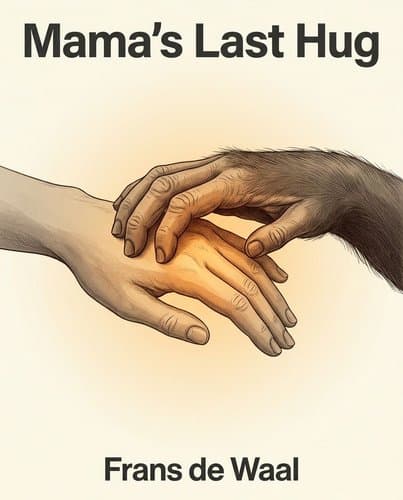
Jan van Hooff had known the chimpanzee for forty years, and he was walking into her night cage to say goodbye. Mama was dying — emaciated, curled in a fetal ball in her straw nest, somewhere past her fifty-eighth birthday. She barely stirred when Jan entered with a few soft reassuring grunts, the kind of sound people who work with apes learn to make. When her eyes opened and recognized him, something shifted in her face. Her lips folded outward into a grin that revealed teeth, gums, and the inside of her mouth all at once. She yelped softly, the sound reserved for high positive emotion. Then she reached for his head, stroked his hair, and pulled him into an embrace. While holding him, her fingers moved in a rapid rhythmic pat against the back of his neck: the same gesture a chimpanzee mother uses to quiet a frightened infant.
When footage of the reunion aired on Dutch television in 2016, viewers wept. The letters to the network kept naming the same thing: the gesture. That patting hand. It looked, they wrote, so human.
Here is where most people get it exactly backward. The scene tempts you toward a certain reading: that Mama had absorbed human behavior over decades of proximity, that closeness to people had made her more like us. The movement goes the other way. The impulse to comfort with rhythmic touch predates our species by tens of millions of years. Neither of them invented it — it came from the common ancestor they share. What Dutch television viewers were watching wasn't an ape edging toward humanity. It was two members of related species recognizing each other through something neither of them owns.
The patting hand isn't an outlier. What we call "human" emotion is mostly primate emotion, and what we call "primate" emotion is largely mammalian. The comfort of being held, the joy of recognition, the impulse to soothe — none of these required invention by our species. They came pre-installed.
What gave the scene its charge was that Mama moved first. She sensed Jan's unease about entering her space and reached for him — patting, reassuring, taking care of the human who had come to take care of her. She died a few weeks later.
The Fighter Who Smiles Most Before the Bout Is the One Who Loses It
Before an Ultimate Fighting Championship bout, which fighter smiles more: the one about to win, or the one about to lose? Researchers who analyzed pre-match face photographs, rating the intensity of each fighter's smile, found the answer runs exactly counter to what you'd expect: the more intense the smile, the more likely the fighter was to lose that day. Smiling didn't signal confidence. It signaled the need for appeasement.
In rhesus macaque groups, the bared-teeth grin flows in exactly one direction: from lower-ranking animals to higher-ranking ones, always. De Waal watched this play out in a captive colony of rhesus macaques he studied for years. Orange was the alpha female, and the pattern around her was unmistakable. Whenever she moved through the group, a cascade of grins followed, other females lifting their lips to expose teeth and gums as she passed, the expression intensifying if she drew nearer or stopped among them. None of them fled. That's the key: the grin doesn't accompany retreat. It keeps you in place while broadcasting I'm not a threat. It mixes fear with a longing for acceptance: "I'd never challenge you" worn on the face.
The human smile descends from this signal. You can see the wiring surface in specific moments: a child being scolded who cannot stop smiling, even knowing it's making things worse. That's not disrespect — it's a primate reflex, the involuntary broadcast of nonhostility. Women smile more than men on average; men who do smile tend to do so when they need goodwill from someone with more power. The UFC photographs just make the signal hard to miss.
What seals it: male chimpanzees caught in a tense confrontation sometimes feel a nervous grin spread involuntarily across their faces — and have been observed pressing their own lips back into place with their fingers before turning to face a rival. They have better control over their hands than their faces. So do you.
Empathy Happens in Your Body Before Your Brain Decides to Feel It
Inbal Ben-Ami Bartal placed a free rat in an enclosure alongside a small sealed container holding another rat in visible distress. The free rat had never encountered this setup. She received no training. She figured out on her own how to open a small door in the container and freed her companion. When Bartal added a bowl of chocolate chips, the free rat often freed the trapped rat first, before touching the food. Something about the other rat's distress mattered more than the smell of chocolate.
Here's the part that closes the argument. Bartal gave the rats an anxiety-reducing drug, the kind that smooths distress without impairing cognition. The drugged rat still knew how to open the container; she opened it readily when chocolate was inside. She just stopped opening it for the trapped rat. Her companion's suffering registered as nothing. She could act; she simply didn't feel the pull. Remove the bodily distress — the thing that passes from one animal to another like a shared current — and the helping disappears entirely. What looked like a moral choice turned out to be a feeling. The feeling lives in the body, not in any calculation the brain performs afterward.
Think of empathy the way you think of balance. You don't decide to balance when you stand; your body is already doing it before any conscious choice enters the picture. Empathy works the same way. The theory that it requires a sophisticated mind making a deliberate leap into someone else's perspective gets the sequence exactly backward.
De Waal calls empathy ancient. Prairie voles' stress hormone levels track their mates' levels even when they weren't present for the stressful event. De Waal documents cases of dogs limping on the same leg as a broken-legged owner. Chimpanzees yawn only when watching familiar faces yawn, not strangers. The mechanism predates everything we like to think is distinctively human about compassion. It traveled to us through mammals, not from us outward.
Your Sense of Fairness Isn't a Moral Principle — It's a Primate Reflex
Sarah Brosnan handed a capuchin monkey a small pebble and held out her palm. The monkey returned the pebble. Sarah gave her a cucumber slice. They did this twenty-five times. The monkey cooperated, almost cheerfully, eating each slice as it came.
Then Sarah changed one thing: she gave the monkey in the adjacent cage a grape.
The cucumber monkey watched. She took her next pebble, went through the exchange, and when the cucumber arrived, she flung it across the cage. A food she had been eating without hesitation moments ago had become an insult. She refused to perform. She rattled the mesh. She hurled the pebbles.
De Waal and Brosnan stumbled onto it. Their lab was unusual in one way: they tested monkeys in pairs rather than alone. That's all it took. With someone else in view, the animals tracked every morsel that went to the other monkey. The cucumber monkey was no worse off, objectively. Her payment hadn't changed. But payment is always relative. Economists have found the same thing in humans: when an entire society grows wealthier together, average wellbeing barely moves. What matters is relative position, not absolute gain. The capuchin and the underpaid employee are running the same calculation.
The paper came out in 2003, on the same morning the head of the New York Stock Exchange was pushed out over a pay package that had enraged the public — a coincidence that made the forwarding make sense. People who saw the one-minute video forwarded it to their bosses. The monkey's outrage (the rattling mesh, the hurled pebbles) looked familiar because it was.
Which makes one celebrated passage in moral philosophy look almost embarrassing. John Rawls, in A Theory of Justice (1971), announced that for "reasons of simplicity," his theory would assume "an absence of envy." De Waal's response is apt: envy is the engine without which fairness would never arise, never feel like anything, never motivate anyone to march or protest or quit. You cannot build a theory of why justice matters by removing the emotion that makes injustice sting. The cucumber monkey didn't need the French Revolution. She just needed to see someone else get a grape.
The Alpha Who Bullied Got Killed. The Alpha Who Consoled Died in His Sleep.
De Waal got the call one morning in 1980: something terrible had happened to Luit. He rushed to Burgers Zoo in Arnhem, the Dutch research colony where he had spent years watching chimpanzee politics, and found his favorite male propped against the bars of the night cage, sitting in a pool of his own blood. Luit had never been affectionate toward people. Now he wanted to be touched. De Waal stroked his head gently. Luit let out a long, slow sigh.
The damage was extensive: deep puncture wounds across the body, missing fingers, missing toes. During surgery, they found that Luit's testicles had been removed. The keepers had found them in the straw. The vet's conclusion was clinical: squeezed through small holes in the skin. Luit never came out of the anesthesia.
Two males he had displaced had reformed their coalition overnight. The older had held Luit still while the younger inflicted the wounds — what the injury pattern suggested: the younger had a few scratches; the older had none at all. Intentional, targeted, lethal. The kind of attack that requires knowing your goal in advance and pursuing it until it's achieved. Chimps weren't supposed to be capable of this: holding a target in mind across hours, coordinating roles, stopping only when the job was done. The night cage at Arnhem said otherwise.
That pattern, confirmed by field reports from Tanzania and Senegal, is brutal in its clarity: bully alphas get killed or expelled; good ones age gracefully. At Mahale, a research site in Tanzania's highlands, a male who ruled for twelve years through careful control of food distribution ended up banished and covered in wounds. In Senegal, a harsh alpha driven out for five years was eventually found dead after a coordinated attack so efficient his attackers wore barely a scratch. Chimp society is a meritocracy of a specific kind: it rewards whoever makes the group feel safe, and corrects, with violence if necessary, whoever doesn't.
De Waal found the other side of this in his consolation data. Alpha males console distressed group members more than anyone else in the colony, more than females, more than close allies. When a fight breaks out, they intervene, holding their arms wide until the screaming subsides, then seeking out the loser afterward. The alpha is the group's healer-in-chief.
The same emotional capacity that lets one chimpanzee hold another down while a coalition mate inflicts lethal wounds is, in a different register, what lets a leader sense who is suffering and move toward them. You can call it political intelligence. You can call it empathy. In the primate brain, they run on the same ancient wiring — aimed in different directions.
Calling Guilt a 'Secondary Emotion' Is Like Calling Your Kidneys Optional
The intuition runs deep: fear and anger are primitive, raw, animal. Guilt, gratitude, and pride feel like something more — something cultivated, something human. Psychologists gave this intuition a name, Basic Emotion Theory: the idea that fear, anger, and disgust are hardwired and universal, while guilt, gratitude, and pride are culturally constructed and uniquely human. It sounds like science. It isn't.
De Waal answers with an analogy. No biologist would rank organs by importance: call the heart essential and the kidneys optional. Every organ evolved for a reason, and remove any of them and the organism dies. The appendix taught us this within living memory. Dismissed for decades as vestigial, it turned out to harbor beneficial bacteria that help the gut recover after severe infection. "Vestigial" was a story we told because we hadn't looked carefully enough. The same logic applies to emotions. The cost of getting worked up (the metabolic expense, the disruption, the vulnerability of strong feeling) means no emotion persists unless it pulls its weight. Natural selection doesn't keep dead wood.
The evidence was always in plain sight. At Burgers Zoo, a newly established alpha named Nikkie was repeatedly challenged by a resistance coalition. After each confrontation left him panting and licking his wounds, he would compose himself — then spend the rest of the day moving through the island to visit each resistant member one by one, finding them alone, confronting them individually, hour after hour. What you see has structure: a remembered injury, a deliberate strategy, a desire that persisted across time and resolved itself into action. De Waal mapped this pattern. Revenge isn't a human luxury emotion. It's a social correction mechanism, as ancient and functional as a liver.
The denial cost science accuracy and cost animals something more concrete: a moral claim on our attention. What's left, once the framework cracks, isn't a question about animals. It's a question about the cost of the story we told instead.
What the Wall Was Actually Protecting
The resistance was never really about rigor. Rigor follows evidence — the matching brain structures, the shared neurotransmitters, the capuchin monkey flinging her cucumber across the cage. What the resistance was protecting was a comfortable distance. If guilt is as ancient as fear, if consolation predates language, if a dying chimpanzee reaches for a grieving man's head and pats his neck the way she once calmed a frightened infant — then the emotional lives of other species stop being a philosophical question. They become a practical one. The century we spent constructing a philosophy to avoid that conclusion didn't just distort the science. It let us off the hook. And the implications don't stop at the cage door: the same reckoning that revises how we understand Mama's grief revises how we understand ours. What follows isn't sentimental. It's structural: every emotion is an organ, none are decorative, and none of them belong to us alone.
Notable Quotes
“I had been mistaken in thinking that I could see clearly into my own heart.”
“it must be expressed and recognized by humans all over the world and be hard-wired—a way of calling it inborn. Basic emotions are biologically primitive and shared with other species. Human emotions that lack stereotypical expressions, on the other hand, are known as”
“What do you want if animals aren't free? Of course they'll kill each other!”
Frequently Asked Questions
- What is Mama's Last Hug about?
- "Mama's Last Hug" draws on primate research to show that emotions long considered uniquely human — guilt, gratitude, fairness — are evolutionary inheritances shared with other animals. Frans de Waal dismantles the divide between human and animal inner life, revealing that moral feelings are ancient biological equipment, not cultural inventions. The book demonstrates what animal behavior can teach us about our own emotional lives, using decades of primatology research to challenge the assumption that complex emotions are exclusively human traits.
- Why did primates evolve to smile?
- The smile evolved as a primate submission signal meaning 'I won't challenge you' — not as a happiness display. This fundamental insight explains why humans smile when nervous or apologetic, why reprimanded children can't stop smiling despite wanting to, and why the UFC fighter with the more intense pre-match smile statistically loses the bout. Understanding smiles as ancient submission signals rather than joy displays fundamentally reframes modern human social interactions, revealing how deep evolutionary mechanisms shape our most common behaviors in subtle but measurable ways.
- Are emotions like guilt and gratitude uniquely human?
- No. The distinction between 'basic' emotions (fear, anger) shared with animals and 'secondary' emotions (guilt, gratitude, pride) unique to humans has no scientific foundation. Guilt, revenge, gratitude, and pride have all been documented behaviorally in other primates. Treating these emotions as cultural inventions leaves moral philosophy unable to explain where these feelings actually come from or why they feel compulsory and unavoidable. De Waal's research demonstrates these emotions are ancient biological traits shaped by evolution.
- What makes a true alpha in primate hierarchies?
- Real alpha status — in chimps and by extension humans — requires consoling losers and mediating disputes more than any other individual in the group. The data is consistent across field sites: bully alphas get coordinated political assassination; popular alphas age out gracefully and retain influence. Intimidation wins fights; consolation wins coalitions. This finding directly challenges common misconceptions about primate dominance hierarchies, demonstrating that true leadership depends on emotional intelligence, empathy, and conflict resolution skills rather than pure physical aggression alone.
Related Book Summaries
Read the full summary of 40180060_mama-s-last-hug on InShort