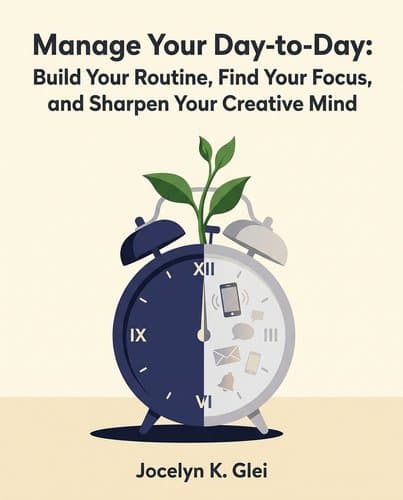
17606014_manage-your-day-to-day
by Jocelyn K. Glei
The modern creative's biggest enemy isn't a blank page—it's the reactive email-checking, notification-responding routine that quietly kills deep work.
In Brief
Manage Your Day-to-Day: Build Your Routine, Find Your Focus, and Sharpen Your Creative Mind (2013) draws on advice from leading creatives and researchers to diagnose why modern professionals struggle to do their best work.
Key Ideas
Prioritize creative work before checking messages
Do your hardest creative work first thing in the morning, before checking email or messages — the ability to resist distraction is highest then and declines throughout the day
Ritual triggers replace willpower decisions
Build associative triggers (same seat, same music, same ritual) to signal your brain that it's time to work — this bypasses the willpower required to 'decide' to start
Schedule creativity as binding appointment
Schedule creative work on your shared calendar as a formal appointment so 'I'm already booked' becomes a legitimate and specific defense against interruption
Work in ninety-minute rhythm blocks
Work in 90-minute blocks followed by genuine breaks — the Ultradian Rhythm means pushing beyond this produces low-quality output dressed up as productivity
Remove distractions from environment entirely
Remove distractions from your environment entirely rather than trying to resist them — even the presence of a tempting website open in another tab degrades performance on the task in front of you
Diagnose blocks before forcing effort
When you feel blocked, diagnose before you push: is the problem a knowledge gap, an emotional barrier, depleted energy, or wrong medium? Each requires a different fix, not more effort
Filter requests through core goals
Tape your two or three most important long-term goals next to your workstation and filter every incoming request through them — distracting opportunities have to die for your best work to live
Weekly creative projects prevent stagnation
Keep a running list of personal creative projects and protect time for them weekly — if your day job is the only creative work you do, you will stop growing
Frequent disconnection refills creative capacity
Practice regular, frequent disconnection — not annual vacations but weekly or daily resets — to allow the brain to refill rather than perpetually drain
Monitor breathing to interrupt spirals
Notice your breathing while using devices: shallow breathing and breath-holding trigger fight-or-flight chemistry that makes you compulsively reach for your phone, not because you want to but because your body is now wired to
Who Should Read This
People working on personal growth in Focus and Creative Thinking, especially those tired of generic motivational advice.
Manage Your Day-to-Day: Build Your Routine, Find Your Focus, and Sharpen Your Creative Mind
By Jocelyn K. Glei
13 min read
Why does it matter? Because the way you spend your mornings is quietly deciding whether your best work ever gets made.
By the time most creative professionals sit down to do their actual work, the day has already been colonized. Not by emergencies — by the low-grade administrative reflex of checking, responding, and reacting that masquerades as productivity. You built that system yourself, in small increments, each one feeling like the only sensible choice at the time. Here's the uncomfortable truth: the problem isn't your discipline, your calendar app, or your open-plan office. The architecture of your day was designed by accident, optimized for everyone else's urgency instead of your own output. Reclaiming your creative work isn't a motivation problem — it's an engineering problem. The routine, the biology, the tools, the mental habits: each one either works for your best thinking or quietly against it. Fixing one without the others changes nothing. Rebuilding the whole system changes everything.
You're Not Distracted — You're Running a System That Was Designed to Distract You
Your distraction problem isn't a character flaw. It's an engineering problem — and someone else did the engineering.
B. F. Skinner showed that rats press a lever more obsessively when rewards arrive at random intervals than when they arrive on a fixed schedule. Predictable reward breeds patience; unpredictable reward breeds compulsion. Your inbox works exactly the same way. Most emails are nothing. But occasionally one is genuinely exciting — a breakthrough, an offer, a note from someone you've been waiting to hear from. That randomness is the mechanism. You can't stop checking because you never know which pull of the lever pays off. Facebook and YouTube are built on the same principle, optimized not for your long-term productivity but for your attention right now. Dan Ariely has made this point bluntly: the apps aren't broken. They're working perfectly.
The cost is more concrete than it sounds. A century ago, poor decision-making contributed to roughly ten percent of human deaths. Today that figure is above forty percent — obesity, smoking, texting while driving — all self-control failures made possible by technologies that exploit the same psychological levers. The digital environment didn't create human weakness; it industrialized it.
Scott Belsky, who built Behance and spent years helping creative professionals execute on their ideas, recognized the dynamic in his own work. He calls it reactionary workflow — the state of spending your working hours pecking through inboxes, responding to the latest alert, staying afloat in a current of other people's priorities. The morning hours that should belong to your hardest, most meaningful work get quietly colonized by email before you've noticed what you've given up.
The uncomfortable truth is that the system is working as designed. You're not failing to resist distraction. You're succeeding at using tools built to capture you.
The Most Productive People Don't Have More Willpower — They've Stopped Relying On It
Every morning, before her body has fully woken up, choreographer Twyla Tharp does one thing: she hails a cab. Not to arrive somewhere extraordinary. Just to go to the gym. But that single act — arm out, taxi stopping, door closing — is the real workout. By the time she's moving through traffic, the decision is already made. Her body knows what's coming. Her brain has no opportunity to negotiate.
A well-designed routine doesn't require you to summon resolve; it removes the moment where resolve would be needed. The trigger comes first, and the work follows automatically — the way a smell from a kitchen can make your mouth water before you've consciously registered hunger. Tharp isn't disciplined in the way we usually imagine discipline: white-knuckling through resistance every morning. She's engineered her environment so the resistance never quite assembles.
Stephen King follows the same logic. Same chair, same music, same vitamin, same time — somewhere between 8:00 and 8:30 AM, every day. He's described the purpose of all this sameness as a message to his own mind: dreaming is about to begin. The ritual isn't ceremony for its own sake. It's a Pavlovian sequence that moves the brain from ordinary wakefulness into a state where fiction becomes available. The routine is the ignition.
This reframes the whole problem. Most people who struggle to protect their creative work assume they need more willpower — or a better app, or a cleaner inbox. But the issue isn't motivational. It's structural. Willpower is finite and expensive, and it gets depleted fastest in the morning by exactly the questions a routine can answer in advance: When do I start? Where do I sit? What do I work on first? Every one of those micro-decisions is a small withdrawal from an account you need full for the actual work.
The writers, painters, and designers who sustain output over decades aren't drawing from some extraordinary reserve of grit. They've quietly stopped needing it. The decision to start has been pre-made by the structure they've built — which means when King sits down at 8:00 AM or Tharp's cab door closes, there's nothing left to decide. The work just starts.
Creative Work First Is Not a Preference — It's a Biological Fact
The morning hours are not simply more peaceful than the afternoon — they are biologically distinct. Your capacity for focus and resistance to distraction follows a predictable arc downward across the day, which means the window before email and meetings swallow your attention is the only window that reliably belongs to you. Treating creative work as something to fit in when everything else is handled isn't humility or flexibility. It's a misunderstanding of how cognitive resources actually work.
Mark McGuinness spent years as a frustrated writer before he understood this. The change he eventually made sounds almost too simple: he stopped booking morning meetings and started writing first instead. Emails waited. Calls went unanswered. People occasionally left irritated messages noting he'd been unreachable for hours. He let them. What followed, in his account, was every significant success he's had as a writer — the result not of new talent but of a structural decision to put his most demanding work in his highest-quality hours, and let the reactive work fill in around the edges.
Cal Newport takes the same logic and turns the machinery of office scheduling against itself. His method is simple: block the creative hours on your shared work calendar exactly as you'd block a client meeting. When a colleague tries to schedule something in that window, the response isn't an apology or an explanation — it's just 'I'm already booked from nine to twelve.' No one argues with a booked calendar. The machinery of office culture, which normally works against deep focus, gets turned around and used as a shield. Newport is clear that this only solves half the problem. The other half is actually staying offline during those blocks, building the tolerance for uninterrupted work gradually, starting with an hour and extending from there. One interruption doesn't just cost you a few minutes; it signals to your brain that distraction is always available, which quietly dismantles the whole structure.
The principle underneath both approaches is the same: creative time doesn't survive on good intentions. It needs structure the way a bridge needs steel — invisible once it's working, catastrophic when it's absent.
You're Not Tired Because You Work Too Hard — You're Tired Because You Never Stop
At 5:30 AM, before he's fully conscious, Zeke reaches for his phone. He's a creative director at a large agency, and he tells himself this is about staying on top of urgent developments. The truth, which Tony Schwartz eventually helped him see, is simpler and more embarrassing: he just can't stop. By 7:30 AM he's at his desk working through twenty-five new emails. Meetings stack back-to-back through the morning with no gaps — he races from one to the next without processing what he just heard. Around 2 PM, running low, he hits the vending machine for a Snickers bar or quietly raids someone's leftover birthday cake. By 7:30 PM he leaves the office hollow, takes the depletion home, and spends the evening cycling between email and games until midnight, when he finally sleeps — for six and a half hours, then does it again. Schwartz presents this not as a cautionary tale of one burned-out executive but as a portrait of how most people in demanding work actually live.
The biological problem with Zeke's schedule is specific. Human bodies operate in roughly ninety-minute cycles of high capacity followed by a physiological pull toward recovery — what sleep researcher Peretz Lavie identified as ultradian rhythms. Blow past that signal using caffeine or sheer force of will and you produce a kind of productivity that resembles the sugar high it often literally runs on: output that feels real but lacks depth. And the sleep math is unforgiving. Fewer than one in forty people can actually function on less than seven to eight hours a night, researchers find. Everyone else is running cognitively impaired and calling it ambition.
The most corrosive part isn't the fatigue itself — it's what depletion does to your judgment about what to work on. When you're exhausted, you don't slow down and do the same work more carefully. You migrate toward simpler tasks because they're easier to complete and completing them feels like progress. The hard, high-value work — the kind that requires sustained concentration and some courage — gets quietly demoted to 'later,' which in practice means never.
Renewal, in this frame, isn't what you do after the real work is finished. It's what makes the real work possible at all.
Multitasking Isn't Inefficient — It's Neurologically Impossible
Imagine you're carrying a full glass of water. Someone keeps tapping your elbow — not spilling it, just tapping. Each tap costs you a tiny correction, a micro-expenditure of effort to stay level. Now imagine you're doing that for eight hours straight. That's the actual texture of a day spent managing digital distraction. Not one big spill. Hundreds of small corrections.
The real problem isn't that distraction wastes time. The human brain cannot actually do two conscious tasks simultaneously — it can only switch between them, and each switch carries a toll. When Microsoft researchers tracked twenty-seven employees over two weeks, they found that responding to a single message cost workers roughly ten minutes. But that wasn't the real damage. Once pulled away, most employees used the break as an on-ramp to cycle through several other applications — checking one thing, then another — so that twenty to twenty-five minutes passed before they returned to their primary work. Sometimes the detour lasted hours. The initial distraction wasn't a ten-minute interruption. It was a trapdoor.
Here's the part that should make you rethink your strategy entirely: you don't even have to take the detour for it to cost you. A University of Copenhagen study found that participants who simply had to resist clicking play on a funny video — who sat next to the temptation and didn't touch it — performed measurably worse on the next task than people who just watched the video and moved on. Resisting depleted them. Keeping everything open and trusting yourself not to click isn't discipline. It's spending the same mental currency you need for the actual work.
This is why novelist Jonathan Franzen didn't just silence his phone. He took a vintage laptop, removed the wireless card, filled the Ethernet port with superglue, and finished the job with a saw. It reads like eccentricity. It's the most rational response to the evidence: if resisting temptation is expensive and switching is expensive, the only cheap option is removal. Not better habits. Not stronger resolve. Just fewer levers to pull.
Your Phone Is Changing Your Body, Not Just Your Schedule
What if the exhaustion you carry home every night has less to do with how much you did and more to do with how you breathed while doing it?
Researcher Linda Stone spent seven months watching more than two hundred people use computers and smartphones in offices, homes, and cafés. What she found was consistent enough to earn its own diagnosis: the vast majority were holding their breath or breathing in shallow sips, especially when responding to email. She called it screen apnea. When she brought the data to researchers at the National Institutes of Health, the picture got darker. Breath-holding triggers the sympathetic nervous system — the ancient fight-or-flight circuitry — flooding the body with biochemical preparation for physical action: elevated heart rate, acidic blood chemistry, disrupted oxygen balance. The problem is there's nowhere to run. You're sitting at a desk. That primed, agitated energy has no outlet, and your brain, now running a stress program, does what stressed brains do: it reaches for the next available stimulus. Another email check. Another scroll. Not because you're weak, but because the biology demands it. You're, as Stone puts it, all dressed up with nowhere to go.
Compulsive phone-checking, then, isn't a bad habit or a character flaw. It's the physiological exhaust from a stress loop you didn't know you'd entered. The body was primed for action; the action it found was your inbox; and the inbox primed it again. The solution Stone arrives at isn't an app or a productivity system. It's breath. Stone found no screen apnea among musicians, athletes, or military pilots — all trained in diaphragmatic breathing. Picture that: someone at a desk, breathing the way a trumpet player does before a performance, and the whole cascade simply doesn't start.
Inbox Zero Won't Save You — Only Knowing What You're Actually Trying to Build Will
The goal of emptying your inbox is the wrong goal. Clearing messages faster just means you're a more efficient servant to other people's priorities — a faster processor in someone else's workflow. The question worth asking isn't how quickly you can get to zero. It's what you're actually trying to build.
Think of the inbox as a prospecting tool. That's the reframe Aaron Dignan offers, and it changes everything about how you read a message. Dignan ran a digital strategy firm advising companies like GE and Ford, and he draws a distinction most productivity systems ignore. Most of us maintain a list of simple tasks — email someone about a deadline, send an invoice, organize a desk. These get done. Above that list floats something harder to touch: the complex goals, the multi-year ambitions that require many steps and no obvious next action. Write a book. Start a company. Build a relationship with someone who could change your trajectory. These don't survive the daily grind because nothing in your inbox flags them as urgent. So they drift.
Dignan's fix is almost embarrassingly physical: every four months, write down your two or three most important complex goals and tape the list to your desk where you'll see it while you work. Then use it as a filter for every message that arrives. Not 'what does this require of me?' but 'could this person be a champion for what I'm actually trying to do? What could I say here that moves something forward?' That's the moment the inbox stops being a queue and starts being an instrument.
The harder discipline is subtraction. Dignan calls it the optimist's trap — the tendency to keep hundreds of emails in play because each one represents possibility. A speaking invitation from an interesting conference. An intro to someone doing adjacent work. A potential collaboration that might go somewhere. Each one feels worth holding onto. The counter-argument is blunt: distracting opportunities have to die for your most important goals to live. When something arrives that doesn't connect to your actual priorities, the gracious decline is the strategic move. If the opportunity is genuinely worth having, it will find you again.
This is where inbox management and creative work finally converge: both require the same difficult act of choosing what to let go. The inbox isn't the enemy. Vague ambition filtered through someone else's urgency is the enemy — and the only defense is knowing, in writing, taped to your desk, what you're actually after.
The Professional Doesn't Wait to Feel Ready — And That's Not a Pep Talk
Here's a question worth sitting with: do you believe that professionals feel ready before they begin?
Seth Godin doesn't think readiness has anything to do with it. His distinction between a professional and a hobbyist comes down to a single variable: what you do when you don't feel like working. Hobbyists create when inspiration arrives. Professionals create when it doesn't — and that gap, Godin argues, is the whole thing. He calls it the emotional waiver. What you're waiving is the condition: the requirement that you feel motivated, confident, or inspired before the work counts. It's the act of showing up anyway, today, in this chair, with this project, whether the feeling is there or not. The waiver converts work from something you do when conditions are favorable into something that belongs to you regardless of conditions.
But there's a subtler obstacle than raw resistance, and it wears a more respectable disguise. Elizabeth Grace Saunders spent years believing she couldn't be a perfectionist because nothing she produced ever felt perfect — which, she eventually understood, was precisely the point. Perfectionism isn't a commitment to excellence. It's a defense. The Creative Perfectionist waits for the ideal moment, researches every angle, revises before the first draft exists — and produces very little. What looks like high standards is actually a way of never submitting work to a world that might find it insufficient. If you don't finish, no one can tell you it wasn't good enough. The bar isn't too high. The bar is a hiding place.
Godin says exactly the same thing from a different angle: the person who makes a brilliant short film but can't raise money for a feature isn't unlucky. They're avoiding the commitment that comes with trying — because trying fully means standing up and saying, clearly, 'I know what I'm doing, here is my work.' Keeping the feature perpetually in development means never having to find out if that's true. The short film is safe. The feature would require them to actually show up as a professional, indefinitely.
The professional doesn't feel that fear less. They just stopped using it as a reason to wait.
Creative Blocks Are Symptoms, Not Sentences
Vikram Seth was a hundred pages into a novel about post-independence India when the story simply stopped. He tried pushing through. Nothing came. What looked like writer's block turned out to be something far more specific and far more fixable: he didn't know enough. Once he understood the actual problem, he stopped writing and started researching — reading old newspapers, visiting the places he was writing about, interviewing people who had actually lived through the era. The planned short novel expanded into 1,500 pages. A Suitable Boy earned him a rumored $1.1 million advance and made him a literary star. The block wasn't a verdict on his talent. It was a knowledge gap wearing a talent gap's disguise.
Mark McGuinness identifies six distinct types of creative block, and almost none respond to the same treatment. An inspiration drought — the feeling that the tank has simply run dry — calls for rest, not more effort; Mark Twain put Tom Sawyer in a drawer for two years and returned to find his imagination had quietly refilled. An emotional barrier, the kind John Fowles faced imagining his parents reading his more explicit passages, calls for permission to draft privately first and decide about an audience later. Mixed motivations — the sophomore slump that hits when a record contract transforms intrinsic joy into external pressure — calls for a deliberate return to the work itself, not the reward. Personal problems, financial constraints, weak presentation: each is a different obstruction requiring a different tool.
The common mistake is treating every block as the same emergency and responding with the same blunt instrument: more effort, more hours, more pressure applied to the same wall. Seth's story shows that the right question isn't 'how do I push through this?' It's 'which kind of stuck am I?' The answer changes everything. Sometimes you need to research. Sometimes to rest. Sometimes to let someone else package what you've already made. A block is a symptom. Diagnose before you treat.
Your Best Work Needs Useless Time to Survive
Think of the mind like soil. You can push it hard for a season, but if you harvest continuously without ever letting a field lie fallow, the yield quietly diminishes until you're farming exhausted ground. The intervals aren't wasted time. They're where the recovery happens.
Jeff Bezos understood this as a structural advantage. In Amazon's early years, when long-range thinking mattered most, he kept two full days per week deliberately unscheduled — no meetings, no agenda, just wandering the building, following curiosity, having conversations that weren't on anyone's calendar. He wasn't protecting leisure. He was protecting the cognitive state that produces vision.
Scott Belsky, who built a career helping creative professionals execute on their ideas, met his wife because two strangers in a nail salon — neither of them on a smartphone — got talking and eventually played matchmaker. The serendipity only became available because the gap was open. That's the pattern he noticed everywhere: the most valuable thing at a conference often happens in the hallway, not on the stage. The most important conversation at a networking event happens in line for coffee. These aren't accidents. They're what becomes possible when attention isn't already spoken for.
Todd Henry frames the same argument from the inside. Around 75 percent of workers globally report feeling like they're not reaching their creative potential. The gap exists, Henry argues, because organizations require predictable output and tolerate no risk — so if your job is the only creative work you do, experimentation never happens and your range quietly contracts. His remedy is what he calls Unnecessary Creation: personal projects with no client, no deliverable, no one looking over your shoulder. Think writing a short story no one asked for, or rebuilding a piece of software just to see if you can. Objectively inefficient. Also the only place left to fail safely, which is the only place most people actually grow.
The conclusion running through all of it is the same: protecting your best work requires strategic emptiness. Less availability. Fewer commitments. More fallow ground deliberately left open.
The Question the Book Leaves You With
Tomorrow morning, before you reach for your phone, there's a single second where none of it has started yet. No one has claimed anything from you. That second is the whole argument of this book, made flesh. Not the apps or the calendar blocks or the superglued laptop — those are just the infrastructure protecting that second from collapsing the moment you wake up. The deeper question isn't how to process your days more efficiently. It's whether the days you're processing are actually yours. Designing them around your best work doesn't require extraordinary discipline or a personality transplant. It requires subtracting — meetings that aren't essential, opportunities that are merely interesting, habits that keep you busy while the real work waits. The goal was never to do more. It was to do less of what doesn't matter, until what does finally has room to breathe.
Notable Quotes
“Sorry, I’m already booked from nine to twelve that day.”
“I was booked all morning and am just seeing this now.”
“I sent you an e-mail two hours ago…!”
Frequently Asked Questions
- What is Manage Your Day-to-Day about?
- Manage Your Day-to-Day explains why modern professionals struggle with deep creative work and offers practical solutions. The book draws on advice from leading creatives and researchers to help you structure your day, eliminate distractions, and protect time for meaningful output. Rather than managing an inbox as your primary goal, it teaches you to consistently produce meaningful work. Specific strategies include doing hard creative work first thing in the morning, using 90-minute work blocks, removing environmental distractions entirely, and protecting personal creative projects. The core message is that protecting creative time requires treating it like a formal appointment and filtering all requests through your most important long-term goals.
- What are the key takeaways from Manage Your Day-to-Day?
- Key takeaways include: do your hardest creative work first thing in the morning before checking email; build associative triggers (same seat, music, ritual) to signal your brain it's work time; schedule creative work as a formal appointment on your shared calendar; work in 90-minute blocks followed by genuine breaks; remove distractions from your environment entirely rather than resisting them; diagnose what's blocking you before pushing harder—is it a knowledge gap, emotional barrier, depleted energy, or wrong medium?; filter all incoming requests through your two or three most important long-term goals; protect weekly time for personal creative projects; and practice regular frequent disconnection to let your brain refill rather than perpetually drain.
- How does Manage Your Day-to-Day suggest managing distractions?
- Remove distractions from your environment entirely rather than trying to resist them—even the presence of a tempting website open in another tab degrades performance on the task in front of you. This principle reflects that willpower is a depleting resource, so environmental design matters more than personal discipline. Rather than relying on self-control to avoid checking email or social media, physically separate yourself from these temptations. Additionally, notice your breathing while using devices: shallow breathing and breath-holding trigger fight-or-flight chemistry that makes you compulsively reach for your phone, not because you want to but because your body is now wired to. Understanding this physiology helps address the root cause rather than fighting symptoms.
- Why should I do creative work first thing in the morning?
- The ability to resist distraction is highest in the morning and declines throughout the day. Your mental capacity and willpower are limited resources that deplete with each decision and distraction you encounter. By tackling your most challenging creative work when your reserves are full, you maximize deep focus and high-quality output. Morning work also protects creative time before urgent emails accumulate and your brain becomes reactive rather than proactive. Once you've checked messages, initiating deep creative work becomes much harder. Starting your day with creative work ensures your best mental energy goes toward what matters most and establishes momentum for productive work.
Related Book Summaries
Read the full summary of 17606014_manage-your-day-to-day on InShort