61272711_master-slave-husband-wife
by Ilyon Woo
Twenty years of forced servitude taught Ellen Craft exactly how a wealthy Southern gentleman moved, spoke, and commanded — knowledge she weaponized to escape…
In Brief
Twenty years of forced servitude taught Ellen Craft exactly how a wealthy Southern gentleman moved, spoke, and commanded — knowledge she weaponized to escape slavery in plain sight, then spent decades fighting to make America acknowledge the performance was over.
Key Ideas
Oppressor's mastery becomes liberatory tool
Performance mastery can become a weapon against the system that demanded it. Ellen's escape worked not because she looked white but because twenty years of compulsory service had taught her exactly how a wealthy Southern gentleman moved, spoke, tipped, and commanded deference — the oppressor's training manual became the fugitive's toolkit.
Federal law mandates Northern complicity
The Fugitive Slave Act of 1850 didn't just threaten fugitives in the South — it conscripted every American into the slave patrol, making complicity the legal default and resistance a federal crime. Boston's legal establishment, federal commissioners, and Daniel Webster were all legally obligated to return the Crafts to bondage. Northern complicity wasn't incidental; it was structural.
Visibility doubles danger and reach
Visibility is double-edged for anyone challenging a powerful system. Robert Collins wrote explicitly that he pursued Ellen not for her monetary value but because her public lecturing had made her 'notorious.' Going public about oppression amplifies both your platform and your danger simultaneously — the two forces cannot be separated.
Writing her own story wins
Control of a story is its own form of imprisonment. When Southern newspapers couldn't physically recapture Ellen, they published fabricated accounts of her begging to return to slavery. The final battleground of the Crafts' story was not a courtroom or a border crossing but a newspaper column — and Ellen won it by writing her own words and signing her own name.
Imperfect freedom beats enslavement
Legal categories can be simultaneously diminishing and liberating. Ellen's marriage under coverture formally erased her independent legal identity. But it also replaced 'enslaved woman' with 'wife,' and freedom sometimes arrives through the nearest available container — imperfect, compromised, and still better than the alternative.
Who Should Read This
History readers interested in World History and Social Issues who want a deeper understanding of how we got here.
Master Slave Husband Wife
By Ilyon Woo
9 min read
Why does it matter? Because Ellen Craft defeated American slavery not by hiding from it but by mastering it — and her story reveals that the "free North" was only ever free for some.
Most escape stories travel through darkness: hidden in cargo, guided by stars. Ellen and William Craft traveled in first class. Ellen dressed as a gravely ill white male planter, right arm in a sling to excuse not signing her name, green spectacles shading eyes that would give her away — and for a thousand miles she traded pleasantries with the men hunting her, sat elbow-to-elbow with someone who had dined with her enslaver the night before, and held her nerve while William rode in the car reserved for the enslaved. No luck, no tunnel. A lifetime of being punished for resembling her enslaver father had turned Ellen's ambiguity into a precision instrument. Ilyon Woo's book is the story of what that instrument cost to build — and why, once they crossed north, the stage only got larger, the federal machinery more determined, and the republic's complicity impossible to deny.
She Walked Out the Front Door in a Silk Hat — and Nobody Stopped Her
Four days before Christmas, 1848, a young couple stood in a locked cottage behind a white mansion in Macon, Georgia, preparing to walk out the front door of American slavery.
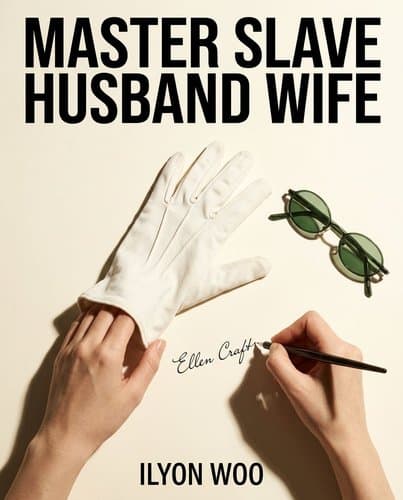
Ellen Craft had spent those four days sewing and solving. She bound her chest, pulled on trousers, vest, and thick-soled boots, each one adding an inch she needed. She wrapped her right hand in a sling so no one could ask her to sign her name, and added a second bandage at her jaw to suggest a toothache and mask her beardless chin. Green-tinted spectacles hid her eyes. An extravagantly tall silk hat rose above everything. Each element solved a specific problem. Together, they made her into a wealthy, ill young white man: too important and too unwell to be questioned.
When William opened the door, he thought of death. Ellen burst into tears. They'd both witnessed what happened to people caught running: torn by dogs, beaten, burned alive. They stepped back in, held each other once more, then walked out.
They separated immediately. Ellen took the longer road to the train station alone.
Eighteen miles out of Macon, the disguise was tested. An old friend of Ellen's enslaver (Scott Cray, a documented slave-catcher who had dined at her enslaver's Collins home the night before) sat down beside her and called out a greeting. Then again, louder. Then a third time. Ellen finally turned, gave a brief nod, and went back to the window. Another passenger offered Cray an exit: terrible thing, to be deaf. Cray agreed and dropped it.
She didn't run. She performed. She gave Cray exactly what he expected from a gentleman too ill to be bothered — a slight, irritated acknowledgment — and he filled in the rest himself. That was the mechanism of the entire escape: give people what they expect to see, and they'll do your work for you.
The Route to Freedom Was Built by the Same System That Imprisoned Them
The train that carried the Crafts toward freedom was not something apart from slavery. It was one of its products. Every mile of the Central Railroad from Macon to Savannah had been laid by people who worked without wages and lived without the option to refuse.
The bridge over the Oconee River (the one William crossed before dawn on December 21st) went through killing swamp. Swamp fever took workers all along the route. No one wanted the job, so those who had no choice were brought in: an enslaved labor force deployed precisely because they couldn't object. Ellen's enslaver, Robert Collins, oversaw the final fifty miles personally. When crews dug four feet down and found earthenware and human remains — including the bones of a child estimated at seven or eight years old, a Muscogee burial ground — Collins's brother collected the relics for display in town. The track ran straight through. Collins was celebrated as a hero for finishing the line.
The railroad's operating logic matched the institution that built it. When boilers overheated on American trains, one line's solution was to station an enslaved brass band between the passenger cars and the engine, buffer and entertainment both, so that if the vessel failed, the musicians would absorb it.
Infrastructure built on captured bodies, moving them across a landscape shaped entirely by the labor of people like them. And beneath the geography was the economic machinery that made it all cohere. An enslaved person's value was tracked year by year like a depreciation schedule: $100 at birth, rising $25 annually until age seven, then $50 a year, peaking at $900 around twenty, then declining. A sixty-year-old was worth $50. Traders pulled gray hairs and oiled aging skin to extend the window. This was not cruelty as aberration. It was cruelty as ledger.
Every piece of ground the Crafts crossed was load-bearing: the bridge, the tracks, the pass-dependent legal system, the hiring-out system by which enslavers rented their workers to other employers and sometimes let them keep a sliver of their wages — just enough, in William's case, to fund his own escape. The wonder wasn't that it was hard to get free. The wonder was that the architecture had a seam at all.
The Whiteness That Saved Ellen Was Made by the Violence She Was Escaping
Think of it as an involuntary apprenticeship: the teacher is a woman who hates you, the subject is how to impersonate her family, and neither of you knows that's what's happening.
Ellen Craft's light complexion, enough to make strangers assume she was a legitimate white child of the Smith family, was an accident of her father James Smith's crimes. But her ability to pass wasn't accidental. It was forged through punishment for doing it involuntarily.
Mistress Smith, the wronged wife who eventually gave Ellen away as a wedding present to her own daughter, couldn't stop people from making the mistake. Every time someone looked at the girl and saw Smith's features, the humiliation renewed. Whatever cruelties the mistress deployed — and her authority over Ellen was near-total — they trained Ellen in something entirely unintended: that the performance held. Not when Ellen was attempting anything; she was a child, working in a house. But the world kept running the experiment and getting the same result. By the time she was eleven, she had been proving for years that she could pass as white.
The same household provided the other half of the training. House slavery meant proximity to the language, the manners, the behavioral signals that mark class. The work was about serving. The byproduct was fluency in exactly the world she would one day impersonate.
Both were produced by the same structure. The rapes that generated Ellen's complexion, the punishment for that complexion, the forced immersion in white domestic life: together they manufactured the precise tool she would use to exit the system. What made her a slave also made her escape possible.
James Smith, Ellen's father and enslaver, left an estate inventory on his death in 1852 that records the logic plainly. It lists 116 people on the same pages as the livestock. Seven-year-old Ellen was appraised at $500. Sixty-year-old Maria, her mother, was listed at $000. The mother who ran: $500. The mother who stayed: nothing. What no assessor could enter into that ledger was what the system had unwillingly produced: the proof, accumulated through years of punishment, that Ellen Craft could pass for something she was never supposed to be.
The Fugitive Slave Act Turned Boston Into a Trap — and Daniel Webster Handed Them the Key
What did it mean to be free in Boston? Before 1850, the answer was reasonably clear: cross enough geography and you crossed out of slavery's jurisdiction. The Crafts had done exactly that (a thousand miles by train, steamer, and carriage) and for nearly two years they lived as free people. William ran a cabinet shop. Ellen learned upholstering. They were building something.
Then Daniel Webster took the floor of the U.S. Senate.
On March 7, 1850, the Massachusetts senator spoke for four hours "not as a Massachusetts man but as an American," making the case that holding the Union together required a deal: the North had to stop sheltering fugitives. He built his case carefully, acknowledged grievances on both sides, and then delivered the line that changed things: "In that respect, it is my judgment that the South is right, and the North is wrong" — about returning escaped slaves. Markets rose. Eight hundred leading citizens signed letters of praise. Webster reportedly never slept more than four hours again.
What passed six months later was machinery. The new Fugitive Slave Act bypassed state officials entirely, empowering federally appointed commissioners to return anyone to slavery on an enslaver's word plus two witnesses. No testimony from the accused. No jury, no habeas corpus. The commissioner earned ten dollars for a positive judgment, five for a dismissal, the financial incentive written into the statute itself. Every citizen was legally conscripted into slave patrol. Helping a fugitive: six months in prison and a thousand-dollar fine. Within twenty-four hours of passage, more than thirty Black Bostonians disappeared from the city. The Twelfth Baptist Church (known as the Fugitive Slave Church) lost a full third of its congregation and stopped construction mid-beam.
The Crafts stayed. When Robert Collins dispatched two agents from Macon, including the jailer who had beaten Ellen's uncle nearly to death, the trap the new law had built snapped around them. William barricaded his shop, loaded his pistols, put his Bible beside them on the workbench. Lewis Hayden, a formerly enslaved Bostonian who ran his home as a station on the Underground Railroad, stocked two kegs of gunpowder under the floor and stood with a match. But Ellen's situation was stranger than any of it.
When the men from Macon arrived, Susan Hillard, wife of a federally appointed U.S. Commissioner, came to find Ellen and brought her home. She concealed her behind a trapdoor in a closet ceiling at 62 Pinckney Street, one block from another Commissioner the Macon jailer had already visited. The legal machinery authorized to return Ellen to Georgia was also the machinery hiding her inside its own walls. George Hillard, a Boston lawyer whose professional world overlapped entirely with the federal commissioners the new act empowered, understood his obligations under the new law and almost certainly knew. He said nothing.
Boston hadn't become free. It had become a city where the same institution could hunt you and hide you — sometimes in the same house.
Celebrity Made Them Famous — and Gave Their Enslaver His Justification
Robert Collins had just celebrated his election as a Georgia convention delegate when the telegraph arrived from his agent in Boston. His reply, written to a friend in the city, was precise. The Crafts' case was "more important than any twenty others" — not because of the money they represented, not because he was desperate to have Ellen back in his household. The reason was the "romantic manner" of their escape, combined with their months of public lecturing, which had made them notorious. Their visibility was exactly what made them useful to him.
He would sell Ellen "at fair rates," he wrote. But only after she was returned to him first.
The abolitionist circuit built the trap without knowing it. William Wells Brown — himself a fugitive from Kentucky, by then among the most visible voices on the antislavery lecture circuit — had recruited the Crafts ten days after their arrival in free territory, making the case that speaking publicly could do what hiding could not: raise money, reach Ellen's enslaved mother, eventually fund her mother's purchase. The argument was real. Audiences in Worcester, New Bedford, and Newburyport packed lecture halls to capacity; some nights they turned people away at the doors. Within weeks, the Crafts were among the most recognizable faces of the antislavery movement.
Collins watched all of this from Macon and understood the logic better than anyone. To him, the Crafts were a test case — "none better calculated to test the law," as he put it — precisely because they were famous. A quiet escape that nobody heard about was one thing. A couple whose story had run on the front page of the New-York Herald, who had shaken hands with hundreds of strangers and been applauded in halls across Massachusetts, who had turned their freedom into a public performance — that was something the Fugitive Slave Law was built to answer. Enforcing it against the Crafts specifically would demonstrate, in front of the entire nation, that the law could reach anyone. Even them. Especially them.
The machinery Collins activated wasn't looking to reclaim property. It was looking to make a point. And the Crafts' celebrity, the courage and deliberateness with which they had built it, was precisely what put them in the crosshairs.
The Real Escape: A Free Woman Writes Her Name in Her Own Hand
The first escape got Ellen Craft out of Georgia. The second — the one that actually finished the job — happened four days after childbirth, in a Surrey cottage, when she picked up a pen.
For two years, slaveholders had been trying to repossess the one thing the law couldn't physically deliver back to Georgia: her narrative. Southern newspapers ran fabricated stories claiming Ellen had abandoned William and begged to be returned to bondage, that she lacked the self-possession to be a wife or a free woman. The reports were persistent enough that a Massachusetts minister who had helped the Crafts flee Boston wrote to ask if any of it was true. Ellen was heavily pregnant. She didn't respond. There are things worth waiting for.
On October 22, 1852, after a hard labor, she delivered a son. They named him Charles Estlin Phillips Craft: Charles for William's brother who had been sold away from him, Estlin for their Bristol benefactors, Phillips for Wendell Phillips, the orator who had prophesied millions would read their story, and Craft, the name they'd carried out of Macon and refused to leave behind. Four days later, Ellen took up her pen.
The letter went to a newspaper editor in England, aimed past him at Georgia. "I have never had the slightest inclination whatever of returning to bondage," she wrote. "I had much rather starve in England, a free woman, than be a slave for the best man that ever breathed upon the American continent." She addressed the false reports, dismissed them, and moved on, not with rage but with the measured authority of someone whose position doesn't require argument, only statement.
Then she signed it: ELLEN CRAFT. In the hand that Georgia law had made illegal for her to develop (developed anyway, at Lady Byron's school in Ockham, Surrey). A postscript added: "Mr. Craft joins me in kind regards to your family." Here, for once, she speaks for both of them.
Everything before (the silk hat, the sling, the thousand-mile performance) was escape by impersonation: Ellen inhabiting roles the system assigned, then subverting them from inside. The letter is different. Ellen steps out from behind every disguise the story required and says, in her own hand, exactly who she is. That's the exit that actually held.
The Pen She Was Never Supposed to Hold
Georgia made Ellen's literacy a crime not to prevent escape but to construct impossibility — to ensure that the one thing she could never do was exactly this: tell you, in her own voice, what her life had been. Four days after labor, with a son named for everything they'd lost and everyone who'd helped them survive, she sat down and wrote. The letter traveled back across the Atlantic through the same networks slavecatchers had used to hunt her and arrived in Georgia as something those hunters had no category for: her own words, in her own hand, signed with the name she'd carried out of Macon and refused to surrender. She learned anyway. Georgia made her literacy a crime, and she published anyway.
Notable Quotes
“William awoke with a start, feeling a hard shake to his body.”
“It was now William's turn to panic: Had Ellen been discovered? He asked the guard standing over him what was the matter.”
“merely wished to know what had become of”
Frequently Asked Questions
- What is "Master Slave Husband Wife" about?
- Master Slave Husband Wife reconstructs the 1848 escape of Ellen and William Craft, enslaved people who fled bondage by disguising Ellen as a white Southern planter. Ilyon Woo explores how compelled servitude became their survival toolkit, how the Fugitive Slave Act made Northern complicity structural, and why the final battle over the Crafts' story was fought through newspapers and narrative control. The book examines performance as resistance and the complex ways freedom was negotiated through identity, law, and public discourse.
- How did Ellen Craft escape slavery according to Ilyon Woo?
- Ellen's escape succeeded through mastery of the oppressor's performance. Twenty years of compulsory service had taught her exactly how a wealthy Southern gentleman moved, spoke, tipped, and commanded deference — the oppressor's training manual became the fugitive's toolkit. Her escape worked not because she looked white, but because performance mastery transformed compelled servitude into a weapon against the system that demanded it. This reversal demonstrates how oppressive institutions can inadvertently provide enslaved people the very tools necessary to challenge and escape their own oppression.
- What role did the Fugitive Slave Act of 1850 play in the Crafts' story?
- The Fugitive Slave Act of 1850 transformed the nature of oppression from regional to fully national. It didn't just threaten fugitives in the South — it conscripted every American into the slave patrol, making complicity the legal default and resistance a federal crime. Boston's legal establishment, federal commissioners, and Daniel Webster were all legally obligated to return the Crafts to bondage. Northern complicity wasn't incidental or byproduct; it was structural, systematically embedded in federal law and enforced through legal institutions throughout the nation.
- How did Ellen Craft win the battle over her own narrative according to "Master Slave Husband Wife"?
- The final battleground of the Crafts' story was not a courtroom or a border crossing but a newspaper column. When Southern newspapers couldn't physically recapture Ellen, they published fabricated accounts claiming she begged to return to slavery. Ellen and William won this narrative battle by writing and publishing their own words, thereby seizing control of their story. Control over a story functions as its own form of liberation. By signing her own name and telling her own story, Ellen reclaimed power that physical escape alone couldn't fully secure, transforming visibility from pure danger into means of self-definition.
Related Book Summaries
Read the full summary of 61272711_master-slave-husband-wife on InShort