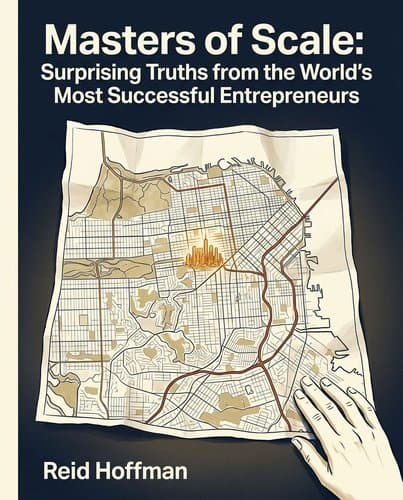
57005189_masters-of-scale
by Reid Hoffman
Billion-dollar companies aren't built on better ideas—they're built by founders who decode rejection, failure, and customer rule-breaking as product signals.
In Brief
Masters of Scale: Surprising Truths from the World's Most Successful Entrepreneurs (2021) draws on interviews with founders who built some of the world's largest companies to extract the counterintuitive principles behind scaling. It teaches readers to read rejection and failure as diagnostic signal, serve early users in deeply unscalable ways, and systematically unlearn the mental models that produced past success.
Key Ideas
Distinguish lazy rejections from expert feedback
Classify your rejections before reacting. A 'lazy no' — from someone unwilling to acquire the context needed to evaluate your idea — should be dismissed and moved past quickly. A 'substantial no' — from someone with direct relevant expertise — is worth integrating. The distinction is diagnostic, not emotional.
Unscalable personal engagement reveals true product needs
Do deeply unscalable things with your earliest users before building systems. Visit them in person. Call every new signup. Ask not 'what can I do to make this better?' but 'what would it take for you to tell every person you've ever met?' The product roadmap lives in their heads, not in your analytics dashboard.
Customer behavior reveals hidden product improvement paths
Watch what customers do, not what they say — especially when they break your rules. A customer 'cheating' your product model (wearing a rented dress to work, forging a new email to extend a free trial) is not a compliance problem; it is a product proposal. Follow the behavior before you tighten the policy.
Triage fires by escalation and existential risk
When racing toward escape velocity, build a fire-triage framework rather than trying to extinguish every fire. Ask two questions: Is the probability of disaster going up or down? If the company hits this failure, is the damage fatal or correctable? Reserve immediate action for fires that are both escalating and existential.
Establish culture values before organizational scaling
Name your culture before scale makes the choice invisible. The values you enforce — or fail to enforce — in your first hundred users, first ten employees, first product decision become the foundation. A C culture can improve to B+, but the path to an A culture runs only through the earliest formative period.
Release old mental models to enable growth
Build a regular 'unlearning' practice into your leadership. The specific mental model that produced your last win is likely the obstacle to the next one. Ask yourself every few months: what did I believe about this market six months ago that I now know is wrong? The founders who navigated multiple transitions were the ones who systematically released their previous winning formula rather than doubling down on it.
Who Should Read This
Business operators, founders, and managers interested in Scaling and Startups who want frameworks they can apply this week.
Masters of Scale: Surprising Truths from the World's Most Successful Entrepreneurs
By Reid Hoffman & June Cohen & Deron Triff
10 min read
Why does it matter? Because the rejection, failure, and rule-breaking you're trying to avoid are actually the most reliable data your business will ever produce.
Here's the assumption you're probably carrying: the founders who built the biggest companies had ideas that clicked early, customers who understood the pitch, and enough good sense to scale before competitors caught up. Tidy. Linear. Wrong.
What seventy founders told Reid Hoffman, across years of recorded conversations, is something stranger and more useful. Kathryn Minshew's 148 rejections weren't a gauntlet before success; they were a map of every pitfall competitors would hit later. The customers breaking the rental rules weren't cheating; they were writing the next product. The tactics that couldn't possibly scale weren't embarrassing workarounds. They were the setup for everything that followed.
The pattern shows up across all seventy: the data you're most tempted to discard is the data that matters most.
A 'No' from the Wrong Person Is a Head Start, Not a Setback
Tristan Walker is in the middle of a pitch for a single-blade razor built for men with coarse or curly hair when he feels the room change. He can pinpoint the exact moment — slide 14 — when a venture capitalist stops engaging and starts tolerating. The question arrives: "I'm not sure issues related to razor bumps are as profound an issue for people as acne." Walker's response is immediate. Call ten Black men, he says. Eight will tell you razor bumps are a permanent daily problem. Call ten white men; four say the same. The data is one phone call away. The VC doesn't make it.
Walker calls this a lazy no. Not a no that challenges the idea, but one that reveals the person giving it was never willing to learn enough to evaluate it. He stops trying to persuade. The investor's ignorance is information — it tells Walker exactly which lane his future competitors are still ignoring, because those same investors won't fund them either.
The founders who built the biggest companies didn't get early validation. They got rejection. Systematically. Kathryn Minshew heard no 148 times before she raised a dollar for The Muse. One of those investors pulled up Monster.com mid-pitch and said it looked perfectly fine. He hadn't looked for a job in twenty years. The rejection wasn't about the quality of her idea. It was about the quality of her audience. The people most likely to say no to a great idea are the least qualified to evaluate it.
Hoffman's point in Masters of Scale: most founders flatten all rejection into one signal. A no from someone who won't do the homework is not a verdict on your idea. It's a census of who your early competitors won't be.
In 2018, after years of being told his razor market was niche, Walker sold his company to Procter & Gamble. The first skill in entrepreneurship isn't resilience. It's sorting.
The Path to a Million Users Runs Through Ten Who Love You
It's winter 2009. Brian Chesky is in snow boots, climbing apartment stairs in New York City with a camera. Paul Graham, Y Combinator's co-founder, had just stopped a pitch meeting cold with a single question: "What are you still doing here?" Chesky had been sitting in Mountain View while his Airbnb users lived in New York. Graham's advice was blunt: go there, meet them, one by one. So here Chesky is, offering to photograph hosts' listings for free.
On one visit, he finishes the photos and asks the host if he has any feedback. The host disappears. Chesky waits. The host comes back carrying a binder — dozens of pages of typed suggestions, features to add, things to fix, a complete vision of what Airbnb could become. Most founders would read this as a difficult customer. Chesky read it as a roadmap. "The roadmap often exists in the minds of the users you're designing things for."
Chesky pushed back: "But that won't scale — if we have millions of customers, we can't meet every customer." Graham's answer: "That's exactly why you should do it now."
The data backs him up. Sam Altman, then running Y Combinator, looked across fifty-plus companies that reached $100M in value and found the same pattern: the biggest ones had fanatical early users. A million people who kind of like your product try it once and drift away. A hundred who love it stick, recruit their friends, and hand you binders full of what to build next.
To show why that 100 matters more than the million, Chesky developed the 11-star exercise. Map the check-in experience from 1-star (host never shows, you can't get your money back) through 5-star (door opens, you're let in) to 7-star (Reid Hoffman greets you with a surfboard and a restaurant reservation) all the way to 11-star (Elon Musk announces you're going to space). The absurdity at the top is the mechanism, not the joke. "You have to almost design the extreme to come backward." Somewhere between "they opened the door" and "I went to space" lies the zone where an experience becomes worth talking about — and things worth talking about are the only things that actually spread.
The host with the binder wasn't a problem. He was a prototype of every fanatical user who would ever find the product. The window where you're small enough to find those people, sit with them, and build what they need doesn't stay open long.
Stop Asking What Customers Want — Watch What They Actually Do
Customers cannot tell you what they want. They can only tell you what they think they want. That's a different thing entirely.
Marissa Mayer ran the experiment that proved this at Google. She surveyed users: how many search results per page do you want? Thirty, they said. More is better. Then she deployed pages with ten, twenty, and thirty results and watched actual behavior: how many searches people ran, how many abandoned the site. Ten results won. Thirty performed worst. Users hadn't lied; they simply couldn't feel page-load speed working against them. A few extra milliseconds multiplied across thirty results made people leave without knowing why. "Time matters a lot more to people than they usually articulate," Mayer said. The signal existed — it just couldn't survive a survey.
The best founders stopped asking what customers wanted and started watching what they did, especially when what they did broke the rules.
When Jenn Hyman launched Rent the Runway, the model was simple: rent a designer dress for one occasion, return it after. Then she noticed customers doing something they weren't supposed to. They were keeping their Saturday-night cocktail dress through the weekend and showing up to work on Monday in it, blazer on top. Keeping dresses through Monday meant more wear, more dry-cleaning, more reshipping. Hyman could have tightened the rules. Instead she followed the behavior. If women wanted to feel well-dressed on a Tuesday, that wasn't a problem with the product — it was a larger market than she'd ever designed for. She built the subscription "closet in the cloud," letting customers rotate multiple pieces at a time. The misbehavior had pointed directly at a bigger business.
Customer misbehavior isn't noise. It's the next product, already designed.
Some Fires Must Burn: The Case for Deliberate Neglect
At PayPal, the customer service department had three people. As users multiplied, so did complaints. Unread emails hit 10,000 a week; desk phones rang nonstop. Hoffman's team turned off every ringer and switched to cell phones. They let the fire burn for months.
The founders who won made a deliberate choice to let certain fires burn. Not all fires — but most of them. Knowing which to ignore matters more than speed itself.
The reason was math. PayPal's users were growing 7 percent per day, and any hour spent on customer service was an hour not spent extending that rate. eBay had a competing payment system in development but couldn't move fast. A fumble for PayPal meant thousands of unhappy users. A fumble for eBay could anger millions and draw government regulators, so they moved carefully, taking over a year to roll anything out. By then, PayPal owned the user base. eBay stopped competing and bought them instead, for $1.5 billion.
The customer service fire? Hoffman eventually flew to Omaha and built a 200-person call center within two months. His framework for deciding: Is the disaster probability rising? Is the damage fatal or correctable? A 0.1 percent daily risk can wait six months. A 1 percent daily risk compounds to roughly 15 percent in a month — that's a fire you handle today. Most fires are the first kind. Founders who treat them like the second never get out of the building.
The Mindset That Built Your Company Will Stall It
Phil Knight receives a quarterly sales report bad enough to change his mind about something he's believed for nearly twenty years. Nike's formula was simple: build the fastest, lightest shoe, put it on a champion's foot, and let the performance speak. It had worked. Elite runners, track coaches, weekend joggers — they all followed the athletes. Then Reebok released Velcro high-tops designed for aerobics, and stylish women started wearing them to work. Athletic shoes had become fashion, and Nike, the performance company, was losing to a fashion company.
So Knight walks into a four-person office with a card table and tells the man across from him, Dan Wieden, "I just want you to know: I hate advertising." Wieden's reply: "That's an interesting way to start." His team spent weeks learning what Nike actually was (its underdog spirit, its chip-on-the-shoulder relationship with winning) before they made anything. Their diagnosis: Knight had never encountered advertising that reflected who Nike actually was. He didn't hate it. He'd just never seen a version of it worth believing in.
The "Revolution" TV campaign followed, then "Just Do It," then the Air Jordan in 1985. Knight estimates the brand they built produced three to four times the revenue they'd have had otherwise. But something had to happen first: the old formula had to fail publicly. The performance-first model wasn't wrong; it was finished. It had run its course. Then it became the reason Knight couldn't see what was coming. He couldn't have walked into Wieden's office a decade earlier and had that conversation. The formula still had runway. It took Reebok eating his lunch to make unlearning possible.
That's the structural trap Hoffman names. Success doesn't just confirm your mental model — it hardens it. Every win makes the next experiment feel unnecessary. You stop testing assumptions because you have proof they work. And when the market shifts, the instincts you've spent years sharpening block the response. The mindset that built the company is the obstacle to leading it.
Knight found his way through by letting an outsider name who Nike actually was. The founders who cleared this trap all did something similar: they reached for something that had been there from the beginning, before the formula took over.
Your Earliest, Smallest Moments Write Your Largest Values
Howard Schultz has six stores, one hundred employees, a business model nobody has proven yet, and a plan his investors think is insane. The year is 1987. He has just paid $3.8 million to acquire a small Seattle coffee company called Starbucks, and his first meeting is not about expansion or location or menu. It is about health insurance.
He tells his investors he wants comprehensive coverage for everyone working twenty or more hours a week — full-time and part-time — and stock options too. No American company has ever offered both to part-timers. His investors have a word for the idea: misguided. Schultz doesn't argue values. He argues business: lower attrition, higher performance, a company where people feel part of something larger than themselves. He knows "it's the right thing" will lose. So he makes the other argument instead.
Twenty-seven years later, Starbucks is losing money in China for the ninth consecutive year. Analysts tell Schultz to close it — tea-drinking country, they say. Schultz has noticed something else: Chinese parents whose college-educated children work at Starbucks are ashamed. In Chinese family culture, that shame drives turnover. The solution he reaches for is the same one he reached for in 1987: extend the benefits. He adds parents to the health plan. Then he launches annual events in Shanghai and Beijing, flying in parents who have never been on a plane to celebrate their children's careers. Retention climbs. Starbucks now opens a new Chinese store every fifteen hours.
That's the arc. The decision that looked like a burden when the company had one hundred employees became the engine of 4,800 stores in a market every analyst told him to abandon. The values weren't the reward for getting to scale. They were what made scale possible in places no spreadsheet could predict.
Every founder in this book who built something lasting made the same move: acting on a second purpose at the worst possible time to afford it. Schultz bought comprehensive health insurance before he had a proven business. Stewart Butterfield built job placement pages for everyone he laid off at his failed gaming startup, then turned that same core into Slack.
None of them were calculating a long-term return. They were just unwilling, in the smallest version of their company, to be a different kind of organization. That is what a Trojan horse actually is: a decision made before you have the resources to be strategic about it. The horse was built in a moment. The army inside had decades to grow.
The Three Words That Separate Founders Who Act from Founders Who Almost Did
Sara Blakely, who built Spanx by cutting the feet off her own pantyhose and turning the idea into a shapewear category, had been scanning for that signal for years. The idea wasn't the breakthrough — the readiness to act on what those years were already showing her was. That's the quiet argument this book keeps making, the one easiest to miss: the founders who built something lasting weren't smarter or luckier at the start. They were practiced. At reading a lazy no as a census. At reading customer misbehavior as a product proposal. At reading failure not as a verdict but as data pointing toward the next version.
And when they finally built something, they built it as a Trojan horse — a viable business carrying a second purpose inside. That purpose wasn't chosen at scale. It was decided in the smallest possible moment, before anyone was watching. The real question isn't whether you're ready to grow. It's whether you've already decided what you're growing toward.
Notable Quotes
“I like to say I had the whole 'rose that grew from concrete' story,”
“I had one goal in life, and that was to get as wealthy as possible, as quickly as possible.”
“The first was to be an actor or an athlete, and that didn't work out for me,”
Frequently Asked Questions
- How should entrepreneurs interpret customer rejection?
- According to Masters of Scale, rejection comes in diagnostic forms requiring different responses. A 'lazy no'—from someone unwilling to acquire the context needed to evaluate your idea—should be dismissed and moved past quickly. A 'substantial no'—from someone with direct relevant expertise—is worth integrating. The distinction is diagnostic, not emotional. This framework helps founders avoid wasting time on dismissive feedback while strategically leveraging informed criticism from knowledgeable sources to refine ideas and accelerate progress toward product-market fit.
- What does it mean to do deeply unscalable things with early users?
- Masters of Scale recommends founders engage in "deeply unscalable things" with early users, including visiting them in person and calling every new signup. The guide advises asking not 'what can I do to make this better?' but 'what would it take for you to tell every person you've ever met?' Rather than relying on analytics, "the product roadmap lives in their heads, not in your analytics dashboard." This intimate customer engagement reveals unmet needs and builds genuine loyalty before establishing systematic processes for scale and growth.
- How should startups use customer rule-breaking to improve their product?
- Masters of Scale teaches that watching what customers do reveals more than listening to what they say, especially when they break your rules. A customer "cheating" your product model—wearing a rented dress to work, forging a new email to extend a free trial—is not a compliance problem; it is a product proposal. Rather than enforcing policies, successful founders follow these behavioral patterns to identify genuine product needs and friction points. These insights should drive roadmap prioritization over traditional analytics.
- How does Masters of Scale recommend managing rapid growth and company culture?
- Masters of Scale teaches that founders must "name your culture before scale makes the choice invisible." The values you enforce—or fail to enforce—in your first hundred users and first ten employees become foundational. Build a "fire-triage framework" for rapid growth, asking: Is the probability of disaster increasing? Is failure fatal or correctable? Reserve immediate action only for fires that are both escalating and existential. Additionally, leaders should practice "unlearning," challenging mental models that produced past success but may now hinder necessary progress.
Related Book Summaries
Read the full summary of 57005189_masters-of-scale on InShort