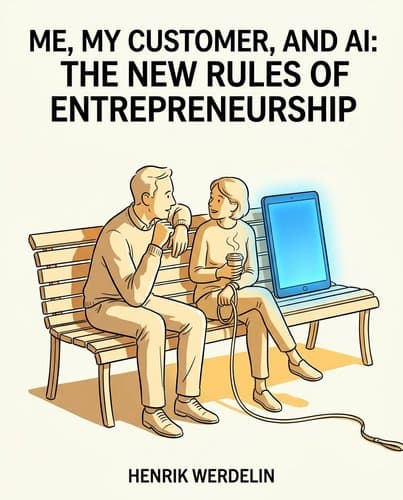
229201751_me-my-customer-and-ai
by Henrik Werdelin
When AI levels the playing field on every tool and tactic, the only edge left is you—your specific history, obsessions, and customer connections.
In Brief
Me, My Customer, and AI: The New Rules of Entrepreneurship (2025) argues that deep founder-customer connection is the only competitive advantage AI cannot replicate.
Key Ideas
Your frustrations signal defensible market opportunities
Map your own 5 P's (Passions, Positions, Possessions, Powers, Potentials) before researching your market — the overlap between what energizes you and what frustrates you is where your most defensible business ideas live.
Flow moments serve as opportunity filters
Build a 'micro-moments' list: 25-30 specific instances when you were in flow or being your best self. Evaluate every new opportunity against it. If the new thing is unlikely to produce more moments like these, that's a real signal.
Know your customer before writing plans
Apply the Founder-Customer Fit Plan before writing a business plan: define a customer persona based on a real, named person; articulate why you specifically understand their problem; write one 'It sucks that...' sentence that captures their tension. Do this before touching financials or product specs.
Make problems visceral before designing solutions
Use the 'It sucks that...' framework to stay in problem mode: complete the sentence from your specific customer's perspective until the problem feels visceral. Only then ask what solution follows. Businesses built from this sentence tend to find their market; businesses built from a solution tend to find Quibi's fate.
Protect founder-customer relationships from automation
Use AI to do everything except maintain direct customer contact — automate operations, draft communications, accelerate prototyping — but treat the founder's direct engagement with real customers as the one thing not to hand off, especially early.
Customer intimacy builds unbeatable brand defensibility
Apply the Intimacy Test to your customer relationships: Can you anticipate their needs? Would they get your jokes? Would they have something to talk about with each other? A brand that passes all three has relationship capital worth defending.
Who Should Read This
Business operators, founders, and managers interested in Startups and Business Strategy who want frameworks they can apply this week.
Me, My Customer, and AI: The New Rules of Entrepreneurship
By Henrik Werdelin & Nicholas Thorne
10 min read
Why does it matter? Because the tools that are supposed to give you an edge are giving everyone the same edge.
Here's the paradox nobody talks about: AI might be the worst thing that ever happened to your competitive advantage. Not because it doesn't work — it works brilliantly — but because it works equally well for everyone. When every founder has access to the same tools, the same synthesis, the same speed, you don't get differentiation. You get a more efficient race to average. So if the tools are equal, what isn't? That's the question this book spends its chapters answering. The answer turns out to be the one thing no model can replicate — something like the guy who already knew every dog owner at the park before he ever opened his Square account, or the couple who understood lonely cruisers so well they designed bunk beds shaped like hearts. Your history, your people, your genuine understanding of one particular customer. Before you write a business plan, before you name a product, before you touch a prompt, there's a more important question to sit with. Not what should I build, but who am I actually built to serve?
The Race to Average: Why AI Makes Everyone Equally Good and Equally Forgettable
Nicholas Thorne was convinced he'd cracked it. He built a database, row by row, each cell containing a paragraph-level instruction from a ChatGPT-generated outline. The system would feed each row to an AI, take the previous paragraph into account, and produce a full book draft — not in an afternoon, but reliably, one paragraph at a time. He called it avoiding the tyranny of averages.
It failed anyway. Each sentence was grammatically sound. Every paragraph was technically coherent. But reading several pages together felt, as Nicholas put it, like eating fast food for a week — it looked like a meal, tasted acceptable, and left nothing to metabolize. The AI could improve a paragraph Nicholas had already written. It could preserve his voice if he handed it something real. Handed only instructions, it produced competent emptiness.
Here's the problem: every other entrepreneur running AI tools right now is producing the same competent emptiness, at the same speed, for the same price. The logo generator that saves you three thousand dollars saves your competitor three thousand dollars too. The copy tool that gives you professional marketing in minutes gives the next person professional marketing in minutes. AI doesn't hand anyone an edge — it erases edges. The tools that lower your barriers to entry lower everyone else's simultaneously, flooding every market with faster, cheaper, and increasingly indistinguishable products.
Henrik Werdelin and Nicholas Thorne — who built prehype and, through it, helped launch BARK — spend their first chapter sitting with this paradox. The same force making entrepreneurship accessible to sixty percent of people who have ideas but haven't acted on them is also making it harder for any single business to be noticed once it launches. When creation gets easier, markets get noisier, and the things that once separated you — technical skill, production speed, professional polish — stop separating anyone.
What's left is the one thing AI genuinely cannot replicate at scale: a real relationship with a specific human being who trusts you because you understand them. Not a demographic. Not a user segment. A person. The question the rest of the book tries to answer is how you find yours.
The One Advantage AI Cannot Democratize
Here is the uncomfortable truth about competitive advantage: it was always borrowed. Technical expertise, production speed, professional polish — these advantages were real, but they depended on scarcity. Make the scarce thing abundant, and the edge dissolves. AI just did that to most of the edges entrepreneurs have relied on for decades, and it did it overnight.
Consider how BARK began. Henrik Werdelin and Matt Meeker met by accident on a cruise ship — assigned to the same cabin, waking up side by side in a heart-shaped bed. What bonded them wasn't capital or a product idea. It was a shared instinct about who they wanted to serve. Matt owned a Great Dane named Hugo, and Hugo's size made finding appropriate products genuinely difficult. That friction — not a market report, not a trend deck — became the seed. They prototyped a subscription box concept, walked to a local dog park with a Square card reader, and left with seventy paying subscribers before they had a website, a logo, or a single product in inventory. The customers didn't sign up because the pitch was polished. They signed up because Matt was one of them.
That's what the authors call relationship capital: a founder whose problem is indistinguishable from the customer's problem. The understanding isn't performed — it's structural. And it compounds in three directions. Customers who trust you give honest feedback rather than walking away quietly, so you innovate faster. They stay longer, which matters because the average customer lifespan has dropped from five years in 1990 to roughly two today, making retention the decisive economic variable. And they recruit for you, carrying your credibility into conversations no ad budget can reach.
The distinction is between a transaction and a relationship. Both involve an exchange. But in a transaction, the exchange moves in one direction — money for product — and stops there. A relationship reciprocates. Your customers tell you what's broken. They defend you when you make mistakes. They feel, in some genuine sense, that your success is connected to theirs. An internet service provider has your money but not your loyalty, because its advantage has nothing to do with knowing you. That's the gap relationship capital fills. What remains when everything else gets democratized is the accumulated trust between a specific founder and a specific person who feels genuinely understood. AI can process your data, but it cannot share your life.
Know Yourself Before You Know Your Market: The 5 P's Framework
What actually separates founders who build something lasting from ones who chase every shiny opportunity until they burn out? The authors' answer is counterintuitive: not superior market research or better timing. Self-knowledge — the unglamorous work of understanding what energizes you before you ever talk to a customer.
Their 5 P's framework is the tool for that work. Passions, Positions, and Powers are the more familiar entries — the problems you think about without being paid to, the roles you've held, the strengths that show up whether or not they're on a résumé. The two that tend to surprise people: Possessions, which isn't a wealth inventory but a values map (a home office stacked with the newest hardware tells a different story than one filled with handcrafted furniture, and both point toward different customers worth serving), and Potentials — not deficits to fix but directions you're genuinely drawn to grow.
The framework's practical payoff shows up in two places. First, it tells you which customers you can serve authentically — the people whose problems live inside your own experience rather than inside a spreadsheet. Second, it tells you where you end and AI begins. One of the authors describes a writer friend who uses AI freely for organizing thoughts and producing initial drafts but draws a hard line at product naming and web copy. Her reasoning: AI gets maybe eighty percent of the emotional charge out of language. The other twenty percent is the part where she'd name a product something like
AI Multiplies Your Resourcefulness, Not Just Your Output
Think of a megaphone. It makes your voice louder — but if what you're saying is wrong, it makes the wrong thing louder faster. That's productivity software: an amplifier for what you already know how to do. Resourcefulness is something different. It's figuring out what to say in the first place, finding the angle nobody else thought to try, building the system that means you never have to repeat today's scramble tomorrow. The distinction matters: a productive worker checks tasks off a list; a resourceful one decides what belongs on the list at all.
AI is a resourcefulness multiplier — and for entrepreneurs, the gap between those two things is everything. Guy Kawasaki illustrated this as cleanly as any example can. His car needed repairs that came in under his insurance deductible, so he was told he was simply out of luck. He opened ChatGPT and laid out the full picture: forty years as a customer, roughly two hundred thousand dollars in premiums paid, home and health insurance bundled with the same company. He asked for a letter that made the case for full payment. What came back was precise, calm, and airtight — the kind of writing that signals a person with a legitimate argument rather than someone gaming the system. He sent it. He won five thousand dollars on an eight-hundred-dollar claim.
Notice what Kawasaki actually did: he didn't ask AI to write a letter. He fed it context, framed the argument, and let the tool crystallize what he already knew into language he couldn't have produced as efficiently on his own. The resourcefulness was his. The leverage was AI's. That's the methodology the chapter is building toward — and it's why Ethan Mollick at Wharton can require students who've never coded to ship working software prototypes in two weeks. The tool doesn't replace judgment. It keeps judgment in motion when it would otherwise stall.
The Most Important Question Isn't 'What Should I Build?' It's 'Who Am I Uniquely Qualified to Serve?'
The most important question isn't what you should build — it's who you're already uniquely qualified to serve. Most entrepreneurs treat customer identification as a research problem: run surveys, build demographic profiles, calculate total addressable market. That gets the sequence exactly backward. The insight, the communication, and the resilience that build a real business don't come from a spreadsheet. They come from being the customer, or knowing one so well the distinction collapses.
Tobi Lütke was an avid snowboarder who wanted to sell snowboarding gear online in 2004. Every e-commerce tool available was inadequate for what he needed, so he built his own. A couple of years later, he realized other online sellers had the same problem, started offering his tools to them, and eventually spun that into Shopify — now worth over $82 billion. Notice what Lütke never did: he never commissioned research to identify the pain points of online retailers. He was an online retailer. He felt the friction personally. That firsthand experience meant he already spoke the customer's language, knew which tradeoffs actually mattered, and could recognize whether a proposed solution was genuinely better or just marginally less bad.
Founder-customer fit is the close alignment between who you are and who you're trying to serve. It's also the precondition for everything that comes later — the trust, the referrals, the compounding word-of-mouth that Section 2 describes as relationship capital. You can't accumulate that capital without fit producing it first. And fit generates three advantages no market study replicates. You reach your first customers faster, because they're already in your orbit — people who share the problem you share. You communicate more precisely, because you're not translating research findings into customer language; you're already in it. And you last longer, because when the early months get hard, you're solving something that matters to you personally, not sticking it out for an abstraction.
The practical entry point here is simple: before asking what the market needs, ask what friction you've absorbed so deeply you stopped noticing it was a choice. That invisible friction is usually the opportunity. Lütke didn't set out to build an $82 billion company. He set out to stop being annoyed. The fit came first. The scale followed.
Stay in Problem Mode Longer Than Feels Comfortable
Quibi's founders raised nearly two billion dollars in 2020 to deliver premium short-form video sized for your phone screen. Six months later, the company was gone. The product worked. The technology was fine. The problem was that nobody had actually been frustrated by the absence of it. Quibi was an answer hunting for a question nobody had thought to ask.
The antidote is a discipline the authors call staying in problem mode, and the entry point is a single unfinished sentence: 'It sucks that.' You start with a specific customer, add what they genuinely want, and complete the sentence by naming the obstacle between them and that want. The tension that surfaces is your business.
Here's how it worked in practice. BARK already knew its customers — dogs and the people devoted to making them happy. So the team ran that definition through the framework and stayed there, resisting the pull toward solutions, until patterns emerged: bad breath, a ninety percent rate of canine oral disease, the expense and difficulty of preventive dental care. No one in the room proposed a product until the problems had piled up. What came back wasn't a clever idea — it was a market of roughly five hundred million dogs with a problem their owners would pay someone to solve. Dog dental health became a product line because the problem kept insisting on itself.
Notice what the framework resists. Starting with a solution — 'we should build X' — and working backward toward a customer who might want it is exactly how Quibi was built. The 'It sucks that' method forces the opposite sequence: you stay locked onto the customer's friction until a solution becomes almost obvious. Jumping to conclusions about what your business should be is almost always wrong, and you pay for it later.
The same discipline reshapes how you pitch. Quibi's pitch started with the product; the listener had to reconstruct the logic themselves. Compare that to: 'Our customers are people like Travis. He wants the convenience of a private driver. It sucks that he can't afford one.' The problem lands before the solution appears, and the listener is already leaning in.
AI Should Keep You Closer to Your Customer, Not Replace You
What's the smartest thing AI can do for a founder who finally has a tool that can handle customer service? The obvious answer is hand it off — free yourself from the inbox, delegate the complaints, reclaim your calendar. The authors argue that's exactly backward.
The logic runs like this: the reason early-stage founders build something people actually want is that they're still close enough to their customers to feel what's wrong. Henrik Werdelin has been running BARK for over a decade and still reads the BarkBox subreddit every day. Not because he has to — he has a full company now — but because that daily contact is the source. It keeps his instincts calibrated. The moment you hand customer service to a system and stop reading the complaints yourself, you stop learning. AI's highest use isn't replacing that contact; it's handling everything else so the founder can stay in it longer.
The subtler idea in this chapter is what the authors call neighbor-ization, and the distinction from personalization matters. Personalization throws your data back at you: here's what you bought last month, here's what people like you bought. A neighbor does something different. You search for chicken stock and they suggest a soup you've never made but somehow knew you'd want — nudging you forward without cataloguing your history. Instacart's "Ask Instacart" works this way. It maps your cart, infers your comfort zone, and suggests recipes you haven't tried but are likely to enjoy. The user feels understood rather than tracked.
That's the identity shift the book is building toward. Not entrepreneur-as-builder, optimizing a product until it scales. Entrepreneur-as-neighbor — someone whose deepest competitive advantage is that they genuinely understand a specific group of people, can anticipate what those people need before they ask, and have earned enough trust that the relationship itself becomes the moat. AI handles the operations. You stay in the conversation.
The Question Worth Carrying Into Every Decision
Every tool in this book eventually asks the same question back: who are you, and who do you actually understand? Not as a planning exercise you complete once and file away — but as the question running underneath every product decision, every AI deployment, every time you choose whether to read the complaints yourself or route them to a bot. The founders who keep asking it stay neighbors. The ones who stop asking become infrastructure — functional, easy to leave, back where Section 1 left them: forgettable. Henrik didn't build BARK by solving for dogs in the abstract. He stayed in the subreddit. He stayed in the conversation. The trust deepens because the attention never stops — and that's the shift worth making: not from idea to execution, but from builder to neighbor — someone whose deepest advantage is who they are and who they can't help but understand.
Notable Quotes
“What did Chihuahuas in Chicago like about Consuela the Cactus?”
“I'm such a crazy dog person, I'll spend six thousand dollars on a plane ticket for my dog!”
“Do you want to start something new or take a job?”
Frequently Asked Questions
- What is the main argument of Me, My Customer, and AI: The New Rules of Entrepreneurship?
- The book argues that deep founder-customer connection is the only competitive advantage AI cannot replicate. Rather than focusing on product innovation or market positioning, the work emphasizes that entrepreneurs must identify the right customers and build genuine relationships with them, then use AI to scale everything else. The book provides practical frameworks including self-mapping exercises, a Founder-Customer Fit Plan, and the "It sucks that..." problem statement to help entrepreneurs systematically approach founder-customer connection. By maintaining direct engagement with real customers while automating other operations, founders can build defensible, sustainable businesses.
- What is the "It sucks that..." framework and how does it help entrepreneurs validate real problems?
- The "It sucks that..." framework keeps entrepreneurs in problem mode before jumping to solutions. Founders should complete the sentence from their specific customer's perspective until the problem feels visceral before asking what solution follows. According to the book, "Businesses built from this sentence tend to find their market; businesses built from a solution tend to find Quibi's fate." This problem-first approach ensures entrepreneurs deeply understand customer frustration rather than creating solutions in search of problems. The framework forces clarity on the real tension their target customer experiences daily.
- What are the 5 P's and how should entrepreneurs use them to identify business ideas?
- The 5 P's—Passions, Positions, Possessions, Powers, and Potentials—form a self-mapping exercise founders should complete before researching their market. Founders should identify where the overlap exists between what energizes them and what frustrates them, as this intersection is where the most defensible business ideas live. This internal mapping helps entrepreneurs recognize their authentic competitive advantage: their unique perspective and passion for specific customer problems. By starting with self-awareness rather than market analysis, founders can pursue opportunities that align with their genuine strengths and motivations.
- What is the Intimacy Test and why does it matter for building defensible customer relationships?
- The Intimacy Test evaluates whether founders have built deep customer relationships through three criteria: Can you anticipate their needs? Would they get your jokes? Would they have something to talk about with each other? Passing all three questions indicates a brand has relationship capital worth defending. This test quantifies the depth of founder-customer connection beyond transactional interactions. Strong relationship capital creates competitive advantage by fostering loyalty and word-of-mouth growth that competitors cannot easily replicate. It's a practical measurement of genuine intimacy.
Related Book Summaries
Read the full summary of 229201751_me-my-customer-and-ai on InShort