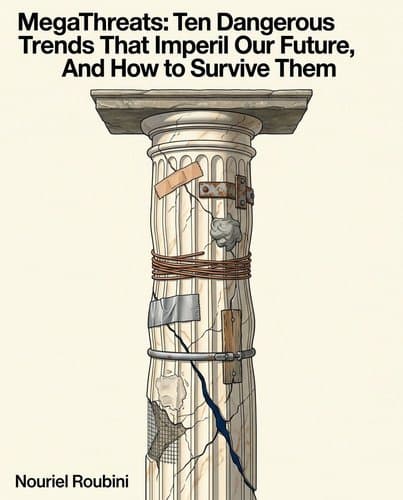
61030508_megathreats
by Nouriel Roubini
The postwar prosperity that shaped your entire worldview was a 75-year accident — and the debt, AI disruption, and inflation now converging will end it.
In Brief
The postwar prosperity that shaped your entire worldview was a 75-year accident — and the debt, AI disruption, and inflation now converging will end it. Roubini maps the ten forces already in motion and what survival looks like when every policy escape hatch has been sealed.
Key Ideas
Postwar Boom Was Historic Exception
The 75-year postwar era of rising incomes, short recessions, and no great-power wars was historically exceptional; the first four decades of the 20th century — World War I, the Spanish flu, the Great Depression, World War II — are a more representative guide to what unmanaged instability looks like.
Crisis Responses Accumulate Debt, Reduce Options
Every major crisis response since 2008 (bailouts, quantitative easing, near-zero interest rates, pandemic stimulus) has added more debt than it resolved, leaving policymakers with less room to maneuver each time — global debt has grown from 220% of GDP in 1999 to over 350% today.
True Debt Burden Vastly Exceeds Reported
Official government debt figures are misleading: the true US liability including unfunded pension and healthcare obligations is roughly 22 times the headline number — already locked in by demographic math that no short-term policy can undo.
Volcker Solution Impossible Under Current Debt
The combination of high debt and inflation is historically unprecedented: Paul Volcker's 1982 cure (20% interest rates) is no longer available because debt ratios are four times higher — raising rates aggressively now would trigger cascading defaults before it controlled prices.
AI Threatens Knowledge Workers Without Fallback
AI differs structurally from all previous automation: steam, electricity, and computing each displaced workers into a new sector (factory work, service work, knowledge work); AI is targeting knowledge work with no remaining fallback sector waiting to absorb displaced workers.
Megathreats Multiply Through Mutual Reinforcement
The ten megathreats are not additive but multiplicative — high debt constrains climate spending, stagflation hits displaced workers hardest, geopolitical rivalry prevents the coordination needed for pandemic response; each threat actively destroys our capacity to address the others.
Stagflation Breaks Traditional Portfolio Protection
The standard 60/40 stock-bond portfolio breaks under stagflation because stocks and bonds fall together (as they did in the 1970s); Roubini suggests inflation-indexed bonds, short-term government bonds, gold, and real estate in geographically resilient locations as partial hedges.
Who Should Read This
Readers interested in Macroeconomics and Geopolitics, looking for practical insights they can apply to their own lives.
MegaThreats: Ten Dangerous Trends That Imperil Our Future, And How to Survive Them
By Nouriel Roubini
10 min read
Why does it matter? Because the next crisis won't look like the last one — it will be all of them at once.
You assume the world bounces back. Markets crater, banks fail, governments lurch toward dysfunction — and then, eventually, the system finds its footing. It always has. That recovery instinct is not wisdom. It is the most expensive misreading of the last century.
The seventy-five years of rising incomes, stable currencies, and relative peace were not the new baseline of human civilization. They were an exception — a window opened by specific, unrepeatable conditions that we have been quietly dismantling ever since. Every bailout, every stimulus package, every rate cut that postponed the next crisis left the underlying structure more fragile than before.
Nouriel Roubini predicted the 2008 collapse in 2006. Colleagues called him Dr. Doom; the IMF published optimistic growth forecasts through 2007. He is not laughing now. What he sees coming is not the next crisis. It is ten of them, arriving together, each one destroying our ability to survive the others.
The 75 Years of Postwar Prosperity Were the Exception, Not the Rule
When Roubini's family arrived in Milan in 1962, Italy was deep in the Economic Miracle, a period of rapid industrial growth that lifted millions into the middle class. His father built an import-export business. The timing was right. As a teenager drawn to Marx and Keynes, Roubini lived through the oil shocks, factory strikes, and rising inflation of the 1970s without ever doubting the basic shape of the future: hard work would pay off, savings would hold their value, and governments would keep the floor from collapsing.
That confidence, Roubini now argues, was not wisdom. It was an accident of timing.
The 75 years after World War II were unusually calm by any historical standard. Recessions were short. Great-power wars didn't happen. Pandemics were something from history books, not the morning news. In most countries, each generation did better than the one before. If you grew up during those years, as almost everyone alive today did, this looks like the natural order of things. It isn't.
Look at the four decades before it. Between 1914 and 1945, a single generation endured World War I, the 1918–19 Spanish flu that killed tens of millions, deglobalization and hyperinflation that wiped out savings across Europe, the Great Depression with its mass unemployment and financial collapse, and then the rise of Nazism in Germany, Fascism in Italy, militarism in Japan, and finally World War II and the Holocaust. Forty years. One generation.
Each crisis on that list weakened the institutions needed to handle the next one. That is what compounding instability looks like. Roubini's argument is blunt: the postwar calm that shaped your expectations was the historical anomaly. The chaos that came before was the norm.
Every Rescue Operation Has Been Building a Larger Next Crisis
In spring 2021, with COVID vaccines rolling out and the economy recovering, a Wall Street trader named Bill Hwang was running what looked like a success story of the easy-money era. His family office, Archegos Capital, held enormous positions in tech and media stocks through borrowed instruments designed to stay hidden from regulators. When Asian tech stocks stumbled, the structure collapsed within days. Five global banks absorbed more than ten billion dollars in losses. It was spectacular, and it was a direct product of the rescue operation that came before it.
After the 2008 financial crisis, the Federal Reserve cut rates to zero and launched successive rounds of asset purchases — QE1, QE2, QE3. The goal was to prevent a second Great Depression, and it worked. But it worked by flooding the system with cheap money that had to go somewhere. It went into stocks, real estate, leveraged buyouts, crypto, and the borrowed positions Hwang built at Archegos. By 2021, the S&P 500's price-to-earnings ratio had climbed past the level that preceded the 1929 crash, into the 30s. Tech sector ratios hit the 50s. A company whose only asset was a New Jersey deli with minimal revenue briefly reached a hundred million dollars in market value.
Roubini traces this pattern across four decades. After the savings-and-loan collapse of the 1980s, the Fed held rates low, seeding the dot-com bubble. After the dot-com bust, it cut to 1 percent and held there for two years, seeding the housing bubble. After 2008, it invented quantitative easing, seeding the 2020–21 bubble. Track global debt across that span: it grew from 220 percent of world GDP in 1999 to over 350 percent by end of 2021. Each rescue left the system more indebted than before, making the next rescue more necessary and more expensive.
Roubini calls this the debt supercycle. His description of the mechanism is blunt: central banks are giving drugs to an addict. A dose that relieves withdrawal prevents immediate collapse and deepens the dependency. Cutting rates and printing money stops a depression; it also makes borrowing irresistible, inflates assets beyond what earnings support, and ensures that when the next correction comes, the debts requiring rescue are larger. Each cycle ends at a higher debt floor. Each rescue leaves policymakers with less room for the one after it.
The reason this matters isn't moral. Nobody running the Fed in 2009 was reckless. They did what the situation demanded. The trap is that there's no clean exit. A central bank that holds rates near zero long enough to prevent a depression cannot then raise them without destabilizing the debt it helped create.
The Debt in the Headlines Is the Smallest Part of the Problem
That baseline had a larger problem beneath it: the debt figures everyone quoted were wrong.
The debt number governments report is not the actual debt. It omits the largest liability entirely.
In 2012, economists Laurence Kotlikoff and Scott Burns calculated what the US actually owed by including what the government had already promised but never funded: Social Security, Medicare, pension obligations. The official public debt at the time was $11 trillion. The real number, once you fold in the unfunded commitments, was $211 trillion. Not eleven. Not twenty-one. Two hundred and eleven. That gap — 22 times the figure that, as they put it, "had everyone's attention" — is what Roubini calls the fiscal gap. A decade later, it had grown to 14 times annual GDP.
The gap exists because of a demographic bet that was always going to fail. In 1960, five American workers paid into Social Security for every retiree drawing from it. The math looked comfortable. By 2009 that ratio had slipped below three-to-one, and by 2030 it is heading toward two-to-one. The Social Security trust fund is projected to run dry in 2033, after which payouts would cover only about three-quarters of what recipients are owed. The promises were made when most workers died before or shortly after retirement; now they routinely live twenty or thirty years past it.
Every fix you can name hits the same wall. Raising the retirement age punishes laborers who started at twenty and die by seventy, while subsidizing lawyers and doctors who collect for decades. Higher payroll taxes squeeze a shrinking workforce to fund an elderly population. That workforce may never collect what it paid in. Taxing billionaires produces hundreds of billions against liabilities in the trillions. Printing money ends in inflation, which is a softer form of default but still default. The standard tools were designed for a world where the workforce kept growing. That world is over, and the tools went with it.
The explicit debt is the invoice. The demographic gap is the bill that was never mailed.
The Fed's Most Effective Inflation Weapon Would Now Cause a Debt Crisis
If inflation surges again, why can't the Federal Reserve just do what Paul Volcker did — raise rates aggressively until prices break? For forty years that's been the working assumption of every policymaker who studied the 1970s.
Volcker's 1980 intervention was not subtle. He pushed the federal funds rate to 20 percent. The result was a double-dip recession, mass unemployment, and pain severe enough to cost Carter his presidency. But it broke inflation. By 1983, the crisis was over.
The cure worked because of the balance sheet Volcker was working against, not his nerve. The United States had an inflation crisis. It did not have a debt crisis. Public and private debt as a share of GDP were a fraction of today's levels. When rates climbed to 20 percent, debt service became painful, but countries, corporations, and households could absorb it. The economy strained but held.
In the four decades since, global debt ratios have climbed from 220 percent of world GDP in 1999 to over 350 percent. Advanced economies were already at 420 percent of GDP by 2019, before COVID pushed them higher. That's a structurally different problem.
Run the Volcker playbook against those numbers. Governments currently spending a manageable slice of tax revenue on interest would suddenly face debt service eating the budget whole. Corporations that refinanced cheaply through a decade of near-zero rates would hit immediate insolvency. Pension funds, sovereign debt markets, mortgage holders — the defaults would cascade before inflation statistics had time to respond. You would have a full-scale debt crisis before you had price stability. The cure triggers the emergency it was meant to prevent.
Roubini's conclusion: the 1970s left one real exit, sustained aggressive monetary tightening. Four decades of compounding debt have closed it. Central banks can signal resolve and raise rates modestly. They cannot raise them enough to discipline inflation without collapsing a system that depends on cheap money to stay solvent. Every central banker trained on the Volcker precedent was handed the right answer to the wrong version of the problem.
The instrument still exists. The economy it was built for is gone.
This Is the First Technology Revolution With Nowhere for Displaced Workers to Go
Ken Jennings had won Jeopardy 74 times, a streak built on recall, lateral thinking, and cultural fluency no human rival could match. Then IBM's Watson beat him on national television. At a TED Talk afterward, Jennings described the experience in language Roubini quotes directly: "freaking demoralizing." Here was the one thing he'd ever been genuinely good at, and a machine had done it faster and better. "I felt like a quiz show contestant was the first job that had become obsolete under this new regime of thinking computers," he told the audience. "And it hasn't been the last."
The standard reassurance — that machines always create more jobs than they destroy, that steam power displaced farmers who became factory workers, that robots displaced factory workers who became accountants and programmers — depends on one assumption: the next fallback sector exists before the current one collapses. It always had. When manufacturing shrank, knowledge work was already growing. Roubini's case is that this time, there's no next sector waiting.
Compare two companies from 2021. Meta carried a market cap of $942 billion with roughly 60,000 employees. Ford was worth $77 billion with 186,000 workers. The most economically powerful companies now employ fewer people than mid-tier manufacturers. When AI accelerates the Meta pattern across sectors, economic growth and job creation decouple permanently. A bigger GDP stops meaning more people with paychecks.
That alone is alarming. Set against the prior sections, it becomes worse. Governments carrying debt at 350 percent of global GDP cannot fund a welfare state capable of absorbing mass structural unemployment. Central banks face the same bind: Federal Reserve chair Paul Volcker raised rates to 20 percent in 1980 and broke inflation because the economy's debt load could absorb the shock. Today's cannot. Aging demographics mean the workers being displaced are the same ones whose payroll taxes were supposed to fund the retirees behind them. The ten threats don't take turns. Each one destroys the tools that might have handled the next.
Roubini's conclusion is specific: every previous technology revolution destroyed jobs and created others because brainpower was still the fallback. When machines claim brainpower too, the fallback disappears. Nothing in the economic architecture was built for that. The instrument still exists. The economy it was built for is gone. The floor of the labor market was breaking at the same time.
Ten Separate Problems Don't Add Up — They Multiply
Think of the global economy as a building with load-bearing walls. A skilled engineer can shore up one failing wall, given enough time, money, and political will. But when three crack simultaneously, the load doesn't distribute evenly across the others. It concentrates. A structure that could have survived any single failure collapses under the combined weight.
Syria is Roubini's sharpest illustration of this mechanism. Before the civil war, the country held a fragile coexistence: Sunni, Shia, Alawite, and Kurdish communities didn't trust each other, but there was enough food to keep the tensions manageable. A drought in 2006–07 collapsed Syrian agriculture. Food prices rose. The margin that held the peace evaporated. The civil war followed — not because the drought caused war directly, but because food scarcity removed the one buffer that kept ethnic tensions in check. Climate stress triggered political collapse, which triggered mass migration, which destabilized neighbors, which pulled in great-power interventions. One threat became five.
Monetary policy is not the only tool being rendered obsolete. Solving climate change costs $3 to $5 trillion a year, but governments already carrying that debt load don't have $3 trillion free. AI displacement swells exactly the population that stagflation hits hardest: workers without savings, without transferable skills, without assets that inflate when prices rise. The geopolitical rivalry between the US and China (two countries that trade more in a single day than the US and Soviet Union traded in a year) makes the coordinated response that climate, pandemic, and debt crises all require structurally unreachable. Xi and Putin declared a partnership with "no limits" right before the Ukraine invasion; climate cooperation is not what that partnership is for.
The slow pace of megathreats is their most dangerous feature. An asteroid you can see forces a response. Threats that unfold over decades give politicians every incentive to defer — and every tool that might handle one threat is the same tool you'll need for the next. The Fed can't raise rates enough to stop inflation without collapsing the debt load it helped create. Government can't fund climate adaptation while carrying unfunded pension obligations at 14 times annual GDP. Social safety nets can't absorb mass technological unemployment while supporting aging populations on contributions from a shrinking workforce.
Roubini is not a pessimist by preference. He predicted the 2008 collapse while colleagues called him Dr. Doom, then watched the same debt cycle reset at higher levels with new threats stacked on top. His conclusion isn't that collapse is certain. It's that each threat already underway is consuming the resources and political capacity the others require. The question isn't whether to be alarmed. It's whether to be surprised.
The Only Advantage You Can Still Earn Is Not Being Taken by Surprise
What Roubini offers is not a prediction of doom but a change in what you expect by default. The postwar decades trained an entire civilization to treat stability as the baseline and crisis as the exception. That assumption is now the liability. When the next financial shock arrives — and it will — you can read it as an interruption to be waited out, or you can recognize it as the predictable output of a system that has been loading strain onto every pressure point simultaneously for forty years. The first reading feels more comfortable. The second one is more useful. The debts are real. The demographics are already locked in. The displacement is already underway. None of this surprises the person who has done the accounting. What arrives won't respond to the usual tools — rates near zero, debt at the ceiling, the playbook already exhausted before the crisis calls for it.
Notable Quotes
“I think perhaps we need a stiff drink.”
“News reports called the outburst”
“This so-called forced liquidation set off a bloodbath,”
Frequently Asked Questions
- What is the core argument of Roubini's MegaThreats?
- MegaThreats argues that ten converging crises are not isolated risks but a mutually reinforcing system threatening economic and social stability. The book demonstrates that the 75-year postwar era of rising incomes, short recessions, and no great-power wars was historically exceptional; the first four decades of the 20th century — World War I, the Spanish flu, the Great Depression, World War II — are a more representative guide. Roubini contends these threats are multiplicative rather than additive, with each crisis destroying our capacity to address the others.
- Why does Roubini argue traditional monetary policy cannot fix the global debt crisis?
- Every major crisis response since 2008 (bailouts, quantitative easing, near-zero interest rates, pandemic stimulus) has added more debt than it resolved, leaving policymakers with less room to maneuver. Global debt has grown from 220% of GDP in 1999 to over 350% today. Paul Volcker's 1982 cure (20% interest rates) is no longer available because debt ratios are four times higher—raising rates now would trigger cascading defaults before controlling prices. True US liabilities including unfunded pension and healthcare obligations are roughly 22 times the headline debt figure.
- How does AI pose a structurally different employment threat than past automation?
- AI differs structurally from all previous automation: steam, electricity, and computing each displaced workers into a new sector (factory work, service work, knowledge work); AI is targeting knowledge work with no remaining fallback sector waiting to absorb displaced workers. Unlike historical cycles that created new employment categories, this wave eliminates the endpoint where displaced workers traditionally found roles. Combined with stagflation and constrained government capacity, AI-driven unemployment represents an unprecedented structural challenge magnifying the broader thesis about converging threats.
- What portfolio strategies does Roubini recommend to survive the megathreats?
- The standard 60/40 stock-bond portfolio breaks under stagflation because stocks and bonds fall together (as they did in the 1970s). Roubini suggests inflation-indexed bonds, short-term government bonds, gold, and real estate in geographically resilient locations as partial hedges. These reflect a portfolio designed to withstand simultaneous equity and fixed-income losses while preserving purchasing power during inflation. However, Roubini emphasizes these are partial protections, not complete solutions, acknowledging that the megathreats' multiplicative nature means no individual financial strategy can fully insulate investors from systemic shocks.
Related Book Summaries


Read the full summary of 61030508_megathreats on InShort