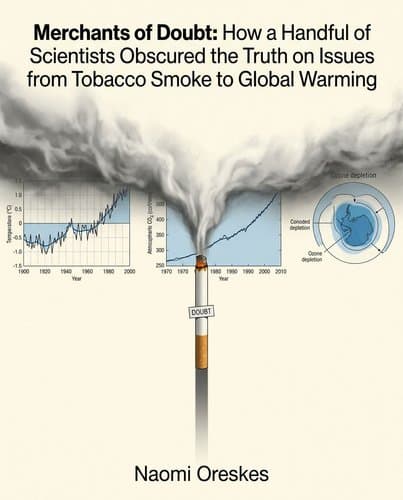
7799004_merchants-of-doubt
by Naomi Oreskes
The same handful of scientists who defended tobacco spent decades manufacturing doubt on acid rain, ozone depletion, and climate change—not because the…
In Brief
The same handful of scientists who defended tobacco spent decades manufacturing doubt on acid rain, ozone depletion, and climate change—not because the evidence was wrong, but because accepting it meant admitting free markets impose real costs on people who never chose them.
Key Ideas
Peer review trumps PR firm campaigns
When a scientific question appears 'controversial' in the press, check whether one side passed peer review and the other passed through PR firms. These are not equivalent, and journalists trained to present 'both sides' cannot always tell the difference.
Confidence thresholds protect manufacturers not victims
The 95% confidence standard is a social convention designed to prevent false positives. In public health contexts where prior evidence is already strong, demanding it is not rigor — it places the burden of proof on victims rather than manufacturers of harm.
Manufactured doubt persists across industries
'Doubt is our product' — a 1969 tobacco industry executive memo — is the most honest description of a strategy that ran continuously from cigarettes through acid rain, ozone depletion, and climate change, with many of the same personnel across decades.
Publishing venue determines credential validity
Watch where scientists publish. Credentialed experts who have largely stopped submitting work to peer-reviewed journals and shifted to op-eds, congressional testimony, and think tank reports are operating outside the system that makes their credentials meaningful.
Market failures create hidden public costs
Market failure — where industrial activity produces costs the market cannot account for — is the common thread connecting every issue in the book. Acknowledging tobacco harm, acid rain, ozone depletion, or climate change all required accepting that free enterprise can impose real costs on people who did not choose or benefit from it.
Consensus defines scientific knowledge production
Consensus of active, credentialed experts is the functional definition of scientific knowledge, not certainty. Dismissing the IPCC because one retired physicist disagrees is not healthy skepticism — it is a failure to understand how scientific knowledge is produced.
Who Should Read This
Science-curious readers interested in Climate Change and Scientists who want to go beyond the headlines.
Merchants of Doubt: How a Handful of Scientists Obscured the Truth on Issues from Tobacco Smoke to Global Warming
By Naomi Oreskes & Erik M. Conway
10 min read
Why does it matter? Because the scientific controversies you've read about were scripted.
By the time it was over, one climate scientist's marriage had not survived it. When you see a news story presenting "both sides" of a scientific question, you assume the disagreement is genuine — two camps of researchers divided by evidence. That assumption is exactly what a handful of men spent fifty years exploiting. The same four physicists — veterans of Cold War weapons programs, united by a conviction that free markets and freedom are inseparable — appeared on the wrong side of every major scientific controversy from the 1950s onward: tobacco, acid rain, the ozone hole, climate change. Not as researchers. As hired skeptics. They produced almost no original science during those decades. What they produced was doubt. By the end, every news story presenting "scientific controversy" will read to you less like reporting and more like a crime scene.
Doubt Is a Product — It Was Invented, Manufactured, and Sold
Scientific doubt looks like an honest signal — evidence not yet sufficient, conclusions still premature. That's what makes it so easy to manufacture. Once you understand that doubt can be produced on demand, packaged, and sold to the public, you cannot look at a "both sides" debate about science the same way again.
In 1953, the presidents of four major tobacco companies gathered at the Plaza Hotel in New York with John Hill, the founder of one of America's most powerful public relations firms. German and American scientists had already established the tobacco-cancer link. The industry knew it. Their own laboratories would confirm it again in the 1960s, and an internal document would describe the connection as having "long ceased to be an area for scientific controversy." Hill's advice was blunt: fund research, put the word "research" in the committee name, and ensure scientific doubt remained.
What followed was not a scientific program. It was a witness program. Over the next three decades, the industry funneled more than $100 million to hundreds of researchers at prestigious institutions, with every grant cleared not by a scientific committee but by the company's legal counsel. The point was stated plainly in one internal document: "Support over the years has produced a number of authorities upon whom the industry could draw for expert testimony in court suits." The goal was not to find truth. It was to generate people who could credibly deny it.
A 1969 internal memo named the strategy directly: "Doubt is our product, since it is the best means of competing with the 'body of fact' that exists in the minds of the general public." Not a discovery. Not a finding. A product. Engineered, distributed, and sold — and the same template was still running a quarter century later.
The Man Who Destroyed Ben Santer's Marriage Had Already Done This Before — With Cigarettes
At some point during the campaign — the Wall Street Journal op-ed, the letters to Congress, the pressure to get him fired — Ben Santer picked up a newspaper and read about the tobacco industry's long effort to manufacture doubt about the smoking-cancer link. The strategy, the article explained, was to "keep the controversy alive." As long as doubt existed, the industry was safe from litigation and regulation.
Santer recognized the method. Then he recognized the men. Frederick Seitz and Fred Singer, the two physicists leading the campaign against his chapter of the Intergovernmental Panel on Climate Change (IPCC) assessment, had both worked for the tobacco industry.
From 1979 to 1985, Seitz ran a biomedical research program for R.J. Reynolds Tobacco Company that distributed $45 million to scientists at universities and research institutions across the country. Every grant was cleared by company lawyers, not scientists. The purpose, made explicit in internal documents, was to generate expert witnesses for courtroom defense. Singer came later. In the mid-1990s, he co-authored a report attacking the EPA's conclusion that secondhand smoke was hazardous. It was funded by the Tobacco Institute, the tobacco industry's lobbying arm, channeled through a think tank called the Alexis de Tocqueville Institution.
The campaign against Santer was a practiced technique: the Journal op-ed, the congressional letters, the push to have him fired. Both men had run versions of it for cigarette companies. Santer spent years defending his reputation through official channels: a letter co-signed by twenty-nine colleagues, a formal IPCC defense from chairman Bert Bolin, an open letter from the American Meteorological Society. Those defenses were correct and well-documented. They were also mostly invisible, published in scientific journals and institutional bulletins while the original attack circulated in the Wall Street Journal.
He spent so much time and energy on this that his marriage did not survive it.
The strategy had a new client. It didn't need new operators.
The Fraud Left a Paper Trail — Literally, in the Fraudsters' Own Filing Cabinets
The men who ran these campaigns left evidence everywhere. Not because they were careless — because they were confident the documents would stay in the cabinet.
In April 1984, the Reagan White House received the final version of a scientific peer review panel's report on acid rain. William Nierenberg, the panel chair, had assembled eight distinguished scientists (six of them members of the National Academy of Sciences), and their conclusion was unambiguous: cut emissions now, even before every scientific detail was resolved. The report was ready. The congressional subcommittee vote on acid rain legislation was scheduled for May. The report was not released until August — after that vote failed, 10 to 9.
Three panelists independently confirmed, in separate letters, that the Executive Summary they had authorized was not what went out. The opening paragraph stating that acid rain's source was "traceable to man-made sulfur dioxide" had been buried near the end. Two rounds of changes had been made without the panel's knowledge. When the story broke in Science magazine, Nierenberg insisted the panel had been "making changes right up to mid-July." Atmospheric chemist Kenneth Rahn responded with a three-page, single-spaced letter laying out the timeline: the final report was finished in March, sent to the White House in April, and nothing the panel had authorized matched what emerged in August. "Tampered with," he wrote, "may not be too strong."
The case didn't rest on the panelists' memories alone. Nierenberg's own papers contained a second copy of the altered Executive Summary, transmitted by the White House's senior policy analyst on May 21. On this copy, someone had written the date by hand: 7/10/84. Next to it, a marginal note: Changes wanted by Keyworth. George Keyworth was Ronald Reagan's science advisor.
The document is not an allegation. It is a receipt, filed by one of the men who accepted the delivery.
The same documentary precision appears in the climate case. Roger Revelle, the oceanographer whose 1957 research first established that human carbon emissions could accumulate in the atmosphere and warm the planet, was 81 and recovering from triple bypass surgery when Singer drafted a climate paper under his name. The galley proofs show Singer asserting that warming would be less than one degree Celsius, too small to distinguish from the natural swing of year-to-year variation. Revelle crossed it out and wrote in the margin: "one to three degrees," the mainstream scientific consensus. Singer published the paper without the numbers; the published version advised against near-term action on grounds that warming remained too uncertain to justify the economic cost. When Revelle died months later, the paper was used in a presidential campaign to attack Al Gore, credited to Revelle rather than Singer.
The margin notes are in Revelle's handwriting. The filing cabinet is Nierenberg's. The memos are dated and signed. These men operated through the normal channels of American science and politics. They were not trying to conceal anything. They had no reason to believe anyone would ever be permitted to look.
Demanding 95% Certainty Is a Public Health Choice, Not a Scientific Law
When the EPA released its 1993 assessment finding that secondhand smoke caused lung cancer in nonsmokers, Singer attacked the finding on statistical grounds.
Imagine applying the criminal standard (beyond reasonable doubt) not to a person on trial, but to a chemical. The presumption of innocence belongs to the substance: innocent until proven guilty, with victims required to establish harm to a level of certainty that working scientists rarely achieve. The manufacturer waits while the case is built.
Singer's objection built exactly that structure. His central complaint, that the EPA had accepted a 90% confidence threshold rather than the conventional 95%, sounds like a demand for rigor. It was a demand for a specific kind of error.
The 95% standard exists to minimize Type 1 errors: false positives, concluding an effect is real when it isn't. In early-stage science, or in criminal law where the state can imprison citizens, this caution makes sense. But it generates Type 2 errors — real effects that go undetected because the bar is too high. In public health, a Type 2 error isn't a missed opportunity. It's people being harmed while the evidence accumulates. Demanding the courtroom standard in a public health context doesn't neutralize the burden of proof. It shifts it onto the victims.
The nine physicians and PhD scientists on the EPA's independent review panel did not criticize the 90% threshold. Their objection ran the other direction: the report had been too conservative, particularly on the dangers to children. They saw no need to address the confidence level because they understood what Singer chose to obscure: when twenty-four of thirty independent studies show increased cancer risk with increased exposure, and the odds of that pattern occurring by chance are less than one in a thousand, consistency is the standard, not an arbitrary cutoff. Demanding 95% at that point is not scientific caution. It is a professional's deliberate use of methodology to manufacture a result.
Every Campaign — Tobacco, Acid Rain, Ozone, Climate — Was the Same Fight Over Whether Markets Can Fail
Why would the same small group of retired physicists — men with no financial stake in tobacco, no connection to the coal industry, no shares in chemical companies — show up in every major scientific controversy of the last half century? The tobacco campaigns, acid rain, ozone depletion, climate change: different industries, different products, different decades. Yet the same names appear in each. The explanation isn't coordination for hire. It's ideology.
Fred Singer named it himself, without meaning to. Sherwood Rowland and Mario Molina had published their mechanism in 1974: chlorofluorocarbons released at ground level drift up to the stratosphere, where ultraviolet radiation breaks them apart, freeing chlorine atoms that catalytically destroy ozone molecules. By the early 1980s the evidence was solid: satellite data, ground measurements, laboratory confirmation. Singer didn't dispute the chemistry. He wrote that the scientists involved "probably have hidden agendas of their own — not just to 'save the environment' but to change our economic system." When defending the tobacco industry on secondhand smoke, he made the same move: without carefully limiting government's role in regulating harm, "there is essentially no limit to how much government can ultimately control our lives." Read those sentences again. He is not talking about chlorofluorocarbons or nicotine. He is talking about whether government can intervene in markets at all.
That is the thread connecting every campaign in this book. Tobacco causes cancer: the government should regulate cigarettes. Acid rain damages forests: the government should cap sulfur dioxide emissions. The ozone layer is thinning: the government should phase out CFCs. The climate is warming: the government should constrain carbon. Each finding, if accepted, required the same institutional response: market activity producing costs that the market itself could not fix, forcing government to step in. Economists call these "negative externalities." For Seitz, Singer, Nierenberg, and Jastrow, they were something worse — proof that free markets fail. And to men who had spent the Cold War equating capitalism with freedom itself, accepting market failure was accepting socialism.
The abstraction collapses when you place it in context. These were physicists who came of age in weapons programs funded by the federal government, who built careers in agencies created by federal appropriations, who then argued, in the pages of the Wall Street Journal and in letters to Congress, that environmental regulation was the first step toward Soviet-style collectivism. "Watermelon," a phrase Singer used in his public writings to describe environmentalists, captures the logic exactly: green on the outside, red on the inside. Revelle, in an earlier exchange with colleagues, was asked about Nierenberg's politics. He replied simply: "Bill Nierenberg thinks the whole New Deal was a mistake, no kidding."
So the campaigns were never really about tobacco, or acid rain, or ozone. They were about a prior commitment: that the verdict on free markets must not change, regardless of what the science finds.
Scientific Controversy and Manufactured Controversy Are Not the Same Thing — Here Is How to Tell Them Apart
Frederick Seitz stopped doing original scientific research around 1970. After that, letters and book reviews. Fred Singer followed the same arc: geophysics gave way to Wall Street Journal op-eds on oil resources, a field with no connection to his training. Neither man was conducting science during the decades he contested it. They had left the institution that tests claims. No peer review, no vetting, no mechanism by which their assertions could be falsified. Claiming expertise in every field is itself a form of fraud; genuine specialists know the limits of their training.
When you buy a house, you hire someone to search the property title. You cannot verify their work; the records are arcane and you lack the training. You trust them not because you can check it but because there is no workable alternative. Science works the same way: the public cannot assess competing claims about ozone chemistry or climate models directly. The question is not whether to trust experts but which experts deserve that trust — those actively submitting claims to peer review, or retired physicists writing op-eds on topics outside their field.
The doubt-merchants were not wrong that science involves uncertainty — it always does. What they exploited was the gap between the certainty the public expects and the uncertainty science actually delivers. Genuine scientific controversy happens inside peer review: competing hypotheses, submitted evidence, judgment by credentialed specialists. Manufactured controversy happens outside it, in op-eds and congressional letters that skip the vetting entirely. When the IPCC assembled thousands of working scientists to assess climate evidence and a handful of retired physicists responded with a Journal letter, those were not two sides of a scientific debate. One was the title search. The other was someone disputing the results without having done the work. When Justin Lancaster tried to say so publicly, Singer sued him into a decade of silence.
S.J. Green, director of research for British American Tobacco, eventually admitted what the doubt-merchants always knew: demanding proof "is always a formula for inaction and delay, and usually the first reaction of the guilty." They understood exactly what they were doing. Now so do you.
What Nierenberg Knew in His Heart
In an unguarded conversation, Nierenberg said what the physics made obvious: that 25 million tons of sulfates over the Northeast would cause damage. This from the man who held up his panel's acid rain report until the congressional vote was over, who accepted White House edits without telling his co-panelists. He knew.
That gap isn't ordinary hypocrisy. What Nierenberg and the others practiced was stranger: a prior commitment strong enough to make a demonstrated fact feel like an ideological concession. Accepting market failure meant accepting that the system they had spent careers defending was flawed. The science wasn't the problem. It was the threat.
The acid rain vote failed 10 to 9. Had the panel's conclusions reached Congress on schedule — before White House staff removed them — it might have gone the other way. The distinction between genuine scientific uncertainty and manufactured doubt costs nothing to make. Failing to make it costs everything. Nierenberg knew the difference. He said so, once, in private. Then he went back to work.
Notable Quotes
“Does cigarette smoking cause lung cancer?”
“Does direct cigarette smoking cause lung cancer?”
“you mean a population base or epidemiologic risk factor, then cigarette smoking is related to certain types of lung cancer. If you mean: In a particular individual is the cigarette smoking the cause of his or her cancer? Then … it is difficult to say”
Frequently Asked Questions
- What is Merchants of Doubt about?
- Merchants of Doubt documents how a small network of industry-funded scientists ran a deliberate campaign to manufacture public uncertainty on tobacco, acid rain, ozone depletion, and climate change. Published in 2010 by Naomi Oreskes and Erik M. Conway, the book reveals how the same playbook succeeded across decades, with many of the same personnel involved in different controversies. Rather than genuine scientific debates, these represented coordinated efforts to create controversy where scientific consensus already existed. The book teaches readers to distinguish legitimate scientific debate—conducted through peer-reviewed journals—from manufactured controversy created by industry funding and PR campaigns.
- What does 'doubt is our product' mean?
- "Doubt is our product" was a 1969 tobacco industry memo describing a deliberate strategy of manufacturing uncertainty. The book presents this as "the most honest description of a strategy that ran continuously from cigarettes through acid rain, ozone depletion, and climate change, with many of the same personnel across decades." The goal was not to prove products safe but to keep public opinion divided and delay action. This approach proved so effective that the same tactics were repeatedly deployed across different products and environmental controversies, always using identical methods of manufacturing public doubt and delaying regulatory response.
- How do you identify when science is being misrepresented in public debate?
- Pay attention to where scientists publish. When a scientific question appears "controversial" in the press, "check whether one side passed peer review and the other passed through PR firms. These are not equivalent." Watch where credentialed experts publish: those who have "largely stopped submitting work to peer-reviewed journals and shifted to op-eds, congressional testimony, and think tank reports are operating outside the system that makes their credentials meaningful." Real scientific debate occurs in peer-reviewed journals with rigorous expert scrutiny. When prominent credentialed figures abandon peer review for opinion pieces and congressional testimony, they are no longer operating within the scientific community proper.
- Why is scientific consensus important even when some scientists disagree?
- "Consensus of active, credentialed experts is the functional definition of scientific knowledge, not certainty." This matters because dismissing consensus due to individual skeptics misunderstands how science works. "Dismissing the IPCC because one retired physicist disagrees is not healthy skepticism — it is a failure to understand how scientific knowledge is produced." Scientific knowledge emerges through rigorous peer review and expert consensus, not individual certainty. The 95% confidence standard prevents false positives. In public health contexts where prior evidence is strong, demanding the highest standard places "the burden of proof on victims rather than manufacturers of harm."
Related Book Summaries

Read the full summary of 7799004_merchants-of-doubt on InShort