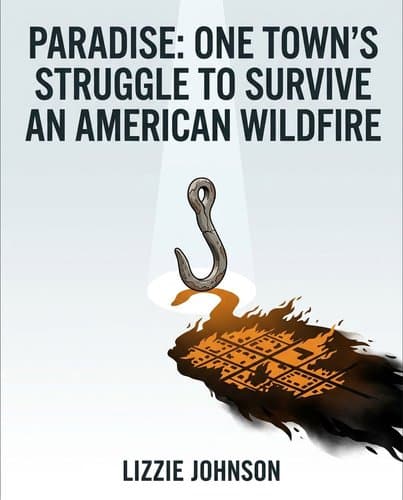
56024292_paradise
by Lizzie Johnson
A $19 replacement part could have saved 84 lives — but PG&E hadn't physically inspected the line in seventeen years. Paradise dismantles the myth of the…
In Brief
A $19 replacement part could have saved 84 lives — but PG&E hadn't physically inspected the line in seventeen years. Paradise dismantles the myth of the "natural" disaster, revealing how corporate neglect, broken evacuation plans, and decades of normalized risk quietly assembled America's deadliest wildfire.
Key Ideas
Demand utility publication of inspection records
PG&E's Caribou-Palermo line had not been physically climbed for inspection since 2001 — seventeen years before the fire. The hook that failed was worn to one-eighth of an inch thick; a replacement would have cost $19. Residents and regulators near wildland-urban interfaces should demand that utilities publish inspection records for aging transmission infrastructure, not just outage logs.
Eighty-two percent of residents unwarned
Emergency alert systems in most U.S. counties are opt-in, partial, or both. In Paradise, roughly 82 percent of residents received no official evacuation warning. Enroll in your county's alert system and treat enrollment as a floor, not a ceiling — assume most of your neighbors have not done the same.
Evacuation bottleneck documented but ignored
Paradise's evacuation capacity was documented at 3,700 vehicles per hour under ideal conditions in a 2002 Public Works memo that no leader acted on. Road design, development density, and evacuation route decisions are life-safety decisions made on your behalf, often without public input. Attend local planning meetings when evacuation infrastructure is on the agenda.
Increase per-death statutory negligence penalties
The maximum criminal fine for 84 deaths under California law was $3.48 million — less than 18 hours of PG&E's 2017 revenue. Statutory penalties for corporate negligence that causes mass casualties function as operating costs, not deterrents. Advocacy for higher per-death statutory caps in utility negligence cases is direct, concrete policy action.
Prescribed burn legislation removes permitting barriers
A century of aggressive fire suppression prevented the low-intensity burns that Indigenous peoples used to reduce fuel loads; the result is forests so overgrown that 20 million California acres now need prescribed burning. Supporting prescribed burn legislation — which removes permitting barriers — is one of the most direct civilian actions on wildfire prevention, separate from the utility accountability question.
Who Should Read This
History readers interested in Climate Change and Ecology who want a deeper understanding of how we got here.
Paradise: One Town's Struggle to Survive an American Wildfire
By Lizzie Johnson
10 min read
Why does it matter? Because the Camp Fire wasn't a natural disaster — it was a paper trail.
We file wildfires under "natural disaster" because that category has no perpetrators. Wind is not indictable. Drought does not appear in court. The Camp Fire killed 84 people in a single morning in November 2018 — and a corporation pled guilty to killing them, then paid a fine of roughly 20 cents per customer. That tension is what this book lives in. Lizzie Johnson reconstructs the Camp Fire not as weather event but as assembly: a 22-cent hook bought in 1919, last climbed for inspection in 2001, worn to a thread before it snapped at dawn and started a fire that spread faster than a person can run. She follows the paper trail back through corporate negligence, civic complacency, and a century of misguided fire policy. By the end, "natural disaster" will feel like an alibi.
An Ordinary Thursday Morning, and Every Condition for Mass Death Was Already in Place
At 5:30 on the morning of November 8, 2018, Captain Matt McKenzie woke to pine needles pinging against Station 36's tin roof. He shuffled to the kitchen, pulled vegetables from the fridge, and started slicing red potatoes for the crew's breakfast. Outside, the anemometer registered 32 mph winds gusting to 52. The emergency radios were muted — he'd silenced them the night before so he could sleep.
McKenzie had spent more than two decades with Cal Fire, California's state wildfire agency, learning to read disaster before it arrived. He had one fixed instinct: the worst doesn't announce itself. His station sat at 2,200 feet above the Feather River Canyon, a sixty-mile chasm that funneled seasonal winds directly toward the towns above. In twenty-five years, flames had ravaged Butte County's foothills 103 times.
Butte County had received 0.88 inches of precipitation since May 1, a record. Live fuel moisture in manzanita stood at 74 percent against a November historical average of 93. A five-year drought had already killed 150 million trees across California, their dried husks layered across every slope beneath fresh-fallen needles. The previous ten months were the fourth warmest in 120 years of state records, following a July measured as the hottest in history. By noon, humidity was forecast to hit 5 percent — drier than the Sahara.
The Jarbo Winds rattling McKenzie's windows were a known annual event: a high-pressure mass spilling west over the Sierra Nevada, funneling through the canyon below. What was different this year was timing: the winds normally follow the rains, and the rains had not come. McKenzie's cellphone rested face-up on the counter. His knife clipped the butcher block. The anemometer whirred outside.
A 22-Cent Hook, Last Inspected in 2001, Was the Final Link in a Chain of Deliberate Choices
The Camp Fire had a specific cause, and it could have been prevented for $19.
Tower 27/222 stood on the Caribou-Palermo transmission line, a web of steel and wire designed in 1917 and put into service on May 6, 1921, three months after Prohibition began. For nearly a century, it had carried 115 kilovolts across the Feather River Canyon. By November 2018, no one had physically climbed it for inspection in seventeen years. Aerial passes (helicopters skimming overhead once a year) had replaced the three-ground-patrols-and-5%-tower-climb schedule from 1987. Within PG&E's siloed maintenance structure, the small iron hooks connecting cables to towers belonged to neither the tower division nor the line division. No one owned them. So no one checked them.
The hook that failed had been purchased for 22 cents in 1919. A replacement in 2018 would have cost $19. Failure analysis later found wear consistent with ninety-seven years of metal rotating against metal, a process so gradual it required no dramatic event, no storm, no extraordinary circumstances. Just time, and the choice not to look. When the hook snapped at 6:15 a.m. on November 8, it was less than one-eighth of an inch thick — the width of a ballpoint pen tip.
PG&E had been warned, fined, and convicted before. In 1994, internal audits showed the company had diverted $77.6 million from its tree-trimming budget into corporate profits. A poorly maintained line sparked the Trauner Fire; prosecutors charged 739 counts of criminal negligence. The fine was $24 million. Sixteen years later, a natural gas pipeline designed incorrectly in 1956 ruptured under a San Bruno neighborhood, killing eight people and gouging a seventy-two-foot crater in the street. Fines exceeded $1.6 billion. In 2017, one year before the Camp Fire, PG&E equipment caused seventeen of the twenty-one wildfires that burned through California's North Bay wine country. The state's penalty for all seventeen: $3.48 million, the equivalent of eighteen hours of PG&E's daily net revenue.
At 6:15 a.m. on November 8, the hook tore from its fitting. A 143-pound braided aluminum wire fell forty-seven feet. Electricity arced at 10,000 degrees Fahrenheit. Molten metal droplets sprayed into the dry grass below. The fire took hold and spread: one football field per second, an area the size of Central Park consumed every eight minutes. A $19 part, never ordered. A hook no one had looked at since 2001.
The Emergency System Built to Warn 26,500 People Reached Fewer Than 5,000
At 8:10 a.m., Paradise's police chief called Town Manager Lauren Gill with a direct message from Cal Fire: evacuate the entire town. Gill had run the town since 2013, earning nearly $180,000 a year to make exactly this call. Her answer was immediate: "No, we aren't going to do that." Her hesitation had a real logic. In 2008, a partial evacuation had jammed 10,000 residents onto a single road crawling at 4 mph; a full evacuation could create the same death trap. She called Fire Chief Hawks for confirmation. He said he didn't want to evacuate the whole town, but "it's bad." She still waited. The fire was moving at six miles per hour.
By the time IT contractor Josh Marquis sent the first CodeRed alert at 8:44 a.m., more than thirty minutes after the police chief's call, it covered fewer than half of Paradise's fourteen zones. A second alert at 9:09 a.m. reached 2,765 phone numbers, but 42 percent were never delivered: the telecom network was already failing under the volume. Then the Comcast internet line cut out. AT&T landlines followed minutes later. Marquis tried to send a third alert; CodeRed ran on the Comcast line, which was already down. IPAWS, the federal system that pushes emergency notifications to every cellphone in an area regardless of registration, had failed earlier that morning due to an undetected software error. Gill and retired fire chief George Morris, who had come in to help coordinate, fled Town Hall through fire burning on both sides of the Skyway before they could send alerts to the final six zones along Butte Creek Canyon.
Final count: 4,855 phone numbers reached out of a population of 26,500. Approximately 82 percent of Paradise residents received no warning from any system — each one failing in a different, documented way, all at once.
Paradise Was Designed to Trap Its Residents Before the Fire Ever Arrived
In 2002, a municipal Public Works memo calculated the hard limit: under ideal conditions, the town's four main routes could move at most 3,700 vehicles per hour out of Paradise, and at least one road would almost certainly close during any real fire event. The math was on file. Paradise's population was 26,500.
In 2014, the Town Council voted unanimously to narrow the Skyway, the primary artery, from four lanes to two. A Bay Area engineering firm hired for the project explicitly warned against raised medians and traffic-calming "improvements." The council installed flowers and benches instead. No one who voted that day intended harm. But the record shows the critical calculation was never made, or was made and set aside: what happens to a town of 26,500 people when their single exit road shrinks — and a fire arrives moving at six miles per hour?
On November 8, 2018, the answer became visible from the air. One hundred and seventy-nine vehicles burned out on Paradise's roadways, blocking the routes behind them. The California Highway Patrol later recovered nineteen thousand more cars, boats, and recreational vehicles across the wider fire zone — the accumulated wreckage of a population trying to escape through infrastructure that had been quietly dismantled. The Camp Fire didn't create the trap. It revealed one that had been under construction for years, dressed in civic flower beds and built with unanimous votes.
The People Who Saved Lives Were Not the People Who Were Supposed To
Bus driver Kevin had never met these children before that morning. By the time he was trapped on Roe Road, carbon monoxide was putting them to sleep in their seats, some slumping, some slack-jawed, their lips chapped white. No water, no medical equipment, no first responder within reach. So he stripped off his polo, pulled off the undershirt beneath it, and handed it to second-grade teacher Mary Ludwig. Tear it into twenty-two squares, he said. We'll wet them and hold them over our mouths.
First-year kindergarten teacher Abbie Davis had a single half-full water bottle — the only liquid on the bus. She dampened each rag and walked the aisle, pressing them into twenty-two pairs of small hands. When the water ran out, Mary climbed off the bus into the smoke and begged from strangers. A tattooed man in his twenties searched his floorboards and found two crumpled, nearly-empty bottles. An older man hosing his own roof eventually handed her a half-case. That was the water supply: strangers with nothing to spare.
Abbie had already lost one fiancé (he drowned in a riverboating accident), and the man who had given her a second chance at that kind of love was at that moment parked outside their house on a nearby street, refusing to leave until the bus passed his driveway. At the back of the bus, Abbie and Mary sat together in the dark, gripping each other's hands hard enough to leave nail marks in each other's palms, and prayed aloud: Please, let the smoke kill us first. Not an abstract plea. Smoke meant unconscious; fire meant aware of it.
The bus got out. But nothing that saved those children was designed to — not the improvised masks, not the strangers' bottles, not the two teachers who had made their peace with dying before leading twenty-two children out alive.
The bus was not the only place where ordinary people were filling in for the systems that had failed. Three miles away, garbageman Dane Cummings was finishing his Thursday route when he found ninety-three-year-old Margaret Newsum standing in her doorway — pink T-shirt, walker, garage door sealed because the power was out, caretaker stranded in Chico. He threw her over his shoulder, carried her to his trash truck, and hung her walker off the back. "It's against your company rules to have a passenger," she told him. "I don't care," he said. "I'm not going to leave you here to die."
The Camp Fire killed eighty-five people. The ones who survived often did so because a bus driver gave up his undershirt, or because a garbageman refused to end his route. These were not the systems Paradise had built. They were what was left when those systems ran out.
Eighty-Four Guilty Pleas, a $3.48 Million Fine, and No Individual Ever Charged
The American legal system is not designed to price 84 deaths. It can name them. In June 2020, Butte County Superior Court judge Michael Deems read each victim's name and manner of death aloud while their photograph was projected on the courtroom wall. Shirlee Teays, 90, found clutching a framed photograph. TK Huff, 71, facedown in his garden, having crawled ten feet from his wheelchair. After each name, PG&E CEO Bill Johnson responded from behind a lectern: "Guilty, Your Honor." The ritual lasted half an hour, 84 repetitions, accountability made ceremony.
Among those photographs: Matilde Heffern, 68, her daughter Christina, and her granddaughter Ishka. They died in a bathtub in Paradise. Matilde called 911. "Are we going to die?" she asked. The line went silent. What remained of three generations fit into a small clear bag of bone shards. District Attorney Mike Ramsey played the 911 recording for PG&E's board. Sheriff Kory Honea showed them the photograph of the bag.
The maximum criminal fine for those 84 deaths: $3.48 million. Roughly $41,000 per life. In 2017, PG&E netted $4.6 million in revenue every single day.
California law allowed $10,000 per human life, and the court used it. Not an error, not a misapplication: the statute, correctly applied. Former CEO Geisha Williams, who had resigned with $2.5 million in severance, listed her Tiburon mansion for sale that same June, as PG&E entered its guilty pleas and Deems read 84 names aloud. She stood to earn $4.7 million on the transaction: more than the total criminal penalty for 84 deaths.
Ramsey investigated charging individual executives but ran into a structural barrier: many of the decisions that let Tower 27/222 go uninspected for seventeen years dated to the 1980s and 1990s. The chain of negligence was too long, too diffuse, too successfully buried in corporate layers for any individual to be held responsible under California's burden of proof. No person was charged. PG&E admitted guilt 84 times, paid the equivalent of eighteen hours of its own revenue, and emerged from bankruptcy restructured and operational.
The three forces Johnson identifies as the fire's deeper causes — a century of fire suppression that converted the landscape into fuel, development patterns that placed 2.7 million Californians on flammable land, a warming climate that made the conditions of November 8 routine — faced no legal accounting at all. The law could name the deaths. It had no mechanism for addressing what made them inevitable.
The Assembly Is Already Underway Somewhere Else
In September 2020, Paradise received another evacuation warning. The North Complex Fire. Same canyon winds, same tinder-dry slopes, same roads narrowed for aesthetics. The hook that started the Camp Fire had gone uninspected for seventeen years. The maximum the law could extract for 84 deaths was $3.48 million — what PG&E earned in eighteen hours. No individual was ever charged. The forests are still overgrown. The statutory caps haven't changed. The assembly of uninspected hardware and narrowed roads and uncleared forest is already underway somewhere else. What Johnson leaves you with isn't grief — it's the awareness that a wildfire is a ledger, and someone is entering figures into it right now, in your county, at your utility, in a town council meeting you didn't attend. The question isn't whether the next fire is coming. It's whether you've read the paper trail.
Notable Quotes
“A half hour later, after acknowledging PG&E's guilt eighty-four times, Johnson read from a printed statement. He could never take away the pain felt by the many thousands of people who had been harmed by the Camp Fire, he said. PG&E was”
“for the fire and its”
“To some, the words sounded awfully similar to those uttered by a former CEO after the 2010 San Bruno explosion.”
Frequently Asked Questions
- What is Paradise: One Town's Struggle to Survive an American Wildfire about?
- Paradise reconstructs the 2018 Camp Fire as a systemic failure built over decades. The book examines how aging utility infrastructure, inadequate evacuation planning, and a century of fire suppression converged in one morning to create a preventable catastrophe. Through detailed investigation, Lizzie Johnson shows how normalized tolerance for risk across corporations, regulators, and local government produced this disaster. The work equips readers to identify similar vulnerabilities in their own communities, focusing on specific failures in emergency systems, infrastructure maintenance, and land management policy.
- What does Paradise reveal about corporate negligence in the Camp Fire?
- The book documents how PG&E's aging transmission infrastructure failed catastrophically due to decades of deferred maintenance. "PG&E's Caribou-Palermo line had not been physically climbed for inspection since 2001 — seventeen years before the fire." The hook that failed was worn to one-eighth of an inch thick; a replacement would have cost $19. Statutory penalties for corporate negligence function as operating costs rather than deterrents—the maximum criminal fine for 84 deaths under California law was $3.48 million, less than 18 hours of PG&E's 2017 revenue.
- What were the major systemic failures that enabled the Camp Fire?
- Paradise identifies three critical systemic failures that converged to enable the disaster. Emergency alert systems were opt-in or partial, leaving approximately 82 percent of Paradise residents with no official evacuation warning. The town's evacuation capacity was documented at 3,700 vehicles per hour in a 2002 memo that no leader acted upon. A century of aggressive fire suppression prevented low-intensity burns that Indigenous peoples used to manage forests, resulting in overgrown forests requiring prescribed burning to reduce fuel loads.
- What specific actions can communities take based on Paradise's findings?
- Paradise offers concrete, actionable recommendations for disaster prevention. Communities should demand that utilities publish inspection records for aging transmission infrastructure, not just outage logs. Residents should enroll in their county's emergency alert system and encourage neighbors to do the same, recognizing enrollment as foundational rather than comprehensive protection. Attending local planning meetings when evacuation infrastructure is discussed directly influences life-safety decisions. Supporting prescribed burn legislation that removes permitting barriers represents one of the most direct civilian actions on wildfire prevention.
Related Book Summaries


Read the full summary of 56024292_paradise on InShort