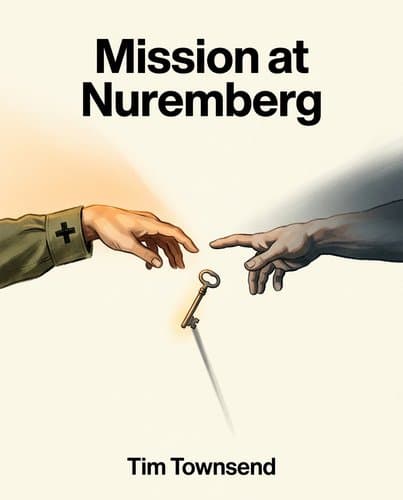
21420139_mission-at-nuremberg
by Tim Townsend
A humble Lutheran chaplain ministered to Hermann Göring and the other Nuremberg defendants, forcing a collision between Christian grace and the Holocaust's…
In Brief
A humble Lutheran chaplain ministered to Hermann Göring and the other Nuremberg defendants, forcing a collision between Christian grace and the Holocaust's incomprehensible evil. Townsend asks whether forgiveness can—or must—extend even to history's worst criminals, without ever letting either theology or atrocity off the hook.
Key Ideas
Grace and Accountability Can Coexist
Extending grace to someone is not the same as excusing what they did — Gerecke's refusal to commune Goering while whispering scripture into his dying ear holds both things at once, and neither cancels the other
Forgiveness and Teshuva Remain Fundamentally Incompatible
The Christian framework of forgiveness (a gift that can precede repentance) and the Jewish concept of teshuva (which requires seeking pardon from the victim) are genuinely incompatible at the scale of the Holocaust — and any honest reckoning with Nuremberg has to hold that tension rather than resolve it
Ordinary People Committed the Holocaust
Calling evil people 'monsters' is not moral seriousness — it is a way of avoiding the recognition that ordinary human beings committed the Holocaust, which is the more disturbing and more useful truth
Character Revealed by Treating the Unredeemable
The most revealing question about someone's character is not how they treat the powerful but how they treat those the world has decided are beyond redemption — Gerecke's prison ministry in St. Louis, Nuremberg, and Chester was the same work in different buildings
Acting on Incomplete Spiritual Evidence
Verifying a spiritual conversion is impossible, which means any pastor working with people who have committed atrocities must decide whether to act on incomplete evidence — Gerecke's willingness to do that, knowing he might be wrong, is what the book ultimately asks the reader to evaluate
Who Should Read This
History readers interested in World History and Military History who want a deeper understanding of how we got here.
Mission at Nuremberg
By Tim Townsend
11 min read
Why does it matter? Because the most morally serious response to radical evil may not be condemnation — it may be the far more uncomfortable act of refusing to stop seeing monsters as human beings.
Imagine a portly Missouri pastor walking into a cell and offering his hand to Hermann Goering. Not reluctantly. Deliberately. That handshake — which scandalized Americans who read about it — is the center of gravity around which this entire book orbits. Because what Henry Gerecke was doing at Nuremberg wasn't just pastoral care. It was a theological wager: that grace has no exemption clause, that the offer of redemption must be extended even — especially — to the men who built the machinery of the Holocaust. Some accepted. Fritz Sauckel wept through communion; Goering sent Gerecke's Bible back unsigned. And the question that lingers long after the last execution isn't whether they deserved it. It's what it cost Gerecke to keep offering it anyway — and what it reveals about the rest of us that we find the whole thing uncomfortably hard to watch.
The Man History Sent to Nuremberg Was Precisely the Wrong Person for the Job
On a November morning in 1945, a fifty-two-year-old Army chaplain named Henry Gerecke sat on a bench outside a bombed-out Munich hospital and prayed harder than he ever had in his life. The question in front of him was whether he would agree to minister to the men who had run the Third Reich — the architects of a war that had killed tens of millions — while they awaited trial at Nuremberg. His commanding officer had given him the choice: go to the Nuremberg prison, or go home to his wife, whom he hadn't seen in two years.
Gerecke was not a glamorous figure. He'd been expelled from Concordia Seminary in St. Louis for marrying Alma Bender, a city girl from a family that worked in a brewery — not the kind of woman the Missouri Synod had in mind for its future ministers. He finished his theological training privately, under a single supervising pastor. His career never recovered its lost prestige. Instead of a respectable urban pulpit, he ended up running a Depression-era salvage operation that employed the destitute, and spending his Sundays conducting five to eight services a day in jails, psychiatric wards, and hospitals across St. Louis. He learned, in those years, how to sit next to people the rest of the world had written off — murderers, addicts, the severely mentally ill — and speak to them without flinching.
Then the Army sent him to England with the 98th General Hospital, where he ministered to thousands of soldiers evacuated from the Normandy front. When the war in Europe ended and the unit moved to Munich, Gerecke visited Dachau — eleven miles from his hospital — multiple times. Standing beside the crematoriums, he kept asking the same question in a soft voice: how could they do something like this? He never answered it. Whatever happened to him there, he kept it inside.
When the OSS came to him and asked him to use the confessional to extract intelligence from German prisoners he was already ministering to, he refused. The seal of confession held even against the claims of national security. That refusal wasn't heroic posturing — it was a man who had spent his entire adult life inside institutions of confinement deciding exactly where the line fell between service and betrayal of trust.
The Decision That Changed Everything Was Made on a Park Bench, Not a Battlefield
What does it actually take to walk into a cell and extend your hand to Hermann Goering? Not metaphorically — physically, your hand, his hand, the man who signed the order that set the Holocaust in motion. That question is the real story of how Henry Gerecke ended up at Nuremberg, and the answer has almost nothing to do with duty.
Sitting on a bench outside the Munich hospital, what Gerecke felt wasn't a calling — it was revulsion. He imagined being close enough to these men to feel their breath on his face. He imagined having to touch them.
What broke the impasse wasn't an order or an argument about the Geneva Convention. It was a single scene from the Gospel of Luke: two criminals crucified alongside Jesus at Golgotha, one of whom turns and asks simply to be remembered. Jesus tells him they'll be together in paradise before the day is out. For Gerecke, who had spent decades sitting next to people the world had abandoned — murderers in the St. Louis jail, men in psychiatric wards, soldiers gutted by Normandy — this was a recognizable situation. Unforgivable sin. Unreserved grace. He had preached exactly this his entire career, mostly to audiences no one else wanted. Now the logic of it was asking something he hadn't anticipated: that he actually believe it.
He walked back in and said he'd go. A few weeks later he was in a Nuremberg prison cell, shaking Goering's hand, while the former Reichsmarshal clicked his heels, bowed slightly, and offered him the only chair. Gerecke knew Goering was performing. He sat down anyway. He was a portly Missouri pastor in a city that was still 91 percent rubble — 30 million pounds of it, 30,000 corpses still underneath — sent to find lost sheep among the men who had caused the slaughter. The absurdity of it doesn't diminish what it cost him to be there.
Goering Walked Into Chapel Every Sunday and It May Have Meant Nothing
Goering attended chapel every Sunday at Nuremberg, and his reason was nakedly transactional. When Gerecke first entered his cell, the former Reichsmarshal — recently stripped of the pills and the power that had defined him for a decade — immediately calculated that a visible spiritual conversion could help his case. He even recruited the paranoid, barely coherent Rudolf Hess to join him, apparently reasoning that two Nazis singing hymns looked better than one. The man who had signed the paperwork setting the Holocaust in motion was treating chapel attendance as reputational currency.
The contrast Townsend builds against this is Fritz Sauckel — the labor chief who had conscripted nearly five million foreign workers in a single year under conditions that killed hundreds of thousands of them. When Gerecke arrived in his cell, Sauckel clutched the chaplain's arms and immediately asked how to prepare for Communion. Their sessions ended the same way every time: both men on their knees on a stone floor beside the steel cot. When Sauckel finally took Communion, he cried out so loudly that guards from the entire floor came running. He was kneeling when Gerecke arrived and, by the chaplain's account, crawled the last few feet to the communion kit. Whether this was genuine transformation or the performance of a man who had spent years deploying practiced phrases for precise situations — the book cannot quite say, and neither could Gerecke.
That uncertainty is the most honest thing in the book. Gerecke's success metric was invisible. He was trying to determine whether something had shifted inside men who were consummate survivors, trained manipulators, and facing death — the conditions most likely to produce exactly the kind of desperate, searching behavior that resembles repentance without being it. He admitted he couldn't always tell the difference. His criterion for communion was not emotion or tears but whether a man genuinely accepted Christ as savior. He believed Sauckel did. He ultimately concluded that Goering, despite a year of Sundays, did not — and denied him the sacrament in their final meeting, hours before the scheduled execution.
He spent the rest of his life uncertain whether he had been a pastor at Nuremberg or a mark, and the question had no answer.
What the Nazis Sang on Christmas Eve 1945 Is the Most Disturbing Scene in the Book
Think of a photograph with two exposures on the same frame: two completely different images occupying the same physical space, neither canceling the other, both demanding to be seen simultaneously. That is what Tim Townsend does with Christmas Eve, 1945, at Nuremberg, and it is the most morally uncomfortable passage in the book.
In a tiny improvised chapel inside the Palace of Justice, thirteen Nazi war criminals — Goering among them — stood and sang 'Silent Night.' Hans Fritzsche, the radio propagandist, described what happened to the room's atmosphere as something like a chain being loosened. The men who had spent months hardening themselves for trial, performing cynicism and defiance for each other, briefly stopped performing. Fritz Sauckel, the labor chief, later said that stripped of decorations and material gifts, only the Biblical meaning of the night remained. Whether that constituted spiritual insight or simply the desolation of a man facing a gallows, Townsend declines to adjudicate.
And then Hoess. The commandant of Auschwitz testified about his methodology with the bureaucratic thoroughness of an engineer reviewing a production problem. He had installed peek-holes in the gas chamber doors so his staff could confirm that no one inside was still moving before they opened the valves. He had dispatched what he called a special detachment of Jewish prisoners to extract gold fillings from the dead and cut the women's hair, which was sent to Nazi workshops to be woven into industrial gaskets. He felt no nightmares about any of this, he explained, because Heinrich Himmler had told him it was a necessity. The extermination of approximately two and a half million people was, in Hoess's accounting, a logistics challenge he had solved.
The book sets these two scenes — the carol and the peek-hole — in the same moral frame and asks you to hold them there. The men in that chapel were not abstractions. They had warmth toward their children, they experienced grief, they could be moved by music in the dark. They were also, in aggregate, responsible for what Hoess described with such flat precision. Townsend's argument, threaded through Gerecke's work, is that acknowledging the first fact does not diminish the second — and that refusing to acknowledge it, insisting these men were simply monsters sealed off from ordinary humanity, is its own form of evasion. Monsters don't need pastors. Human beings do. That is the book's most unsettling claim, and the Christmas Eve chapel is where you feel its full weight.
The Letter That Exposed the Impossible Position Gerecke Had Put Himself In
A letter arrived at a house in St. Louis sometime in the fall of 1946, written in cramped German script and signed by the most scrutinized group of men alive. The defendants at Nuremberg had somehow obtained Alma Gerecke's address and written to ask her — to plead with her — not to call her husband home. They had heard a rumor that she wanted him back. They described her husband as the one person in their world offering 'uncompromising friendliness' against a backdrop of 'cold disdain or hatred.' Then came the line the book cannot quite get past: 'We simply have come to love him.'
Goering signed it.
That is the problem the book cannot resolve, and doesn't pretend to. The same man who had attended chapel every Sunday as a calculated hedge against a worse verdict — who had recruited the barely coherent Hess to join him for the optics — put his name to a letter declaring love for the Missouri pastor who had spent months sitting with him. Both things happened. The letter was not forged. The calculation was not invented. They belong to the same man in the same months of the same year, and you cannot choose which one to believe without discarding evidence.
Gerecke eventually denied Goering the sacrament in their final conversation, a few hours before the scheduled execution. Goering had spent the meeting mocking the creation story, dismissing the doctrine of atonement, and calling Jesus 'just another smart Jew.' The line was clear, and Gerecke held it. Then Goering died that night with cyanide clenched in his cheek, leaving behind a note addressed to 'Dear Pastor Gerecke,' asking him to console Emmy and expressing confidence that God would receive him on his own terms. No malice in it. No apparent awareness that anything had gone wrong between them.
Forgiving the Architects of the Holocaust: A Gift, or a Betrayal of the Victims?
Can a Christian pastor forgive sins committed against people who were not Christian — people who, in fact, were murdered precisely because of who they were? That question sits at the heart of Gerecke's year at Nuremberg, and the book allows it to cut without softening the blade.
Simon Wiesenthal, who survived the camps and spent decades hunting Nazi war criminals, was once brought to the bedside of a dying SS soldier who wanted absolution. Wiesenthal walked out of the room in silence. He wasn't being cruel. He was being precise. He had no standing, he believed, to forgive crimes committed against people who were not him. That refusal has a name in Jewish thought: teshuva holds that forgiveness must travel from victim to perpetrator — it cannot be collected wholesale from God while the victims' families still grieve. That moral logic runs directly counter to the framework Gerecke operated within, where grace is a gift extended by God and mediated by a pastor regardless of whether the victims are present, willing, or even alive. Neither position is sentimental. They are simply incompatible.
Gerecke tried to hold the line inside his own framework. When Goering, hours before the scheduled execution, asked for Communion — the sacrament at the center of Lutheran practice — Gerecke refused. Goering had just finished mocking the creation story, dismissing the doctrine of atonement, and calling Jesus nothing more than a clever Jew. Gerecke told him he could not in conscience offer the sacrament to someone who rejected the God who instituted it. That was Gerecke's criterion throughout: not emotion, not tears, not a deathbed performance, but whether a man had genuinely accepted Christ. He held it even when it cost him something to do so.
Then Goering died two hours later with cyanide in his cheek, and Gerecke rushed to the cell and leaned down to the dying man's ear and said, 'The blood of Jesus Christ cleanseth us from all our sins.' He said it to a man in convulsions who had just rejected everything that sentence meant. Whether that was pastoral reflex, desperate hope, or the deepest possible expression of what Gerecke believed — that grace precedes repentance, that it moves toward the undeserving before they ask — the book does not resolve. Goering left behind a note thanking 'dear Pastor Gerecke' and expressing quiet confidence that God would receive him anyway, on his own terms. The note contains no malice, which is almost the worst thing about it. Goering understood that Gerecke's care was real. He simply concluded it pointed toward a God who, like every other system he had ever encountered, could be navigated around.
What the teshuva framework exposes is not that Gerecke was wrong to be there, but that the grace he carried could not do what justice required. He could commune Sauckel and refuse Goering. He could not speak for the five million people Sauckel had conscripted, or the millions Goering had helped murder.
The Work Didn't End at Nuremberg — It Just Became Less Famous
Nuremberg was the assignment that made Henry Gerecke famous, but it was never his whole life — it was just the interval when the world happened to be watching. The capacity he took into those prison cells in 1945, to sit beside men the rest of the world had abandoned without either endorsing what they'd done or withdrawing your hand, was something he had been building for twenty years in St. Louis jails and psychiatric wards. He would keep at it until a heart attack took him in a prison parking lot in 1961.
The truest measure of that practice isn't what he accomplished at Nuremberg. It's what happened the night before his funeral in Chester, Illinois. When the warden of Menard Penitentiary called Gerecke's widow to relay a request from the prisoners — that his body be brought inside so they could pay their respects — eight hundred men convicted of some of the worst crimes in Illinois history filed through the prison chapel and past his casket. The warden believed it was the first time anything like it had been done in the country. They moved in silence, according to those present, a line that took the better part of an hour to clear. They weren't filing past a celebrity. They were filing past the one man many of them considered their only friend. Not their chaplain, not their pastor. Their only friend. What Gerecke had done at Nuremberg — extending ordinary human regard to people who had forfeited any claim to it — he had been doing to murderers and rapists and armed robbers in downstate Illinois for years.
After he died, the prisoners at Menard took up a collection. The contributions ran from thirteen cents to five dollars. The money eventually funded a white neon cross mounted atop the local Lutheran school, directly across from the church where Gerecke had worshipped. In 2010, the community raised six thousand dollars to build a new one, and at the dedication ceremony a young pastor, just ordained, a seminary graduate like Gerecke, took the same vows Gerecke had taken: to preach the Gospel, to forgive the repentant, and never to reveal what the penitent had confessed. Then someone threw a switch and the cross lit the valley below. The coins of eight hundred convicted men had started that light.
The Question the Neon Cross Is Still Asking
The coins matter because of what they don't prove. Eight hundred men who had done genuinely terrible things reached into their pockets and gave what they had — thirteen cents, a dollar, five — and none of that tells you whether grace found them, or whether Gerecke was right to keep offering it, or whether the victims of what they'd done would recognize any of this as justice. The cross those coins built isn't a verdict. It's a record of the attempt, repeated daily inside a maximum-security prison by a portly Missouri pastor who had already sat with Goering and gotten no clean answer. He never resolved it. He just kept showing up.
Notable Quotes
“on the counts of the indictment on which you have been convicted, the Tribunal has sentenced you to death by hanging.”
“The Lord bless you, and keep you; The Lord make his face shine on you, and be gracious to you; The Lord lift up his countenance on you, and give you peace.”
“We’ve been punished justly for the crimes we committed,”
Frequently Asked Questions
- What is Mission at Nuremberg about?
- Mission at Nuremberg tells the true story of Henry Gerecke, an American military chaplain who ministered to Nazi war criminals during the Nuremberg trials. The book draws on theology, history, and moral philosophy to examine the limits of forgiveness, the nature of evil, and what it means to extend grace to those who committed history's worst atrocities. Through Gerecke's prison ministry and his interactions with condemned Nazi leaders, author Tim Townsend explores how ordinary people became capable of committing the Holocaust and what it means to treat those the world has deemed beyond redemption with dignity and spiritual care.
- What does Mission at Nuremberg teach about forgiveness?
- Mission at Nuremberg reveals a crucial distinction: extending grace is not the same as excusing someone's actions. The book contrasts two incompatible frameworks—the Christian concept of forgiveness as a gift that can precede repentance, and the Jewish concept of teshuva, which requires seeking pardon from victims. At the scale of the Holocaust, these approaches are genuinely incompatible. The book doesn't resolve this tension but instead insists we hold it honestly. Through Gerecke's ministry, Townsend shows that one can simultaneously extend grace and refuse moral evasion, neither canceling the other.
- How does Mission at Nuremberg challenge our understanding of evil?
- Mission at Nuremberg argues that calling evil people 'monsters' is not moral seriousness—it is a way of avoiding the recognition that ordinary human beings committed the Holocaust. This is the more disturbing and more useful truth. Rather than portraying Nazi war criminals as inhuman aberrations, Townsend examines what made ordinary people capable of extraordinary evil. The book suggests the most revealing question about someone's character is not how they treat the powerful, but how they treat those the world has decided are beyond redemption, which is ultimately what defines our humanity.
- What does Mission at Nuremberg reveal about spiritual conversion and redemption?
- Mission at Nuremberg confronts an unsolvable problem: verifying spiritual conversion is impossible. This challenge lies at the heart of Gerecke's dilemma when ministering to Nazi war criminals. The book explores the question every pastor must face when working with those who have committed atrocities—how to proceed without certainty of genuine repentance. Gerecke chose to act despite this uncertainty, practicing the same prison ministry in St. Louis, Nuremberg, and Chester. The book ultimately asks readers to evaluate whether his willingness to extend grace based on incomplete evidence represents moral wisdom or dangerous naiveté.
Related Book Summaries



Read the full summary of 21420139_mission-at-nuremberg on InShort