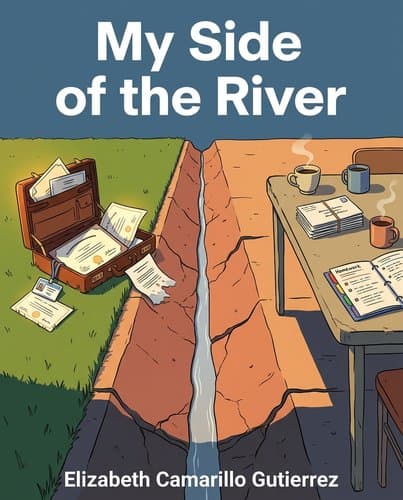
126918693_my-side-of-the-river
by Elizabeth Camarillo Gutierrez
A daughter of undocumented immigrants earns an Ivy League degree only to discover that exceptional achievement doesn't buy belonging—it buys debt, family…
In Brief
A daughter of undocumented immigrants earns an Ivy League degree only to discover that exceptional achievement doesn't buy belonging—it buys debt, family dependency, and the requirement to keep your trauma pitch-ready. Gutierrez exposes how 'proper channels' are engineered to extract compliance while withholding the security they promise.
Key Ideas
Rule-following as engineered exclusion mechanism
Legal compliance is not the same as legal protection — Elizabeth's parents were punished most severely for following the rules exactly, and the memoir is a case study in how 'proper channels' can be engineered to exclude the people who use them most faithfully
Elite institutions reward trauma packaging
The 'exceptional immigrant' narrative requires continuous trauma disclosure — Elizabeth's four-step formula shows that elite institutions don't reward survival; they reward the ability to package survival into a pitch, which means the suffering must be kept accessible and renewable
Success redistributes family burden perpetually
First-generation success frequently redistributes sacrifice rather than eliminating it — Elizabeth's Ivy League degree didn't free her family; it repositioned her as their healthcare plan, legal guardian, and retirement fund, with a corporate salary replacing the chromium factory as the mechanism of extraction
Belonging transcends institutional achievement
The feeling of belonging — what Elizabeth calls 'ordinariness' in Mexico — cannot be earned through achievement; it exists independent of credentials, and chasing it through institutions that commodify identity delays rather than delivers it
Rule gaps unmask systemic beneficiaries
When systems fail people who comply with them, the question worth asking isn't 'what did they do wrong?' but 'who benefits from the gap between the rules as written and the rules as enforced?'
Who Should Read This
Readers who connect with first-person stories about Memoir and Social Issues and want to see the world through someone else's eyes.
My Side of the River
By Elizabeth Camarillo Gutierrez
12 min read
Why does it matter? Because the 'American Dream' is a trap that punishes the people who believe in it most.
Here's the assumption: exceptional effort is the key that unlocks the door. Straight As. Ivy League. Corporate salary. Work hard enough, sacrifice enough, and the system rewards you. Elizabeth Camarillo Gutierrez did all of it — valedictorian, University of Pennsylvania, finance career in Manhattan — and discovered something nobody puts in the brochure. Every institution she climbed into extracted something on the way out. The immigration system took her parents. The boarding school system rejected her brother. The Ivy League took her sense of self. The corporate ladder took her sanity. This is a memoir about a first-generation American daughter who followed every rule the country laid out for people like her, won by every available measure, and then had to reckon with what winning actually cost — and who came out the other side still carrying her brother, her parents' debt, and the tab for a system that was never going to pay her back.
The System Looked Like a Ladder. It Was Actually a Toll Road.
Picture a man standing in a warehouse that smells like blood. That's how Elizabeth Camarillo Gutierrez's father described his first breath inside Square Corp, the Arizona metal-plating factory where he'd been hired through a neighbor's tip. The manager, Steve, handed him a stack of paperwork listing what the job might do to his body: perforations in the nasal septum, damage to the liver and brain, lung cancer. When Elizabeth's father mentioned that he'd studied law in Mexico and understood exactly what he was signing, Steve laughed. That kind of education, he said, didn't matter in America. Then Steve misread the name on the form — skipping the first name entirely, landing on the middle name Edgar — and that became what everyone called him from that day forward. He didn't correct them. Asked later why not, he told his daughter simply: his real name didn't matter here either.
This is the transaction the book keeps returning to. Not exploitation in the obvious sense — nobody held a gun — but something more efficient: a system that offers just enough access to secure your participation, then bills you in ways you won't calculate until it's too late. Elizabeth's parents were sharp people. Her father could eyeball a salvage-lot car and know within minutes whether the damage was cosmetic or structural. Her mother could navigate the whisper networks — informal job chains that kept undocumented workers out of the official systems where authorities watched — with the instincts of someone who should have been running a firm. They worked around every barrier they encountered: wrong zip code to get into a better school? Find someone in-district to share an address. No Social Security number? Split costs with a brother who had one.
The system registered all of this effort. It just kept the returns. The factory got a worker who knew he was being poisoned and signed the paper anyway, because the alternative was worse — and Steve got to call him whatever he wanted.
Following the Rules Was the Most Dangerous Thing Elizabeth's Parents Ever Did
The most dangerous thing Elizabeth's parents ever did was trust the process. The actual procedural kind: hire lawyers, fill out every form, pay every fee, show up to the embassy with a padfolio thick enough to double as a doorstop. The belief underneath all of it was straightforward — if you demonstrate good faith, the system responds in kind. It doesn't.
When SB 1070 passed in April 2010, it didn't just threaten undocumented workers — it exposed the lie at the center of the family's particular strategy. Elizabeth's parents had entered on tourist visas, which meant they technically had documentation. They'd rehearsed what to say if stopped, calibrated what to wear, internalized exactly which answers would keep them on the right side of a police officer's judgment. The problem was that 'show me your papers' wasn't really about papers. The law authorized stops based on suspicion — an officer's discretion — which meant no document, no rehearsed answer, no correctly purchased visa could override the more fundamental variable: how brown you looked walking down a Tucson street. The family had built their safety on a script, and the law rewrote the rules so the script didn't matter.
What happened next is almost too cruel to be instructive, but it is. When the tourist visas neared expiration in early 2011, Elizabeth's parents made a choice the people around them were not making: they went back to Mexico to reapply the legal way, because they believed a valid visa was safer than overstaying. They paid lawyers. They assembled utility bills, tax records, documentation proving Mexican residency. They drove to the U.S. embassy and waited. The application was denied with no explanation. They regrouped, paid more money, filed again. Denied again. No explanation again. An agent told them not to try for at least three years — less advice than a ban. The people around them who had stayed, who had done nothing, were still there.
Elizabeth got this news over the phone from her mother — 'nos la negaron otra vez' — while sharing a bunk bed in a friend's house, her eight-year-old brother Fernando in the bed below. She climbed down to hold him while he cried for their mother. The next day, her first-semester transcript arrived: straight A's, ranked first in her freshman class. The family had followed every rule. The rules had taken everything. What was left was a fifteen-year-old girl holding her brother in the dark, deciding that the only thing she could control was how well she showed up tomorrow.
She Bought Her Education with Her Brother's Childhood
Here is the question the book forces you to sit with: when Elizabeth decided to stay in the United States without her parents, was she brave or was she abandoning her eight-year-old brother? The memoir's answer is that those were the same thing.
Fer disappeared from Rosario's house on an ordinary afternoon. Elizabeth came home from school, set her backpack on the kitchen table, and Rosario walked in wearing the expression she'd worn when she delivered the visa denial. Uncle Alfredo had picked Fer up from school and driven him across the border — no warning, no goodbye. Her father delivered the reasoning over the phone with an ease that made her face go hot: the boy was too small to stay without them. What neither parent acknowledged was that Elizabeth had been the one getting him ready for bed, checking his color-coded homework folders, shielding him from the full weight of what was happening. She had been the only nuclear family he had. When he was taken, she sat in his empty bunk for weeks and left everything where it was — his things arranged the way a classroom keeps a missing kid's desk, untouched — because preservation felt like a form of refusal.
She spent that spring visiting Fer's old classroom at Richardson Elementary after school, venting to his teacher until the computer lab teacher, Mrs. Hernandez, walked in and made an offer so casual it almost didn't register: if Elizabeth needed somewhere to live to finish high school, she could stay with her family. That one sentence became the entire architecture of Elizabeth's next year. She spent the rest of her freshman year ranked first in her class, hiding the plan from her parents, waiting to argue it in person.
In Mexico over the summer, her father's ego and fear collided with her determination. She stopped eating — not as gesture but as the only leverage available to a teenager who had run out of other options. For weeks she lay in bed while her mother brought food she refused and her father insisted she'd stay in Mexico. When her mother finally looked at her husband and said he was killing their daughter, something in him broke. He promised to drive her back.
The drive to the Nogales border crossing took them through small towns whose white churches dated to Spanish colonial missions built on Tohono O'odham land — a people whose territory the border had cut in two. Elizabeth thought about them on the drive: how they must have crossed back and forth to reach the people they loved, the way she now would. The forces weren't different. The geography had just found new families to sever.
At the pedestrian crossing in Nogales, her brother's face collapsed into tears. She knelt and held him, promised she'd come back, then walked toward the officer's booth and blinked away what she was carrying. When the agent asked where she was going, she said: home. It was legally accurate. It was also the most expensive word she had ever spoken.
'Be the Best' Was Her Mother's Love. It Was Also HR's Recruitment Pitch.
Think about what a really sophisticated sorting machine looks like. It doesn't reject the inputs it can't use — it processes them into a form it can. Elizabeth's mother understood this instinctively, which is why her kindergarten send-off wasn't a hug and a packed lunch. It was a briefing: you have to be the best, but you don't announce it. Perform excellence, suppress the performance of performing it. What looks like parental love — and genuinely was — also happened to be a precise operational manual for surviving institutions that needed her Brown face without wanting her Brown reality.
By the time Elizabeth reached Penn's recruitment season, corporate America had independently developed the same algorithm, just with better branding. Through the Hispanic Scholarship Fund, she received what amounted to a three-day seminar on converting biography into currency. The framework had four steps: establish immigrant origins, reframe the suffering as proof of resilience, flatter the company's stated mission, then use the assembled package to negotiate a twenty percent salary increase. She practiced it until the delivery was calibrated — knowing exactly which pauses landed, which phrases moved recruiters' faces in the right direction. When a social media company asked why she wanted the job, she described how their platform had been the only way her separated family could stay in contact across the border. It was true. It was also engineered. She admits she sometimes nearly convinced herself she wanted to be there.
The suffering had to be real for the pitch to work — recruiters could smell performance without stakes. But the more fluently Elizabeth could narrate her family's fracture, the more the story belonged to the companies paying for it and the less it felt like hers. By graduation, she had told the version of herself that had held her crying brother in the dark so many times for so many interviewers that it no longer produced feeling. The story still moved rooms. It just stopped moving her.
Her mother's command was an act of love wrapped around a survival strategy. The HSF formula was a survival strategy dressed up as empowerment. Both required the same thing: package your identity for consumption, keep the rawness legible but not overwhelming, never let them see you calculating. She played the game anyway. The payout was real. Her brother still needed to come home.
The Ivy League Admitted Her. It Did Not Make Room for Her.
Elizabeth arrived at Penn wearing everything she owned that was heavy — flannel shirt, winter jacket, Timberland boots — because she couldn't afford the fee for a third checked bag on her August flight. When the van dropped her at a road closure a few blocks from campus, the driver completed a U-turn and left her standing on a Philadelphia sidewalk with two bright suitcases that were, without exaggeration, larger than her body. She solved the problem the only way available: grab the orange one, haul it fifteen feet forward, walk back to the red one, haul that fifteen feet, repeat. In the middle distance, parents were carrying their kids' things into the dorms. Nobody saw her. Javier — another first-gen Mexican student who seemed to read the situation instantly — came running and carried the bags the rest of the way. Elizabeth already knew what he was before he said a word. When you grow up poor and undocumented, she writes, you develop a sixth sense for finding the people who won't need things explained.
That sense would prove essential, because the institution she'd fought to enter was not built for her body to move through it comfortably. The Canada Goose jackets are the sharpest measure of the distance. Her classmates wore them to frat parties and left them in piles on sticky floors, where they got stepped on and forgotten. When Elizabeth and her friend Richard finally looked up the price, they stared at each other: a thousand dollars for a jacket that rich kids were losing and posting about in the class Facebook group the next morning. Meanwhile, she watched those same classmates disappear into bathrooms to do lines handed off by trust-fund heirs, then emerge and go on to post perfect GPAs. They could afford the detour. Failure, for them, was recoverable — a dip before the safety net caught. For Elizabeth, a B was a scholarship threshold, an internship disqualifier, a crack in the only structure holding everything up.
The pressure eventually became physical. After a break-in at her off-campus house stole her laptop, her camera, and her sense of safety, the panic attacks started — chest locked, hands tingling, the absolute certainty that she was dying. She went to Penn's counseling service and got assigned a therapist who asked, genuinely not knowing: what does it mean to be undocumented? Elizabeth spent the session educating the person paid to help her. She eventually got medication that helped, got a second counselor who taught her a grounding technique, got her GPA back above the threshold that unlocked scholarships and honor societies. The formula worked. It always worked. It was also eating her alive — her immune system so depleted that a doctor found a throat infection typically seen only in newborns. One side could afford to be messy. Hers required a perfection the institution was simultaneously destroying.
Success Extracted the Thing It Promised to Deliver
She had done everything right. Corporate job. New York City. Legal guardianship secured, Fer enrolled in Brooklyn public school, their shared apartment in Prospect Park. The résumé said 'success.' The daily reality was something else: coworkers who called her 'Chica Elizabeth' and then told new hires that diversity hires never really cut it. A manager named Larry who was invisible during the actual work and present only when it came time to inform her, coolly, that her contract wouldn't be renewed — citing her lack of urgency, for a job her entire family's stability depended on, so he could hand the spot to a friend. She had just given a TED Talk that went viral. The entire floor congratulated her. Her immediate team pretended the internet didn't exist.
The corporate world that recruited her wanted exactly the story she carried: immigrant daughter, deported parents, brother left at the border, resilience forged in scarcity. That story made her valuable in pitch decks and diversity reports. It also meant that whenever she took a call to fight Fer's school for ESL services he was legally owed, or left early for a guardianship hearing, her colleagues read it as proof she didn't belong. The trauma that got her in the door was the same thing they used to show her the exit.
Every day she stared at the Vessel from her floor-to-ceiling window — a $150 million tangle of connected staircases built as public art on the Hudson River, shut down after three people leaped from its railings. Its designers had refused to install barriers proven elsewhere to prevent suicides — at a library atrium across town, on the George Washington Bridge. The money existed. The will didn't. She was earning more than anyone in her family ever had. She was also the family's entire safety net — healthcare, tuition, stability — while a building down the street stood as a monument to exactly how much infrastructure the powerful choose not to build when the people who need it aren't them.
Ordinariness Was the Finish Line the Whole Time
What was Elizabeth actually running toward? Not the Penn degree — she knew better than to mistake the admission price for the destination. Not the Wells Fargo salary or the viral TED Talk. The whole machinery of sacrifice and performance was pointed somewhere quieter: a kitchen table in Sonora with mismatched cups and reheated tamales, where nobody needed her to be exceptional at all.
The moment arrives after her father's prostate cancer diagnosis — the one that may trace a straight line back to the chromium dust at Square Corp, the factory where he signed away his health rights because his Mexican law degree bought him nothing in Arizona. Elizabeth cancels her flight back to New York, manages his surgical care in Mexico City, and then, following her mother's blunt instruction to stop hovering over a man who is recovering, books a trip to the Oaxaca coast.
But the truer finish line had already arrived, in the Sonora kitchen, watching her father grill steaks among aunts and uncles arguing over coffee in cups that don't match. Her mother tells childhood stories. The table is loud and ordinary and completely indifferent to her résumé. In Mexico, Elizabeth is just another Brown girl eating beans with orange-red chiles mashed in. She spent two decades performing exceptionalism so relentlessly that what she got on the other side of all of it — the right to be unremarkable — was what she should have been allowed to keep from the start.
Then Carlos, a local surfer, gives her a single lesson on the Oaxacan coast: the undertow isn't your enemy. It's a freeway. Use it to reach the back line instead of fighting it to exhaustion. She paddles out, stands for a fraction of a second, loses her balance, and tumbles under. When she finds her way to the surface, her friends are cheering from the shore. The currents Elizabeth spent decades battling — legal status, family obligation, the constant pressure to out-perform every room she entered — were never simply obstacles. They were also the forces that moved her. She doesn't have to just survive them anymore.
What the River Knew All Along
The Rillito River runs dry most of the year — dammed upstream, cut off from where it was always trying to go. Tucson built a park along its concrete banks anyway, jogging paths and picnic tables, an amenity for one side of the city that the other side mostly can't reach. The river became infrastructure for people who didn't need it and a boundary for people who did. Elizabeth was not the river. She made it through. But you should sit with what that cost: a father renamed by a factory manager who couldn't be bothered, parents punished for trusting paperwork, a brother handed across a border with no goodbye, a girl rehearsing her own trauma until it stopped hurting her — all of it feeding a system that was never broken, never failing, never losing its way. It was working.
Notable Quotes
“Elizabeth, nos la negaron otra vez,”
“We’re not going to be able to come back.”
“I’ll keep you safe, Fer,”
Frequently Asked Questions
- What is My Side of the River about?
- My Side of the River is a memoir by Elizabeth Camarillo Gutierrez tracing her journey as a first-generation American navigating elite education and corporate success while supporting her undocumented parents. The memoir examines how systems that promise upward mobility—immigration law, Ivy League institutions, corporate careers—extract belonging rather than deliver it. It provides readers a sharper lens for understanding who these systems actually serve, revealing the gap between the rules as written and how they are enforced in practice.
- What are the key takeaways from My Side of the River?
- The memoir reveals that 'legal compliance is not the same as legal protection,' and that systems promising upward mobility often extract belonging rather than provide it. Gutierrez demonstrates that 'first-generation success frequently redistributes sacrifice rather than eliminating it'—her Ivy League degree didn't free her family but repositioned her as their healthcare plan and financial provider. The book also shows how elite institutions don't reward survival itself but rather the ability to package survival into a pitch, requiring continuous trauma disclosure. Finally, true belonging—what Gutierrez calls 'ordinariness'—cannot be earned through credentials but exists independent of achievement.
- How does My Side of the River address the experience of first-generation Americans?
- The memoir shows how 'first-generation success frequently redistributes sacrifice rather than eliminating it,' with achievement creating new obligations rather than freedom. Gutierrez's Ivy League degree didn't free her family; instead, it repositioned her as their healthcare plan, legal guardian, and retirement fund, with a corporate salary replacing factory work as the mechanism of extraction. The book challenges how elite institutions operate: they don't reward survival itself, but the ability to package survival into a pitch, which requires continuous trauma disclosure. This dynamic reveals how institutional success can obscure new forms of dependency for first-generation families.
- What does the memoir reveal about how elite institutions operate?
- The memoir reveals that elite institutions—like Ivy League schools and corporate employers—don't reward survival itself; they reward 'the ability to package survival into a pitch,' which requires continuous trauma disclosure. This system means suffering must remain accessible and renewable. Furthermore, the memoir demonstrates a critical gap between rules as written and rules as enforced: 'legal compliance is not the same as legal protection,' and proper channels can be engineered to exclude those who follow them most faithfully. Ultimately, Gutierrez proposes asking not 'what did they do wrong?' but 'who benefits from the gap between the rules as written and the rules as enforced?'
Related Book Summaries

Read the full summary of 126918693_my-side-of-the-river on InShort