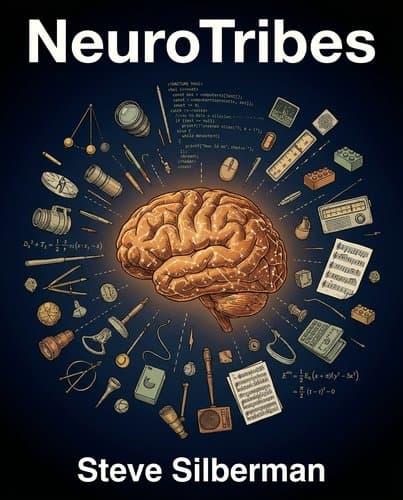
22514020_neurotribes
by Steve Silberman, Oliver Sacks
The 'autism epidemic' was never a crisis of broken children—it was a crisis of a society that spent a century misclassifying, harming, and ignoring a natural…
In Brief
The 'autism epidemic' was never a crisis of broken children—it was a crisis of a society that spent a century misclassifying, harming, and ignoring a natural variation in human cognition. Silberman reveals how bad science, one man's narrow diagnosis, and institutional blindness shaped fifty years of needless suffering.
Key Ideas
Diagnostic criteria widening explains increased diagnoses
The rise in autism diagnoses since the 1980s is primarily explained by a widening of diagnostic criteria — not a biological epidemic; Lorna Wing's Camberwell study showed the 'missing' population had always been there, uncounted.
Kanner's narrow definition shaped fifty years
Leo Kanner's narrow 1943 definition of autism excluded the vast majority of people it should have described, and he was working alongside the very diagnosticians who had already built a broader model in Vienna — the 'sin of omission' shaped fifty years of inadequate clinical practice.
Harmful treatments were mainstream and funded
The refrigerator mother theory and Lovaas-style aversive behavioral therapy were not fringe ideas — they were mainstream, funded, and celebrated treatments that actively harmed autistic children and their families through the 1970s; knowing this history is essential context for evaluating any 'new' treatment promising a cure.
Autistic advocates built neurodiversity framework early
Autistic people did not wait for medicine to advocate for them: Jim Sinclair, Donna Williams, and Judy Singer built the neurodiversity framework in the early 1990s, arguing that accommodation rather than cure was both more ethical and more achievable.
Accommodation corrects architecture, not biology
Practical accommodation — sensory-quiet spaces, skills-based hiring, flexible communication norms — is not charity but a design correction; the mismatch between autistic cognition and standard environments is a problem of architecture, not biology.
Outcome clarity prevents intervention harm assessment
When evaluating any autism intervention, ask what the outcome actually measures: 'looks normal' and 'functions well on their own terms' are different targets, and confusing them has caused enormous harm.
Who Should Read This
Curious readers interested in Neuroscience and Social Issues and the science of how the mind actually works.
NeuroTribes
By Steve Silberman & Oliver Sacks
10 min read
Why does it matter? Because the 'autism epidemic' you've been hearing about was never what anyone said it was.
Here's a thought that might unsettle you: the "autism epidemic" you've been hearing about for thirty years isn't what you think it is. Not the vaccines. Not the screens. Not something in the water. What Steve Silberman discovered — after years of following the evidence into archives, clinics, and living rooms from Vienna to Silicon Valley — is that the explosion in diagnoses reflects a century of deliberate not-looking. The minds we're calling newly broken have always been here: in the labs, the radio shacks, the institutions where we warehoused them and called it care. We just kept changing who counted as worth seeing. The cost of that choice shows up in the lives of people who spent decades being told nothing was wrong with them — while everything, quietly, was.
The Tribe That Was Always There
In 1797, a sixty-six-year-old man sealed himself into a backyard shed in South London and spent nine months staring through telescopes at lead spheres swinging on a wire. He communicated with his household staff through notes left on a hall table. He wore the same gray-green coat every day of his adult life, ordered two legs of mutton when told one wouldn't feed five guests, and had a second staircase built after a maid startled him in a corridor. Henry Cavendish filled that shed with 44 thermometers and 11 telescopes, erected an 80-foot pole in his yard, and when he emerged from his months of solitary measurement, his figure for the density of the Earth was so accurate that no one could improve on it for a century.
Cavendish isn't a historical curiosity. He's a data point in an argument Steve Silberman builds across NeuroTribes: the minds we now call autistic didn't appear in the late twentieth century. They've always been here — building laboratories in their backyards, calculating gravitational constants, debugging code. We just didn't have a name for them.
In 2001, while reporting a story for Wired, Silberman got a call from a supervisor at Microsoft. "All of my top debuggers have Asperger syndrome," the man told him. "They can hold hundreds of lines of code in their head as a visual image. They look for the flaws in the pattern, and that's where the bugs are."
That sentence reframes everything. The same mind that found the density of the Earth by staring at pendulums through a telescope is now finding software bugs by holding an entire codebase as a mental image. The cognitive style didn't change. The world changed around it — and suddenly there were jobs that rewarded exactly this kind of attention.
The tribe was always there.
One Man's Definition Erased a Generation
The history of autism diagnosis looks, from a distance, like steady scientific progress. Up close, it looks like one man quietly burying another man's more accurate map.
Hans Asperger had spent more than a decade at Vienna's Children's Clinic observing hundreds of children, and what he saw was a spectrum — a continuous range of traits running from children who couldn't speak to adults who became professors of astronomy. Leo Kanner, working in Baltimore, saw something narrower: a small, sharply defined group of children who had been born outside the social world. His 1943 paper described eleven of them. He called the condition early infantile autism.
The detail that makes Kanner's claim of independent discovery hard to accept is this: the two people who had done the most to develop the Viennese view of autism — Georg Frankl, Asperger's chief diagnostician, and Anni Weiss, who had written the clinic's landmark case studies — were sitting in Baltimore when Kanner made his breakthrough. He had personally rescued them from the Nazis and hired them at Johns Hopkins. Frankl spent two weeks producing the detailed behavioral portrait of Kanner's first patient, Donald Triplett, a Mississippi boy who could recite every U.S. president but appeared not to notice whether another person was in the room. Frankl's observations were woven directly into Kanner's published paper. Yet Kanner never mentioned Asperger's name in print — not once, across an entire career — and let the field believe he had arrived at the discovery alone.
What followed from that silence was a definition so narrow it excluded most of the people it should have described. Kanner insisted autism was rare. He ruled out any child with epilepsy or signs of organic brain damage — conditions now understood to co-occur with autism routinely. He treated the spectrum as a fixed point. When pressure came from the psychiatric establishment to categorize his patients as a subtype of childhood schizophrenia, he accepted, provided autism remained rare and strictly bounded. That truce held for forty years.
Vienna Had the Answer in 1944 — and the Nazis Nearly Buried It
Rather than sitting children down with IQ tests, the staff at Hans Asperger's Heilpädagogik Station — including a remedial teacher named Sister Viktorine Zak — conducted what they called play interviews, watching a child for hours, looking for the thing that lit them up. The goal wasn't to measure deficits. It was to find what Asperger called each child's archetype: the future mathematician, the future professor of grammar, the future astronomer hiding inside a boy everyone else had written off as feeble-minded. Where other clinicians saw only dysfunction, the Heilpädagogik team saw a spectrum — Asperger used the word literally — running from children who couldn't speak to adults who went on to careers in science and art.
He was making that argument to people who had a different use for children who deviated from the norm. In 1938, Vienna had become a Nazi stronghold. A colleague of Asperger's, Erwin Jekelius, was running a nearby clinic called Am Spiegelgrund, where nearly eight hundred children would eventually be killed under the Third Reich's program of 'mercy death' for the disabled. That year Asperger stood before an audience that included Gestapo officials and delivered the first public description of autism in history. It wasn't a scientific announcement. It was a calculated defense: these children are not ballast, they are assets. A dash of autism, he argued, was essential for exactly the kind of creative, rule-breaking intelligence that built science and art. He was trying to draw a line around his patients before someone drew one around them first.
He kept the clinic alive through the war. Sister Viktorine kept working with the children. Then, in 1944, Allied bombs hit the building. She died shielding one of her students with her own body.
The clinic was gone. Asperger's work, written in German and published in a Europe the Americans were bombing flat, never crossed the Atlantic. The spectrum view, the strengths-based model, the idea that autism was a lifelong human variation rather than a childhood tragedy — it had all been worked out in Vienna, in detail, a generation before the American psychiatric establishment got there. It was buried under rubble, and then buried again under silence, and it took forty more years to dig it out.
'Refrigerator Mothers' and Electric Shocks: How Medicine Became the Enemy
The theory that mothers cause autism didn't drift into medicine through slow accumulation of error. It was built, deliberately, by people with credentials and institutional power — and then used to justify treatments that would be prosecuted as abuse if they happened today.
Bruno Bettelheim had survived Dachau and emerged with a theory: the emotional coldness of an autistic child's home was structurally identical to a concentration camp. The mother was the Kommandant. The child, unable to bear the conditions, had retreated behind a psychological wall. The cure was removal — what clinicians called 'parentectomy' — placing the child in Bettelheim's Orthogenic School on the South Side of Chicago. His 1967 book, The Empty Fortress, laid out this logic without apology, called autism 'a suicide of the soul,' and claimed a 92 percent cure rate. The New York Times reviewed it enthusiastically. His own staff later called those numbers hyperbolic, and acknowledged that none of the children actually reached independence.
Ole Ivar Lovaas at UCLA was working a different angle. In a published interview with Psychology Today, he described a nine-year-old girl named Beth who was injuring herself. When she struck her head against a metal cabinet, Lovaas hit her. He said he 'really laid it on her,' and expressed relief that she was 'a big fat girl' who offered 'an easy target.' His protocols dressed this up in the language of behaviorism — 'aversive stimuli,' 'extinction of garbage behavior' (his phrase) — but the logic was simple: make the wrong behavior painful enough and the child would stop. His lab also used electric shocks from a device called the Harvard Inductorium. The research got federal funding and became the foundation for what is still called Applied Behavior Analysis.
The Numbers Didn't Explode — The Net Finally Widened
What if there was no epidemic — just a definition that finally started fitting the people it was always meant to describe?
When Lorna Wing surveyed children with special needs in the London borough of Camberwell in the 1970s, she wasn't looking for Kanner's rare, precisely bounded type. She was doing something simpler and more honest: looking at every child who was struggling and asking what she actually saw. What she found was a hidden population that Kanner's checklist had been quietly filtering out for decades. Some children were entirely nonverbal. Others could talk at length about tide tables or memorize every character who'd ever appeared in a soap opera — but couldn't navigate a conversation or keep a friend. None of them fit neat categories. All of them were real, all of them were there, and almost none of them had ever received a diagnosis that acknowledged what was actually happening to them.
When Wing published her concept of the autistic spectrum in 1981, she made an explicit prediction: broaden the criteria, and the numbers will rise. Not because something new is happening to children's brains, but because you will finally start counting people who were already there.
The DSM did broaden, in stages — 1987, then 1994 — and the numbers rose exactly as she said they would. Clinicians were playing fast and loose with labels anyway. One former chief of child psychiatry at the National Institute of Mental Health (who the book does not name by request) admitted openly that she would 'call a kid a zebra' if it would get him the services he needed. When the National Audit Office analyzed disability data for the British government, they concluded that the apparent increase was 'almost certainly the result of better recognition.' The epidemic that was alarming newspaper editors and fueling speculation about vaccines and plastics and modern toxins was, in large part, a measurement artifact — the predictable result of a net that had finally been rebuilt to the right size.
The tribe had always been there. Wing had just taught people what to look for.
'Don't Mourn for Us': The Moment Autistic People Claimed Their Own Story
Jim Sinclair had driven twelve hundred miles to a conference in North Carolina specifically to meet other people like himself. What he found instead was the familiar spectacle: autistic people placed on a stage so that clinicians and parents could observe them, like specimens in a very polite zoo. He had his diagnosis, he had his story, and everyone assumed that was the point — that he existed to inform the people who would then go home and make decisions about people like him.
In 1993, he stood up and told them what that felt like from the inside.
The speech he gave, 'Don't Mourn for Us,' landed like a diagnosis of the diagnosticians. Its central charge was surgical: when you pray for a cure, when you grieve publicly over your child's existence, what your child actually hears is that you wish for a different child entirely. 'Your greatest wish,' Sinclair told the room, 'is that one day we will cease to be, and strangers you can love will move in behind our faces.' He wasn't rejecting the grief of parents who faced real hardship. He was exposing the logic underneath it — that the goal of autism treatment had been, from Bettelheim onward, the elimination of the autistic person rather than their flourishing.
What made the speech land as something other than grievance was that Sinclair had already begun building the alternative. With Donna Williams, an Australian writer, and Kathy Lissner, he had founded Autism Network International — the first organization run by and for autistic people rather than about them. The three had met in St. Louis, where they spent a day doing something none of them had ever done outside a clinical setting: simply being autistic together. They forgot about tea they'd made, left chores undone, and arranged glittering objects on the floor to pass between them like gifts. Sinclair observed, with characteristic precision, that this looked 'suspiciously like a person wanting to share a pleasurable activity with her friends.' It was, of course, exactly that — friendship, expressed in their own register, without anyone taking notes.
The Vaccine Panic Was Manufactured — But the Grief Behind It Was Real
Imagine you go to a doctor with a sick child, and the doctor tells you nothing — not the cause, not the prognosis, not what to do tomorrow morning. Just: your child has a lifelong condition, good luck. Now imagine a stranger hands you a map. The map might be wrong, but you've been given nothing else to navigate by. That's the situation American families were in when Andrew Wakefield showed up.
Wakefield was a gastroenterologist — his own admission — who knew nothing about autism before he became its most famous theorist. What he had instead was a financial relationship with trial lawyers who needed a medical expert to argue that the MMR vaccine had harmed their clients' children. In 1998, he staged a press conference timed to coincide with publication of his Lancet paper, standing before television cameras to suggest a link between the measles-mumps-rubella vaccine and what he called 'autistic enterocolitis.' The paper involved twelve children. The financial conflict was undisclosed. The science was later exposed as fabricated — the Lancet retracted the paper, and Wakefield lost his medical license. None of that happened before the damage was done.
But here's what Silberman won't let you forget: the parents who believed Wakefield weren't gullible. They were desperate, and the desperation was medicine's creation. Shannon Rosa had spent years navigating a system that offered her son Leo nothing — no coherent services, no honest accounting of what his life might look like, only a diagnosis handed over like a verdict. When the DAN! protocol arrived, promising recovery through elimination diets and supplement regimens and chelation therapy, it offered what no clinician had: a plan, a community, the feeling of doing something. A network of clinics seemed to find dangerous toxin levels in nearly every child they tested, and families who pushed back eventually saw the circular logic — but only slowly, and only some of them.
The fraud filled a vacuum that a broken medical system had spent forty years carving out. The grief was always real. The map was sold to people who had been refused every other one.
Building the World the Tribe Actually Needs
Think of the Internet. It was built, from the start, to be platform-agnostic — it didn't care whether your machine ran Windows or Unix or something weirder. That design choice wasn't charity toward minority operating systems. It was the reason innovation happened at all. Silberman's final argument is that the same logic applies to the physical and social world: the question has never really been whether to include autistic minds, but whether we've been willing to stop building everything for a single cognitive style.
By neurotypical standards, the autistic brain looks broken — slow to process social cues, prone to fixation, overwhelmed by sensory input that others filter out automatically. Flip the frame, and by autistic standards, the typical brain 'suffers from a deficit of attention to detail' and is 'obsessively social.' Neither is broken. They're different hardware running different software, and the world we've built is just a Windows monoculture.
The practical proof is Specialisterne, a Danish company that stopped running job interviews entirely. In their place: Lego Mindstorm robots. Candidates spend days building and programming them, and what gets evaluated is the actual skill — logical precision, pattern recognition, the ability to hold a complex system in mind and find where it's failing. Strip out the social performance that has nothing to do with debugging software, and the people who looked unemployable turn out to be exactly who you needed.
The tribe was always there. The only thing that ever needed fixing was the architecture.
What 'Completely at Home on Earth' Actually Takes
In Kensington, California, there's a man known as the Mayor — not by official title but because he knows every neighbor by name, organizes the block parties, remembers who's been sick and checks in on them. His name is Mark Rimland, and for most of his childhood the clinical consensus was that his life would be narrow and supervised. What changed wasn't Mark. It was the people around him, who stopped handing him a checklist of everything he couldn't do and paid attention long enough to notice what he could. That's not a heartwarming exception. That's the answer this book has been building toward.
Judy Singer coined 'neurodiversity' in the late 1990s because she needed a word for what she was seeing — that the human nervous system doesn't have one correct configuration, and that people wired differently aren't broken versions of a standard model. The word caught because the idea was true. The question was never really about autism. It was about what happens when a society designs everything for one kind of mind and then labels every other kind defective. Build the world differently — not as charity, but as a basic correction to a design flaw — and you don't just get Mark Rimland knowing every family on his street. You get the person who finds the flaw in a thousand lines of code, the researcher who stares at pendulums for nine months and comes back with the density of the Earth.
The tribe was always there. The question is whether we build the world to meet them.
Notable Quotes
“Earthworms were the first living creatures that I could identify with,”
“Being autistic, I’m not supposed to understand things like this,”
“but to me that looked suspiciously like a person wanting to share a pleasurable activity with her friends.”
Frequently Asked Questions
- What explains the rise in autism diagnoses since the 1980s?
- The surge in autism diagnoses since the 1980s reflects a significant broadening of diagnostic criteria, not a biological epidemic. Lorna Wing's Camberwell study proved the "missing" autistic population had always existed but remained uncounted due to overly narrow definitions. Leo Kanner's 1943 diagnostic framework was so restrictive it excluded the vast majority of people who should have been identified as autistic. When diagnostic criteria expanded, these previously undiagnosed individuals—many functioning well in society—finally appeared in statistics. Understanding this history is crucial for rejecting the myth of an autism "epidemic" caused by environmental factors.
- What harmful treatments shaped autism care through the 20th century?
- The refrigerator mother theory and Lovaas-style aversive behavioral therapy were not fringe ideas but mainstream, funded, celebrated treatments that actively harmed autistic children and families through the 1970s. These approaches were based on false premises—that autism resulted from maternal emotional coldness or required painful behavior modification to force normalcy. Understanding this history is essential for evaluating any modern treatment claiming to offer a cure. The documented harm demonstrates why accommodation and acceptance, rather than normalization through punishment, represent the more ethical path forward in autism care.
- What is the neurodiversity framework and who developed it?
- The neurodiversity framework emerged in the early 1990s through autistic self-advocates like Jim Sinclair, Donna Williams, and Judy Singer, who argued that accommodation rather than cure was both more ethical and more achievable. This paradigm shift recognized autism not as a disorder to be eradicated but as a naturally occurring variation in human cognition with distinct strengths and challenges. The framework challenged the medical model's focus on normalizing autistic people, advocating instead for societal changes that honor neurodivergent differences. This movement remains foundational to contemporary autism advocacy and policy.
- Why is accommodation more important than normalcy for autistic people?
- Practical accommodation—sensory-quiet spaces, skills-based hiring, flexible communication norms—is not charity but a design correction recognizing that the mismatch between autistic cognition and standard environments is a problem of architecture, not biology. When evaluating autism interventions, the critical question is what outcomes are actually measured: "looks normal" and "functions well on their own terms" represent different targets, and confusing them has caused enormous harm. Accommodation respects autistic people's authentic functioning rather than forcing compliance with neurotypical standards through potentially harmful interventions designed solely to achieve normalcy.
Related Book Summaries
Read the full summary of 22514020_neurotribes on InShort