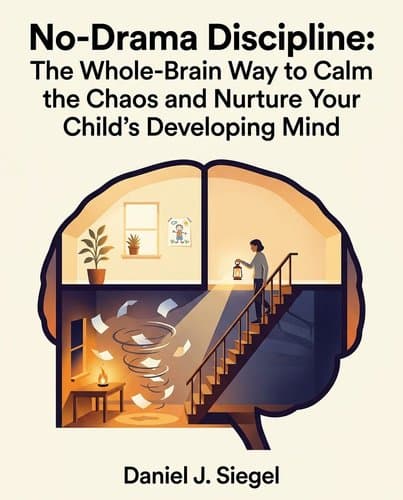
40873423_no-drama-discipline
by Daniel J. Siegel
Connection isn't the soft alternative to discipline—it's the neurological prerequisite that makes any lesson actually stick. Learn how to calm chaos by working…
In Brief
No-Drama Discipline: The Whole-Brain Way to Calm the Chaos and Nurture Your Child's Developing Mind (2014) reframes discipline as a tool for brain development rather than punishment. Drawing on neuroscience, it shows parents how to connect with a child's emotional state before correcting behavior — and gives practical strategies for turning misbehavior into opportunities for teaching, resilience, and stronger relationships.
Key Ideas
Check Emotional Readiness Before Teaching
Before responding to any misbehavior, ask: 'Is my child in a state where they can actually receive a lesson?' If emotions are running high, connect first — get below eye level, make physical contact, validate the feeling out loud — before redirecting behavior.
Pause and Regulate the Flooded Brain
When you catch yourself about to lecture mid-meltdown, remember the fighting dog: it won't sit. Neither will an emotionally flooded child whose upstairs brain is offline. Pause, regulate together, then teach.
Discover Why Before Choosing Response
Chase the why before choosing your response. Put on the Sherlock Holmes hat: is this about hunger, exhaustion, frustration, or something else? Treating the symptom (the behavior) without understanding the cause is why the same misbehavior keeps recurring.
Fast Repair Models True Accountability
When you blow it — and you will — repair explicitly and fast. 'I didn't handle that how I'd like to. Will you forgive me?' is not weakness; it's the most powerful relational skill you can model, and the one your child will carry into every relationship they have.
Flexibility Builds More Credibility Than Rigidity
You can walk back an overblown consequence. Saying 'I got mad and wasn't thinking clearly' teaches more about accountability than stubbornly enforcing an unreasonable punishment. Consistency matters; rigidity doesn't — and your child's credibility in you actually rises when you self-correct honestly.
Who Should Read This
Curious readers interested in Child Development and Family and the science of how the mind actually works.
No-Drama Discipline: The Whole-Brain Way to Calm the Chaos and Nurture Your Child's Developing Mind
By Daniel J. Siegel & Tina Payne Bryson
10 min read
Why does it matter? Because discipline and punishment aren't the same thing — and your child's brain is being built either way.
You've done the warnings. You've counted to three. You've taken away the iPad, revoked screen time, tried consequences with the measured calm of someone who has read at least one parenting book. And three days later you're in the exact same screaming match, except now everyone's crying and you're Googling "am I a bad parent" at midnight.
Here's what this book wants to tell you: the problem isn't finding the right punishment. Punishment isn't the tool that changes brains, and changing a brain is what you're trying to do. Every tantrum, every defiant "no," every meltdown over a wrongly cut sandwich is a brain that hasn't learned to regulate itself yet. You can't punish a brain into that skill. But you can build it — and the first step looks a lot less like a consequence and more like kneeling down and actually listening.
Discipline Never Meant Punishment — and That Confusion Is Costing You
A mother pulls Dan Siegel aside after a parenting talk. Her son Sam is eighteen months old, active and curious, getting into everything. She's been working with him constantly: showing him what's safe, what to leave alone, how to move through the world without breaking it. "I'm doing a lot of teaching with Sam," she tells Dan. "But when do I start disciplining him?"
She had no idea she'd already been doing both.
The word "discipline" traces back to the Latin disciplina, which meant teaching and learning when it entered English around the eleventh century. Its root, disciple, means student, not prisoner. The entire etymology is about teaching, not punishment. Somewhere along the way, we replaced that meaning with something closer to consequences, and the substitution has been quietly wrecking our parenting ever since.
Most of us arrive at a discipline moment with a single goal: stop the behavior. The toddler is throwing things; we want the throwing to stop. The nine-year-old won't do homework; we want it done. Consequences, time-outs, privilege removal. These aim at that target. And sometimes they hit it, briefly. But Siegel and his co-author Tina Bryson argue we've been solving for the wrong thing.
There are actually two goals when a child misbehaves. The first is immediate: get cooperation now. The second is longer: build the internal machinery — impulse control, emotional regulation, empathy — that makes misbehavior less likely next time. Parents who pursue only goal one end up disciplining the same behaviors forever, because they're never building anything. The brain that threw the toy is unchanged after the time-out. It will throw the toy again.
What changes a brain is repeated experience. Discipline-as-teaching offers that. Punishment just interrupts the behavior without rewiring the child who did it. Every time you respond to misbehavior, you're either building a skill in your child's brain or missing the chance to.
What Sam's mother was already doing was building a brain. She just didn't have the word for it.
A Tantrum Isn't Defiance — It's a Brain Temporarily Offline
Every tantrum is a neurological event.
The brain isn't one unified thing — it's a collection of regions with different jobs that have to work together. Siegel and Bryson describe two layers that matter most for parenting. The "downstairs brain" handles instinct, survival reactions, and raw emotion; it's the part that fires when a toddler doesn't get their way. The "upstairs brain" handles everything we actually want to teach: sound decision-making, impulse control, empathy, the ability to pause before acting. The problem is that the upstairs brain isn't fully developed until a person's mid-twenties, and it goes offline under emotional stress, even in adults.
When those two layers stop communicating, when the reactive downstairs overwhelms the reflective upstairs, Siegel and Bryson call it "disintegration." Not a metaphor. A technical description of what's happening in the brain. The child screaming on the grocery store floor isn't choosing to be difficult. Their upstairs brain has been temporarily knocked offline by a flood of emotion, and what you're watching is the downstairs running unmanaged.
Disintegration reframes everything. If a tantrum is willful manipulation or moral failure, the right response is punishment: make the behavior costly enough and the child will choose differently next time. But if a tantrum is disintegration, a brain that has temporarily lost its ability to regulate itself, then punishment can't reach it. You can't lecture someone whose capacity to process language has gone offline. You can't teach a lesson to a nervous system that's in survival mode. The lesson bounces off.
What moves a disintegrated brain back toward integration is the presence of a calm, connected adult. Not because warmth is nice, but because it's neurologically functional: a child's nervous system can borrow regulation from a caregiver's, using the connection to settle the downstairs brain enough for the upstairs to come back online. Only then can teaching happen.
The brain physically changes in response to repeated experience. Neurons that fire together wire together — and every time you help a child move through a meltdown back to calm, you're building the circuitry that makes self-regulation easier next time. The child who regularly gets walked through storms gradually develops better wiring for weathering them alone.
A tantrum is a signal: the brain needs help pulling itself back together. Read it that way, and you stop feeling like a disciplinarian facing a problem child. You start feeling like someone who actually understands what's happening and knows what to do next.
Why Every Lecture You've Ever Delivered Mid-Meltdown Has Landed on Deaf Ears
Imagine trying to teach a drowning person the breaststroke. The information is good. The timing is terrible.
That's the situation you're in every time you kneel down to explain why hitting isn't acceptable to a child mid-tantrum. They can't hear you. Not won't, can't. Mid-meltdown, the upstairs brain isn't just distracted — it's offline, which means everything you say lands as noise or as threat.
Siegel and Bryson compress the whole problem into one image: you can't teach a dog to sit while it's fighting another dog. A fighting dog won't sit. Not because the dog is stubborn, but because everything available (attention, body, nervous system) is already committed to the fight. The lesson has nowhere to land.
Connection has to come first. Not because warmth is nice, or because children need to feel validated before they can be corrected (though both are true), but because connection is the neurological mechanism that moves a child from reactivity back to receptivity. It's what ends the fight so the sitting can begin.
And it works faster than almost any other approach. The authors illustrate it through Michael, a father in the book, who walks into his living room to find his five-year-old has upended hundreds of organized Lego pieces across the floor. His instinct is to stand over the child, explain consequences, lay out what was wrong. Instead, he kneels and opens his arms. The child falls into them. Within sixty seconds, through nothing but physical closeness and an occasional "I know, buddy," the boy calms enough to say, sheepishly: "I spilt the Legos." From there, Michael can actually teach: about empathy, about impulse control, about what to do with big feelings of exclusion. The lesson lands because the child is now capable of receiving it.
The authors map that exchange as a cycle. Michael got small first: knees on the floor, arms open, collapsing the distance a flooded nervous system reads as threat. He didn't leap to consequences. He stayed quiet and let the boy find words. When the boy said "I spilt the Legos," Michael reflected it back, which looped them to comfort again (another nod, more presence) until the child settled. Not a checklist to complete and move on from; a cycle that runs until the child's nervous system settles.
The reason connecting mid-meltdown feels like surrender is that it looks like giving in. But giving in would mean abandoning the lesson. Connection is what makes the lesson possible. Without it, you're not choosing between soft and firm. You're choosing between effective and ineffective.
Two Parenting Experts, One Tiny Crepe, and a Threatened Tongue Removal
Dan Siegel — the child psychiatrist who literally wrote several of these books — is sitting in a small crepe shop with his two kids when something snaps.
The trigger is almost impressively minor. His teenage son ordered a small crepe. His nine-year-old daughter, who had declined to order anything, now wants a taste. The son gives her a piece, barely a crumb, which she immediately declares is too small, and also the burnt part. Dan, instead of just buying another crepe, picks a side. He can feel his fists tighten, his heart accelerate, his head beginning to spin: all the warning signals his own research describes as the downstairs brain taking over. He notes them. Then he ignores them.
By the time the family reaches the car, the parenting expert is cursing at his son, calling him names, and threatening to confiscate the boy's guitar, consequences entirely disconnected from the crepe dispute his son is navigating with calm, measured responses. The inversion is almost too neat: the teenager maintained better upstairs-brain function than the person who literally wrote the book on it. Dan's son had stayed integrated; Dan had not.
The story shows something specific about physiology. Dan had noticed every warning sign. He consciously told himself he would stay calm. None of it worked, because he suppressed the signals instead of responding to them, and a nervous system in that state doesn't take instructions from the prefrontal cortex, not even a well-credentialed one.
The recovery is where the real lesson lives. Dan knew he couldn't repair with his son while his vital signs were still elevated, so he went skating first — physical movement to let the physiology reset. During that time, something surfaced: he'd been unconsciously reading his teenage son as his own older brother. Not a deliberate comparison, but a below-the-surface pattern that had loaded a crepe dispute with decades of emotional weight it had no business carrying. That insight was only available because he'd stopped trying to solve the problem and let his nervous system settle.
When he knocked on his son's door, he arrived with a question rather than an explanation. His son told him he'd been too protective of his sister (accurate) and that he hadn't done anything wrong (also accurate). Both times Dan felt the pull to defend himself. Both times he kept quiet. The repair worked not because Dan found the right words, but because he wasn't competing with his son's experience. He was receiving it.
The co-author's version is shorter and goes further. Tina Bryson's three-year-old hits her. She works through every reasonable approach (patient explanation, empathy, firmness, time-out at the bottom of the stairs, time-out at the top) and the child matches each escalation with one of his own, eventually switching from hitting to kicking when she bans hitting, technically complying with the letter of her rule. When he sticks out his tongue, she announces she'll rip it out of his mouth.
Both authors share these stories because shame usually buries them. We tuck the worst moments away, tell ourselves they were aberrations, and never examine what happened. Owning them has a function: the recovery protocol (recognize it, stop, repair) only gets practiced when we admit it's needed.
A perfect parent doesn't exist. A repairing one does.
The Most Important Parenting Moment Is the One Right After You've Blown It
When you've already blown it — when the harsh words are already out — what does going back accomplish? Most parents treat repair as damage control: smooth things over, don't draw more attention to the failure, hope the child forgets. The instinct makes sense. Returning to the scene of your worst moment feels like reopening something that's just beginning to close.
But repair isn't about managing fallout. It's active construction.
When you return to a child and say plainly, "I didn't handle that well — will you forgive me?" something happens that can't happen any other way. They watch someone they love do something genuinely hard: acknowledge a failure without excuse, ask for something without demanding it, stay in the discomfort long enough to wait for an answer. That's not a lesson you can assign or explain. It has to be lived in front of them.
Siegel and Bryson describe three ways repair actually sounds, not as scripts but as options depending on where you and the child are. Sometimes it needs transparency: "I know I didn't handle myself well. I'll listen if you want to talk about what that was like for you." Sometimes it's lighter: laughter at yourself, inviting the child to narrate the absurdity back to you. Sometimes it's brief: "I didn't handle that how I would have liked. Will you forgive me?" The mode matters less than that it happens at all.
The same logic runs through every chapter of this book: circuits used get stronger, circuits unused go quiet. Every time you explicitly repair in front of a child, you're exercising pathways that would otherwise sit dormant: the capacity to recognize a rupture, feel discomfort about it, return anyway, and restore connection. That's the relational skill that will shape every close relationship your child ever has. The skill develops because you modeled it, not because you described it.
And the brain's plasticity doesn't close at some developmental deadline. Which means the question is never whether you've already done too much damage. It's whether you'll repair next time faster than you did last time.
A parent who comes back.
The Serenity to Know When Nothing Will Work Right Now
There's a moment Tina describes near the end — every technique spent, her son still curled under the covers, facing the wall, anti-Mom drawing taped to his door. Nothing left to deploy. The Serenity Prayer, she says, is the actual philosophy hiding inside this whole approach: sometimes you accept that nothing more will happen today. That's not failure. That's wisdom. The brain is plastic at any age, yours included, which means the work is never finished and never too late. You won't remember every technique when your vital signs are elevated and someone is kicking you over a crepe. But if you come back afterward, say the hard thing out loud, and ask to be forgiven, you've done the most important thing the book asks of you. Not perfect. Just directional. Repair fast.
That's also the answer to the question you were Googling at midnight. The book doesn't promise you'll stop screwing it up. It just shows you how to come back.
Notable Quotes
“spare the rod and spoil the child”
“free to be you and me”
“the decade of the brain”
Frequently Asked Questions
- What is No-Drama Discipline about?
- No-Drama Discipline reframes discipline as a tool for brain development rather than punishment. The book draws on neuroscience to show parents how to connect with a child's emotional state before correcting behavior. It provides practical strategies for turning misbehavior into opportunities for teaching, resilience, and stronger relationships. Rather than viewing discipline as punishment, the approach emphasizes understanding the root cause of behavior and regulating emotions together before providing guidance. The core principle is ensuring a child is in an emotional state capable of receiving a lesson before attempting to teach one.
- What does the book mean by connecting before correcting?
- The foundational principle is asking: 'Is my child in a state where they can actually receive a lesson?' When emotions run high, you must connect first—get below eye level, make physical contact, validate the feeling out loud—before redirecting behavior. The authors use the metaphor of a fighting dog: 'it won't sit. Neither will an emotionally flooded child whose upstairs brain is offline.' Connection calms the nervous system and moves a child back into a state where learning is possible. Only after emotional regulation can effective teaching occur.
- What are the key takeaways from No-Drama Discipline?
- Key takeaways include: Before responding to misbehavior, determine if your child can receive a lesson. Use connection—physical touch and validation—before redirecting. Chase the root cause before choosing your response; treating only the behavior ensures it recurs. When you make mistakes, repair explicitly and fast: 'I didn't handle that how I'd like to. Will you forgive me?' is powerful modeling. Finally, you can walk back unreasonable consequences—consistency matters more than rigidity. Self-correction teaches accountability and actually increases your child's credibility in you, not weakening your authority.
- Why does parental repair matter in the No-Drama approach?
- Explicitly repairing mistakes is the most powerful relational skill you can model. When you blow it—and the authors affirm you will—saying 'I didn't handle that how I'd like to. Will you forgive me?' demonstrates accountability without weakness. Walking back an overblown consequence by acknowledging 'I got mad and wasn't thinking clearly' teaches more about accountability than stubbornly enforcing unreasonable punishment. This honesty and self-correction isn't inconsistency; it's integrity. Your child will carry this relational skill into every relationship they have, and your willingness to repair honestly actually increases their trust and credibility in you.
Related Book Summaries

Read the full summary of 40873423_no-drama-discipline on InShort