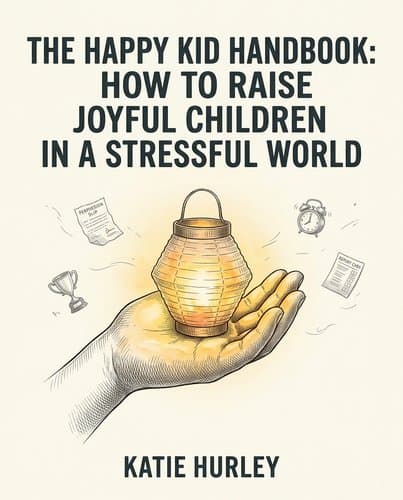
24611711_the-happy-kid-handbook
by Katie Hurley
Joyful children aren't shaped by discipline techniques—they're built from the inside out. Katie Hurley shows parents how to cultivate the emotional foundation…
In Brief
The Happy Kid Handbook: How to Raise Joyful Children in a Stressful World (2015) reframes childhood happiness not as an outcome of good behavior but as the emotional foundation children need before resilience and coping skills can develop.
Key Ideas
Meltdowns signal emotional vocabulary gaps
When a child melts down, ask 'what feeling don't they have a word for?' before asking 'how do I stop this?' — the behavior is almost always a vocabulary problem, not a discipline problem.
Validate emotions before requesting empathy
Validate your child's feelings before pivoting to 'how do you think she feels?' — asking for empathy before the child's own emotions are acknowledged teaches them their feelings don't matter.
Unstructured play builds emotional regulation
Protect unstructured, child-directed play time as seriously as any scheduled activity — it is the primary mechanism through which children develop empathy, frustration tolerance, and emotional regulation, not recreational filler.
Build confidence in coping with anxiety
The goal with anxious children is not to reduce anxiety but to build confidence in their ability to cope with it. Consistently troubleshooting for them prevents the skill-building you're trying to produce.
Your stress shapes their emotional baseline
Before adding another rule or activity, audit your own stress level — parental reactivity, rushing, and unprocessed emotion are doing more to shape your child's emotional baseline than any technique you apply to the child directly.
Fair means meeting individual needs
'Fair isn't about everyone having exactly the same thing. Fair is about everyone having their needs met' — apply this when you catch yourself parenting the child you imagined rather than the one in front of you.
Two activities maximum prevents hidden stress
Two extracurriculars maximum. Busyness that looks like personality is often accumulated stress — and children are expert at hiding it until they can't.
Who Should Read This
Curious readers interested in Child Development and Mental Health and the science of how the mind actually works.
The Happy Kid Handbook: How to Raise Joyful Children in a Stressful World
By Katie Hurley
11 min read
Why does it matter? Because the behavior you're trying to fix is actually a skill your child hasn't been taught yet.
You picked up this book because something specific is going wrong — tantrums, shutdowns, the back-talk that starts the moment you walk through the door. You want a fix, and that's completely reasonable. But here's the uncomfortable possibility worth sitting with: the behavior you're trying to stop isn't the problem. It's your child's only available answer to an emotional question they haven't been given the language to ask. Every meltdown, every "I'm fine" that clearly isn't, every morning stomachache with no medical cause — these aren't failures of discipline. They're information. What this book offers isn't a better set of corrections. It's a different goal entirely: not a child who behaves, but a child who actually knows how to feel — and from that foundation, everything else you want for them becomes possible.
The Parenting Industry Sold You the Wrong Problem
The parenting advice industry has been solving the wrong problem. Bookstore shelves groan with strategies for stopping tantrums, ending back-talk, and correcting the thousand things that can go wrong — as if happiness were a reward children earn by behaving correctly. The causal arrow actually runs the other direction: a happy foundation is what produces academic success, durable friendships, and better health. Optimizing for compliance doesn't build happiness; it just delays the question.
The anxiety driving all of this is real, and it has a specific shape. Somewhere along the way, 'parent' stopped being something you are and became something you perform — a verb loaded with judgment, trends, and the constant implication that you're doing it wrong. Every new book, every parenting blog, promises a better technique. The result isn't more confident parents; it's more overwhelmed ones, reaching for quick fixes that don't hold as children grow.
What gets lost in all this optimization is the child's inner experience. Hurley's answer is blunt: children who lead with happiness are already ahead. They don't need to earn their way there through corrected behavior. They need adults who understand them well enough to build from where they actually are — their temperament, their emotional wiring, their particular way of moving through the world. That means meeting kids where they are instead of managing them toward where you think they should be. Everything else follows from that.
Your Child's Meltdown Is a Vocabulary Problem, Not a Discipline Problem
Jake was seven years old and he was miserable — except he couldn't tell you that. Every week he turned up in a child therapist's office with a new physical complaint: stomachaches on Monday, headaches by Wednesday, a sore throat by Friday. His smile was wide, his eyes crinkled when he laughed, and when the therapist asked how he was feeling, his answer never changed: happy. Everything was great. No problems. Meanwhile his teacher watched him shut down every time schoolwork stretched past his comfort zone, anxiety written plainly across his face even when his mouth said the opposite.
When the therapist tried a simple exercise — a stack of flash cards, each showing a different emotional expression — the real picture emerged. Card after card, face after face, Jake called every single one happy. Not because he was lying. Because happy was the only emotional state he'd ever been taught to name. His anxiety was real and it was loud, but it had no label, so it tunneled somewhere his body could express it instead: his stomach, his head, his throat.
Jake's situation is more common than most parents expect, and the reason traces back to a specific developmental moment. When children are infants, adults narrate their emotions constantly — guessing at each cry, soothing with words, connecting the feeling to the cause. Then toddlerhood arrives and something shifts. The focus moves from understanding what the child is feeling to correcting how the child is behaving. At precisely the moment children need the most help building an emotional vocabulary, the adults around them stop providing one.
The result is children who experience a full range of emotions — fear, frustration, jealousy, shame — but have only a handful of words available to describe any of it. What they have instead is their bodies and their behavior. The kick, the wail, the collapse in the parking lot: these aren't defiance. They're the only vocabulary available.
That changes what you actually do next. Telling a dysregulated child to calm down, without ever teaching them how feelings work or what theirs are named, is like shouting instructions at someone drowning who never learned to swim. The goal isn't to stop the behavior — it's to give the child enough language that the behavior eventually becomes unnecessary. Jake didn't need discipline. He needed a word for what was happening inside him. Once children can name a feeling, they can begin to do something with it.
Play Isn't How Children Relax — It's How They Learn to Feel
Language builds the container, but before children have words for what they're carrying, they need another way in. For many of them, that way in is play.
For three weeks, a nine-year-old named Avery sat across from her therapist with her arms folded, refusing to engage beyond complaining that the office was boring and there was no dollhouse. She had been adopted at birth into a conservative family that wanted her quiet and compliant; she was naturally loud, artsy, and combative about all of it. Conversation got nowhere. Then the therapist bought the dollhouse, and everything changed.
Avery spent the next year directing a doll family through the same crisis on repeat: the girl doll packing a bag, running away to New York, escaping. The therapist had strict orders to follow the script. No improvising. Six months in, Avery's parents called to complain she was just playing — they wanted a list of behavioral goals, not a toy. But the play was doing something no goal sheet could. One day Avery broke from the usual loop and asked aloud what the parents in the story would actually feel if the doll left for good. Would their lives be easier without her? The question shifted everything. She moved from rage into grief, and then, slowly, into something like empathy. After three years, she could assert her needs without erupting, and she could see her adoptive parents as people with their own limits rather than enemies. The dollhouse reached feelings that had no words yet.
That's what Hurley is arguing: play isn't downtime wedged between the activities that actually develop children. It is the development. When children direct their own play, they're doing emotional and cognitive work that conversation can't access — practicing empathy by inhabiting other roles, building frustration tolerance by negotiating with other kids, working through feelings that haven't been named yet by acting them out in miniature. The child who melts down, withdraws, or develops a recurring stomachache often isn't defiant or fragile. They're carrying something they can't articulate, and they need a medium other than language to process it.
What works against this is the well-intentioned impulse to stay in control — to enroll children in structured activities and direct the play toward productive outcomes. When adults control the environment continuously, children learn that their own ideas and instincts don't drive anything. That lesson compounds. Child-led play teaches children that their imagination has weight. Remove it, and you don't just eliminate fun — you remove the primary tool children use to figure out who they are and how to manage the world pressing in on them.
You Can't Teach Empathy by Asking 'How Do You Think She Feels?'
Jonathan was eight years old and living in residential treatment. He entered every therapy session like a courtroom, announcing the latest injustice with theatrical urgency, then cycling through complaints about the staff, the other kids, his placement there. The adults around him had a consistent response: asked him, session after session, to stop and consider how his words were landing on other children. The time-outs kept coming. Nothing changed. The strategy was aimed at the right destination — empathy for others — but it was skipping a step that turned out to be the whole mechanism.
The therapist eventually tried something different. She took Jonathan for a walk outside the office, let the silence run for a while, then said simply: she didn't know what it was like to be sent away from home at his age, but she imagined it was genuinely hard — lonely, confusing — and she thought she'd probably be furious at everyone too. Jonathan looked up at her with tears forming, and then he actually talked. Not about the other kids. About feeling like a disappointment to his parents. About the quality of loneliness that hit at night. About never quite feeling like a child. The explosive anger turned out to be a symptom of feelings that had never been given any room. Nobody had validated them, so they had nowhere to go but outward.
This is the counterintuitive move the research keeps pointing toward, and it's worth naming directly: you can't build empathy outward in a child whose own emotional experience is consistently bypassed. Most parents reach for the obvious tool — redirecting the child outward mid-conflict with 'How do you think she feels right now?' It sounds like empathy instruction. But when adults jump to 'how does she feel?' without first acknowledging 'here's what I notice you're feeling,' the message the child absorbs is that their inner life is an obstacle to clear before the real conversation begins. When a child experiences being truly heard — when their frustration or loneliness or grief is met with recognition rather than redirection — they learn, through direct experience, what it feels like to have someone tune into you. That's what they carry forward. Empathy toward others is something children learn by first receiving it themselves.
Anxious Kids Don't Need Less Worry — They Need Confidence That They Can Handle It
The goal of raising an anxious child isn't to reduce their anxiety — it's to convince them they can handle it. That distinction sounds small. It isn't.
Natalie was a third-grader who checked the door locks twice and confirmed the oven was off before leaving the house. Her family had made her worries useful: she had a list of official household jobs — closing the garage door, bringing snacks for road trips, turning out the lights — and the structure kept her anxiety purposeful. Then her mother moved to a full-time position with a long commute. Early-morning and after-school programs replaced the time they'd had together. The jobs disappeared. And Natalie's anxious brain had nothing to grip. She started reorganizing her bookshelves compulsively during the school day, worrying about her GPA in third grade, wondering whether she'd get into college.
What had changed wasn't the intensity of her anxiety. It was her sense of control. The longer separations and shattered routine left her feeling like her own life was happening to her. Treatment started with her body — breathing exercises to slow her down before anything else — then moved to her thoughts. The intrusive thoughts were "bossy" and often wrong, and Natalie could learn to talk back to them. With practice, she could catch the anxiety at the moment it fired rather than riding it all the way into panic.
Parental instinct runs in the opposite direction. When adults step in to troubleshoot every stressor — smoothing the transition, resolving the conflict, removing the trigger — children never discover that the discomfort is survivable. The coping capacity they'd have built by working through something hard simply doesn't form. What feels like helping is actually a kind of borrowing: the child feels better now, but the debt comes due the next time anxiety strikes and they have no tools of their own.
Hurley's closing line in this chapter is a thesis statement for the whole book: happy kids aren't children who are free from anxiety — they're children who trust their own ability to get through it. That confidence doesn't arrive through reassurance. It's built, slowly, through doing hard things and discovering they're still standing afterward. Which raises the question of how much stress a child can actually carry before the load becomes too much — and how parents can tell the difference.
The Most Powerful Variable in Your Child's Happiness Is Your Own Stress Level
Think of a tuning fork. Strike one and hold it near another — the second begins to vibrate without being touched. Transfer happens through proximity, not instruction. That's how parental stress moves through a household.
Daniel came to therapy because he struggled to connect with people. He had a rich inner life, attended karate twice a week, and didn't mind solitude the way everyone assumed he should. What he showed unmistakably was depression. His mother had a ready explanation: the school was failing him academically. She delivered this verdict in rapid-fire calls made while commuting between a demanding job and the kids she was barely keeping up with. She yelled — at teachers, at the therapist from her car — and ran at a pace that left no room for stillness. The financial wreckage of a divorce had stripped away her options. She genuinely believed she was doing everything she could.
What family therapy revealed stopped her cold. She had no idea how often she raised her voice. She hadn't noticed that her relentless rushing communicated urgency and danger to Daniel's nervous system every single day. She couldn't perceive the stress level in her own home because surviving it had consumed all available attention. The school wasn't the problem. She was the environment Daniel was living in, and that environment was the source.
Parental stress during a child's early years doesn't just affect mood or behavior — it can alter which of the child's genes are expressed, with effects detectable well into adolescence. A parent's emotional state isn't a backdrop to development. It's the medium the child develops in.
All the techniques covered earlier — the emotion vocabulary, the breathing exercises, the play — are tools a parent applies from some assumed position of stability. But the parent is the most powerful variable, operating continuously, not just during the moments when they deploy a strategy. A household running at high stress is doing something to a child's emotional baseline that no amount of correct intervention fully offsets. The question isn't only what you're teaching your child. It's what your nervous system is broadcasting — which is the same tuning fork, still vibrating.
Letting Children Be Different From What You Imagined Is the Work
Nicole was eleven when Hurley first met her — a skilled ballet dancer who had trained since she was two, following the path her mother had paved. In honest moments, she admitted dance wasn't really her thing. What she actually loved was drawing, though her schedule left no room for a single art class. The pressure to perform and measure up to her mother's legacy eroded her confidence steadily, until she gave up on the drawing dream entirely. When Hurley last saw her, just before thirteen, Nicole had finally stopped dancing and was alone in her room, filling notebook margins with sketches. Hurley still wonders whether she ever formally studied art.
The tragedy isn't that Nicole danced. It's that her mother's vision left no space for Nicole's own. When parents redirect a child away from what genuinely lights them up — toward the sport, the instrument, the path that fits the parent's idea of a worthwhile childhood — the child learns something no amount of later encouragement easily undoes: that her instincts about herself are wrong. Hurley calls these negative core beliefs, and they compound.
The alternative isn't permissiveness. It's attention. The boy who cycled through soccer, baseball, tennis, karate, and swimming — failing at all of them — only found confidence when his mother finally asked what he actually liked doing in his free time. Legos. An engineering class changed everything: new friends, real focus, the anxiety gone.
Giving each child what they need won't look equal, and it shouldn't. The child who wants to needlepoint, collect coins, or draw alone in a notebook deserves the same support as the one who wants to play in the championship game. The gap between the child you imagined and the child in front of you is real — and closing it starts with following the actual child's lead, even when it diverges sharply from what you'd hoped. That's the work.
The Child in Front of You
The child who cried about nothing you could identify on the way home from school — that's where this book leaves you. Not with a revised schedule or a new script for the next meltdown, but with a different question to carry into the evening: what is she feeling, and does she have a word for it yet? That's the actual work. Not the emotion vocabulary exercises or the empathy-first moves, though those matter. The work is the willingness to slow down long enough to wonder about your child's inner life before cataloging what needs fixing in their outer one. And the hardest part — the part no chapter quite cushions — is that the most powerful thing shaping that inner life isn't anything you do to your child. It's the emotional weather you carry into the room with you.
Notable Quotes
“A high-intensity child, for example, is likely to be prone to yelling in frustration when things aren't going his way. I would know. I have one of those. A”
“When you're finished with your thought, I need your help”
“? As parents, we tend to create labels for kids and explain their behaviors or tendencies before another person has even spent a minute with the child. What we are really saying is,”
Frequently Asked Questions
- What is The Happy Kid Handbook about?
- The Happy Kid Handbook reframes childhood happiness not as an outcome of good behavior but as the emotional foundation children need before resilience and coping skills can develop. Katie Hurley draws on child psychology to provide parents with practical tools for building emotional literacy, protecting unstructured play, managing anxiety, and managing their own stress. Rather than focusing on correcting children, the handbook emphasizes cultivating the conditions in which they thrive by shifting parental attention from behavior correction to emotional development and environmental support.
- How should parents respond to children's tantrums according to The Happy Kid Handbook?
- Rather than immediately seeking to stop a meltdown, Hurley recommends asking "what feeling don't they have a word for?" before addressing the behavior. She explains that "the behavior is almost always a vocabulary problem, not a discipline problem." The approach validates the child's emotions first, then helps them develop emotional literacy by naming their feelings. This shift transforms tantrums from discipline issues into opportunities for teaching emotional recognition and self-regulation, building the emotional foundation essential for childhood happiness and resilience.
- What does The Happy Kid Handbook say about the importance of unstructured play?
- Unstructured, child-directed play is the primary mechanism through which children develop empathy, frustration tolerance, and emotional regulation, not recreational filler. Hurley emphasizes that parents must protect this time "as seriously as any scheduled activity." In our overscheduled world, unstructured play builds critical emotional skills children cannot develop in supervised, goal-oriented settings. This time is foundational to developing the resilience and emotional capacity essential for childhood happiness. By safeguarding unstructured play, parents support the emotional development that structured activities and lessons cannot provide.
- What does The Happy Kid Handbook say about parental stress and fairness?
- Hurley emphasizes that "parental reactivity, rushing, and unprocessed emotion are doing more to shape your child's emotional baseline than any technique you apply to the child directly." Before implementing new rules or activities, parents should first audit their own stress levels. She also redefines fairness: "Fair isn't about everyone having exactly the same thing. Fair is about everyone having their needs met." This reframing encourages parents to tailor parenting to each child's individual needs rather than applying standardized approaches, acknowledging that different children thrive with different responses.
Related Book Summaries

Read the full summary of 24611711_the-happy-kid-handbook on InShort