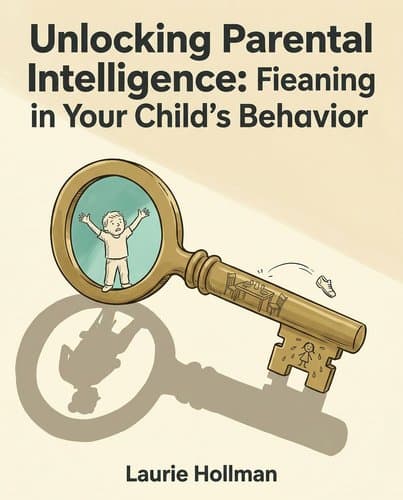
26783626_unlocking-parental-intelligence
by Laurie Hollman
Every tantrum, defiance, and outburst is your child trying to tell you something they can't yet put into words — and your own unresolved past is distorting…
In Brief
Unlocking Parental Intelligence: Finding Meaning in Your Child's Behavior (2015) teaches parents to read misbehavior as communication rather than defiance. It shows how a parent's own unresolved history can distort their responses to children, and offers a framework for replacing punishment with curiosity — so that understanding the meaning behind behavior becomes the path to lasting change.
Key Ideas
Behavior speaks truths children cannot verbalize
Before reacting to misbehavior, pause and ask what it might be communicating — children often express distress through behavior precisely because they cannot yet verbalize what's actually wrong
Your intensity reveals reactivated old wounds
When your emotional reaction to your child feels disproportionate to what just happened, treat that intensity as a signal: an old wound may be reactivating, and the reaction is partly about the past, not just what's in front of you
Preserve body signals—masks hide what you need
Avoid commands like 'get that sneer off your face' — they train children to mask the facial and body signals you need in order to read their inner state
Consequences matter; punishment alone builds shame
Punishment 'pays' for misbehavior on an external ledger without building internal conscience; when a consequence doesn't connect to the child's own understanding of cause and effect, it produces confusion and shame rather than learning
Escalation proves punishment missed the real problem
When a child's misbehavior escalates despite consistent punishment, treat the escalation as evidence the punishment is missing the actual problem — the behavior is getting louder because it hasn't been heard
Safety-first language invites honesty without cost
Create safety before difficult conversations: saying 'whatever it is, we can work it out' before knowing what it is signals to a child that honesty won't cost them the relationship
Meet children where their development actually is
A child's developmental age in specific capacities — frustration tolerance, social reasoning, emotional regulation — may lag significantly behind their chronological age; adjust expectations to where the child actually is
Professional support extends what parental work alone cannot
Parental Intelligence is a foundation, not a complete solution: situations involving neurodivergence, clinical depression, or absent parents also require external support, professional help, or structural change alongside the internal work
Who Should Read This
Readers interested in Child Development and Education, looking for practical insights they can apply to their own lives.
Unlocking Parental Intelligence: Finding Meaning in Your Child's Behavior
By Laurie Hollman
9 min read
Why does it matter? Because your child's worst behavior is a message you're not yet equipped to read.
Your first instinct when your child misbehaves is probably right: something needs to happen. What this book quietly dismantles is the assumption that the something is a consequence. Every parent in these pages started exactly where you are: certain that firmness, consistency, and the right response would fix the problem. None of them were wrong to want those things. They were just answering the wrong question. The shift Laurie Hollman asks you to make is deceptively small — from "what do I do about this?" to "what is this trying to tell me?" — but it changes the shape of everything downstream. Because it turns out you can't fully hear your child until you understand what in your own past is making it hard to listen. That's the double mirror at the center of this book. And once you've started asking the second question, you find you can't go back to asking only the first.
Thrown Shoes Are Never Just About Shoes
Six-year-old Clive's shoes hit the wall before his father had finished the sentence. He'd simply said it was time for school — and the shoes were already across the room.
The instinct in that moment is almost physical: the spike of irritation, the reflex to assert authority, to make clear that throwing things is not acceptable. Clive's father felt all of it. He also didn't act on any of it. He held his breath and waited.
What Clive eventually explained — slowly, in pieces — was this: the day before, during arithmetic, he'd gotten a problem wrong. A classmate laughed. Clive poked the boy with the eraser end of his pencil. The boy yelped. And his teacher, who usually liked Clive, who saw him as a kind kid, shouted at him. Clive didn't understand why he'd thrown the shoes. His father did. The shoes were carrying everything: the shame of the wrong answer, the humiliation of being laughed at, the disorientation of being yelled at by someone he trusted. The shoes were the only language he had.
This reframe is what Hollman builds her entire framework around. A child's misbehavior isn't a problem to be corrected — it's a message to be decoded. The behavior is already the communication. When a parent responds by punishing first and asking nothing, they never find out what the child was asking. They also teach the child that their inner life, when it spills out sideways, produces consequences rather than conversation.
Clive's father had learned to hold two things in his mind at once: his own frustration and his son's distress. That double awareness — refusing to let his reaction crowd out curiosity about his child's experience — is what made the difference. He asked a simple question: is something upsetting you about getting ready for school? And the door opened.
The same behavior, seen through a different lens, becomes something else entirely. A shoe thrown in anger looks like defiance. A shoe thrown by a kid carrying yesterday's humiliation looks like a cry for help. Same shoe, same room, same morning. Different question, different meaning, different outcome.
Punishment Solves the Wrong Problem
Punishment doesn't build a child's conscience. It teaches them to manage consequences.
That's the distinction Hollman draws at the center of this book. When a parent punishes, they're asking "how do I stop this?" But the child's misbehavior is already asking something different: can you figure out what's happening inside me? Punishment answers the wrong question — and the child learns, not that their behavior was wrong, but that it carries a price. Pay the price, reset the ledger, move on. No understanding accumulates on either side.
The mechanism gets worse. Punishment generates resentment, and resentment amplifies exactly the behavior it was meant to extinguish. The cycle looks like escalating defiance; it's actually escalating distress.
Consider the mother who had been screaming at her fourteen-year-old every day that week for switching on his iPod before finishing his homework. She'd already taken away a weekend party as punishment. Nothing changed. Talking to a friend, she catalogued her frustration — he's ignoring her, he knows the rule, she's losing her mind. Her friend pushed back: he's actually a good student, he usually does listen, he probably just needs to decompress before he can settle into schoolwork. And the party she canceled? He'd been looking forward to seeing a girl he liked.
Here is Hollman's most unsettling claim: children usually already know right from wrong. Punishment doesn't teach it to them — they already have it. When a child misbehaves, something else is going on. The real work isn't correction. It's understanding what that something else is.
The Parent You Once Were Is Sitting in the Room
Imagine you're wearing tinted glasses you've forgotten you have on. Everything you look at carries that tint — not as a distortion you'd notice, but as the color the world simply is. This is what Hollman keeps returning to: the emotional history you carry into every interaction with your child. You believe you're reacting to what's in front of you. Often, you're reacting to something that happened twenty or thirty years ago.
Claudia was nineteen, caring for her four-month-old daughter Lara, and she kept reading the same scene as rejection. The baby would wake up happy: batting at a mobile, exploring her own hands, gurgling contentedly. Claudia saw none of that. She saw: she doesn't want me.
Lidia, a retired maternity nurse who had come to help, watched this pattern until she could name it. Claudia's childhood had been a succession of disappearances: a mother with severe panic attacks who regularly screamed at her to leave the room, a parade of housekeepers who arrived and vanished, a father who eventually left entirely. Claudia had internalized a single explanation for every absence: I did something wrong and the person left. That old explanation was now running automatically, labeling a contented baby as a rejection.
Lidia said it plainly: Claudia was confusing her infant with her mother. The past was sitting in the room, and she couldn't tell it apart from the present.
Claudia heard this and said something honest: the logic made sense, but it didn't feel true yet.
That gap is precisely Hollman's point. Understanding the mechanism and being free of it are different things — sometimes very different things. The old interpretation was faster, more automatic, built from years of accumulated evidence. The work isn't a single insight; it's learning to notice the reenactment while it's running.
Hollman calls this self-reflecting, and it starts with one question: when did you feel this before? Not abstractly, but in a particular room, with a particular person, at a particular age. Once that earlier scene comes into focus, the present one reorganizes. A baby exploring her hands stops looking like indifference. A child running late for the bus stops looking like contempt. The parent's reaction was never about the child. It was about someone else, somewhere else, a long time ago.
Until the reenactment becomes visible, the child stays invisible behind it.
What a Six-Year-Old Drew When He Couldn't Find the Words
Weeks after the shoe incident, Mr. Richards — Clive's father — found his son in the small office down the hall, bent over a keyboard, building something on-screen. He stood back and watched. Clive, six years old and the quieter of two identical twins, was navigating a painting program he had taught himself to use. Mr. Richards didn't know his son could do this. He didn't, he was beginning to realize, know much about his son at all.
He asked to see the painting. Clive hesitated — "You might get mad at me" — and when his father promised he wouldn't, the drawing appeared: the word "Daddy" in large letters, Clive's own name written tiny beside it, and small tears falling from a stick figure.
What followed was the conversation Mr. Richards had never thought to have: patient questions, long pauses, a six-year-old working up to something he couldn't quite say. Piece by piece: Clive had been hitting his twin brother Ari whenever the teacher called on Ari to read, and again at home whenever their father played with Ari. He thought the teacher called on Ari because Ari could read, and had stopped liking Clive. He thought his father left on business trips because Ari was a smart boy and Clive wasn't.
Then the worst part: "I don't like me either because I can't read."
He wasn't confessing. He was consoling his father, absorbing all the blame to protect a relationship with the one parent who had never really sought him out. A child who could barely articulate any of this had organized it into a complete theory of why he wasn't loved, with himself as the cause.
Mr. Richards had done the work that made this conversation possible. He'd confronted something he'd been avoiding: that he'd bonded with Ari's exuberance and found Clive a mystery he'd slowly stopped trying to solve. He'd recognized, with something close to shame, that he resented his quieter son for not being more like him. That recognition was what let him sit still in that chair and listen instead of explain.
Clive had never climbed into his father's lap before that conversation. At the airport weeks later, when Mr. Richards headed through security, Clive ran to him and held on. The relationship that had never quite formed was forming now, because one parent had been willing to look at what he'd failed to do, and then sit quietly enough for a child to draw him a picture.
Understanding Is Necessary — and Sometimes Not Sufficient
What happens when a parent does everything right — slows down, looks inward, asks the right questions — and the situation still doesn't stabilize?
The question matters because Hollman's framework can read as a complete solution: understand your child deeply enough and behavior will normalize. The chapters on neurodivergence test this honestly.
Eight-year-old Cathie has just been diagnosed with ADHD. Her mother Lia, a strict woman who ran the household on orderly rules, has been reading her daughter's hyperactivity as disrespect. The turning point is a physical act: Cathie, overwhelmed by two unfinished homework sentences, curls under the kitchen table in a fetal ball, and Lia sits down on the floor beside her instead of punishing. The escalation stops. Given a calm Saturday to describe ADHD from the inside, Cathie talks about waking up "jumbled up," losing the thread of sentences mid-conversation, finding a sneaker in the bathroom with no memory of how it got there. Lia listens, and the part of her that had been taking the disorder personally releases.
That shift is real. It's also not enough.
The homework meltdowns ease once mother and daughter devise a timer system: ten minutes of work, five-minute break. But things don't fully stabilize until the school agrees to a separate accommodation package: reduced homework, extended time, permission to leave the classroom when internal pressure spikes. That required a negotiation entirely outside the parent-child relationship. Lia's changed understanding made her an effective advocate rather than an apologetic one. It couldn't change the demands Cathie faced six hours a day, five days a week.
Understanding is the necessary foundation. Without it, Lia would still be punishing symptoms she mistook for defiance. But it also reveals what else needs to happen. Sometimes it's a school accommodation. Sometimes it's a missing parent. When Leslie opens up to her mother Ceci about the depression, the disclosure is specific: her father had promised to come to her dance recital and hadn't. Ceci realizes the conversation she needs to have is with him. Understanding opened the door; someone else had to walk through it.
The framework doesn't promise resolution. It promises that you'll understand what resolution actually requires.
What Gets Practiced at the Kitchen Table Travels Forward
What a parent practices at the kitchen table doesn't stay there.
Eva, a teenager in the book's final chapter, was seventeen and shaking when she finally said what she'd rehearsed for months. She refused her father's grounding, described it as a fairy tale where he was the king locking the princess in her room, announced she was going to a rock concert at Madison Square Garden, then disclosed the thing she'd never said aloud: she wanted to be a doctor, had been researching pre-med programs alone, because neither parent had thought to visit colleges with her.
Ward, who had spent weeks tracing his reflexive punishments back to a harsh father he'd unconsciously replicated, didn't blow up. He withdrew the grounding. He told her she was beautiful — something he'd never said. He proposed a practice trip to Penn Station before Saturday, so she could navigate the city once with him before going with friends.
Eva's final words were: "I don't feel like I'm in prison anymore."
Not because the problem was solved (seventeen years of walls don't come down in one dinner) but because Eva could now see her father was capable of changing. That is what children carry forward: not their parents' best moments, but their parents' capacity to see them.
Hollman's own son, raised with this approach, later put it plainly: certitude masquerades as strength, but it comes from ignorance and fear. The capacity to hold another person's mind in mind, practiced first between a parent and a child, is the earliest intervention we have in how a person learns to be with other people. That's where it starts — in a particular kitchen, with a particular child.
The Pause That Changes Everything
The entire framework rests on something almost embarrassingly small: a pause. Not a technique you practice in a workshop, not a checklist you run through — just a moment of deliberate stillness before you react. What is happening inside my child right now? And what in me is making it hard to see?
That pause, practiced once and then again, is how the relationship slowly changes. Your child never knows you're doing this. They just learn — gradually, without being told — that the truth is safe to bring into the room. Even when it arrives sideways in thrown shoes or a drawing on a screen, curiosity meets it before punishment does.
None of this stays at the kitchen table. It travels forward into who your child learns to be with other people, into who you become in the process, and, in the book's most ambitious reach, into the kind of world built by people who were, once, genuinely seen.
Notable Quotes
“grabs a piece of toast, and runs out the door. You feel disrespected. He barely noticed what you'd done. You're angry he wasn't grateful for the lovely meal you prepared. You assume he was mad at you from the quick,”
“You punched the wall when your brother took your baseball mitt without asking. He's been doing this for weeks, and your frustration has reached its limit. Think about it. I bet by hitting the wall, you were avoiding hitting him.”
“Let's think and talk more about your frustration, so you don't ever need to punch a wall.”
Frequently Asked Questions
- What does it mean when your child's misbehavior seems intentionally disrespectful?
- The book teaches that misbehavior is often communication, not defiance. Children often express distress through behavior precisely because they cannot yet verbalize what's actually wrong. Before reacting, pause and ask what the behavior might be communicating. This shift—from viewing misbehavior as intentional rudeness to seeing it as a child's attempt to express something they can't articulate—opens the door to understanding rather than punishment. By treating behavior as a message, parents can address the underlying issue causing the child's distress and create opportunities for meaningful conversation and lasting change.
- What should you do when your reaction to your child feels disproportionately angry?
- When your emotional intensity seems larger than the situation warrants, treat it as a signal about your own past. When your emotional reaction to your child feels disproportionate to what just happened, treat that intensity as a signal: an old wound may be reactivating, and the reaction is partly about the past, not just what's in front of you. This awareness helps you separate your child's behavior from your history. Pausing to recognize that your reaction is partly rooted in your own unresolved experiences allows you to respond more calmly and fairly to your child's actual needs.
- Why does punishment stop working with children who keep misbehaving despite consequences?
- Punishment addresses behavior on an external ledger without building internal understanding. When a consequence doesn't connect to the child's own understanding of cause and effect, it produces confusion and shame rather than learning. When misbehavior escalates despite consistent punishment, treat the escalation as evidence the punishment is missing the actual problem — the behavior is getting louder because it hasn't been heard. This escalation signals that the child hasn't understood why their behavior was wrong. Shifting to understanding—exploring what the behavior communicates—often stops the cycle.
- How can parents help children feel safe enough to be honest about their problems?
- Create safety before attempting difficult conversations. Saying 'whatever it is, we can work it out' before knowing what the problem is signals to a child that honesty won't cost them the relationship. This foundational safety allows children to disclose problems instead of hiding them through behavior. When children know their honesty will preserve the relationship, they're more likely to bring issues to you directly rather than expressing pain through misbehavior. This proactive communication prevents buildup of unspoken distress and allows parents to address problems collaboratively.
Related Book Summaries

Read the full summary of 26783626_unlocking-parental-intelligence on InShort