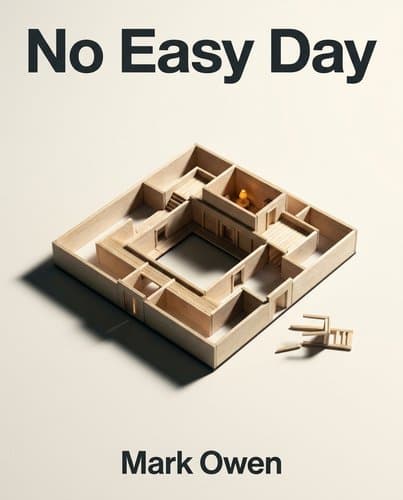
15814872_no-easy-day
by Mark Owen, Kevin Maurer
A firsthand account of the bin Laden raid reveals that elite operators don't eliminate chaos—they train to sprint through it. Mark Owen exposes the gap between…
In Brief
A firsthand account of the bin Laden raid reveals that elite operators don't eliminate chaos—they train to sprint through it. Mark Owen exposes the gap between Washington's polished narrative and the improvised, dangerous reality on the ground that night in Abbottabad.
Key Ideas
Preparation determines crisis response speed
Preparation doesn't eliminate chaos — it determines how quickly you move through it. The SEAL team rehearsed the Abbottabad raid on a full-scale replica, which is why a crashed helicopter in the first sixty seconds didn't stop the mission.
Protect operators from leadership interference
Elite performance requires insulating ground-level experts from well-intentioned interference from above. The 'Good Idea Fairy' — top-down tactical suggestions from people not bearing the consequences — is a real operational hazard in any high-stakes environment.
Discipline appears as deliberate restraint
Restraint is a trained skill, not an absence of action. The point man's decision not to shoot two rushing women, and the team's deliberate creep toward bin Laden's room rather than a Hollywood breach, reflect professional discipline that looks like inaction but isn't.
Victory hides individual operational cost
The gap between institutional celebration and personal cost is real and structural. The operators who executed the mission were told to go quiet while Washington managed the story — a pattern worth recognizing in any organization that uses individual performance for collective credit.
Mission achievement leaves future undefined
Defining yourself entirely by a single mission — however significant — creates a post-mission identity crisis. Owen's departure from the Navy after the raid is the honest conclusion of a decade spent pursuing one goal, with no plan for what follows.
Who Should Read This
History readers interested in Military History and Leadership who want a deeper understanding of how we got here.
No Easy Day
By Mark Owen & Kevin Maurer
11 min read
Why does it matter? Because the gap between preparation and chaos is where character actually lives.
Most people assume elite performance means the plan works. Train hard enough, rehearse long enough, and execution becomes inevitable — chaos is what happens to other teams. Then a Black Hawk helicopter carrying the most experienced special operations team in American history fell out of the sky before a single shot was fired at the most wanted man on earth. Not enemy fire. Not a mechanical failure anyone predicted. Physics, heat, and a courtyard wall. The mission continued anyway. That's the part nobody talks about: not the perfection, but what happens when perfection dissolves in the first thirty seconds and you're still expected to finish the job. No Easy Day is the account of a man who spent thirteen deployments learning that preparation isn't a guarantee — it's the only thing that keeps improvisation from becoming catastrophe. The distance between those two things is where elite actually lives.
Rehearsal Is Not the Same as Readiness — But It's the Only Path There
Somewhere in a North Carolina forest, a team of operators walked the halls of a building that didn't exist yet. It was made from shipping containers and plywood — a full-scale replica of a compound in Abbottabad, Pakistan — and the men moving through it were rehearsing a mission they weren't sure would ever get a green light. They walked it in daylight. They walked it in darkness, through four-tube night vision goggles that opened their field of view from the standard 40 degrees to a panoramic 120, a difference that sounds marginal until you're moving fast through a building you've never been in and need to see the corner before you turn it. They walked it until the geometry was in their feet.
SEAL Team Six manufactured readiness this way. Not through talent — though talent was assumed — but through obsessive, specific preparation. The replica wasn't symbolic. It was functional. Every doorway, every courtyard dimension, every approach angle had to be encoded in muscle memory because in the real building, twelve time zones away, there would be no pause to remember. The body had to already know.
What the preparation couldn't resolve was the mission's central fact. Everything rested on a man the CIA called The Pacer — a tall figure spotted on drone feeds walking the compound's courtyard in the same clockwise loop, day after day. The analyst assigned to the target told the assembled team she was completely certain this was their man. Owen had heard that language before. In 2007, a tip put his unit in the mountains at Tora Bora chasing a tall man in white robes who turned out to be no one. The intelligence had been confident then too.
So the team trained on a replica of a compound that might be empty. They memorized approach routes to a building they had never touched. They calibrated gear across years of prior missions, knowing the current mission's central fact — whether the right man was inside — was something no amount of rehearsal could verify. That uncertainty wasn't a flaw in the planning. It was the condition they accepted and then set aside, because the alternative was to not go at all.
The Plan Fails in the First Sixty Seconds
Owen was sitting on a small camp chair — the kind bought at a sporting goods store back in Virginia Beach — as the Black Hawk closed on Abbottabad. The seats had been stripped from the helicopter to save weight, and so the most experienced counterterrorism unit in the world was making its final approach on the most significant raid in modern military history propped on the sort of furniture you'd bring to a youth soccer game. There is something useful in that image. It tells you exactly how fine the margin was between normal and impossible, and how little that margin seemed to matter to anyone on board.
Then the helicopter flared out to hover above the compound and something went wrong. The pilot fought the controls, the aircraft rocking as it hunted for stable air. Owen, perched at the door with the rope in his hand, was already weighing whether to throw it anyway, take his chances, get on the ground. The go-around call came instead — Plan A was dead, sixty seconds in — and as the helicopter tried to climb out, it spun ninety degrees to the right, hard and fast. Owen felt himself rising off the floor, his body tilting toward the open door. Walt's grip tightened on the carry loop at the back of his armor. Owen pulled his legs into his chest, reasoning that if the fuselage rolled and caught his legs underneath, that would be the end of it. The wall of the compound was coming up at him sideways. The engines screamed.
The tail caught the privacy wall and the nose drove into the courtyard floor. Owen was stopped so abruptly he didn't register the impact. Walt shoved him from behind — two words, no ceremony: get out — and Owen dropped into the dirt and ran. Thirty yards clear, he turned back and saw what should have been a catastrophe: the Black Hawk nose-down at a steep angle, tail boom snagged on the wall, rotors still churning the air, his teammates already moving toward the compound gate.
Preparation doesn't buy you a plan that survives contact. Nothing does. What it buys you is a team that can absorb a helicopter crash in the first minute of the most rehearsed mission of their careers and not slow down. Owen's next thought, by his own account, was that Charlie and Walt were already moving and if he stood there gawking he would never hear the end of it. That's not posturing — that's what the rehearsal actually bought them. The emergency had already been processed and filed. There was a building to clear.
The 'Good Idea Fairy' Is the Enemy of Every Expert
The greatest threat to a well-designed plan is often the people above it. Owen coined a name for the phenomenon: the Good Idea Fairy, his term for suggestions that float down from senior levels, generated by people with authority over the mission but no exposure to its physical realities. The suggestions arrive in the spirit of helpfulness. They land like sand in the gearbox.
The clearest example from the Abbottabad planning: someone above the operational level proposed placing a fake police light on a civilian car and parking it near the compound to create a plausible local presence. The men who would actually run toward that building, in the dark, under noise discipline, carrying sixty pounds of gear, recognized immediately what the idea's author apparently didn't — that a prop car with a novelty light introduces variables no operator can control and solves no problem that professional tactics hadn't already addressed. The team had spent weeks encoding the compound's geometry into their nervous systems. They didn't need a prop. They needed the chain of command to trust the preparation it had funded.
McRaven's Go order eventually cut through the noise — the admiral delivered it cleanly, and the mission launched. But Owen's account makes clear that the distance between a good plan and what gets executed is never just a function of enemy action. It's also a function of how much institutional energy gets spent defending the plan from well-intentioned interference. Every hour a team spends managing upward is an hour not spent on the problem itself. The Good Idea Fairy doesn't arrive as an obstacle. It arrives as a superior officer, and it requires a particular kind of discipline — patient, political, invisible in the final record — to send it back empty-handed. That night, it went back empty-handed.
The Killing of Bin Laden Looked Nothing Like the Movies
Professional violence, done well, is slow. That's the detail Owen's account keeps returning to, and it's the one that most completely dismantles every action-movie assumption about what the breach of bin Laden's room actually looked like.
On the third floor, the point man reached the landing ahead of the others and spotted a figure in a doorway about ten feet down the hall — a man peering out, testing the darkness. The shots came: two suppressed rounds, barely louder than a staple gun. Then the team did something most people wouldn't predict. They waited. They crept. Owen is explicit about this: nobody bounded up the final steps, nobody rushed the door with a weapon raised. They moved to the threshold and peered inside the way you'd look into a room where you'd heard something fall. The man was already on the floor at the foot of a bed, the point man's rounds having caught him in the head. Two women stood over him, screaming. When the younger one charged the doorway, the point man dropped his rifle to the side and drove both women into the corner with his body — a calculation made in fractions of a second that if either of them was wearing a vest, the distance between them was already too close for anyone else to matter.
Owen entered behind him. He and another operator put laser sights on the man's chest and fired until he stopped moving. Then Owen scanned the room.
What he found was a bedroom. Three small children sat frozen in the corner by the sliding glass door, too stunned to make noise. On a shelf nearby sat a box of Just For Men hair dye — the kind sold in every pharmacy in the Western world, belonging to a man who had spent a decade in hiding and apparently still cared about going gray.
The restraint is the point. In a firefight, speed and noise feel like control — they feel like you're doing something. The discipline to slow down when the threat is partially neutralized, to not fill a dark room with rounds, to stop and look before you act — that's the harder skill, and it's the one that kept three children alive in the corner. What separates trained operators from the cinematic version isn't how fast they move. It's knowing when not to.
The Point Man Made a Decision That Can't Be Taught
Back up to the hallway, the moment before the women charged.
The team had just cleared the doorway — two women in sleeping clothes stood over the man crumpled at the foot of the bed, wailing. The younger one looked up, saw the point man, and rushed him. The hallway was barely five feet wide. No room to create distance, and distance is the currency of survival in that situation. He swung his rifle out of the way and drove both women bodily into the corner.
Owen's gloss, stripped down: a selfless decision made in a split second. That phrase is doing specific moral arithmetic. If either woman had been wearing a suicide vest — a reasonable operational assumption in that compound, in that decade — pressing his body against theirs would have taken the blast and probably saved everyone behind him. He made that trade without being asked to. The institution didn't make it. His training didn't make it. He made it, alone, in the dark, in the time it takes to blink.
The weight the system places on individual operators is never fully acknowledged. Training can encode building layouts. Rehearsal can automate breach sequences. Neither one can install the willingness to absorb a blast radius so the man six feet behind you can walk out of the building. That readiness lives somewhere below procedure, and the person who carries it also carries its cost — whether the vest was real or not, whether anyone in the debrief mentions it or not. Owen mentions it. That's the whole point of mentioning it.
Confirmation Was More Surreal Than the Killing
What does it feel like to confirm that you've just killed the most wanted man in the world? The question sounds like it belongs to the movies — a dramatic pause, something said over a radio, someone shaking hands. The reality Owen describes is a forensics problem, and a frustrating one.
Once the room was cleared, the team shifted into Sensitive Site Exploitation — the clinical process of documenting and collecting evidence before the helicopters came back. Owen knelt beside the man on the floor and wiped blood from his face with a blanket to get a clean photograph. The feature he was trying to capture: the nose. Intelligence analysts had described the target's nose as long and slender, an identifying marker visible even in grainy drone footage, and now Owen was cleaning a dead man's face the way you'd wipe a counter to get a better look at a scratch underneath. The violence of the previous three minutes was over. This required patience.
Then came the bone marrow sample. Two spring-loaded syringes, designed to core into bone and extract tissue for DNA matching, both failed to fire. The most consequential identification in American counterterrorism history — ten years of intelligence work, two wars of collateral pressure — was temporarily stalled because two pieces of medical equipment malfunctioned on a bedroom floor in Pakistan. Someone eventually got the sample another way, but the image is hard to shake: operators in full kit, kneeling beside a dead man with a broken syringe, improvising.
The final confirmation didn't come from the sample or the photograph. It came from the compound's own people. A child on the balcony, and eventually a wife, who under pressure said the name. The sheikh. Osama bin Laden. The word 'Geronimo' went up the chain to the admiral and then to the president.
What SSE does, procedurally, is force the team to slow down and fully inhabit the room they're standing in. During the assault, movement is the insulation — you're always going somewhere, always doing the next thing. The exploitation phase removes that. You're kneeling beside a dead man with a blanket and a broken syringe, in a bedroom with children's clothing on the floor, and the decade-long abstraction called Osama bin Laden is just a person in front of you. That's where the weight arrives. Not during the shooting.
The World Celebrated While the Operators Were Told to Go Quiet
By the time the team landed back in Virginia Beach and was told to keep a low profile, the story had already escaped. Washington was leaking. Officials who had watched the raid on screens in a secure conference room were briefing reporters. The operational details the team was instructed to sit on were appearing in press accounts attributed to sources with security clearances and no personal exposure to the compound's third floor. The asymmetry was complete: the people who'd carried the physical risk were asked to go quiet, while the people who'd carried the political risk took their share of the credit publicly.
The meeting with President Obama at Fort Campbell was exactly what you'd expect. Professional. Unremarkable. Owen had no grievance with the man, but he also had no illusions about what the event was — a formal obligation that exists to be photographed.
On the flight back from Abbottabad, a CIA analyst named Jen — who had spent roughly ten years of her professional life trying to locate one specific man — was found curled in the fetal position on the floor of a C-130, sobbing. Owen had worked alongside her in the lead-up to the raid, and he knew what the decade had cost her. The crying wasn't performance. It was the body releasing something it had been holding for a very long time. Everyone else, including Owen himself, moved through the return with the same professional containment they'd brought to the assault. Jen didn't. That's the only fully unguarded emotional moment in Owen's account of the aftermath, and it lands harder for being surrounded by people who kept it together.
Owen eventually left the Navy. He describes it as a clean exit — the mission he'd been working toward since watching the towers fall had finally closed. But the structural irony stayed with him. The moment a covert operation succeeds, it stops belonging to the people who ran it.
When the Mission Is Done, Who Are You?
What do you do when the thing you've spent a decade becoming is no longer needed? Owen's answer is contained in a single word he uses in the Author's Note to explain why he wrote the book: closure. He spent thirteen consecutive combat deployments inside the most elite counterterrorism unit in the American military, and when it was over, he needed a word for what the book was for. He chose the one that therapists use. That's worth sitting with.
Owen's identity was built entirely around forward pressure — the next deployment, the next target, the next iteration in the kill house. From the moment he watched the second plane disappear into the South Tower from a barracks television in Okinawa, the decade that followed had a shape: find the man responsible. Train for it, deploy for it, lose teammates to it, miss your family's holidays for it. The mission gave everything else its meaning. And then, on a bedroom floor in Pakistan, it was done. The target was on the ground. The word went up the chain. The helicopters came back.
The institution that produced Owen was designed for one thing: the next mission. It selected for men who could process a crisis in real time and keep moving, who calibrated gear and tactics across years of accumulated deployment knowledge, who built their entire professional identity around perpetual readiness. It had no equivalent architecture for the moment when the defining mission was complete and nothing carried the same weight. Owen left the Navy. He says he wrote the book so a kid in junior high might read it and want to be a SEAL. That's a generous explanation. The more honest one is in the title he chose for his chapter on the mission's end: something finished, and the person who finished it had to figure out who he was without it.
The Question the Book Can't Quite Answer
Owen never directly asks the question underneath everything he writes: what do you do when your enemy was also your purpose? He found bin Laden. He put laser sights on a man's chest in a domestic bedroom and fired until the problem was solved. Then he went home, shook a president's hand, and left the Navy. The sequence makes a kind of terrible sense. But the institution that made him was built entirely for forward motion — it had no architecture for the morning after the last mission. What you're left with, reading between Owen's careful lines, isn't a story about triumph. It's a portrait of a man who built himself around a decade-long purpose, achieved it completely, and then had to figure out who he was once the weight was set down — not on the next target or the next deployment, but permanently. No follow-on mission. No new grid coordinate. Just the rest of his life.
Frequently Asked Questions
- What is 'No Easy Day' about?
- 'No Easy Day' provides a firsthand account of the SEAL Team Six raid that killed Osama bin Laden, written by Mark Owen, one of the operators on the ground. The book combines tactical detail with broader lessons on elite performance under uncertainty, exploring how rigorous preparation enables improvisation, why ground-level expertise outperforms top-down management, and the personal identity crisis that follows a career built around a single defining mission. It's both a procedural account and a meditation on what happens to individuals when their value becomes inseparable from an extraordinary achievement.
- How does 'No Easy Day' explain the relationship between preparation and performance?
- Preparation doesn't eliminate chaos—it determines how quickly you move through it. The SEAL team rehearsed the Abbottabad raid on a full-scale replica, which is why a crashed helicopter in the first sixty seconds didn't stop the mission. Owen demonstrates that elite performance requires translating meticulous planning into real-time improvisation. Rather than a script to follow, rigorous preparation creates muscle memory and decision-making frameworks that allow operators to adapt instantly when reality diverges from the plan. This principle applies beyond military contexts to any high-stakes environment requiring sustained excellence.
- What does 'No Easy Day' reveal about organizational decision-making in high-stakes environments?
- Elite performance requires insulating ground-level experts from well-intentioned interference from above. Owen identifies the 'Good Idea Fairy'—top-down tactical suggestions from people not bearing the consequences—as a real operational hazard. The book argues that the gap between institutional celebration and personal cost exposes a structural pattern: operators execute the mission while Washington manages the narrative, leaving those who bore actual risk in silence. This dynamic extends beyond the military to any organization where frontline expertise conflicts with institutional messaging or where individual performance becomes fodder for collective credit-claiming.
- What does 'No Easy Day' suggest about identity after extraordinary achievement?
- Defining yourself entirely by a single mission—however significant—creates a post-mission identity crisis. Owen's departure from the Navy after the raid represents the honest conclusion of a decade spent pursuing one goal with no plan for what follows. The book also emphasizes that restraint is a trained skill, not an absence of action; the point man's decision not to shoot two rushing women reflects professional discipline that looks like inaction but isn't. Owen explores how operators grapple with life after their defining moment, when external recognition collides with internal emptiness.
Related Book Summaries


Read the full summary of 15814872_no-easy-day on InShort