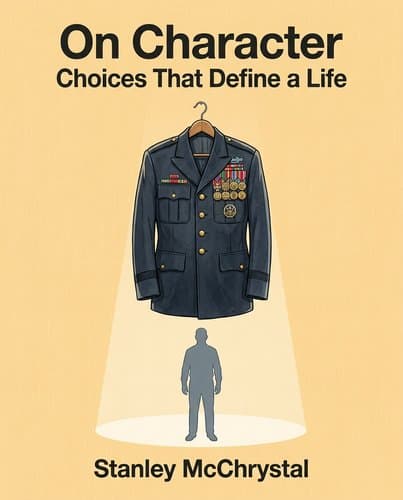
220551965_on-character
by Stanley McChrystal
Character isn't what you're born with—it's a daily equation: convictions multiplied by discipline, where either variable hitting zero collapses everything.
In Brief
Character isn't what you're born with—it's a daily equation: convictions multiplied by discipline, where either variable hitting zero collapses everything. McChrystal reveals how to stress-test your beliefs, audit your real priorities, and build the kind of character that holds under pressure.
Key Ideas
Calendar Reveals True Priorities
Write down your stated priorities, then track how you actually spend your time for one month — the discrepancy between the two lists is your real character audit, more honest than any self-assessment
Stress-Test Inherited Beliefs
Distinguish belief (inherited from your tribe, institution, or upbringing) from conviction (what survives deliberate interrogation) — until you've stress-tested a belief, you don't actually know if you hold it or if it holds you
Conviction Times Discipline Equals Character
Apply the Character = Convictions × Discipline formula as a diagnostic: if a value you claim to hold has produced no changed behavior under pressure, one of the two variables is likely zero
Distinguish Hard from Merely Painful
When facing a painful setback, ask whether the situation is genuinely hard (many who attempt it fail) or merely painful (feels terrible but failure isn't required) — most career and life pivots are the latter, which means survival requires only one thing: don't quit
Would You Recognize Your Rationalization?
Before rationalizing an action that compromises your values, ask whether you would recognize the same reasoning as rationalization if someone else used it to justify their behavior — General Johnson circling the White House is a useful test case
Silence Always Serves Someone's Interests
Stop treating silence on important questions as neutral or principled — ask whose interests your silence actually serves, and whether you'd be comfortable with that answer
Who Should Read This
Thoughtful readers interested in Leadership and Self-Improvement willing to slow down and wrestle with ideas.
On Character: Choices That Define a Life
By Stanley McChrystal
13 min read
Why does it matter? Because the character you claim to have and the character you actually live are almost certainly different — and you can close that gap.
He spent thirty-eight years preparing for the moment his career would end — imagined it as a hero's defeat, the kind that earns a respectful nod from history. Instead, it ended in a White House anteroom, with a resignation accepted before lunch. Not glory. Not tragedy. Just a quiet, professionally worded conclusion. McChrystal is honest about this, which is exactly why the book is worth your time. Character is a product, not a possession — and that's an uncomfortable thing to sit with, because it means the work is never finished and the assumptions you've been coasting on may already be wrong. The question he's really asking isn't whether character matters — everyone already claims it does, usually loudly, usually about themselves. The question is whether you're actually constructing it, day by day, through the friction of hard choices, or whether you've been assuming it accrues automatically from good intentions and a decent track record. That's what the formula makes concrete: convictions times discipline. Drop either variable to zero and the whole thing collapses. The only question left is which one you're currently lying to yourself about.
The Math That Makes Character Feel Impossible to Ignore
Picture a retired four-star general standing in a corridor near the Oval Office, his uniform layered with nearly four decades of ribbons, combat bars, and the quiet authority of someone who had commanded troops in active war zones for six of the previous seven years. Stanley McChrystal had survived everything the battlefield could throw at him. What ended his career was a magazine article he'd barely read — a Rolling Stone profile whose fallout took less than an hour to dissolve thirty-eight years of military service into a handshake resignation with the president.
McChrystal is upfront about what happened next: not enlightenment, not a graceful pivot, but years of replaying the sequence, recalculating it, imagining other outcomes that never arrived. What the experience eventually forced, though, was a harder question than 'what went wrong.' It forced him to ask who he actually was underneath the uniform — and he found he couldn't answer it cleanly.
That admission is where this book begins, and it's worth sitting with for a second. Here is a man whose life résumé could fill a wall, telling you his convictions are still a work in progress at nearly seventy. Not false modesty — a mathematical claim. McChrystal proposes a formula: Character = Convictions × Discipline. Two variables multiplied together. The brutal implication isn't that character is hard to build; it's that it can collapse to zero the moment either variable does. You can hold the most admirable beliefs imaginable, but without the discipline to act on them, the product is nothing. Conversely, iron self-control aimed at hollow convictions produces nothing worth having. Both inputs have to be real, and both have to hold.
Which means character isn't a thing you've earned. It's a thing you're either maintaining or losing, right now. McChrystal isn't offering comfort. He's offering precision.
The Difference Between What You Believe and What You've Actually Decided
Belief and conviction feel like the same thing until someone separates them for you. McChrystal does it with a single memory: arriving at West Point as a nineteen-year-old in 1972 and immediately absorbing the Academy's motto — Duty, Honor, Country — without having worked out what any of those words meant to him personally. He believed them because belonging to that institution required it. The belief was real, but it came preloaded. It took years before he could say those words and feel like he'd actually chosen them.
That gap is everything. Belief, in McChrystal's accounting, is what you absorb from your tribe, your family, your institution — the inherited firmware of your identity. Conviction is what happens after you've interrogated that inheritance and decided, deliberately, what survives the scrutiny. Most of us never take that second step. We carry our beliefs into adulthood intact, never realizing we're still running software installed when we were too young to read the license agreement.
The stakes of that distinction become grotesque when you look at the suicide bombers who killed fifty-seven civilians at Amman wedding receptions in 2005, acting on behalf of al-Zarqawi's network. Their commitment was absolute. By any external measure, they had conviction — purpose, certainty, willingness to die. The bombers had absolute commitment. What they didn't have was a single moment of honest interrogation about where that commitment came from. Fervor without friction isn't conviction. It's just belief with a detonator.
The move McChrystal is asking you to make is uncomfortable: stop assuming your values are yours because you hold them. Ask when you actually chose them.
The Pie Chart You Don't Want to Look At
How confident are you that the way you spend your Tuesday actually reflects what you say matters most to you? Not what you intend, not what you'd claim in a job interview or a eulogy — but what your calendar and your habits would testify to if they could talk.
McChrystal ran this experiment on himself while commanding forces in Afghanistan, and the results were humbling enough that he kept running it. Each month, he'd tell his staff where his time should go, what deserved his attention most. At the end of the month, the staff would map his actual hours against those stated priorities in a set of pie charts. The gap, he admits, was usually substantial. A man responsible for one of the most complex military campaigns in recent history, with decades of hard-won discipline behind him, consistently failed to spend his time the way he'd explicitly said he would. He describes facing those charts as painful. He kept doing it anyway, because the pain was the point — the data forced his daily decisions back into contact with his stated values, rather than letting the narrative in his head substitute for the reality on the page.
Most of us never run this experiment. We know what we care about — family, health, meaningful work — and we assume that knowing is most of the battle. It isn't. Knowing is just the beginning of a gap that widens invisibly, every day, between the person you think you're being and the person your actual choices are building. McChrystal's argument is that this gap is normal, nearly universal, and only visible when you measure it rather than narrate it. The story you tell yourself about your priorities is almost always more flattering than the evidence. The pie chart doesn't care about the story.
Convictions Without Discipline Are Just Opinions You Haven't Tested Yet
Somewhere in Yakima, Washington, during a 1999 winter training exercise, a seventy-three-year-old man was walking alone through sub-zero snowfall. Colonel Ralph Puckett — Korean War veteran, Medal of Honor recipient, honorary commander of the Ranger Regiment — had vanished from his assigned position. When a young Ranger reported him missing, McChrystal's response was, by his own admission, something north of alarm. Rangers scattered. They found Puckett exactly where a leader is supposed to be: moving the defensive line, crouching into foxholes, talking to soldiers scraping frozen ground with their bare hands. No fanfare. No announcement. Just an old man in a snowstorm doing what the conditions demanded, because the conditions demanded it. 'Particularly if they sucked,' as McChrystal puts it.
That image is a useful place to start thinking about what discipline actually is — not rules, not grinding compliance, not the military version of making your bed. Puckett wasn't out there because someone ordered him to be. He was out there because his convictions about leadership had been reinforced by so many repetitions over so many decades that the behavior had become automatic. The belief and the action had fused. That's what discipline actually does: it closes the gap between what you say you value and what you do at two in the morning in a snowstorm when nobody's watching.
Without that closure, convictions are just preferences with better branding. Puckett had spent fifty years getting tested — in Korea, where he held a hill with a depleted company until he was nearly killed, and in every training cycle afterward where he could have stayed warm and let younger men do the walking. By the time he stepped into that Yakima snowstorm, the walk wasn't a choice he had to make. It had already been made, thousands of times over. A conviction you've never acted on under pressure isn't a conviction. It's a self-description you haven't verified yet.
The equation cuts both ways. Rangers' standards were prescribed down to the specific knots used to attach gear — not to strangle initiative, but to eliminate variables so leaders could adapt to chaos without the foundation shifting beneath them. That's discipline without conviction: pure compliance, mechanically efficient, morally empty. What made Puckett's walk through the snow mean something wasn't the walk itself. It was that the walk expressed, without words, what he believed a leader owed the people he led. Strip the conviction out and you have a cold old man walking in circles. The whole thing only works when both sides are genuine.
The Siren's Call: How Good People Rationalize Their Way Out of Their Values
Late one night in the mid-1960s, Army Chief of Staff General Harold K. Johnson — a man who had survived the Bataan Death March, led troops in Korea, and built a career on the kind of moral seriousness that people write biographies about — ordered a car from the Pentagon motor pool. He was going to the White House to resign. The Vietnam War was going wrong in ways he understood better than almost anyone, and he disagreed with both the battlefield strategy and the president's refusal to mobilize the reserves his military judgment said were essential. His values were clear, his course was set, and the car was on its way. Then, as it approached the White House, he told the driver to keep going. Circle the mansion. Back across the river. Back to the office. He stayed on, telling himself he could do more good from inside than out. He second-guessed that decision for the rest of his life.
Johnson wasn't a coward. He wasn't cynical. He was a man with tested values reasoning his way, one defensible step at a time, to an outcome he would never fully make peace with. That's what rationalization looks like when it operates on a good person — not a sudden surrender to greed or fear, but a chain of individually plausible logic, each link feeling like wisdom until you look at where the chain ends.
McChrystal asked Yale students whether they'd endorse torturing a captured terrorist to locate a nuclear weapon set to detonate in hours, and watched idealistic twenty-year-olds say yes almost unanimously, with barely a pause. He found himself unable to condemn them. If his own family were in that city, he thinks he'd say yes too. The thought experiment isn't designed to settle the question — it's designed to show you how fast the 'I would never' dissolves once the stakes are framed the right way. Add enough pressure, give it the right emotional weight, and almost any principle becomes negotiable.
The drift is rarely dramatic. It's usually a slightly uncomfortable silence, a joke you laughed at when you shouldn't have, a board meeting where you stay in the room one year too long. McChrystal's argument is that each small compromise doesn't just bend your values — it recalibrates what you think zero looks like. The next decision doesn't get measured against who you were before; it gets measured against who you became after the last one. You don't end up somewhere unrecognizable in one step. You walk there incrementally, and each step felt reasonable at the time.
Perspective Isn't an Excuse — But It's Not Nothing Either
A United States senator and forty Pashtun elders sit on the floor of a mud-walled room in Helmand province. Senator Carl Levin — attorney, career legislator, a man steeped in the mechanics of American democracy — has just challenged the group: every single vote in the district went to Hamid Karzai. How, he asked, could that possibly count as democracy? The elders conferred, and then one stood and answered with quiet precision. The community had deliberated together, chosen the candidate they believed would serve the district best, and agreed to vote as a bloc rather than split their influence. Then the elder turned the question around: how was that not exactly what democracy was about?
Two internally coherent positions. Neither man was confused, or lying, or acting in bad faith. They simply arrived at the meeting having traveled completely different roads.
If he had been born into the life of an al-Qaeda suicide bomber — same parents, same community, same losses — McChrystal thinks he'd hold that man's views. He isn't saying this to excuse anything. He's saying it because it changes what kind of problem we're actually dealing with. When two sides are fighting over land or resources, a deal is at least theoretically possible — you can divide what's divisible. When two sides are fighting over reality itself, over what democracy means or what God requires, there's nothing to split. The conflict isn't a negotiation. It's a collision of formations, each one shaped by a journey the other side hasn't taken.
Perspective can be a real force without becoming a permission slip. Understanding how someone arrived at a belief doesn't obligate you to accept it. The Pashtun elders' logic about bloc voting doesn't make it right for every context. But once you accept that perspective is a product of environment rather than a failure of intelligence or morality, the work of disagreement changes. You can no longer win an argument simply by demonstrating that the other side is wrong. You have to reckon with the journey that produced the wrong — which is harder, and slower, and doesn't end with a verdict.
When Silence Is the Most Dangerous Position You Can Take
Understanding how people drift into bad beliefs doesn't fully account for something McChrystal finds equally troubling: capable people who haven't drifted, who know better, and who say nothing anyway. Silence feels principled. Staying out of the brawl, refusing to wade into tribal arguments, keeping your credibility intact by refusing to spend it — this reads like wisdom. McChrystal spent decades watching that logic operate, and his conclusion is blunt: when capable, credible people opt out, they don't preserve neutrality. They hand the room to whoever shows up.
His sharpest illustration comes not from a battlefield but from a series of conversations he calls gut-wrenching to watch. A politician, privately repulsed by a nominee's behavior, stands before a microphone and pledges full support anyway. McChrystal's comparison is deliberate: men imprisoned in Hanoi's worst facilities broke under systematic torture and then spent years clawing their way back to some sense of self. The politicians he describes faced fundraising dinners and donor calls. The people who survived actual captivity at least had an excuse.
What makes that tolerable — to the politicians themselves, to the voters watching — is the same machinery that makes any drift feel reasonable. You tell yourself the stakes are high enough to justify the compromise. You tell yourself you'll do more good inside the tent. You tell yourself the alternative is worse. Each step has its own clean logic, and none of them feel like surrender until you look back at the distance you've traveled.
McChrystal's point is that silence and complicity are different words for the same inaction. When people with standing, experience, and credibility stay quiet because the cost of speaking feels too high, what fills the space isn't calm — it's whoever has the least to lose. Staying out of it isn't the high road. It's just a more comfortable way of choosing a side.
After the Fall: The Difference Between Hard and Painful
After his resignation, McChrystal had to travel for work — airports, concourses, strangers. He'd catch someone pointing him out to a companion and immediately assume the worst: that they were cataloguing his disgrace, reciting his failures to each other like a cautionary tale. He projected his own verdict onto them without evidence, and it took weeks of hearing people stop to say kind things before he could admit his assumptions had been wrong every time.
That detail matters because it illustrates what he eventually identified as the real danger after a fall: confusing painful with hard. He draws a clean line between the two. Hard means the odds are genuinely against you — many who attempt it won't make it through. Painful means it's going to feel terrible while you do it. Most people treat them as synonyms, which turns survivable situations into ones that feel predetermined. If something is hard, the question is whether you have the talent. If something is only painful, the question is simpler: are you willing to keep going?
The first weeks after the resignation were painful in almost every direction — the airport gauntlets, the retirement ceremony he almost skipped, the period of hiding before forcing himself back to work. None of it required exceptional talent to survive. It required not quitting. He returned to teaching, joined boards, started a business. The people he worked with judged him on current performance rather than old headlines, and slowly the gap closed between the person the news had described and the person showing up in the room. The renewal wasn't dramatic. It was just what happens when you keep moving.
The Final Arithmetic: Why the Heavier Load Is Still Worth Carrying
Think about the scoreboard at the end of a game that was already decided by halftime. McChrystal uses exactly this logic when he pictures his own funeral at Arlington — the three rifle volleys, the folded flag, the haunting final notes of Taps — and then points out that the ceremony is identical for soldiers of admirable and poor character alike. Same caisson. Same white headstone. Every road, regardless of the terrain you chose, ends at the same patch of grass. So why carry the heavier load?
His answer comes from a military axiom most of us will never have to test: the hardest battles are the ones with no realistic hope of victory, and yet soldiers fight them anyway, because the willingness to fight for what matters is itself the thing that matters. The outcome and the effort are not the same currency. One is what the scoreboard reads; the other is what the game actually was. McChrystal extends this without sentimentality — he isn't arguing that effort always triumphs, or that character guarantees a particular life. He's arguing something harder: that a life without the discipline to close the gap between your values and your behavior is an emptier room to live in, regardless of how it ends.
He admits, without hedging, that his greatest remaining challenge is exactly that gap — not the distance he already closed, but what's still left between the character he shows and the character he knows he's capable of. Not triumph. Ongoing effort. The young Ranger on that forced march, silently relacing a boot over a wound that should have ended his day, wasn't performing courage for an audience. He was making a quiet decision about who he was going to be. That's the final arithmetic: not what the headstone says, but whether you carried what you believed all the way to the end.
The Gap Is the Work
The ceremony at Arlington is identical for everyone. Three volleys, folded flag, Taps fading into the tree line — and then the same white stone, whether the man underneath spent his life closing the gap between his values and his behavior or quietly widening it. McChrystal's point isn't that character gets rewarded. It's something older and less comfortable: certain battles deserve to be fought even when the outcome is already written, because going through the motions and meaning it look identical from the outside, and the only place the difference lives is in you. You won't find that on any headstone. You'll only find it in the daily, mostly private decision about whether who you're being today is closing the distance toward who you're capable of being — or letting it drift. That decision doesn't get easier. It just gets more yours.
Notable Quotes
“Recognizing that I volunteered as a ranger…”
“that has made all the difference.”
“I will never leave a fallen comrade to fall into the hands of the enemy.”
Frequently Asked Questions
- What is 'On Character' by Stanley McChrystal about?
- On Character argues that character is not a fixed trait but a daily choice expressed through Convictions × Discipline. Retired General Stanley McChrystal draws on military leadership and historical examples to provide readers with a diagnostic framework for auditing actual values, distinguishing inherited beliefs from tested convictions, and building behavioral consistency. The book challenges the assumption that character is static, instead positioning it as something shaped by deliberate choices made under pressure. McChrystal's framework helps readers understand what they truly value versus what they claim to value, providing practical tools for character development.
- What is the Convictions × Discipline formula in McChrystal's character framework?
- In McChrystal's framework, Convictions × Discipline serves as a diagnostic formula for evaluating character. Convictions are beliefs that have survived deliberate interrogation—not inherited assumptions but values you've actively tested and chosen. Discipline is the behavioral consistency that expresses these convictions under pressure. The formula works mathematically: if either variable approaches zero, the entire product collapses. McChrystal suggests that if a value you claim to hold has produced no changed behavior under pressure, one of the two variables is likely zero. This means you either don't genuinely hold the conviction or lack the discipline to act on it.
- How can you audit your actual values according to the book?
- McChrystal offers a practical auditing method: write down your stated priorities, then track how you actually spend your time for one month. The discrepancy between these two lists reveals your true character more honestly than any self-assessment. This exercise exposes the gap between espoused values and lived values. McChrystal argues this real-world tracking is far more revealing than introspection or self-reporting, because it captures what you genuinely prioritize when making daily choices. By honestly comparing intention with action, you can identify where discipline fails to support your convictions, or where your convictions may be weaker than you thought.
- What is the difference between belief and conviction in McChrystal's framework?
- McChrystal distinguishes belief from conviction as fundamental to understanding character. A belief is inherited from your tribe, institution, or upbringing—absorbed rather than chosen. A conviction survives deliberate interrogation and stress-testing. Until you've actively examined a belief through rigorous questioning, you don't actually know if you hold it or if it holds you. Beliefs can be comfortable and unexamined; convictions require intellectual honesty about whether they truly reflect your values when pressure is applied. Building character requires transforming inherited beliefs into tested convictions through deliberate examination and lived experience.
Related Book Summaries
Read the full summary of 220551965_on-character on InShort