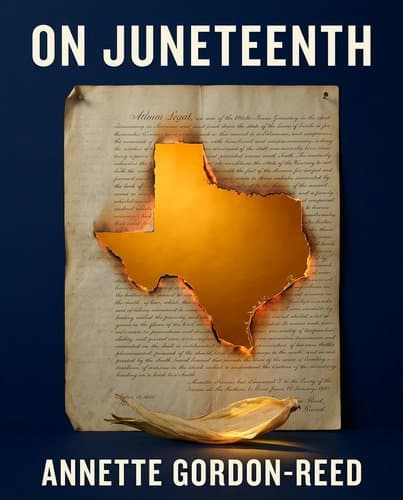
55298325_on-juneteenth
by Annette Gordon-Reed
Texas built its myths—the Cowboy, the Rancher, the Oilman—to bury the figure who made Juneteenth necessary: the Slave Plantation Owner.
In Brief
Texas built its myths—the Cowboy, the Rancher, the Oilman—to bury the figure who made Juneteenth necessary: the Slave Plantation Owner. One Black Texan historian dismantles that erasure, revealing Texas not as an exotic exception to America but as its most concentrated, unacknowledged expression.
Key Ideas
Slavery, not federalism, drove Texas independence
Texas's revolt against Mexico was not about federalism — Stephen F. Austin argued in writing that without enslaved labor, Anglo settlers would 'be poor for the rest of their lives.' The Texas Republic was founded explicitly as a slaveholder's state, internationally isolated and recognized by almost no one, and was annexed to the U.S. partly to secure that slave economy against British abolitionist pressure.
Black counter-narratives deserve equal evidentiary standing
The historical archive is not neutral. Records produced by people who attended lynchings as picnics and cheered open courtroom murders encode the oppressor's perspective. When Black communities maintained counter-narratives, those accounts deserve equal epistemic standing — not as 'alternative history' but as evidence produced by people who were systematically prevented from making official records.
Historical starting points are themselves political choices
The 1619/Jamestown origin story for Black American history is an artifact of Anglo-centric nationalist framing, not an accurate account. Estebanico — a Black Arab Muslim from Morocco — walked across Texas in 1528, nearly a century before Jamestown, and served as chief translator for the Cabeza de Vaca expedition because of his extraordinary talent for languages. Choosing where to start a history is itself a historical act.
Texas Constitution guaranteed permanent slavery, banned Blacks
The 1836 Texas Constitution was explicit: it banned free Black people from residing in the republic, forbade Congress from ever emancipating the enslaved, barred enslavers from freeing enslaved people without legislative consent, and deliberately omitted Jefferson's 'all men are created equal.' The erasure of slavery from Texas's origin myth was a choice made against documents that said the opposite.
Juneteenth order reversed Confederacy's racial cosmology
General Order No. 3 on June 19, 1865 was not administrative paperwork. Placed against Alexander Stephens' Cornerstone Speech — which declared the Confederacy 'the first government in the history of the world' founded on the principle that Black people are not equal to white people — Granger's order announced the inversion of an entire racial cosmology. The violence that followed was a direct response to that magnitude of reversal.
True belonging requires clear-eyed criticism
Loving a place and criticizing it sharply are not in tension. Gordon-Reed's argument — demonstrated in the gap between Jefferson the theorist and Jefferson writing his will — is that belonging is made of specific people and places, not myths, and that you cannot serve the hopes you hold for somewhere without a clear-eyed view of what it has done and still does.
Who Should Read This
History readers interested in World History and Social Issues who want a deeper understanding of how we got here.
On Juneteenth
By Annette Gordon-Reed
11 min read
Why does it matter? Because Texas isn't the exception to America's story — it's the most honest version of it.
When outsiders started celebrating Juneteenth, Annette Gordon-Reed felt possessive in a way she recognized immediately: that belongs to Texas. It's a reflex every Texan knows — the certainty that nothing that happened there can be understood from outside. She doesn't dismiss the feeling. She follows it to its source. The territorial instinct that made Juneteenth feel like Texas property, she finds, is the exact machinery that erased the figure who made Juneteenth necessary: not the Cowboy or the Oilman or the Rancher, but the Slave Plantation Owner, who arrived in East Texas not for frontier adventure but to rebuild Mississippi's cotton economy on unpaid labor. Texas, it turns out, was never an exotic exception to the American story. It was the American story, running hotter and more visible than almost anywhere else. This book is what it looks like to love a place enough to say so — and to trace exactly how the story got buried.
Texas Didn't Fight Mexico Over Federalism — It Fought to Keep Enslaved Labor
The standard story you'll find in Texas schoolbooks frames the 1836 revolt against Mexico as a dispute about federal overreach: Anglo settlers who wanted to be left alone, pushed too far by a centralizing government. Gordon-Reed spent her school years inside that story. It wasn't until later that she understood what the textbooks omitted: Stephen F. Austin had written down exactly what Texas was about, and it had nothing to do with liberty in the abstract.
Austin's lobbying to Mexican legislators was explicit. Anglo settlers could not clear forests, plant crops, and ship them to Gulf Coast ports without unpaid labor. Any family that tried it alone would come up poor. Austin told everyone who would listen that without legal protection for slavery, the Anglo colonies would fail. This wasn't an ideology — it was a business plan. The right to enslave was the economic foundation, and Austin stated it plainly, in writing, to the people whose laws stood in the way.
When the Mexican government kept gesturing toward abolition (it had restricted the importation of enslaved people and continued to signal that the institution couldn't last), Anglo-Texans found a solution: revolution. The Republic of Texas, founded in 1836, was a slaveholder's state. Internationally isolated, recognized by almost no one, perpetually broke after the Panic of 1837, and vulnerable to both Mexico and growing British abolitionist pressure, it survived less than a decade before annexation to the United States in 1845 secured the slave economy against all of it.
What came afterward was a different story. Gordon-Reed points to the Balcones Escarpment, a limestone fault line that divides Texas's wet, forested east from its dry, sparse west. More Texans have always lived on the eastern side, in the plantation country where Austin built his colonies. After Appomattox, the cattle drives that followed gave Texas a replacement myth — one that began in 1865, left the enslaved out of the frame, and traveled well. Cattle drives, tumbleweeds, Giant shot in Marfa: the western image became the face of Texas. The plantation east, where the economic logic of the whole enterprise actually lived, was buried underneath it.
Texas history classes exhorted students to remember the Alamo and remember Goliad. The revolt against Mexico was a founding myth worth honoring. What those lessons never quite answered was the follow-up question: freedom from Mexico to do what, exactly?
The Historical Record Was Made by People Who Attended the Lynching
In June 1941, in a Conroe, Texas courtroom, W.S. "Dude" Cochran walked to the front of the room and shot Bob White in the back of the head. White died instantly. Cochran handed the gun to the prosecutor. Bond was set at $500. His trial lasted three hours. The jury deliberated two minutes and returned "not guilty." The judge, lawyers, officers, and dozens of spectators had all watched the murder happen. No one moved to stop it.
What made this moment possible was everything that came before. White had been accused of raping Ruby Cochran, a white woman, in 1936. Fifteen Black men were brought from a cotton field for her to identify her attacker; she couldn't pick one by sight but identified White by voice after authorities had him repeat phrases she said the assailant used. He was arrested. Texas Rangers, then the state's enforcers of racial order, took him nightly into the woods, chained him to trees, beat him, and threatened to kill him until he signed a confession he couldn't read. He had no lawyer. He was convicted and sentenced to die. Then something rare happened: the case reached the Supreme Court, which overturned the conviction on due process grounds. A retrial was ordered. Cochran was waiting.
The official record of all this is clear enough. What it doesn't contain is what Gordon-Reed's stepgrandfather — a man who knew both White and the Cochrans — passed down: that White and Ruby Cochran had been involved, that White talked openly about it, and that when her husband found out, events followed from there. The Black community in Conroe and Livingston maintained this counter-narrative across generations. It never entered any archive. Black people under that system had little ability to create official records, and were sometimes actively prevented from witnessing events at all, as when roads into Conroe were blocked before Joe Winters was burned alive on the courthouse square in 1922.
No moral framework makes the account produced by people who cheered Cochran's acquittal more credible than the one passed down by people legally excluded from making official records. We take for granted that documentation — court transcripts, newspaper accounts, school curricula — is a neutral approximation of what happened. But documentation requires access, and access was controlled. The archive in these East Texas cases was built by people who picnicked at lynchings, who applauded during the prosecutor's closing statement, who returned a not-guilty verdict in two minutes and found nothing worth examining. The counter-narrative survived without institutional support. Treating the first as neutral and the second as suspect is a political choice dressed up as a question about evidence.
Black History in the Americas Didn't Begin at Jamestown — and Choosing to Say It Did Was a Decision
Controlling the record determines not just whose lives get believed, but where the clock starts.
Where does the story of Black Americans begin? Most people would say 1619, the year twenty Africans arrived in Virginia, and they'd be offering an answer that feels like historical fact but is actually a design decision. The 1619 date isn't wrong, but treating it as the starting point required ignoring roughly a century of earlier history, and Gordon-Reed argues that choice was never neutral.
By 1619, Spanish colonizers had already built an organized system of racially-based slavery in St. Augustine, Florida — in 1565, more than fifty years earlier. The Spanish also chartered a settlement in 1735 for enslaved Africans who escaped English colonies and reached St. Augustine, keeping parish records of births and deaths that Protestant colonies simply ignored. French colonizers had enslaved populations across Louisiana. The English won the territorial contest, and nationalist history followed the winners. The Spanish and French became also-rans, their Black populations written out, and a narrow frame locked into place: Black people arrived from Africa, learned English, worked on plantations. That's where they lived and who they were.
The cost of that frame becomes visible in a single figure Gordon-Reed's Texas education mentioned only in passing. Estebanico was a Black Arab Muslim from Azamor, on the Moroccan coast: enslaved, forced to convert to Christianity, brought to the Americas as part of a Spanish expedition of three hundred people in the 1520s. After hurricanes, attacks, and illness collapsed the mission in Florida, survivors crossed the Gulf of Mexico on rafts. Estebanico made it to what would become Texas with about fifty others; three other parties died. His group was enslaved for six years by tribes along the Texas Gulf Coast before escaping. What followed was a years-long walk across Texas to the Pacific. Cabeza de Vaca, who survived to write a memoir of the ordeal, names Estebanico as the expedition's indispensable translator, called upon by Spanish and Indigenous peoples alike because of his gift for languages.
Emily West got a different kind of erasure, two centuries later in the same territory. She was a free Black woman from New York with an indenture contract in Texas when Santa Anna's army swept through in April 1836 and took her. She didn't choose to be in his camp. The legend that grew around her cast her as the "Yellow Rose of Texas": a spy who seduced a general into distraction while Sam Houston's forces gathered, a captive rewritten as an agent. Gordon-Reed recovers the actual woman: free, from New York, with a contract and a legal status the myth didn't need.
That's the detail the narrow frame couldn't accommodate. A man enslaved twice over, walking across a continent, keeping a party alive through communication. A free woman whose captivity got rewritten as cunning. Gordon-Reed's schooling presented Estebanico as a curiosity during "Spanish exploration" — decoupled from anything that followed. The omission was structural: the plantation template needed Black people to appear without a history of capacity, and both had too much of one.
The Texas Founders Put Their Racial Logic in Writing — and Then Dared Anyone to Notice
The 1836 Texas Declaration of Independence deliberately dropped Jefferson's language about the equality of all men. Gordon-Reed names the omission directly: there was no place for that language in a fight where race and culture were the whole point. What the founders wrote instead were numbered provisions. Section 9 of the Texas Constitution stated that enslaved people "shall remain in the like state of servitude." Congress was barred from ever emancipating them. Enslavers were barred from freeing them without legislative consent — the right to dispose of one's own property, suspended, because the property was people and the founders feared freedom more than they trusted markets. Section 10 defined citizenship as belonging to "All persons, (Africans, the descendants of Africans, and Indians excepted)." Free Black people required congressional approval to live in the republic permanently.
The men who died at the Alamo had enslaved people with them. Travis brought a manservant named Joe; Bowie had a cook named Betty. When Travis drew his famous line in the sand and invited volunteers to choose their fates, Joe and Betty got no invitation. They were legally property. That detail was absent from Gordon-Reed's fourth-grade and seventh-grade Texas history classes. So was Bowie's biography: he'd made his fortune slave-trading alongside the pirate Jean Lafitte, then renounced his American citizenship to gain land advantages in Mexico. The mythology needed the Alamo's defenders to be men of principle. The documents they produced said exactly what those principles were.
Gordon-Reed grew up learning to remember the Alamo. The question the curriculum never quite answered was what the men who died there were building. The answer was in print. It always had been.
Granger's Order Didn't Just Announce Freedom — It Announced the Inversion of Everything the Confederacy Was Built On
Two days before General Gordon Granger landed in Galveston on June 19, 1865, Black men working the city's wharves were already shouting. When other workers asked what they were celebrating, the answer was simple: we're free. Port cities carry information the way rivers carry sediment: through every ship, every dockside conversation. The men who loaded Texas cotton onto vessels headed for world markets knew what was coming before the general's boat arrived.
When Granger's troops fanned out across Galveston to read General Order No. 3, the proclamation did two things. The first sentence announced the obvious: all enslaved people were free. The second sentence said something the Confederacy had been founded specifically to prevent: "an absolute equality of personal rights and rights of property between former masters and slaves." The same word Jefferson had written into the Declaration of Independence — equality — dropped into a Texas where that word had been deliberately, legally erased.
To understand why the second sentence was the more explosive, read what Alexander Stephens said in March 1861, in what became known as the Cornerstone Speech, when he was laying out the Confederacy's founding logic as the Confederacy's vice president. He was direct. Jefferson's claim that all men are created equal was not merely incorrect, Stephens argued — it was "a sandy foundation," an error that had caused decades of "agitating questions" about slavery. The Confederate government, he said, was founded on the opposite premise: "the great truth that the negro is not equal to the white man." He noted, without embarrassment, that it was "the first, in the history of the world" built explicitly on that principle.
That cosmology had produced a specific social order. General Order No. 3 announced that every piece of it was wrong. If the Order had simply ended slavery (left the formerly enslaved as near-peons with curtailed rights, which Texas eventually imposed), Whites would still have been furious. But the Order said something different: former masters and former property now stood as equals. Gordon-Reed puts it plainly: announcing the end of slavery would have been shocking. Announcing equality was a different order of magnitude.
In at least one Texas town, Whites responded by whipping dozens of freed people for celebrating. The logic was coherent, in its brutal way. The celebration was itself a claim to the equality the Order had announced. If you understood what Stephens had put in writing four years earlier, and what Granger had just answered back, you understood why the shouts on the Galveston docks were not merely festive. They were the sound of a cosmology collapsing.
Loving a Place and Criticizing It Sharply Are Not in Tension — They Are the Same Act
Think of someone who argues, on principle, that no person can love a country that treats them as less than human — then, in the document where he frees five men he enslaved, petitions the state legislature to let them stay. Not because the principle was wrong. Because applied to actual people in an actual place, the principle stopped being the point.
That's Jefferson: theorist and will-writer. In Notes on the State of Virginia, he argued Black Americans could not love a country that didn't love them — better off somewhere else. Tidy logic. Then he died, and the will needed words. He freed five men — John Hemings among them — and asked Virginia to exempt them from a law that would otherwise force them out within a year or back into slavery. His reason: Virginia was where "their families and connections" were. The abstraction dissolved when he had to write about people he knew by name.
Gordon-Reed uses that gap as her own answer. When asked how she can love Texas, given everything this book has described, she doesn't offer a theory. She offers a thirty-five-mile drive. Her father took her to Huntsville for piano lessons with Mrs. Tull, a professional classical pianist, because her mother had decided her daughter needed it. ("What on earth did my mother think was going to happen with that?") That drive is not a metaphor. It is what belonging looks like from close up.
The book's final argument is that love requires exactly this: you have to see the hard parts clearly and say so. You cannot hold real hopes for a place without an honest accounting of where it has failed. That is not a contradiction of love. It is what love looks like when it means something.
What the Tamales Actually Prove
The tamales are the argument. Corn husks, pork, masa — a Mesoamerican dish, made by Black Texas women, to celebrate emancipation inside a Methodist church. Everything Texas law had worked to keep apart — formerly enslaved people and public ceremony, Mesoamerican food traditions and emancipation celebrations, Black women and the Protestant church — brought to one table. Gordon-Reed doesn't offer this as poetry. She offers it as evidence: that belonging can be built in defiance of every statute that said it couldn't exist.
That's what you're left with. Not a theory of love for difficult places, but love in its actual form — the thirty-five-mile drive for piano lessons, the grandmother at the kitchen counter, the tin buckets of red soda water on a June afternoon. Specific, stubborn, unresolved. She never claims Texas deserved any of the love it received from the people it worked hardest to exclude. She just insists, with all the documents in front of you, that the people who made it possible were worth it.
Notable Quotes
“storm came and the wind blew.”
“Slavery is over. And former slaves will now become the equivalent of peons on the land of whites, with severely diminished to nonexistent legal, social, and political rights”
“The American Civil War was not about slavery. It was about states' rights,”
Frequently Asked Questions
- What is On Juneteenth about?
- On Juneteenth traces how Texas deliberately erased slavery from its founding myth, replacing it with the Cowboy and the Rancher. Historian Annette Gordon-Reed, drawing on her experience as a Black Texan, demonstrates that Texas was not an exception to American racial history but its most concentrated expression. The book provides documented evidence of what Juneteenth actually commemorates, challenging popular misconceptions about Texas's founding and relationship with slavery. Rather than viewing the state as uniquely progressive, Gordon-Reed positions it as emblematic of broader American patterns of historical erasure and racial violence—patterns that were not truly broken until the emancipation proclaimed on June 19, 1865.
- What role did slavery play in Texas's founding according to the book?
- Texas's revolt against Mexico was explicitly driven by slavery interests, not federalism. Stephen F. Austin argued that without enslaved labor, Anglo settlers would 'be poor for the rest of their lives.' The Texas Republic was founded as a slaveholder's state—internationally isolated and recognized by almost no one—and was annexed to the U.S. partly to secure that slave economy against British abolitionist pressure. The 1836 Texas Constitution made this explicit: it banned free Black people from residing in the republic, forbade Congress from ever emancipating the enslaved, barred enslavers from freeing enslaved people without legislative consent, and deliberately omitted Jefferson's 'all men are created equal.'
- What does Gordon-Reed say about Black counter-narratives to official history?
- Gordon-Reed argues that historical archives are not neutral. Records produced by people who attended lynchings as picnics and cheered open courtroom murders encode the oppressor's perspective. When Black communities maintained counter-narratives, those accounts deserve equal epistemic standing — not as 'alternative history' but as evidence produced by people who were systematically prevented from making official records. This principle reshapes how we evaluate historical authority. Gordon-Reed insists historians recognize oppressed communities' documented memories as primary evidence essential to understanding the past, not subordinate interpretations.
- Why does Gordon-Reed challenge the 1619/Jamestown narrative about Black American history?
- Gordon-Reed argues that the 1619/Jamestown origin story for Black American history is an artifact of Anglo-centric nationalist framing, not historical accuracy. Estebanico—a Black Arab Muslim from Morocco—walked across Texas in 1528, nearly a century before Jamestown, and served as chief translator for the Cabeza de Vaca expedition because of his extraordinary talent for languages. Choosing where to start a history is itself a historical act, one laden with assumptions about whose presence counts. By beginning with Jamestown, historians implicitly marginalize earlier Black presence in what became the United States, reinforcing the invisibility Gordon-Reed argues Texas itself perpetuates.
Related Book Summaries
Read the full summary of 55298325_on-juneteenth on InShort