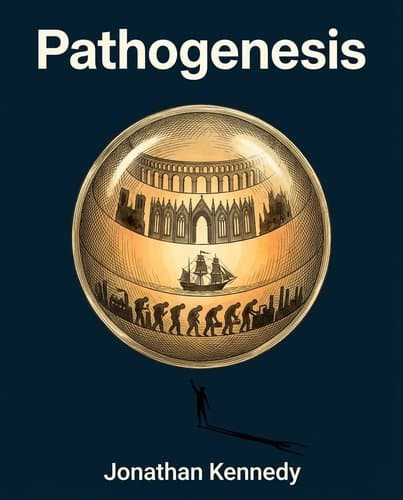
61327450_pathogenesis
by Jonathan Kennedy
Behind every empire's collapse, every religion's rise, and every revolution's success, a microbe struck first. Kennedy reveals how epidemics—not leaders…
In Brief
Behind every empire's collapse, every religion's rise, and every revolution's success, a microbe struck first. Kennedy reveals how epidemics—not leaders, ideas, or economic forces—were the true architects of human civilization, from prehistoric migrations to the birth of the modern welfare state.
Key Ideas
Epidemics, not leaders, shaped historical transitions
When a major historical transition is credited to a leader, a religion, or an economic system, check what epidemic preceded it — you will almost always find one that collapsed the old order first.
Disease resistance determined slavery's racial categories
Racial categories in American slavery weren't purely ideological inventions: they tracked differential immunity to yellow fever and malaria, with West African resistance making enslaved Africans 'economically preferable' to European indentured laborers in tropical regions where Europeans died in droves.
Neanderthal genes still protect modern humans
Your immune system carries genetic remnants of Neanderthal and Denisovan interbreeding — including variants that protect against RNA viruses like influenza and HIV. You are, in a literal genomic sense, made partly of the people your ancestors replaced.
Political power, not wealth, improved health
The great 19th-century health improvements in Britain came not from economic growth or medical advances but from a specific political event: the 1867 Reform Act enfranchised working-class men who didn't pay local rates and wanted sewers — breaking the shopocracy's decades-long veto on sanitation spending.
Policy choices created the global health gap
The 30-year life expectancy gap between the world's richest and poorest nations is not a natural condition produced by wealth differences — it is the traceable result of specific decisions in the 1980s to defund the WHO, redirect money to the World Bank, and impose health-budget cuts via structural adjustment programs.
Antibiotic resistance accumulates quietly into catastrophe
Antimicrobial resistance already kills more than 1.2 million people annually from previously treatable infections, and the death toll is rising. Unlike COVID-19, it will not announce itself with a single dramatic wave — it will accumulate quietly until routine surgeries and common infections become life-threatening again.
Who Should Read This
History readers interested in World History and Biology who want a deeper understanding of how we got here.
Pathogenesis
By Jonathan Kennedy
9 min read
Why does it matter? Because the political, religious, and economic structures you inhabit weren't built by visionary humans — they were forced into existence by specific epidemics.
Pick any turning point in history (the spread of Christianity, the collapse of Rome, the conquest of the Americas, the birth of capitalism) and you'll find a story about human vision, ideology, or power. Jonathan Kennedy finds something else behind each of them: an epidemic. Not as backdrop. As cause. His argument is that the structures you inhabit today — the religions, the racial categories, the economic systems, even the relative wealth of nations — weren't built by visionary humans pursuing ideas. They were forced into existence by specific epidemics most history books treat as footnotes, and the leaders and ideologues who came after got credit for navigating the aftermath. The humans were real. They just usually arrived after the microbes had already broken everything open.
Your Body Is Not Entirely Yours
Think of your body the way you think of your home: something built for you, shaped entirely by your own history. Now consider: 8 percent of your DNA was installed by viruses.
Not as damage, not as noise in the code — as working architecture. Between 100 and 200 million years ago, a small shrew-like creature was infected by a retrovirus. Retroviruses reproduce by inserting their code into a host's DNA. When this one infected a reproductive cell, the viral code was copied into every cell of every subsequent generation. And one of those viral genes encoded a protein that would change mammalian history.
That protein is what makes the placenta work. The organ that lets a mammal grow her offspring inside her own body (rather than in an egg) requires an extraordinary trick: the placenta must attach to the uterine wall, commandeer its blood supply, and ferry nutrients across the barrier, all without triggering the mother's immune system to destroy the fetus as foreign tissue. The protein that performs this feat is nearly identical to the one retroviruses use to slip inside cells without provoking an immune response. The placenta wasn't slowly refined by natural selection. It was acquired in a single infection. Without that ancient virus, every mammal alive today — including you — would hatch from an egg.
Homo Sapiens Didn't Replace Neanderthals Because We Were Smarter — We Replaced Them Because We Were Sicker
The standard story — Homo sapiens outcompeted Neanderthals because we were smarter — gets almost every detail wrong.
Consider what Neanderthals actually did. They manufactured fire on demand, sailed open water to reach Crete, produced glue from birch bark, and used poplar bark and Penicillium mold as medicine (the same compounds humanity would later refine into aspirin and penicillin). In northern Iraq, a 45,000-year-old skeleton reveals a male who survived to middle age despite being blind in one eye, partially amputated on one arm, and profoundly deaf from birth. He could not have fed himself. Someone fed him for decades. You don't care for a burden unless you recognize a person. Margaret Mead argued that human civilization begins when we care for the weak — by that measure, Neanderthals were already civilized.
The real explanation is simpler and more brutal: Homo sapiens arrived from Africa carrying diseases Neanderthals had never encountered.
Tropical Africa, with its extraordinary density of animals and insects, generated far more pathogens than glacial Europe. When our ancestors and Neanderthals encountered each other in the Eastern Mediterranean, they exposed one another to pathogens neither had met. Contact was lethal in both directions. An invisible barrier prevented sustained migration for tens of thousands of years.
The barrier lifted through interbreeding. Modern Europeans carry roughly 2 percent Neanderthal DNA, most of it clustered around immune response: resistance to RNA viruses like influenza and HIV, first acquired around 50,000 years ago, exactly when Homo sapiens broke out of Africa. Interbreeding was accidental vaccine exchange: Neanderthals supplied both the disease and the antidote.
Once Homo sapiens had that immunity, they pushed into Eurasia. Neanderthal and Denisovan populations, which had never faced African pathogens, collapsed. Not because we were smarter. Because they were immunologically defenseless.
Plague Chose Christianity and Islam
Why did Christianity spread? The standard answer reaches for theology: Jesus promised eternal life, monotheism was intellectually cleaner than a squabbling pantheon, the message of redemption gave suffering a shape. All of this is true. None of it explains the timing.
Christianity had barely 100,000 followers across the entire Roman Empire by the early third century — about the same proportion as Sikhs in the United States today. Then the Plague of Cyprian arrived. For fifteen years starting in 249 CE, a hemorrhagic fever tore through the empire. Alexandria's population fell from 500,000 to 190,000. And in the middle of all this, the two faiths behaved in starkly different ways.
When plague hit a Roman city, wealthy pagans fled. Those who stayed avoided the sick. The bishop of Alexandria watched pagan families abandon their loved ones in the streets, leaving them half-dead. Christians did the opposite. Their theology held that acts of care were how you earned your place in heaven, so they stayed and nursed, strangers and pagans alike. Basic nursing: keeping fever patients hydrated, keeping them fed. Rodney Stark calculated this reduced mortality by up to two-thirds. Christians survived at dramatically higher rates. The pagans they'd saved watched their own families die while these strangers lived. The effect looked miraculous. By 312 CE, the emperor Constantine converted. By 380, Christianity was the empire's official religion. Stark's conclusion: without the Antonine and Cyprianic plagues, Christianity might never have achieved this.
The same logic, different pathogen, built Islam. The Plague of Justinian shrank the Byzantine army from 350,000 to 150,000. It was bubonic plague — Yersinia pestis DNA from sixth-century skeletons across Germany, France, and Spain confirms it. The Persian Sasanian Empire took an equivalent hit. The nomadic Arab Bedouins, living beyond the reach of settled society, were far less exposed to the rat-borne fleas that spread the disease. Arab commanders who had spent years fending off Byzantine raids marched into Syria in 636 and found an army less than half its former size, not beaten by battle but hollowed out by plague. When Muslim armies pushed deeper into the Middle East, they weren't conquering a civilization at its peak. They were walking into a ruin. Kennedy's verdict is flat: without Yersinia pestis, Islam as a world religion probably doesn't exist.
The Black Death Didn't Just Kill Half of Europe — It Killed Feudalism
On March 21, 1349, a merchant named Kalman von Wiehe pressed 30 kilos of silver and gold into his basement wall. The haul included thousands of coins and a wedding ring, a miniature Gothic tower with "Mazel Tov" cut in Hebrew across the roof. He sealed it and left. He never came back. The mob that killed von Wiehe that day killed every Jew in Erfurt. The treasure sat in the wall for 650 years.
The well-poisoning story that triggered these killings spread faster than the plague itself. When Strasbourg's city council polled neighboring towns on whether to believe it, eighteen of nineteen said yes. Emperor Charles IV wasn't merely indifferent — he wrote to nobles promising them Jewish property of those "who have already been or may still be killed." The logic was sometimes economic: Augsburg's mayor, who opened his gates to the mob, was heavily indebted to Jewish moneylenders. No creditors, no debt. Three hundred fifty attacks followed. Sixty large communities were destroyed. Survivors fled east to Poland, seeding the shtetl culture that produced the Yiddish writer Sholem Aleichem and the painter Chagall, until the Russian pogroms, and then the Holocaust.
Medieval Europeans didn't become murderous out of ideology — they became murderous because 60 percent of the continent was dying and someone had to be responsible. The scapegoating and the looting were inseparable.
The demographic math also ended feudalism. When more than half a workforce dies, laws meant to hold it in place stop working. English lords tried to freeze wages at pre-plague levels; anyone who moved for better terms got branded on the forehead with the letter "F" for falsity. The Peasants' Revolt of 1381 failed. But the numbers didn't. Land was everywhere, labor was nowhere, and lords eventually competed for the peasants they'd been trying to chain. By 1750, English agricultural productivity had risen 50 percent while France, which rebuilt feudalism through centralized taxation instead, suffered two famines that killed 2 million people.
Cortés Was Losing the War When Smallpox Arrived
On the night of June 30, 1520, Hernán Cortés was fleeing for his life.
He'd been in Tenochtitlan for seven months, not as a conqueror but as a guest inside the Mexica capital, a city four times the size of Seville on an island lake connected to the mainland by causeways. When open war broke out, the Mexica attacked from every direction. Two-thirds of the Spanish force died on the causeways or drowned under the weight of looted gold. A 2-kilogram ingot excavated during construction work in downtown Mexico City in 1981, along the exact escape route, was dated to 1519 or 1520. The treasure was real. So was the defeat.
Cortés was decisively beaten by a much larger force defending its own capital. The guns and steel that are supposed to explain European dominance couldn't deliver a victory when the Mexica were fully mobilized. They had slingshots that hurled baseball-sized rocks at high velocity, quilted armor so practical that many conquistadors adopted it. They had numbers, terrain, and every reason to fight.
A few weeks after the rout, a soldier from fresh Cuban reinforcements introduced smallpox to the city. The virus moved faster than any army could. Within months, between a third and a half of the population was dead — including Cuitláhuac, the emperor who had led the victorious defense. Less than a year later, Cortés re-sieged Tenochtitlan for seventy-five days. Ninety-nine and a half percent of his forces came from indigenous tributary states, also eventually swept by the epidemic. The conquistadors watched while the city collapsed around them.
Jared Diamond's argument that European weapons would have guaranteed conquest regardless collapses right there. The weapons had already failed. A pathogen turned a rout into an empire.
Fifteen American States Exist Because of a Mosquito
The racial logic of American slavery was, at its core, an epidemiological calculation.
European colonists in the Caribbean and American South tried importing indentured laborers from Britain and Ireland — and watched them die. Yellow fever and malaria killed Europeans in tropical conditions at catastrophic rates; West Africans, repeatedly exposed since childhood, had acquired immunity. Elena Esposito tracked 3,000 slave sale records from Louisiana between 1719 and 1820 and found that enslaved Africans from the most malaria-endemic parts of West Africa commanded significantly higher prices than those from healthier regions. Plantation owners were making precise epidemiological calculations. The racial hierarchy that followed was the ideology built to justify the economic decision already made.
The clearest proof is Haiti. In 1789, the French colony of Saint-Domingue produced two-fifths of the world's sugar, all on the forced labor of nearly half a million people. When enslaved Africans rose up in 1791 and slavery was abolished, Napoleon sent 65,000 troops to reconquer it a decade later. The rebel commander Jean-Jacques Dessalines knew exactly what weapon he had. His strategy was simple: avoid pitched battle, retreat into the mountains, and wait. "The whites from France cannot hold out against us here," he told his troops. "They will fight well at first, but soon they will fall sick and die like flies." When the rainy season arrived and the mosquito population exploded, the French fell fast. Napoleon's brother-in-law wrote back: "The colony is lost... What general could calculate on a mortality of four-fifths of his army?" He died of yellow fever that November. More than 50,000 of Napoleon's 65,000 soldiers died, nearly all from yellow fever. The rebels were barely touched.
Haiti declared independence on January 1, 1804. Napoleon, stripped of his Caribbean base, sold France's entire North American territory to the United States for $15 million. Fifteen states were carved from that purchase. The mosquito didn't just shape slavery — it drew the map.
Today's Global Health Gaps Are a Political Choice, Not a Natural Condition
Why is a Nigerian child expected to die thirty years before a Japanese one? The obvious answer — poverty — is only half right. It tells you where you are, not who put you there.
Britain's public health gains didn't come from getting richer. Between the 1820s and 1860s (peak Industrial Revolution), life expectancy in England and Wales barely moved. In Manchester, factory laborers could expect to live to seventeen. The wealth existed. The technology existed. What was missing was political will, and it arrived only when the wrong people were made uncomfortable.
In the summer of 1858, a heat wave cooked the Thames into sludge. The smell penetrated the Houses of Parliament. Politicians held handkerchiefs over their noses; most retreated to the countryside. Within weeks, Parliament commissioned London's sewer network: 318 million bricks, 82 miles of underground tunnels. After 1866, cholera disappeared from Britain.
Nine years later, the 1867 Reform Act enfranchised working-class urban men for the first time. These new voters didn't pay local property taxes and had everything to gain from sanitation investment. The shopkeepers who had blocked infrastructure for a generation, voting to keep rates low while people died, lost their grip on municipal politics. Within two decades, provincial death rates fell sharply, almost entirely from the collapse of waterborne disease.
The technology and money had existed for fifty years. What changed was who held political power.
Today's thirty-year gap follows the same logic in reverse. When antiretroviral drugs for HIV were developed in the mid-1990s, pharmaceutical companies priced a year's treatment at $10,000 in a region where average annual income was under $600. Generics cost $350. Pressure campaigns took a decade to force generic access; over that decade, at least 10 million people died of a treatable disease. Their governments had been hollowed out by structural adjustment programs — IMF loan conditions that required cutting health budgets in exchange for debt relief.
These deaths weren't a failure of science or of wealth. They were the outcome of deliberate decisions: about patents, about funding, about who holds power and for whose benefit. The only mechanism history has found for closing gaps like these is the one that finally built London's sewers: state investment, driven by people who can no longer escape the consequences of ignoring it.
The Microbes Don't Care — Which Is Exactly Why We Have To
The paradox Kennedy leaves you with is this. The entire book has argued that microbes — not generals, not prophets, not markets — wrote most of the history you thought you knew. Plague chose Christianity. A mosquito drew fifteen state lines. A retrovirus built the placenta. Human agency was always smaller than we believed.
And yet the thirty-year life expectancy gap between rich and poor nations isn't biology. It's a ledger of deliberate choices. London got its sewers not because it got richer, but because parliament could no longer breathe around the problem. That's Kennedy's final exhibit: the only mechanism history has found to redirect pathogens is public investment, made by people who can't avoid the consequences. Microbes run the long game. But who holds political power is still a human decision. And that, after all of this, turns out to matter enormously.
Notable Quotes
“by exposing them to a novel pathogen, but also the”
“Christianity might never have become so dominant a faith.”
“pagans believed in an unattractive existence in the underworld.”
Frequently Asked Questions
- What is Pathogenesis about?
- Pathogenesis argues that microbes — not leaders, ideologies, or economic systems — are the primary drivers of civilizational change. Jonathan Kennedy traces how epidemics collapsed existing orders across human history, from the spread of Homo sapiens to the rise of capitalism and the modern welfare state, offering readers a new lens for understanding why the world looks the way it does. Rather than crediting major transitions to individual leaders or economic systems, the book demonstrates how disease and immunity have fundamentally shaped human civilization throughout history.
- What are the main arguments in Pathogenesis?
- Pathogenesis presents a revolutionary perspective on historical causation. The central argument is: "when a major historical transition is credited to a leader, a religion, or an economic system, check what epidemic preceded it — you will almost always find one that collapsed the old order first." The book shows racial slavery categories in America tracked differential immunity to yellow fever and malaria, with West African resistance making enslaved Africans 'economically preferable' to European laborers. Additionally, your genome contains Neanderthal and Denisovan protective variants, while Britain's 1867 Reform Act—by enfranchising working-class sewage advocates—drove health improvements, not economic growth.
- How does Pathogenesis explain slavery through disease immunity?
- Pathogenesis reveals that racial categories in American slavery weren't purely ideological but tracked biological immunity patterns. Kennedy argues: "Racial categories in American slavery weren't purely ideological inventions: they tracked differential immunity to yellow fever and malaria, with West African resistance making enslaved Africans 'economically preferable' to European indentured laborers in tropical regions where Europeans died in droves." This wasn't random—colonizers deliberately chose enslaved Africans because their genetic inheritance from malaria-endemic regions provided survival advantages in disease-ridden environments where European settlers faced decimation. This demonstrates how epidemiological facts, not ideology alone, shaped slavery's brutal system.
- What does Pathogenesis warn about antimicrobial resistance?
- Pathogenesis identifies antimicrobial resistance as a critical emerging threat to civilization. "Antimicrobial resistance already kills more than 1.2 million people annually from previously treatable infections, and the death toll is rising. Unlike COVID-19, it will not announce itself with a single dramatic wave — it will accumulate quietly until routine surgeries and common infections become life-threatening again." Kennedy emphasizes this silent accumulation makes resistance particularly dangerous: without a dramatic signal like pandemic waves, societies may fail to respond adequately until the crisis becomes severe. The book positions this as a modern pathogenic threat rivaling historical epidemics in potential civilizational impact.
Related Book Summaries

Read the full summary of 61327450_pathogenesis on InShort