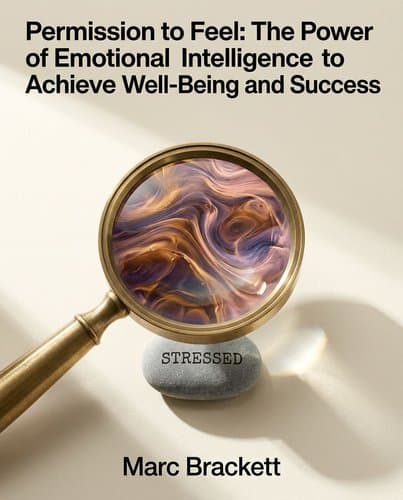
43782400_permission-to-feel
by Marc Brackett
Feelings aren't weaknesses to suppress—they're data points you've never been taught to read. Marc Brackett shows how becoming an "emotion scientist" instead of…
In Brief
Feelings aren't weaknesses to suppress—they're data points you've never been taught to read. Marc Brackett shows how becoming an "emotion scientist" instead of an "emotion judge" unlocks better decisions, deeper relationships, and the emotional intelligence our schools and families never gave us.
Key Ideas
Look Beneath Emotional Outbursts for Truth
Treat emotional outbursts as signals, not problems — before you respond to the behavior, ask what's underneath it. 'What's really going on?' is the most powerful question in this book.
First Answers Rarely Tell the Whole Story
Keep asking. The first answer someone gives when they're upset is almost never the real one. The college student said 'stress.' Three questions later: a dead grandmother and a mother who texts ten times a day.
Accurate Emotional Diagnosis Enables Right Response
Learn the distinctions between similar emotions: shame (external — others think you've broken a rule) is not guilt (internal — you think you broke a rule); stress (too many demands) is not pressure (something at stake in your performance). Wrong diagnosis, wrong response.
Body Language Must Show Genuine Curiosity
Your nonverbal posture while asking matters as much as the question. Eyes on the phone, arms crossed, or leaning away signals 'I already know what you're going to say.' Curiosity has to show in the body, not just the words.
Identify Triggers to Enable Self-Regulation
Name your triggers before you're in them. Anger, mess, repeated requests, snotty tones — parents name these instantly. Knowing them in advance is the gap where regulation becomes possible instead of accidental.
Your Emotional Climate Is Their Curriculum
The emotional climate you create at home is the curriculum your children are enrolled in — whether you designed it or not. Jason's coping script for his little brother is a precise readout of what that curriculum has been teaching.
Who Should Read This
Curious readers interested in Positive Psychology and Mental Health and the science of how the mind actually works.
Permission to Feel: The Power of Emotional Intelligence to Achieve Well-Being and Success
By Marc Brackett
9 min read
Why does it matter? Because every instinct you have when someone you love explodes emotionally is backwards.
You probably think you handle other people's emotions reasonably well. Not perfectly. You've lost your temper, said the wrong thing. But well enough. You know when to give space, when to say something, when to wait it out.
Here's what Marc Brackett spent decades learning: that instinct to manage, to contain, to move things along is exactly backwards. The moment someone erupts, your first thought is how to stop it. His question is different. He wants to know what it means.
Feelings aren't problems to be neutralized. They're data — specific, legible, often urgent — and most of us were never taught to read them. We inherited a culture that treats emotional outbursts as misbehavior and emotional silence as strength. Every family, every classroom, every workplace is still paying that cost. This book makes the case for a different first move: not how to handle the feeling, but what it actually is.
When Someone You Love Explodes, the Problem Isn't the Explosion
Marc Brackett is thirteen, sitting in his mother's car outside a martial arts studio. He has just failed his yellow belt test. Three months of daily practice. He had begged his instructor to let him sit the exam early. He was so nervous he didn't want his mother watching — she waited in the car.
He gets in. The door closes. And he detonates.
He screams that he hates her, that he's a loser, that she never should have let him go. His mother, who had been in the parking lot praying he'd passed, screams back. Stop it. How dare you talk to me that way.
When Brackett replays this scene in presentations years later, he asks the audience what he was feeling. Anger. Disappointment. Embarrassment. Humiliation. The answers come quickly, and you'd probably give the same ones. Everyone is confident. Everyone is guessing. They're inferring how he felt from what he did, or imagining how they'd feel in his shoes. Neither is curiosity.
Nobody thought to ask why. Not "what is he feeling?" but what was underneath it.
Brackett's father was a tough man from the Bronx who had pushed his bookish, bullied son into martial arts to toughen him up. Marc had practiced daily for three months not because he loved Hapkido but because he was trying to become what his father needed him to be. The failure wasn't a setback — it was a verdict. The screaming wasn't rage. It was the only language available to a kid who didn't yet have words for what the afternoon had just confirmed about himself.
His mother didn't ask. She answered his rage with hers, and the real cause stayed buried. This is the failure that plays out in homes, classrooms, and workplaces every day. An outburst happens. Adults treat it as a behavior problem: some version of "stop it" or "wait until your father gets home." Order is restored. The symptom gets managed. The disease goes untouched.
This isn't a case for endless therapeutic processing. The point is narrower: responding to an outburst with another outburst, or silencing one with a threat, guarantees the cause stays invisible. The only thing that could have found it was curiosity. Defensiveness kills that instantly.
You can't read that in a scream. You can only find it by asking.
Naming an Emotion Is Not the Same as Understanding It
Naming what you see isn't the same as understanding what it means. Emotion labels ("stressed," "angry," "embarrassed") are rough categories, not diagnoses. Treating someone based on the wrong label is like a doctor prescribing for the wrong illness: confident, well-intentioned, and entirely off-target.
A student emails Brackett at nine on a Sunday night before a midterm, asking for a makeup exam. A tournament weekend has left her "so fucking tired and stressed." She skips the exam. Over the following weeks she compounds it — an attitude in class, an offer to "let him know" what she'd like to work on at his center once she figures it out. Every encounter reads as entitlement. Brackett is irritated. He invites her to office hours anyway.
His first question: "What's going on?" Her answer: tremendous stress, same as every other college student.
He asks again. "What's really going on?"
What came out: her grandmother had just died. Her mother, terrified of her own mortality, texts her ten times a day and pushes for weekly visits or shows up on campus herself. The student had been calling all of this "stress" because stress was the available word, the thing people reach for when life feels unmanageable. But Brackett draws a precise line: stress is too many demands relative to the resources available to meet them; pressure is the perception that something at stake depends on your performance. What she was living with was neither. She was carrying grief she hadn't been given space to feel, absorbing her mother's fear, managing a relationship that left nothing in reserve. She needed support navigating a parent's anxiety, not time management strategies or an essay extension.
Most people, including the person in pain, will reach for the first word that fits well enough. It's close enough to feel true. It's not precise enough to be useful.
When a child says "I hate school," you know nothing useful yet. The label is hatred — but underneath it might be fear of a bully, shame from a public failure, or dread of an upcoming test. Asking through the label is what moves you somewhere. Every emotion has an underlying theme: anger is always a response to perceived unfairness, fear to perceived danger. Once you know the theme, you know which questions to ask next, and what kind of answer you're prepared to hear.
The label is where you start. Understanding is where you go.
The Emotional Climate You Grew Up In Was the School You Attended
Where did your emotional habits come from? Most people assume they're simply theirs: the temper, the avoidance, the instinct to fix everything before it gets uncomfortable. These feel like personality, something native to us. But they didn't come from nowhere. We learned them. And the classroom was the house we grew up in.
Brackett asks audiences worldwide to describe the emotional climate of their childhood home in a single word. Roughly 70% of responses are negative: words like stuck, toxic, suppressed, avoidant, unsupportive. Only 20% are positive. When he posed the same question to his own brother, the answer came back without hesitation — not a mood or an adjective, but three objects from the house they'd grown up in: an ashtray, a hanger, a belt. Brackett didn't need an explanation.
That's not a personality profile — it's a curriculum. Children don't choose the emotional lessons their homes teach. They absorb them the way they absorb an accent: before they have words for it, before they can question it. A child raised in a home where anger is answered with silence learns that conflict means withdrawal. A child who watches a parent explode and then act as if nothing happened learns that feelings are things to bury. A child who is never asked "what are you feeling?" learns that the question isn't worth asking.
The inheritance becomes invisible because it feels like personality. By the time we're adults, we've been practicing these patterns for decades. The father who shuts down when his child cries is following a script handed to him so early he forgot he received it. The mother who meets every emotional display with a solution is doing what she was taught: that discomfort needs fixing, not feeling.
Recognizing this is the starting place, not the indictment. The 70% figure doesn't mean most people had bad parents; it means most people were raised in homes that lacked tools, because those homes lacked them too. Emotional illiteracy runs in families the same way languages do: you can only pass on what was given to you. But unlike an accent, these patterns aren't fixed. Once you can see the curriculum you absorbed, you can decide what to keep teaching, and what you're ready to stop.
Children Don't Just Absorb Our Explosions — They Build Systems Around Them
The night David asked his father for batteries, his dad was already in the middle of a fight with his wife. The six-year-old didn't understand any of that. He knew only that he wanted to play his game, and his father was right there in the kitchen. "Dad-Dad-Dad-Dad-Dad-Dad." The father exploded. Half-chased the boy upstairs. Sent him to his room.
The next morning, the father found a note beside David's bed. The handwriting belonged to Jason, his ten-year-old brother, who had been learning emotion skills at school. The note was a coping script: Take three deep breaths. Daddy was just in a really bad mood. He will feel better tomorrow after he rests.
Jason hadn't written it to be seen. He'd written it because his little brother needed something to hold onto, and nobody else had given it to him.
This is what the "resilient child" narrative misses. Children don't simply weather emotional chaos and bounce back unchanged. They adapt to it, systematically and invisibly. Some grow hypervigilant, learning to read the barometric pressure of a parent's footstep in the hallway. Others learn avoidance, finding elaborate routes around whatever consistently explodes. Jason's adaptation was to build a script. His note wasn't precocious wisdom; it was triage. He had learned, somewhere in his ten years, that adult explosions happen and that surviving them requires a plan. The education he was receiving at home (what to expect from the adults in it, how to manage the aftermath) was being quietly passed to his younger brother in the dark.
Brackett tells parents something that silences a room: repeated blowups over time actually alter a child's developing brain. The stress systems that regulate fear and anxiety are especially vulnerable in childhood, and chronic exposure to unpredictable adult rage — appearing without warning, subsiding without explanation — keeps cortisol elevated long after any single fight. Years of that sustained stress reshape the amygdala itself. Parents sit very still, doing the math. Then Brackett adds that brain plasticity cuts both ways: the minute adults start regulating better, the brain begins to change. The room exhales. Then: that doesn't mean the damage already done disappears.
Jason told his father they should build a charter at home, like the one at his school: a shared agreement about how everyone in the family wanted to feel.
The Entire Method Fits in One Question, Asked Three Times
Think about what it actually takes to get a real answer from someone who's hurting. Most people assume it requires a therapist's training, unusual patience, or a gift for emotional intimacy. It doesn't. The skill is simpler and harder than that: when the first answer arrives, stay curious enough to ask again.
A college student emails Brackett at 9 PM the night before a midterm: she's exhausted, overwhelmed, she's going to skip the exam. He asks what's going on. She says she's stressed about school. He asks again: what's really going on? She goes a bit deeper. Not all the way. He asks a third time. That's when the actual thing surfaces: her grandmother just died, her mother texts ten times a day and wants her home every weekend, and what had looked like academic stress was her mother's anxiety, misattributed and carried alone. Three questions, three different answers. The real one was never going to volunteer itself.
Brackett calls this the difference between an emotion judge and an emotion scientist. The judge already has a verdict; she just needs enough to confirm it. The scientist walks in without one. When Brackett's uncle Marvin sat him down as a teenager and asked how he was feeling, he wasn't deploying technique. He was sincerely interested. He wanted to know. Young Brackett had kept his misery locked up for years: the bullying, the abuse, the family chaos. No adult had ever made it safe to say any of it out loud. One question, asked with genuine curiosity, opened everything. Marvin didn't interpret, didn't fix, didn't assess. He listened. Brackett describes it as impossible to fake, and he's right: you can't manufacture the quality of attention that makes someone trust you with the real thing.
Body language cancels words. Ask about someone's feelings while checking your phone, leaning back, arms crossed. The message your posture sends overrides everything you just said: I already know what you're going to say and I'm ready to push back. The words invite; the posture shuts the door. The question is a vessel — what fills it is whether you're visibly ready to be surprised.
This is the habit that breaks the cycle. Not willpower. Not a personality overhaul. The inherited script — respond to rage with rage, treat the symptom and leave the cause — runs so deep it feels like character. But it's a behavior, which means it can change. The shift from judge to scientist doesn't require transformation. It requires one move: withhold the verdict long enough to ask the next question. And if the first answer feels like a surface, ask it again.
The Question You Already Know How to Ask
What Brackett never lets himself off the hook for is also what makes him trustworthy: he has been both people in that car. The child who couldn't name what the afternoon had just cost him. The adult who answered the wrong signal with the wrong signal. None of this requires a transformation — just the habit of pausing long enough to wonder whether the first answer is actually the real one. The question itself isn't complicated. The hard part is holding it open past the point where the answer isn't what you expected. That's the whole curriculum. Not a technique. A posture. And it's learnable — which means the script you inherited doesn't have to be the one you pass on.
Notable Quotes
“I hate you! I'm never going back to Hapkido again! I'm a loser! You should never have let me go! You knew I'd never be good at it! And I'm not going to school tomorrow either!”
“Stop screaming at me! How dare you talk to me like this! Stop it this instant! Wait until I tell your father how you're treating me!”
“First you sent that email about not taking the exam. Then you gave me an attitude in class. Then you said you'd let me know what you're interested in when you figure it out. Tell me something: What's going on?”
Frequently Asked Questions
- What is Permission to Feel about?
- Permission to Feel: The Power of Emotional Intelligence to Achieve Well-Being and Success argues that most people are conditioned to suppress or judge emotions rather than understand them. Drawing on decades of research, it offers a practical framework for recognizing, naming, and using feelings as data. This approach enables you to respond more effectively at home, at work, and in relationships. Instead of treating emotions as problems to eliminate, the book teaches you to recognize them as signals containing valuable information about what's really happening beneath the surface.
- How should you respond when someone has an emotional outburst?
- Treat emotional outbursts as signals, not problems — before you respond to the behavior, ask what's underneath it. Rather than reacting to visible behavior, dig deeper. Importantly, "the first answer someone gives when they're upset is almost never the real one." Keep asking until you uncover the genuine issue. This approach ensures you address the actual root cause rather than just the surface symptom. As noted in the book, "What's really going on?" is the most powerful question for understanding what truly troubles someone.
- What are the key emotion distinctions in Permission to Feel?
- Marc Brackett highlights critical distinctions between commonly confused emotions. "Shame (external — others think you've broken a rule) is not guilt (internal — you think you broke a rule); stress (too many demands) is not pressure (something at stake in your performance)." Understanding these differences is essential because "wrong diagnosis, wrong response." When you accurately identify which emotion someone is experiencing, you can provide appropriate support. Misidentifying shame as guilt, for example, leads to ineffective responses that don't address the person's actual emotional need.
- How does body language affect emotional conversations?
- Your nonverbal posture while asking matters as much as the question. Eyes on the phone, arms crossed, or leaning away signals 'I already know what you're going to say.' Curiosity has to show in the body, not just the words. This means maintaining open posture, making eye contact, and leaning in to demonstrate genuine interest. Your body language directly communicates whether you're truly curious or dismissive. When your physical presence aligns with your spoken words, people feel safe opening up about what's really troubling them.
Related Book Summaries


Read the full summary of 43782400_permission-to-feel on InShort