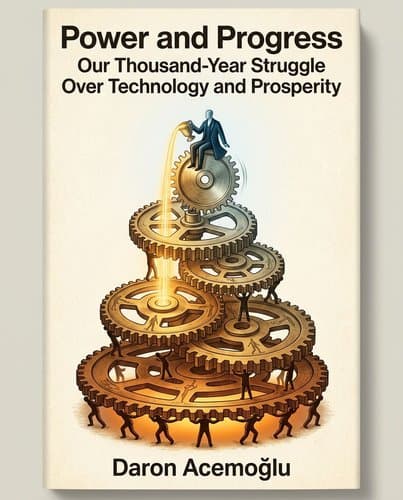
62315566_power-and-progress
by Daron Acemoğlu
The US tax code pays companies $20,000 for every $100,000 of workers they automate away — and current AI deployments create disruption without the productivity…
In Brief
The US tax code pays companies $20,000 for every $100,000 of workers they automate away — and current AI deployments create disruption without the productivity gains to replace those jobs. Acemoğlu and Johnson reveal why shared prosperity from technology has happened exactly once in a thousand years, and what it took.
Key Ideas
Postwar conditions enabled shared technology prosperity
Shared prosperity from technology has happened exactly once in the historical record — during the postwar decades — and required specific conditions: technology directed toward new tasks rather than pure automation, and institutions that gave workers bargaining power to claim a share of gains. Both conditions collapsed after 1980.
Automation requires new tasks for wage gains
Automation raises average output per worker mechanically (by removing workers from the denominator) while reducing worker marginal productivity — what one more worker adds. Unless automation is accompanied by new tasks that create demand for human labor, the productivity gain does not translate to wages.
Disruption without sufficient economic bandwagon
"So-so automation" — technology that displaces workers without sufficient productivity gains to generate new demand — is the norm with current AI deployments, not the exception. It produces the disruption without the bandwagon.
Tax asymmetry structurally subsidizes automation
The US tax code imposes a 20-percentage-point asymmetry that structurally subsidizes replacing workers: a company replacing $100,000 in labor with $100,000 in automation equipment cuts its tax bill by $20,000. Eliminating payroll taxes and depreciation allowances on automation equipment is the single most tractable policy lever the authors identify.
Identical technology, different workforce outcomes
Germany adopted industrial robots at more than twice the US rate while growing auto employment; the US adopted them more slowly while cutting auto employment by 25%. The technology was identical. The difference was whether firms chose to retrain workers into new technical tasks or to eliminate them.
Platform harms flow from engagement maximization
Platform harms — algorithmic amplification of hate speech, misinformation, and outrage — are not bugs in the engagement-maximization business model but its predictable outputs. Alternative models (subscription, public-interest) have different incentive structures and already exist at scale.
Who Should Read This
Readers interested in Economic History and Technology History, looking for practical insights they can apply to their own lives.
Power and Progress: Our Thousand-Year Struggle Over Technology and Prosperity
By Daron Acemoğlu & Simon Johnson
11 min read
Why does it matter? Because the technology story you've been sold was written by people who benefit from you believing it.
The story you probably believe goes like this: new technology disrupts for a while, inequality spikes, and then the gains spread. Steam engines, electrification, the internet — disruption, then shared prosperity. AI will follow the same arc. Patience.
That story is false. Not incomplete — false. Broad technological prosperity has happened exactly once in recorded history, in a roughly thirty-year window after World War II, and producing it required decades of organized political combat. Before that window: a thousand years of productivity gains flowing almost entirely to elites. After it: the same pattern returning. Acemoglu and Johnson show that the current trajectory of AI, worker surveillance, and algorithmic control isn't an inevitable side effect of progress but a set of specific choices, made by identifiable people, contestable through mechanisms that have already succeeded twice before.
For a Thousand Years, Productivity Gains Went to Cathedrals and Plantations — Not Workers
Sarah Gooder is eight years old. Every morning before four, she descends into the Gawber pit in West Yorkshire and takes up her post at a trapdoor, a wooden door she opens and closes to prevent deadly gases from spreading through the tunnels. She sits alone in the dark for fourteen hours. She doesn't sleep. Sometimes she sings when she has a light, she told investigators from Britain's Royal Commission in 1842. Not in the dark, though. "I dare not sing then."
The same year Sarah Gooder gave that testimony, cotton spinning in England required 135 hours of labor to produce what had required 50,000 hours in India fifty years earlier, a 370-fold improvement. The Industrial Revolution had generated enormous wealth. Richard Arkwright, who built the first water-powered cotton mills, became one of the richest men in England and famously lent five thousand pounds to a duchess to cover her gambling debts.
Sarah Gooder's wages did not increase. Neither did anyone else's.
Real wages for British unskilled workers in 1850 were roughly equal to wages in 1750 — a full century in which productivity transformed and wealth concentrated while workers saw nothing. Average working hours rose from about 2,760 per year in the mid-1700s to nearly 3,370 by 1830. More work, same money.
But this wasn't one bad industry in one bad decade. Across a thousand years, this was the rule. Medieval water mills doubled agricultural productivity between 1000 and 1300 CE; English peasant life expectancy held at around 25 years while the surplus funded cathedrals (France spent roughly 20 percent of total output on religious construction between 1100 and 1250). Eli Whitney's cotton gin tripled US cotton exports in thirty years; the enslaved population grew from 558,000 to 3.2 million over the same period. In every case, new technology generated wealth and delivered it to whoever already held power.
You've probably absorbed the counterargument: things were bad for a while, then they got better. The tide rose. It did, eventually. But wages in Britain rose to match productivity only after Chartists collected three million signatures demanding voting rights, after Parliament legalized trade unions in 1871, after the Master and Servant Acts that had legally bound workers to their employers were finally repealed in 1875. The rising tide wasn't delayed prosperity arriving on schedule. It was the outcome of a century of organized political struggle.
That's the baseline this book establishes. Not that technology fails to generate prosperity — it obviously generates enormous prosperity. But for whom has always been a political question, never a technical one.
Automation Raises What Firms Produce Per Hour — It Does Nothing for What You Earn
But whether political struggle can capture those gains depends on what kind of automation is actually happening — and the economics here are not what the optimism story assumes.
Imagine a factory that runs almost entirely on machines: hundreds of units per hour, far beyond what any human crew could manage. One person remains: he feeds the dog. The dog keeps him from touching the equipment. Divide total output by workers on payroll and you get a spectacular productivity number. Ask what happens to output when you hire a second worker, and the answer is nearly nothing. There's nothing for them to do.
That gap between average productivity and marginal productivity is what the optimism story ignores. Economists and tech boosters talk about productivity gains lifting wages, but wages respond to marginal productivity (what one more worker actually contributes), not to total output divided by total workers. A factory that has automated away most human roles can produce far more per employee while having almost no reason to hire anyone new or pay existing workers more. The two numbers can move in opposite directions. That divergence is structural.
Economists call this the bandwagon effect — when automation creates so much new demand that workers are pulled along rather than pushed out. Ford was the textbook case. When Ford introduced the Model T in 1908, it redesigned its Highland Park factory around individual electric motors, one per machine, which let machinery be arranged in the order tasks actually had to happen. Output exploded, but so did the need for workers: assemblers, welders, machine operators, quality inspectors, clerks to coordinate it all. Ford's system created new tasks faster than it eliminated old ones. As the company expanded, it hired more people and eventually paid them more. The $5 day, introduced in 1914, came partly because 380 percent annual turnover was strangling the assembly line. Average productivity rose, and so did worker marginal productivity. That's the bandwagon in motion.
Self-checkout kiosks are its inverse. Grocery chains installed them, cut cashier hours, and called it automation. But the gain came mainly from shifting scanning from employees to customers. Groceries didn't get meaningfully cheaper, stores didn't expand, no supplier hired more workers to meet new demand. The cashiers who lost shifts found no new roles waiting. The productivity gain was too small to pull new employment in its wake. Economists call this "so-so automation."
The line between bandwagon and dead end runs through one question: does the technology open new uses for human labor, or does it only foreclose old ones? When it opens new uses, wages can follow productivity. When it only closes them, they don't — and nothing in economics guarantees they eventually will.
The Direction of Technology Is Decided by a Small Group Whose Vision Was Never Designed to Include You
The direction of technology is set by whoever can make their vision appear inevitable. That has never required legislation or force, only the ability to define what counts as a serious option.
In September 2008, a dozen bank executives walked into Washington with a stark choice: bail us out generously, or watch the economy collapse. Policymakers, journalists, and economists accepted that framing. AIG received $182 billion in government support and paid nearly half a billion in bonuses the same year (including the people who had wrecked the firm). Nine of the largest bailout recipients paid 5,000 employees more than a million dollars each, explained as essential to retain "talent." Goldman Sachs CEO Lloyd Blankfein announced in 2009 that bankers were doing "God's work."
Persuasion power, the ability to determine which arguments happen at all, doesn't require winning every debate. Wall Street built it through prestige, revolving-door access to regulators, and a repeatable story: large, integrated finance was good for everyone. When the crisis arrived, they were the experts. The constraints they described as structural were political.
The authors call the technology version of this a vision oligarchy: founders, executives, and investors with similar backgrounds whose past success makes their certainty look like expertise. When Sam Altman frames the public question as "how do we make AI safe while moving fast," he's not answering the hard problem — he's selecting it. The question of who should decide what AI optimizes for, and in whose interest, never gets into the room. Their preferred path, automation and surveillance, concentrates power and profit upward. But because they genuinely believe they are building for the common good, and because journalists and policymakers have absorbed the story, alternative paths go unasked. The cage is ideological, not coercive. That is what makes it hard to see.
Today's AI Is Bentham's Panopticon at Scale — and It Is Working Exactly as Intended
In the eighteenth century, Jeremy Bentham designed a prison he called the panopticon: a circular building with a guard tower at the center, where one officer could watch any prisoner at any moment without prisoners knowing when they were actually being watched. The insight was that the mere possibility of observation controls behavior. AI-powered monitoring is the panopticon at the scale of the global workforce.
In 2017, activists and human rights organizations spent months documenting calls for violence against Rohingya Muslims on Facebook — accounts calling them invaders, urging their elimination, organizing real-world attacks. They reported the posts. Facebook's moderation team reviewed them. Then the algorithm interpreted those reporting interactions as engagement signals and promoted the posts to a wider audience.
Most people know Facebook failed to stop a genocide the UN would later confirm. The hidden part is that the system worked exactly as designed. The algorithm had one objective: maximize engagement. Outrage, fear, and calls for violence generate clicks, shares, and time-on-platform. When thousands of users interacted with a post to flag it as dangerous, the algorithm read that as proof the content was compelling and served it to more people. Facebook employed exactly one Burmese-speaking moderator for 22 million users in the country. The platform wasn't negligent about Myanmar's ethnic tensions. It was indifferent to them. Engagement was the metric; genocide was an externality.
The same logic runs through Amazon's warehouses. The company pays above minimum wage while its AI monitors every idle second and automatically generates termination notices for workers who miss productivity targets. The warehouse injury rate runs nearly twice the industry average, spiking during peak periods when monitoring is most intense. The system isn't malfunctioning. Throughput is up. Injuries are a cost Amazon has calculated and accepted.
What makes these cases hard to argue about is that executives can point to real metrics improving (engagement, packages delivered, shareholder returns) and say the system works. They're right. It works for the objectives it was designed to serve. The question is who chose those objectives, and what alternatives existed.
Germany answers that with a data point that should be more famous. German factories adopted industrial robots at more than twice the rate of American ones. German auto employment still grew between 2000 and 2018. American auto employment fell by a quarter over the same period. The technology was identical. The difference was that German firms, still negotiating with unions and still accountable to worker representatives on corporate boards, combined robots with retraining programs that moved workers into technical, supervisory, and design roles. The share of white-collar occupations in German auto manufacturing rose from 30 to 40 percent. American firms simply eliminated the jobs. Both outcomes came from choices made by people with access to the same equipment.
Elon Musk eventually admitted what Toyota had learned decades earlier: "Excessive automation at Tesla was a mistake. To be precise, my mistake. Humans are underrated." The lesson costs less when you draw it from history than when you learn it from a halted production line and a missed product launch.
The Formula That Already Broke the Robber Barons and Redirected Fossil Fuels Can Redirect AI
Can democratic politics actually redirect technologies controlled by companies worth more than most national economies, built on code almost nobody in government understands?
That feels like a concession before the argument starts. But it has a concrete answer: this already happened, against opponents with comparable power, using a formula you can name.
In 1902, Standard Oil controlled 90 percent of US oil refining, owned key rail infrastructure, and had deep ties to US senators (selected then by state legislatures, not voters). Ida Tarbell began publishing investigations into the company in McClure's Magazine that year, partly motivated by direct grievance: Rockefeller had destroyed her father's Pennsylvania oil business through a secret deal that gave Standard Oil special railroad rates while charging rivals more. She wasn't running for office — she was doing reportage. The series ran for nearly two years, collected into a book in 1904, and transformed what the American public believed companies could do. Muckrakers following her lead exposed Senate corruption and financial manipulation. Activists organized workers and led children's marches to politicians' homes. Specific policies followed: antitrust action against Standard Oil, a constitutional amendment creating the federal income tax, and another requiring senators to be elected directly by voters. The formula (shift the narrative, build organized countervailing power, implement specific policy) ran from 1902 to roughly 1920 and remade American institutions.
The same formula already redirected fossil fuel technology. In the mid-2000s, solar energy cost more than twenty times what fossil fuels cost. Today, solar and onshore wind are cheaper to run than coal and gas plants. That didn't happen automatically. Rachel Carson changed the narrative in 1962 with Silent Spring. Greenpeace organized it into political pressure. Germany and others implemented carbon taxes and research subsidies. China entered the solar market chasing European demand, scaled through learning-by-doing, and drove costs down further. Specific policy produced a reversal that looked impossible.
The policy levers for AI are already identified. The most arresting: US tax law charges labor at roughly 25 percent (payroll taxes combined with income taxes) while charging capital equipment at under 5 percent. A firm paying $100,000 in wages owes $25,000 in taxes; the same firm spending $100,000 on automation to do the same work pays less than $5,000. That's a 20-point structural subsidy for replacing workers, invisible and bipartisan, and nobody has to lobby to keep it. Eliminating it requires no new spending, just removing a preference for capital that's been sitting in the tax code for decades.
The pattern in every case is the same: the forces were real, the obstacles were real, and the outcome looked impossible until it wasn't.
The direction of digital technology is not a law of physics. It is being written now, by a small group of people who have decided their vision is the only one worth considering. That has always been how the cage is built — and always, eventually, how it is opened.
The Choice Has Always Belonged to Whoever Organized to Take It
In the late 1980s, HIV patients had no organizational power, no political allies, and no presence inside the institutions that mattered. The Reagan administration had spent seven years not saying the word out loud. Drug companies had no financial reason to hurry; FDA approval timelines ran a decade by design. ACT UP formed in 1987 — angry, disruptive, and technically fluent enough to argue with the officials running the clinical trials. Within five years, they had rewritten FDA approval protocols, forced parallel-track drug testing, and put dying patients on the committees that decided which compounds got funded and how fast.
The people who had HIV in 1987 were told the same story you are being told now — that the forces working against them were too large, too profitable, too technical to redirect. They were right about the forces. They were wrong about what happened next. Someone decided what AI is for. Someone can decide differently.
Notable Quotes
“The factory of the future will have only two employees, a man and a dog. The man will be there to feed the dog. The dog will be there to keep the man from touching the equipment.”
“Yes, excessive automation at Tesla was a mistake. To be precise, my mistake. Humans are underrated.”
“Only years of practice will teach you the mysteries and bold certainty of a real gardener, who treads at random, and yet tramples on nothing.”
Frequently Asked Questions
- What is Power and Progress about?
- Power and Progress argues that technology produces shared prosperity only when institutions redirect it toward new tasks and give workers leverage over its gains. Drawing on a thousand years of economic history, Acemoğlu and Johnson diagnose why current AI deployments concentrate gains rather than share them. The book identifies specific historical conditions that enabled broad prosperity from technology — particularly postwar decades when technology created new tasks and workers had bargaining power. Both conditions collapsed after 1980, leading to automation that displaces workers without generating sufficient new demand for labor. The authors name specific policy levers that could restore technology's potential for shared prosperity.
- When has technology actually produced shared prosperity?
- Shared prosperity from technology has happened exactly once in the historical record — during the postwar decades — and required specific conditions: technology directed toward new tasks rather than pure automation, and institutions that gave workers bargaining power to claim a share of gains. Both conditions collapsed after 1980. The postwar era saw companies invest in training workers for new technical positions created by mechanization, while strong labor institutions ensured wages rose with productivity. Since 1980, automation has increasingly focused on replacing workers entirely rather than creating new roles, while worker bargaining power declined significantly.
- Why does current AI concentrate wealth instead of sharing it?
- Current AI follows "so-so automation" — technology that displaces workers without sufficient productivity gains to generate new demand for human labor. Automation raises average output per worker mechanically by removing workers from the denominator while reducing worker marginal productivity — what one more worker adds. Unless accompanied by new tasks that create demand for human labor, this productivity gain does not translate to wages. Unlike postwar technology that created entirely new industries requiring human workers, today's AI typically eliminates job categories without generating equivalent replacement roles, producing disruption without the economic bandwagon that once distributed benefits broadly.
- What policy changes could make technology benefit workers?
- The US tax code imposes a 20-percentage-point asymmetry that structurally subsidizes replacing workers: a company replacing $100,000 in labor with $100,000 in automation equipment cuts its tax bill by $20,000. Eliminating payroll taxes and depreciation allowances on automation equipment is the single most tractable policy lever the authors identify. Germany adopted industrial robots at more than twice the US rate while growing auto employment; the US adopted them more slowly while cutting auto employment by 25%. The identical technology produced different outcomes because German firms retrained workers into new technical tasks rather than eliminating them.
Related Book Summaries



Read the full summary of 62315566_power-and-progress on InShort