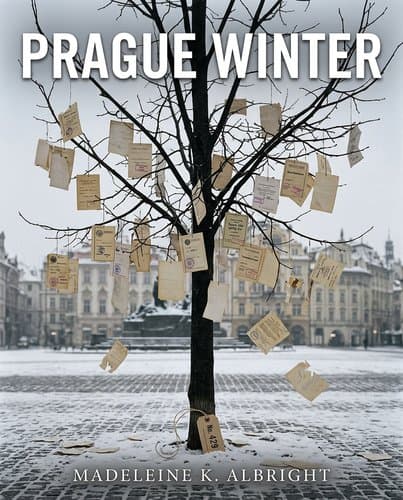
13096280_prague-winter
by Madeleine K. Albright
Madeleine Albright traces how Munich and the Communist coup both succeeded through the same fatal flaw: leaders who projected their own rationality onto…
In Brief
Madeleine Albright traces how Munich and the Communist coup both succeeded through the same fatal flaw: leaders who projected their own rationality onto ruthless adversaries. A searingly personal history that reframes appeasement as self-deception—and forces the question of what democratic defense actually costs.
Key Ideas
Appeasement defers violence, costs the vulnerable
Appeasement is never a strategy of peace — it is a strategy of deferred violence that transfers the cost to whoever is least able to defend themselves; Munich didn't prevent a war, it determined who would pay its opening price
Assumer projects rationality onto adversary
The psychology of appeasement is not cowardice but projection: Chamberlain assumed Hitler was a practical, business-oriented man like himself; Beneš assumed Stalin would be liberalized by exposure to the West; both men believed powerful adversaries would ultimately be governed by reason because they themselves were
Democracy requires active will, not form
Procedural democracy is not self-defending — the Czech republic's own constitutional rules were used by Gottwald to execute the 1948 coup; democratic institutions require active political will to function, not just formal existence
Making atrocity visible enables complicity
The visibility of atrocity is not accidental: the Nazis invested enormous effort in making Terezín look like a spa for the Red Cross, and that deception directly enabled the liquidation of prisoners who were no longer needed for show; systems of mass harm routinely require the complicity of observers who choose not to look
Moral weight of choices under pressure
Personal identity and historical catastrophe are inseparable — Albright's family converted to Catholicism in 1941 to protect their children, a decision she says would have been morally inconceivable four years later after the full scale of the Holocaust was known; the choices individuals make under pressure carry moral weight even when made from love
Faith in reason delays necessary action
The people best positioned to resist authoritarianism are often the ones most invested in believing it won't be necessary — Beneš's 'mathematical' faith in reason, Chamberlain's faith in negotiation, and the democratic ministers' faith in constitutional process all made them slower to act than the people who faced no such constraint
Who Should Read This
History readers interested in Memoir and World History who want a deeper understanding of how we got here.
Prague Winter
By Madeleine K. Albright
15 min read
Why does it matter? Because the people who enabled history's worst betrayals weren't monsters — they were reasonable people who refused to see what was plainly in front of them.
Czechoslovakia in 1938 was not a failing state waiting to be put down. It had free elections, an independent press, minority cabinet ministers, and a literacy rate that shamed its neighbors. It was, by every measurable standard, working. And it was handed to Hitler anyway—not by traitors, but by reasonable men who simply could not make themselves believe that another reasonable man meant what he said. A decade later, the same country was handed to Stalin—again not by traitors, but by democrats who resigned at precisely the wrong moment and a president who kept insisting the Communists would flinch. Madeleine Albright's Prague Winter is the story of that double catastrophe, told by someone whose family was consumed by it. What makes it devastating is that the people who failed aren't hard to understand. They're disturbingly easy to recognize.
The City That Forgot to Be Afraid
On the morning of March 15, 1939, as German convoys plastered with ice rolled toward Prague Castle, Adolf Hitler was about to enjoy a meal. The man who neither drank nor ate meat chose that night to celebrate his conquest of Czechoslovakia with a bottle of Pilsener and a slice of Prague ham — a small, obscene intimacy that says everything about what had just been destroyed.
To feel the weight of that meal, you need to understand what Prague was before that morning. Twenty years earlier, a nine-year-old boy named Josef Körbel had been woken in the night by his neighbors singing in the streets of a small Czech town, tearing down the emblems of the Austro-Hungarian Empire. The next day his mother dressed him in his Sunday suit and sent him to school, where the whole village was in an uproar — embracing strangers, raising Czech flags. That afternoon the children marched to a park and planted a linden tree. A tree of freedom, they called it.
The country those children inherited was not a consolation prize. By 1930, Czechoslovakia ranked among the ten most industrially powerful nations on earth. Its constitution guaranteed women's suffrage, an independent press, and no political prisons. Ethnic Germans served in the cabinet — something no other European democracy managed. Prague's concert halls were full. Its military was genuinely formidable. The democracy worked.
Then, on that frozen March morning, Czech civilians lined the sidewalks and watched German tanks move through their city. Some wept. Some raised their fists. In Wenceslas Square, crowds gathered and sang patriotic songs while artillery was unloaded at the train station nearby — defiance and helplessness sharing the same cold air. By nightfall, Hitler was eating ham in the castle.
Reasonable Men Built the Road to Munich
The road to Munich was built by reasonable people who simply could not believe what they were seeing. That is the harder truth — harder, at least, than blaming cowards.
Start with Konrad Henlein, the leader of the Sudeten German movement. His own mother was Czech. He knew Czechoslovakia was not persecuting its German minority in any way that compared to what was happening across the border in the Reich — Germans in Czechoslovakia had their own schools, their own parties, their own cabinet ministers. None of that stopped him from touring London drawing rooms and convincing experienced British diplomats that he was, as one senior Foreign Office man gushed after meeting him, an honest and clear-sighted moderate. This was not a failure of intelligence. These were professionals trained to read people. What defeated them was simpler: Henlein told them what they needed to hear, and they needed to hear it badly enough that they stopped checking.
The same mechanism operated at the top. Neville Chamberlain flew to meet Hitler three times in a matter of weeks — the first time he had ever been on an airplane. Each time Hitler raised his demands. Each time Chamberlain came home and described his host to the cabinet as a man whose word could be relied on. Not naively, but with evident conviction. He had sat across from Hitler and read him as a practical man who, once his core grievance was addressed, would settle. Chamberlain was projecting, imagining the negotiating partner he would himself have been. The possibility that Hitler meant every word of his speeches — that domination, not accommodation, was the actual goal — was a thought Chamberlain's mind kept sliding away from.
The Munich Conference itself is where this failure became architectural. Four men who had collectively never set foot in Czechoslovakia met in Hitler's Munich headquarters on September 29, 1938, to determine the country's borders. There was no seating plan, no agenda, no official record-keeper. While they talked, two Czech diplomats sat in a Gestapo-supervised hotel room waiting to be summoned. They never were. When Chamberlain and the French premier handed them the finished agreement near midnight, they tried to object. They were told the matter was closed. Chamberlain, yawning, said he was pleasantly tired.
What made men like these so dangerous was not malice but method. Intelligent, experienced men built elaborate intellectual frameworks for why the monstrous thing in front of them was actually manageable — and kept building those frameworks even as each one collapsed. The impulse to believe a problem is more tractable than it looks, that the other side must share your basic commitment to avoiding catastrophe, is the default setting of reasonable people. Munich is what happens when that default is the only tool you reach for.
The Price of a Moral Holiday Is Always Paid by Someone Else
What would it have taken for Czechoslovakia to avoid occupation entirely? After the war, the imprisoned German general Wilhelm Keitel answered that question with brutal clarity: the Reich would not have attacked in 1938 if the Western powers had stood behind Prague. The German military was not ready. The generals knew it. Hitler knew it. The whole elaborate crisis over the Sudetenland was, in Keitel's own account, a strategy for buying time, completing rearmament, and pushing Soviet influence back from Central Europe.
Sit with that for a moment. The catastrophe was not inevitable. It required the active cooperation of people who believed they were preventing one.
President Edvard Beneš capitulated at Munich with what he described as feelings of pain, having concluded that yielding was the realistic choice — that a larger war was coming regardless, that Czechoslovakia alone could hold out perhaps three weeks, that its people were better conserved for a more favorable moment. The American diplomat George Kennan praised this as genuinely heroic realism: a magnificent younger generation preserved from sacrifice. Albright cannot quite accept that framing, and neither should you. Because what Beneš's logic required was treating his country as a cost-benefit calculation while German troops were already massed on the border — and the people who paid the price for that calculation were not, in the end, the soldiers whose lives were being conserved. They were the ones who couldn't leave.
The ten days after the Nazis marched into Prague in March 1939 illuminate the arithmetic precisely. Josef Körbel, targeted for arrest, slept each night in a different friend's house while his wife carried their toddler through the streets by day, because the Gestapo preferred to take people at night. They scraped together exit papers — some petty bribery involved, no question — packed two small suitcases, and caught the Orient Express south. An office run by a thirty-three-year-old named Adolf Eichmann was at that moment busy encouraging Jewish emigration, which sounds almost benign until you understand the trap built into it: emigration was being encouraged precisely because no country would accept Jewish applicants, their quotas already full or their doors simply closed, making departure simultaneously the only option and effectively impossible.
The moral weight of Munich is not that Beneš was a coward. It is that each act of deferred confrontation narrowed the exit door a little further — and the people closest to the door when it closed were the ones with the least leverage to push it back open.
A Cardboard Tag Numbered 298
Dáša Deimlová was eleven years old when she boarded the train. She carried a tiny doll and wore a cardboard sign around her neck stamped with the number 298. On the platform in Prague stood her parents and her seven-year-old sister Milena, who was also on the list to go but whom her parents pulled back at the last minute — she was too young, they decided, too small, perhaps not quite ready. It was an act of love so ordinary it barely registered.
Milena died at Auschwitz.
Dáša's train was one of four organized by Nicholas Winton, a British stockbroker who had visited Prague, seen what was coming, and spent months placing children with English families — begging, cajoling, pressing the United States for help and receiving none. Of the six thousand children on Winton's lists, roughly five thousand never got out. Dáša was among the lucky fraction. When the train crossed into Germany, Nazi soldiers with rifles and bayonets walked the platform, and the children sat motionless at the windows for nearly five hours while a paperwork error was sorted out. Then the locomotive moved again, westward through Dresden and Frankfurt, until Holland, where Red Cross workers handed the passengers bananas and postcards to send home.
For a while, home wrote back. Letters arrived from Dáša's mother Greta — practical at first (wear warm clothes), then quieter and stranger. Greta described Milena calling out Dáša's name each night from her bed, as though volume alone could cross the distance. Then Milena was transferred to a Jewish-only school. Then that school closed. Then there was no school, and no non-Jewish children to play with, and the letters grew shorter and came less often.
Albright traces this same narrowing through her own grandparents. Her grandmother Růžena was fifty-four years old when she was deported — five years younger than Albright was when she became Secretary of State. The transport left on June 9, 1942, the same day the village of Lidice was being burned to the ground in Nazi reprisal for the assassination of Reinhard Heydrich. Růžena was likely dead within weeks, executed at a camp called Trawniki. Albright's paternal grandparents Arnošt and Olga arrived at Terezín on train AAv, their numbers 451 and 452. Arnošt died that September of bronchial pneumonia, on the single deadliest day in the camp's history.
Dáša never forgave her parents for keeping Milena behind. She told a journalist decades later that Milena had missed the train because of a broken arm. That wasn't true. The real reason was simpler and more devastating: they loved her too much to let her go.
What the Nazis Built in Terezín Was Designed to Be Invisible
Imagine a government that wanted to commit mass murder and never appear to be doing so — not to the international community, not to neutral observers, not even, as long as possible, to the victims themselves. The challenge is partly logistical but mostly architectural: you need the killing to happen inside a structure that looks, from the outside, like something else entirely. Terezín was that structure.
The Nazi camp at Terezín was presented to the world as a Jewish spa town — self-administered, culturally rich, adequately fed. When the International Red Cross pressed for a visit in 1944, the Nazis spent weeks preparing. Fake storefronts were constructed. A bank was opened. A park was planted. On the day of the inspection, inmates were fed generous portions of grilled meat and cake. Outside, young women carrying rakes marched past the delegates with theatrical cheerfulness. A soccer match produced a perfectly timed cheer. The same group of well-dressed children was quietly routed past the inspectors several times throughout the day, giving the appearance of a thriving, populated town. The lead inspector, a man named Rossel, brought a camera and snapped three dozen photographs. His subsequent report described women in silk stockings, high-quality food, an atmosphere of reasonable comfort. The Nazis distributed copies of the document internationally as evidence that reports of mass murder were Allied propaganda.
Rossel's credulous report had a consequence more operational than reputational. Thousands of prisoners had been kept alive specifically to populate the performance — to fill the park, cheer the goal, march with the rakes. Once he filed his findings, those prisoners were no longer needed as props. The liquidation of the camp's so-called family population followed almost immediately. The performance had done its work.
Among those sent east in the transports that followed was a doctor named Rudolf Deiml. On the platform at Auschwitz, his friend Jiří Barbier — a carpenter — urged him to lie about his profession, to say they worked together in the same trade. Deiml was noncommittal. When the SS doctor conducting selections asked what he did, Deiml said simply: I am a doctor. He was directed to the left, toward the gas chambers. Barbier, the carpenter, went right. He survived, and decades later he wrote of the moment of parting: 'His last look will remain forever in my memory.'
Liberation Came, and Brought New Masters
Liberation arrived in Czechoslovakia in May 1945 already half-owned by the wrong side. The structural compromises Beneš had made to survive — handing Communists control of the police and military before a single vote was cast, installing a prime minister more loyal to Moscow than to Prague, signing a twenty-year friendship treaty with Stalin on the strength of a factory tour and a VIP welcome — meant the liberated country was not actually free. The chains were just invisible.
The clearest image of what liberation actually looked like is the Prague Uprising. On May 5, ordinary Czechs tore down German signs, ripped up cobblestones, and fought the SS from barricades made of mattresses and trash barrels. They broadcast desperate pleas for help. Patton's Third Army was fifty miles away in Plzeň. Eisenhower, bound by his agreement with the Soviets not to advance beyond that line, told his forces to hold. For four days the Czechs bled alone — 1,700 dead — before the Red Army finally appeared. The Americans who could have prevented those deaths sat drinking Pilsener while families dragged their furniture into the streets. The Communists spent the next decade making sure no one forgot that arithmetic.
Beneš had walked into this arrangement with open eyes and a closed imagination. In December 1943 he flew to Moscow, toured factories, attended theaters, and came home convinced that Stalin was a practical man who could be reasoned with — aimed, this time, at a different powerful man in a different capital. Stalin promised not to interfere in Czechoslovak internal affairs, without a moment's hesitation. Beneš signed the twenty-year treaty and took the promise at face value. What he got in exchange was the Košice Program: a Communist-drafted blueprint that became the default postwar settlement because the democrats had failed to write one of their own. By the time Beneš returned to Prague, the police were already theirs.
Jan Masaryk was still playing Czech folk songs on embassy pianos. The baroque spires were intact. The elections still happened. There is enough hope in this period to make what followed feel like a death rather than a foregone conclusion — which is the point. The second democratic collapse, when it came in 1948, was not inevitable. It was prepared.
The Republic's Own Rules Were Used to Kill It
How did Klement Gottwald, a man who had spent decades failing to build a popular majority, end up with all the power in twelve days? The answer is not Soviet tanks. The answer is that he understood parliamentary procedure better than the people who wrote the rules.
The democratic ministers, led by Hubert Ripka, believed they had found a trap to spring on the Communists. In February 1948, they resigned en masse to protest Communist infiltration of the police — calculating that this would collapse the government, trigger new elections, and force a vote before Gottwald could fully corrupt the security apparatus. The plan had a fatal flaw they had not bothered to confirm in advance: it required the Social Democrats. Without them, a working cabinet majority remained in place. The government had not technically fallen. Gottwald was still prime minister. And a prime minister who keeps his job when a dozen ministers walk out gets to demand their replacements.
Gottwald's own summary of what followed is the most clarifying sentence in the book. He told associates, giddily, that he had always known he would win but never imagined the democrats would hand him their victory on a platter. That is not the boast of a man who outmuscled his opponents. It is the satisfaction of someone who watched educated, principled people defeat themselves. The mass resignation — meant as a decisive blow — gave the Communists constitutional cover they could not have manufactured from scratch.
Masaryk is the figure who carries the human weight of this failure. The night before the coup completed itself, he was hiding in his bedroom at the Foreign Ministry, refusing to come out and sign a document condemning the West, telling Josef Korbel that every part of him was with the British and Americans — the people he was being asked to denounce. Two weeks later, his body was in the courtyard below his bathroom window. The police concluded suicide. Albright concludes murder.
What the 1948 coup demonstrates, at cost, is that democratic institutions are not self-defending. They provide rules, and the rules are neutral — available to anyone disciplined enough to follow them precisely while everyone else assumes good faith. The people who paid first were not the ministers, who mostly escaped into exile. They were the ones who couldn't: the border sealed behind them, the secret police with their lists, the most vulnerable stripped of protection the moment the law stopped meaning what it said.
His Father Left One Book on Suicide. His Son Left No Note.
Rummaging through boxes in her garage decades after the events in this book, Albright found a manila folder containing 123 pages of triple-spaced prose — her father's only attempt at fiction. The story opens with a diplomat named Peter Ptachek landing in postwar Prague, running to his mother's door, finding a stranger. The stranger explains that the apartment was first occupied by a German family, then by herself. She has no information about the previous tenants. Peter walks through the city in a daze, reaches an aunt's apartment, knocks, and a second stranger answers. This one knows what happened: they took her in May 1942, and two weeks later the husband got a note about it, then the husband and wife were taken, then the children. Peter's body, the manuscript says, sank into the darkness. He made it to his hotel room and collapsed into a pillow. 'The war was over. It left behind many holes. Some could be patched up. Some couldn't.' Josef Korbel — a trained historian, a man of documented facts — apparently could only process the deaths of his mother and his relatives by pretending they had happened to someone else.
The same unbearable logic runs through Albright's account of Jan Masaryk's death. His father had written his first book on suicide, treating it as a symptom of spiritual collapse. Jan had revered that father above anyone. Albright concludes he was murdered, probably by Soviet agents who could neither jail him nor release him. The evidence she marshals is less forensic than philosophical: a son so shaped by his father's moral universe simply would not have made the choice his father spent a career condemning.
The pattern in both losses — the novel no one was supposed to find, the death no one was permitted to investigate — is what totalitarianism actually looks like from the inside. It does not announce itself. It closes doors quietly, one at a time, until the people with the least leverage find there are none left. Beneš died that September at his estate in Sezimovo Ústí, surrounded by Communist guards, a broken man who had spent a lifetime calculating the realistic path. The democrats who might have stopped the coup had resigned on principle, surrendering constitutional power to a man who treated principle as a tool. The Korbels fled on borrowed time, arriving in New York Harbor on Armistice Day, 1948. The borders sealed behind them. The people who could not leave paid the price that everyone who could leave had deferred.
The Holes That Couldn't Be Patched
Korbel never found a publisher for his novel — a callback worth making here, because the holes Peter Ptachek stumbled through didn't close when the war ended. They closed, where they closed at all, because someone paid for them to.
Every reasonable man who decided that confrontation was too costly, every democratic minister who trusted the rules to defend themselves, Chamberlain signing a piece of paper in Munich, Beneš accepting terms he knew were fatal — they didn't cause the catastrophe. They just made sure someone else absorbed it. The most vulnerable people always settle the debts that the reasonable ones defer.
That is what this book finally asks you to hold: not the horror of what the Nazis or the Communists built, but the quieter accounting of what made the building possible. The generation that lived through it knew what winter actually costs. The question this history keeps putting back on the table is whether any generation learns that lesson before the bill arrives.
Notable Quotes
“View this equally as trust and obligation.”
“a land wet with sweet milk and honey.”
“Those that are Christ’s have crucified their own flesh.”
Frequently Asked Questions
- What does Prague Winter argue about appeasement and the Munich Agreement?
- Madeleine Albright contends that "appeasement is never a strategy of peace — it is a strategy of deferred violence that transfers the cost to whoever is least able to defend themselves." She demonstrates this through Czechoslovakia's experience: "Munich didn't prevent a war, it determined who would pay its opening price." Through historical analysis and family memoir, Albright shows how leaders who believed negotiation could constrain aggressive powers were fundamentally mistaken. The book reveals how faith in rational adversaries enabled democratic capitulation with consequences that fell heaviest on the vulnerable and powerless.
- How do democracies fail from within according to Prague Winter?
- Prague Winter demonstrates that procedural democracy is not self-defending. "The Czech republic's own constitutional rules were used by Gottwald to execute the 1948 coup" without military force or violent overthrow. Democratic institutions require active political will to function, not merely formal legal existence. Albright reveals how leaders invested in faith in constitutional process were paralyzed by confidence in their own systems. "The people best positioned to resist authoritarianism are often the ones most invested in believing it won't be necessary," making them slower to act when institutions face direct threats.
- What psychological factors enabled appeasement in Prague Winter?
- Albright identifies projection as the core psychological driver of appeasement, not cowardice. "Chamberlain assumed Hitler was a practical, business-oriented man like himself; Beneš assumed Stalin would be liberalized by exposure to the West." Both men "believed powerful adversaries would ultimately be governed by reason because they themselves were." This misreading of opponents' psychology—interpreting hostile actors through the lens of one's own rationality—directly enabled democratic leaders to delay defensive action. Albright shows how this psychology of misplaced confidence in reason made resistance too late, surrendering agency to those unconstrained by such faith.
- What does Prague Winter say about how atrocities are concealed?
- Albright argues that "the visibility of atrocity is not accidental." "The Nazis invested enormous effort in making Terezín look like a spa for the Red Cross," and "that deception directly enabled the liquidation of prisoners who were no longer needed for show." Systems of mass harm routinely require the complicity of observers who choose not to look. This reveals that genocide depends not only on perpetrators but on widespread willingness to accept convenient fictions and blindness, implicating bystanders in the machinery of destruction through their calculated inattention.
Related Book Summaries
Read the full summary of 13096280_prague-winter on InShort